admin
admin
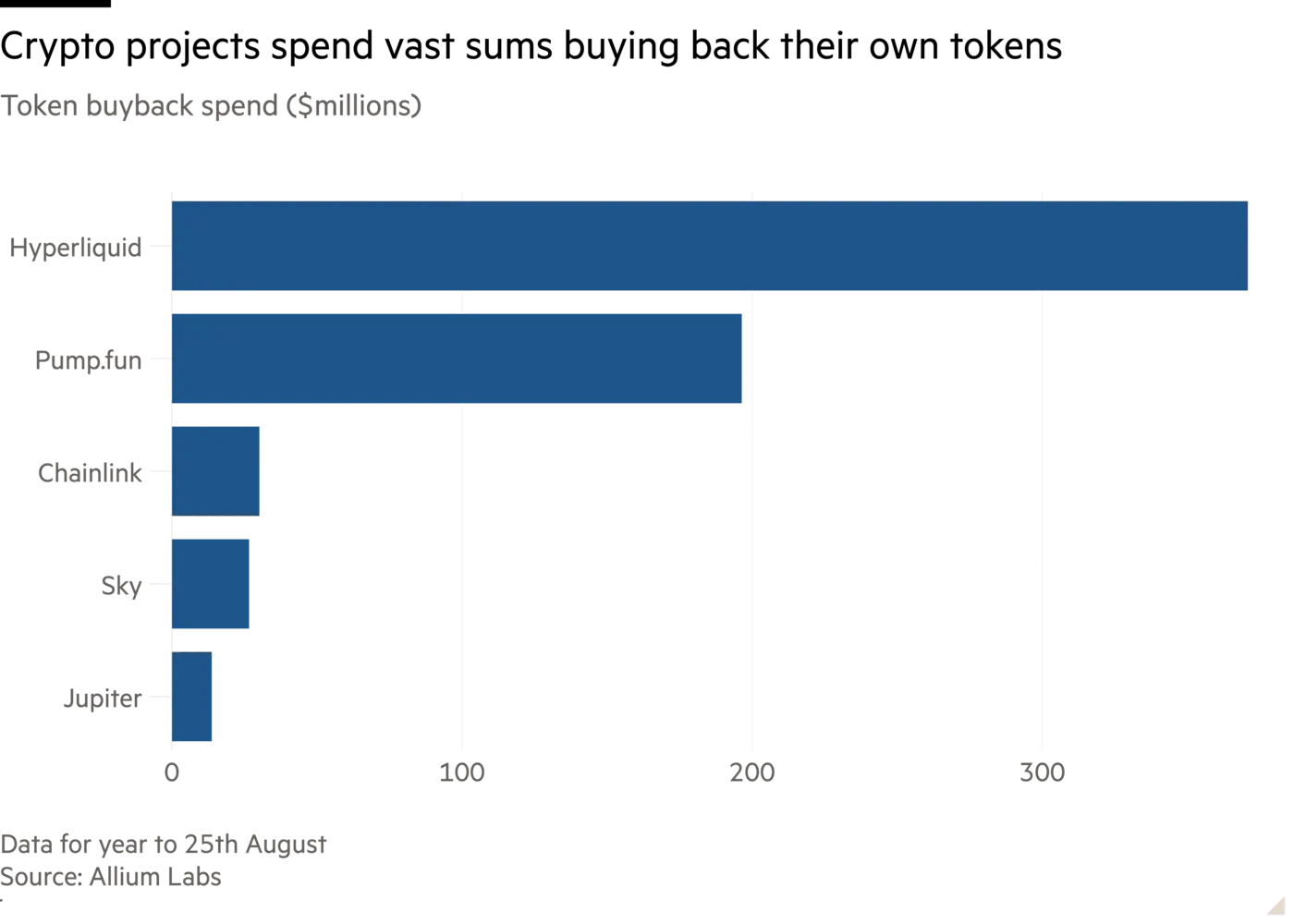
The cryptocurrency sector has witnessed a transformative shift in capital allocation strategies throughout 2026, as decentralized protocols increasingly adopt traditional corporate finance mechanisms to bolster token valuations. According to data from Allium Labs recently highlighted by the Financial Times, crypto projects have spent a record-breaking $638 million to repurchase their own native tokens year-to-date. This figure represents a significant escalation from the $545 million recorded during the same period in 2025 and a staggering increase from the mere $366,000 spent in 2024. The surge is primarily driven by two dominant entities: the decentralized exchange Hyperliquid and the memecoin launchpad Pump.fun, which together account for nearly 90% of the total buyback volume in the industry.
Token buybacks, a practice mirrored after share repurchases in publicly traded companies, involve a protocol using its accrued revenue or treasury holdings to purchase its own tokens from the open market. This process effectively reduces the circulating supply or creates a consistent "buy wall," which can support price stability and enhance the value proposition for long-term holders. As the digital asset market matures, the transition from purely speculative tokenomics to revenue-backed value accrual is becoming a defining trend of the 2026 fiscal year.
The Dominance of Hyperliquid and Pump.fun
Of the $638 million deployed in buybacks so far this year, Hyperliquid has emerged as the clear market leader, contributing approximately $370 million to the total. Hyperliquid, a decentralized exchange (DEX) known for its high-performance perpetual trading and native Layer 1 blockchain architecture, has implemented one of the most aggressive capital return programs in the history of decentralized finance (DeFi). Reports indicate that the platform directs an estimated 99% of its net revenue toward token repurchases. In its second-quarter earnings report released on August 6, Hyperliquid revealed a quarterly revenue of $169 million, of which $141 million was immediately funneled into HYPE token buybacks.
Following closely behind is Pump.fun, the Solana-based memecoin launchpad that has capitalized on the ongoing retail frenzy for speculative assets. Pump.fun accounted for nearly $200 million of the year’s total buyback volume. The platform’s model involves allocating approximately 50% of its net protocol revenue for token repurchases. Based on its average daily revenue over the past 90 days, Pump.fun currently maintains an annualized revenue run rate of $420 million. The synergy between high-velocity trading fees and a consistent buyback program has allowed Pump.fun to maintain a dominant position in the launchpad sector despite increasing competition.
A Comparative Analysis of Market Performance
The impact of these buyback programs is clearly reflected in the price performance of the respective tokens, particularly when contrasted with the broader cryptocurrency market. While the industry at large has faced headwinds in 2026, tokens with robust buyback mechanisms have demonstrated significant resilience and growth.

According to TradingView data, the Hyperliquid (HYPE) token has surged by 145% year-to-date, while the Pump.fun (PUMP) token has gained 109%. These gains occurred during a period where Bitcoin (BTC), the market’s primary benchmark, saw its price decline by 10%. Furthermore, the total cryptocurrency market capitalization experienced an 11.9% contraction over the same timeframe. The divergence between revenue-generating protocols and the wider market suggests that investors are increasingly prioritizing "yield-bearing" or "buyback-backed" assets over those relying solely on speculative demand or inflationary rewards.
The data suggests that buybacks provide a fundamental floor for token prices. By removing tokens from circulation, protocols increase the scarcity of the remaining supply. If the demand for the protocol’s services remains constant or grows, the reduced supply naturally exerts upward pressure on the price, allowing these assets to decouple from the price action of Bitcoin and Ethereum.
The Ethena Foundation and the Shift Toward Fee-Switches
The trend toward revenue-driven tokenomics is expanding beyond Hyperliquid and Pump.fun. On Thursday, the Ethena Foundation—the entity behind the synthetic dollar protocol Ethena—initiated a community vote on a "fee-switch" proposal that could fundamentally alter the ENA token’s value accrual mechanism. Under the proposed framework, 95% of the net revenue generated from Ethena’s core business lines would be dedicated to repurchasing ENA tokens from the market.
The market’s reaction to this proposal was immediate and positive, with the ENA token rising 10.7% in the 24 hours following the announcement. This proposal marks a pivotal moment for Ethena, which has previously focused on scaling its USDe stablecoin. By proposing a mechanism that directly links protocol success to token holder returns, Ethena is aligning itself with the "real yield" movement that has gained traction across the DeFi ecosystem.
The shift toward fee-switches and buybacks is often seen as a response to the "low float, high FDV (Fully Diluted Valuation)" criticism that plagued many projects launched in 2024 and 2025. By implementing buybacks, projects are attempting to prove that their tokens have intrinsic value based on the cash flow generated by the underlying protocol.
Historical Chronology: The Evolution of Token Repurchases
To understand the significance of the $638 million figure in 2026, one must look at the rapid evolution of token management strategies over the last three years:
- 2024: The Infancy of Buybacks. In early 2024, the concept of a token buyback was largely experimental. Most projects utilized "burn" mechanisms where tokens were permanently removed from a pre-allocated supply (inflationary reduction) rather than being purchased from the open market using protocol revenue. Total buyback volume was a negligible $366,000, as most protocols were still in their bootstrapping phases.
- 2025: The Rise of Revenue Sharing. As decentralized applications (dApps) began generating significant fees, the community demand for "value accrual" intensified. Buyback volume jumped to $545 million for the same period in 2025. This era saw the first major implementations of "buy-and-distribute" or "buy-and-burn" models by mid-tier DEXs and lending protocols.
- 2026: The Year of Institutional-Grade Buybacks. The current year represents the institutionalization of the buyback. With Hyperliquid and Pump.fun leading the charge, buybacks are no longer seen as a niche experiment but as a standard requirement for high-valuation protocols. The $638 million record reflects a more mature market where revenue generation is the primary metric for success.
Expert Perspectives and Economic Implications
Financial analysts and industry leaders have begun to weigh in on the long-term implications of this trend. Bitwise Chief Investment Officer Matt Hougan recently suggested that crypto valuations could potentially double within the next two years as more protocols transition to buyback and burn models. Hougan noted that as protocols return more value to investors, the risk premium associated with these tokens may decrease, leading to higher price-to-earnings (P/E) multiples similar to those seen in the traditional tech sector.
"We are moving away from the era of ‘hope and hype’ and into the era of ‘revenue and repurchases,’" stated one industry analyst. "When a protocol like Hyperliquid uses 99% of its revenue to buy back tokens, it changes the fundamental calculus for an investor. You are no longer just betting on a technology; you are betting on a cash-flow machine."
However, some critics point out potential risks. Heavy reliance on buybacks can limit a protocol’s ability to reinvest in research and development or maintain a "war chest" for bear market survival. Furthermore, regulatory bodies such as the U.S. Securities and Exchange Commission (SEC) have historically viewed stock-like characteristics—such as buybacks and profit sharing—as potential indicators that a digital asset should be classified as a security. As buybacks become more prevalent, the legal scrutiny surrounding these protocols is expected to intensify.
Future Outlook for Tokenomics
The record-breaking data from Allium Labs and the Financial Times underscores a broader maturation of the cryptocurrency industry. As the $638 million year-to-date figure continues to grow, it is likely that more "legacy" DeFi protocols will face pressure from their communities to implement similar fee-switches or buyback programs.
The success of HYPE and PUMP in a declining market serves as a powerful case study for founders and DAO contributors. In an environment where liquidity is fragmented and investors are increasingly discerning, the ability to demonstrate tangible, revenue-backed value is becoming the ultimate competitive advantage. If the current trajectory holds, the final quarter of 2026 could see total buyback volumes approach the $1 billion mark, signaling a new chapter in the intersection of decentralized technology and traditional corporate finance.
The emergence of these strategies also highlights the growing importance of protocol sustainability. Unlike the inflationary rewards of the 2020-2021 "DeFi Summer," buybacks are funded by actual usage and fee generation. This creates a more sustainable economic loop: increased protocol usage leads to higher revenue, which leads to larger buybacks, which in turn rewards the token holders who govern and support the ecosystem. As 2026 progresses, the industry will be watching closely to see if this model can withstand prolonged market volatility and whether it will eventually become the standard for all top-tier digital assets.