James Watt
The global digital asset market has witnessed a historic month of August, with Bitcoin demonstrating an unconventional decoupling from traditional risk assets amid a backdrop of intensifying geopolitical conflict and a pivot toward more restrictive monetary policy. As of the final days of the month, Bitcoin is trading in the vicinity of $78,400, marking a monthly appreciation of more than 24%. This performance stands as the strongest August rally for the world’s largest cryptocurrency in nine years and represents its most significant single-month price advancement since late 2024. The rally is particularly notable because it has occurred in the face of two major "black swan" style events: a direct military confrontation between the United States and Iran and a surprisingly hawkish stance from the Federal Reserve.
The month began with a tentative recovery from summer lows, but the narrative quickly shifted toward global instability. In the Middle East, a series of military escalations sent shockwaves through the energy and bond markets. Over a pivotal weekend, United States forces conducted targeted airstrikes against Iranian rocket launchers on Larak Island. This action was described by U.S. Central Command as a necessary preemptive strike to prevent the deployment of naval mines into the Strait of Hormuz, a critical artery for global oil transit. Tehran responded shortly thereafter, launching missile strikes against American military installations in Jordan. While Jordanian air defenses intercepted a majority of the inbound threats, the exchange triggered an immediate spike in crude oil prices, with Brent crude surging above $91 a barrel.
Under typical market conditions, such a surge in energy prices and the accompanying "risk-off" sentiment would lead to a sharp contraction in speculative assets. High oil prices act as a tax on global growth and serve as a primary driver of headline inflation, which in turn pressures central banks to maintain high interest rates. However, Bitcoin’s price action remained stubbornly constructive. Rather than retreating, the token consolidated its gains, suggesting that institutional and retail participants may be viewing the asset through a different lens—perhaps as a hedge against currency debasement or as a disconnected alternative to the traditional financial system during times of kinetic conflict.
A Chronology of Macro Pressure: The Jackson Hole Pivot
The geopolitical flare-up was not the only hurdle Bitcoin cleared in August. Just days prior to the Middle East escalation, the financial world was focused on the Jackson Hole Economic Policy Symposium, where Federal Reserve Chair Kevin Warsh made a high-profile debut. Market participants had entered the month largely expecting a "dovish" tilt, hoping for signals of an impending rate cut cycle. Warsh, however, delivered a starkly different message.
In his address, Warsh challenged the prevailing market optimism, noting that progress on cooling inflation had stalled significantly above the Federal Reserve’s 2% target. He emphasized that price stability remains the paramount objective of the central bank, even if it requires maintaining a "higher-for-longer" interest rate environment. One of the most discussed segments of his speech involved the dismantling of the Fed’s traditional forward-guidance framework. Warsh cautioned that providing too much verbal commitment to future policy moves risks creating a "hall of mirrors" effect, where the Fed and the markets simply reflect each other’s expectations rather than responding to raw economic data.

Warsh pointed to several pillars of economic strength—including consumer spending growth exceeding 2%, unemployment holding steady near 4.1%, and a massive wave of corporate investment into Artificial Intelligence (AI) infrastructure—as evidence that the U.S. economy can withstand tighter monetary conditions. Following these remarks, Treasury yields climbed, and the market-implied probability of a 25-basis-point interest rate hike in September jumped to 60%. While the S&P 500 and Nasdaq showed signs of fatigue under the weight of these hawkish projections, Bitcoin’s dip below $77,000 was short-lived. By the following Monday, it had reclaimed the $78,000 handle, effectively absorbing the shock of a more aggressive Federal Reserve.
Analyzing the Energy Shock and Inflationary Impulses
The intersection of military conflict and monetary policy has created a complex environment for commodity strategists and digital asset analysts alike. The direct military engagement in the Persian Gulf serves as a secondary inflation impulse. When energy costs rise, the cost of transporting goods and manufacturing increases, making it harder for the Federal Reserve to achieve its 2% inflation mandate.
Despite the tension, some analysts believe the market has already priced in a significant portion of the risk. Ole Hansen, the head of commodity strategy at Saxo Bank, noted that while the recent developments reduce the likelihood of a near-term diplomatic resolution in the Middle East, the actual flow of oil remains relatively stable. An estimated 6 million to 8 million barrels of crude continue to pass through the Strait of Hormuz daily. This continued flow has prevented a full-scale energy panic, which in turn has provided a "buffer zone" for Bitcoin. If oil were to breach $100 a barrel, the resulting liquidity squeeze might finally force a correction in the crypto markets, but for now, the energy shock remains contained enough to allow for consolidation.
Internal Market Mechanics: The Power Law and Cycle Maturity
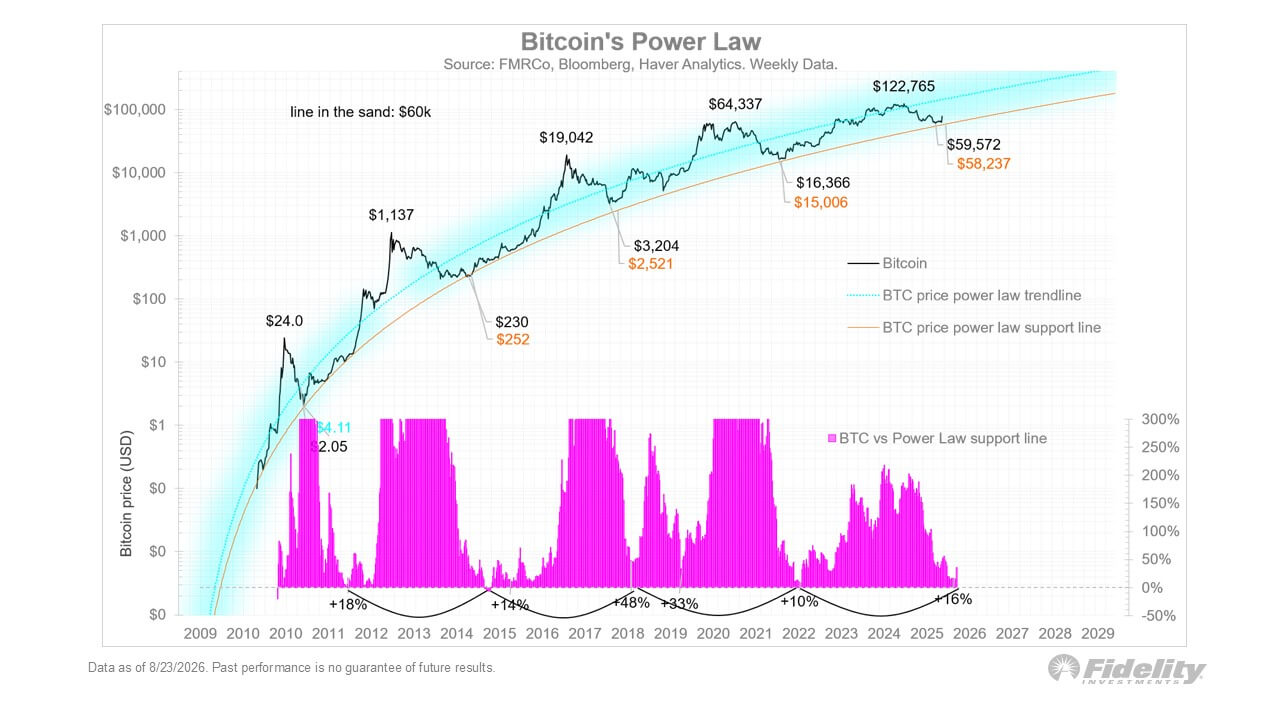
To understand why Bitcoin is holding its ground, some analysts are looking beyond macro headlines toward internal market structures. Jurrien Timmer, the Director of Global Macro at Fidelity Investments, has provided a technical framework suggesting that Bitcoin’s corrective phase, which dominated much of the early summer, may have finally reached maturity.
According to Timmer’s "Power Law Model," Bitcoin recently tested the lower boundaries of its long-term growth curve. The asset’s recent cycle low near $59,572 held firm just above the model’s critical support level of $58,237. In Timmer’s view, the duration of this correction has been sufficient to satisfy the "time component" of a typical mid-cycle winter. By spending several months in a sideways-to-downward trend, Bitcoin has "washed out" excessive speculative leverage, creating a cleaner foundation for the August breakout. While this model does not guarantee future gains, it suggests that the asset is no longer overextended relative to its historical adoption curve.
The Liquidity Conundrum: Stablecoins and Spot Volume
While the price action is undeniably bullish, a deeper dive into on-chain and exchange data reveals some cautionary signals. A healthy, sustainable bull market is typically characterized by an expansion of liquidity and high trading volumes. Currently, these metrics are lagging behind the price.
Data from market analytics firm Bit Official highlights a stagnation in the aggregate stablecoin market capitalization. Stablecoins like Tether (USDT) and Circle (USDC) act as the primary "on-ramp" for fiat currency into the crypto ecosystem. Between August 2024 and October 2025, the supply of USDT grew from $120 billion to $196 billion, providing the dry powder necessary for a massive rally. In contrast, the current growth in stablecoin supply is marginal. Without a fresh influx of fiat-backed liquidity, the current rally risks becoming "top-heavy," relying more on the repositioning of existing capital rather than new participants entering the space.
Furthermore, spot trading volume on centralized exchanges remains at multi-year lows. During Bitcoin’s previous market peak in October 2025, monthly spot volume on Binance hovered around $198 billion. In August, that figure sat closer to $44 billion—a staggering 70% decline. Similar trends are visible on Bybit and Gate.io. This divergence suggests that the current price increase is being driven by the derivatives market—options and futures—rather than "real" buying of the underlying asset on spot exchanges.
The Path to $82,000 and Beyond
As August draws to a close, the market is focused on a specific "confirmation zone" between $80,000 and $82,000. For the August rally to be viewed as the start of a new expansionary phase rather than a temporary "dead cat bounce" in a larger sideways range, Bitcoin needs to break and hold above the $82,000 level with a noticeable increase in trading volume.
The derivatives market is already positioned for such a move. Bitcoin’s options skew has flipped positive for the first time in nearly a year, indicating that traders are paying a premium for "calls" (bets on price increases) over "puts" (protection against price decreases). Implied volatility has also surged, suggesting that traders expect a significant move in the coming weeks as the market reacts to the Fed’s September policy meeting.
In summary, Bitcoin’s performance in August has been a masterclass in resilience. It has successfully navigated a hawkish central bank transition and a dangerous military escalation in the Middle East. While the lack of spot volume and stablecoin growth remains a concern for long-term sustainability, the asset’s ability to hold the $78,000 level suggests a maturing market that is increasingly capable of absorbing global macro shocks. If the coming weeks bring a return of spot demand and a stabilization of geopolitical tensions, the record-breaking August of 2024 may be remembered as the foundation for Bitcoin’s next major run toward the six-figure mark.