James Watt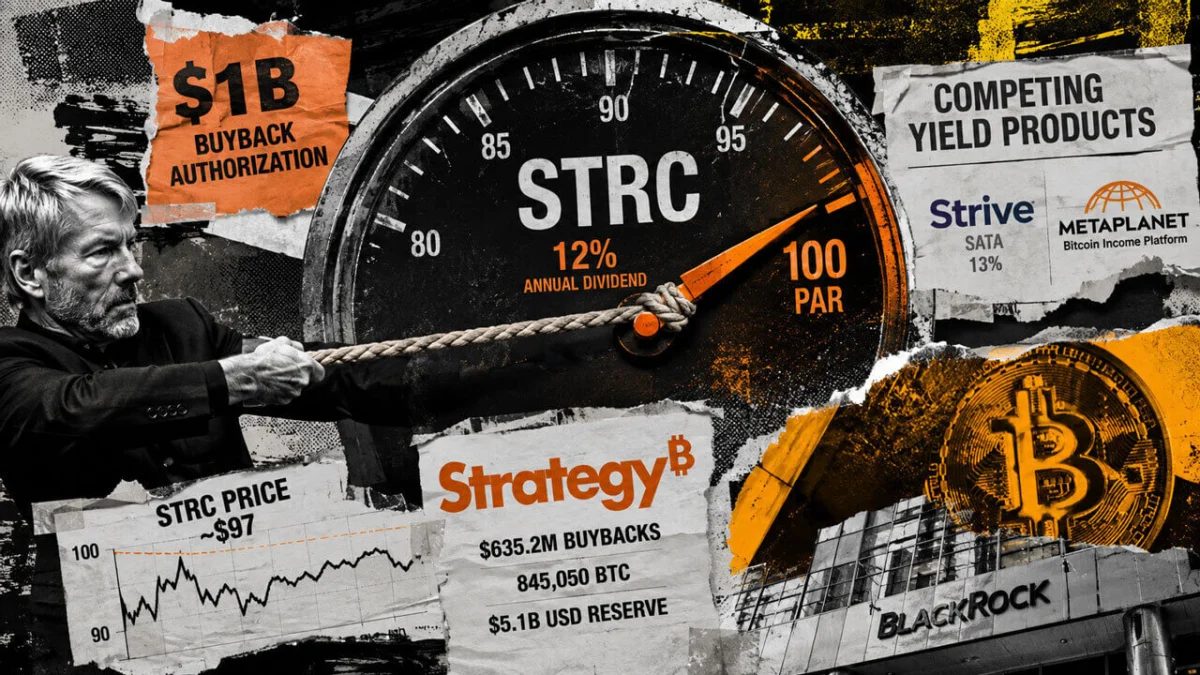
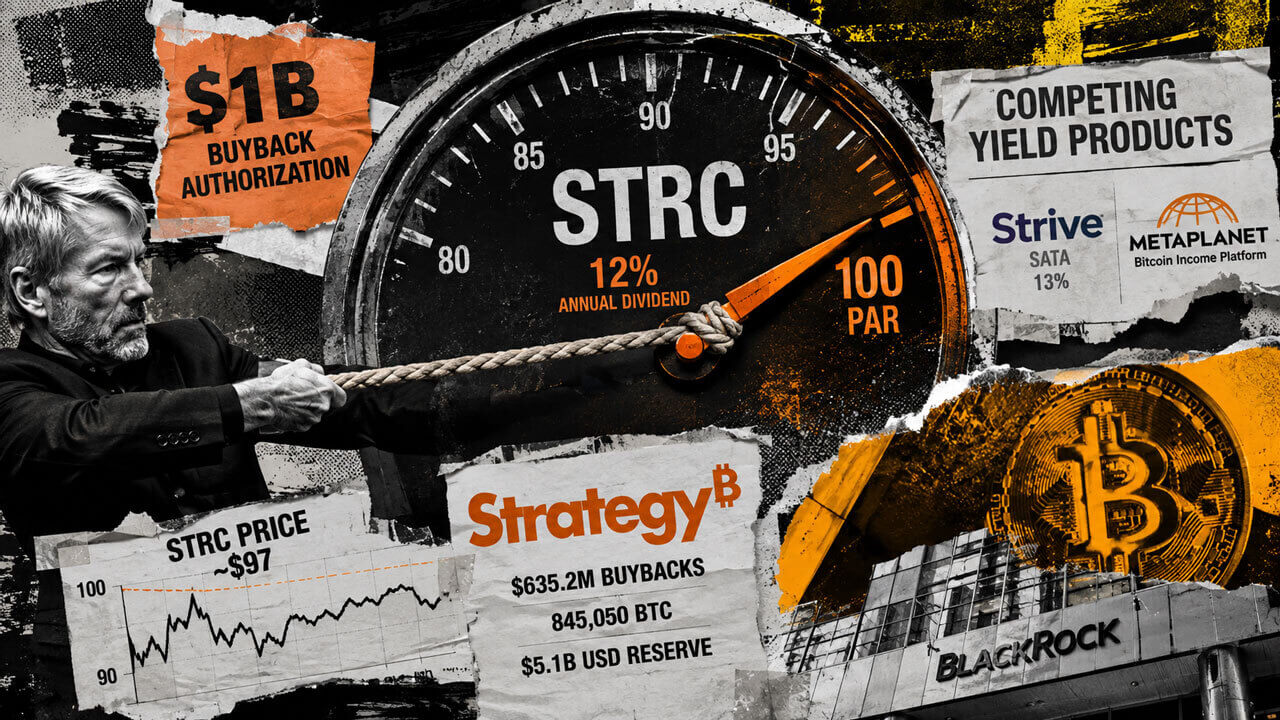
Michael Saylor, the Executive Chairman of Strategy, has approximately one week to finalize a high-stakes financial maneuver aimed at returning the company’s preferred security, STRC, to its $100 par value by an informal September 8 target date. This self-imposed deadline represents a critical juncture for the firm’s broader financial architecture, which has recently functioned as a pressurized system of capital reallocation. Despite an aggressive buyback campaign that has seen Strategy deploy $635.2 million in capital, the security remains stubbornly positioned around the $97 mark. The company is now navigating a complex landscape where it must balance the repair of its "broken dividend engine" with a renewed push to accumulate Bitcoin, all while facing a surge in competition from new Bitcoin-linked yield products entering the institutional market.
The path to par has evolved into a capital-intensive grind that challenges the firm’s initial economic assumptions. While the security has recovered significantly from its May 28 lows, the final $3 gap is proving to be the most expensive to close. This effort is not merely a matter of corporate pride; it is a fundamental restructuring of the company’s balance sheet intended to restore investor confidence and reactivate STRC as a viable tool for future capital raises.
The Mechanics of the STRC Buyback Campaign
Strategy’s effort to stabilize STRC began in earnest in late July, following a period of volatility that saw the preferred security trade at a significant discount to its $100 par value. In a corporate context, a preferred security trading below par often signals market skepticism regarding the issuer’s ability to maintain dividend payments or the underlying value of the assets backing the security. For Strategy, whose primary asset is a massive treasury of Bitcoin, the discount on STRC was seen as a direct challenge to the "Saylor Playbook" of using diverse financial instruments to fund cryptocurrency acquisition.
Initially, management outlined a tapering framework for the buyback. The logic was straightforward: the company would deploy the most capital when the discount was deepest, capturing the most "alpha" by retiring shares for significantly less than their $100 stated value. As the price approached par, Strategy intended to scale back its intervention, allowing organic institutional demand to provide the final momentum. However, the market dynamics of August upended this plan. Instead of tapering, the company’s weekly spending accelerated as the discount narrowed.
The data reveals a steady escalation in capital deployment:
- July 20–26: Strategy deployed $25.0 million at an average price of $86.52, representing a 13.48% discount.
- July 27–Aug. 2: Spending tripled to $81.2 million as the price rose to $89.02.
- Aug. 3–9: The firm crossed the $100 million weekly threshold, spending $108.6 million at an average price of $94.27.
- Aug. 10–16: Capital deployment reached $132.2 million at $95.20.
- Aug. 17–23: Spending remained high at $136.4 million with the price hovering at $95.30.
- Aug. 24–30: In the most recent disclosed period, Strategy spent a record $151.8 million to push the price to $97.48, a narrow 2.52% discount.
The total expenditure of $635.2 million has retired a substantial portion of the outstanding STRC shares, but it has also depleted the company’s authorized buyback fund. Strategy currently has $364.8 million remaining under its $1 billion authorization. At the current pace of spending—over $150 million per week—the company has roughly two weeks of "firepower" left before it must either seek new authorization or rely entirely on the market to bridge the final gap.
A Strategic Pivot: Resuming Bitcoin Accumulation
The STRC repair effort has occurred alongside a significant shift in Strategy’s Bitcoin acquisition strategy. For a two-month period during the height of the STRC volatility, the company hit a "freeze" on Bitcoin purchases. During this time, the firm took the unusual step of selling a net 6,916 Bitcoin across four transactions to fund preferred-stock obligations and the initial phases of the buyback campaign. This move was viewed by some analysts as a defensive measure to protect the integrity of the firm’s credit structure, even at the cost of its primary treasury asset.
However, the most recent financial disclosures indicate that Strategy has regained its offensive footing. Last week, the company pivoted back to common-equity issuance, selling 4.53 million shares of MSTR stock for $602.8 million in net proceeds. This capital was immediately bifurcated: $151.8 million was used to support the STRC buyback, while $369.7 million was used to acquire 4,603 Bitcoin.
This purchase brought Strategy’s total holdings to a staggering 845,050 BTC. The resumption of buying signals a belief within the executive suite that the "financial machinery" is now robust enough to support both the preferred security and the Bitcoin treasury simultaneously. To further insulate the company from market shocks, Strategy has established a $5.1 billion USD Reserve specifically earmarked for preferred dividends and debt interest, supported by an additional $1.6 billion pool of flexible cash.
The Institutional Importance of STRC
The urgency behind the STRC recovery is tied to the security’s role as a bridge between the traditional finance (TradFi) world and the Bitcoin ecosystem. When STRC was first offered in July 2025, it was met with overwhelming demand. What was originally planned as a $500 million offering was upsized to $2.52 billion as institutional investors clamored for a high-yield instrument (12% annualized dividend) linked to the Bitcoin story.
By mid-2026, STRC had become a staple in the institutional "yield-seeking" portfolio. Michael Saylor frequently highlighted that the security had entered the mainstream, noting its inclusion in major US preferred-stock ETFs. Specifically, STRC became a top holding in BlackRock’s iShares Preferred and Income Securities ETF (PFF), Virtus InfraCap Beneficial and Income ETF (PFFA), and VanEck’s Preferred Securities ex-Financials ETF (PFXF).
For these institutional holders, STRC represents a unique asset class: it offers the yield of a junk bond with the perceived balance-sheet security of a company holding billions in liquid digital gold. If STRC fails to maintain its par value, it risks being off-loaded by these ETFs, which often have strict mandates regarding price stability and credit quality. Maintaining the $100 anchor is therefore essential for keeping Strategy’s "institutional moat" intact.
Rising Competition in the Bitcoin-Linked Yield Market
While Strategy was the first mover in creating a massive Bitcoin-backed preferred security, it no longer enjoys a monopoly. The market for Bitcoin-linked income products is becoming increasingly crowded, providing investors with alternatives that may offer more attractive terms or more frequent distributions.
Strive, a prominent competitor, has recently expanded its SATA preferred stock. SATA carries a 13% annual dividend—one percentage point higher than STRC—and features a novel distribution schedule that pays out every business day. Like Strategy, Strive has instituted a policy against issuing new shares below the $100 par value, signaling to the market that it is committed to price stability from the outset.
Simultaneously, the Japanese firm Metaplanet is aggressively positioning itself as the "Strategy of Asia." Metaplanet recently acquired Siiibo Securities, a licensed platform, to develop and distribute Bitcoin-linked yield products directly to a broader range of investors. Through partnerships like Super League Enterprise, Metaplanet is also expanding its footprint in the United States, creating a global distribution network for Bitcoin-backed credit.
This competitive pressure means that STRC cannot simply rely on its history. To remain the "gold standard" of Bitcoin preferreds, it must demonstrate that it can trade at or above par without constant issuer intervention. The coming weeks will reveal whether the 12% yield is sufficient to attract new capital in an environment where 13% or more is becoming available elsewhere.
Analysis: The Sustainability of the $100 Anchor
The central question facing Strategy as the September 8 target approaches is whether the return to par is a permanent fix or a temporary artificial floor. The company’s policy of barring new STRC issuance below $100 is a strong signal of intent, but it also limits the firm’s ability to raise new capital through this specific channel until the market price stabilizes at par.
There is a fundamental irony in the current situation: STRC was designed to be a source of capital for Bitcoin purchases. Instead, for much of the summer, Bitcoin sales and MSTR stock issuances have been the sources of capital for STRC. This "inverted" relationship is sustainable in the short term due to Strategy’s massive cash and Bitcoin reserves, but it is not the intended long-term function of the security.
Success for Michael Saylor will be defined by the "hand-off." As Strategy eventually reduces its weekly buyback spend, the market will see if independent institutional demand—driven by the ETFs and private funds—is willing to step in and buy STRC at $100. If the price holds, the "dividend engine" is repaired, and Strategy can once again use STRC as a low-cost (relative to equity) way to fuel its Bitcoin acquisitions. If the price slips back toward $95 as soon as the company stops buying, it suggests that the market currently views the 12% yield as inadequate for the perceived risk, necessitating either a higher dividend rate or a more substantial change in the security’s structure.
As the September 8 deadline looms, the financial world is watching Strategy’s balance sheet with intense scrutiny. The outcome will not only impact the holders of STRC but will also provide a definitive case study on the viability of using traditional credit instruments to fund the transition to a Bitcoin-standard treasury. For now, Michael Saylor continues to bet that the sheer scale of Strategy’s holdings and the persistence of his "capital machinery" will be enough to bend the market to his timeline.