James Watt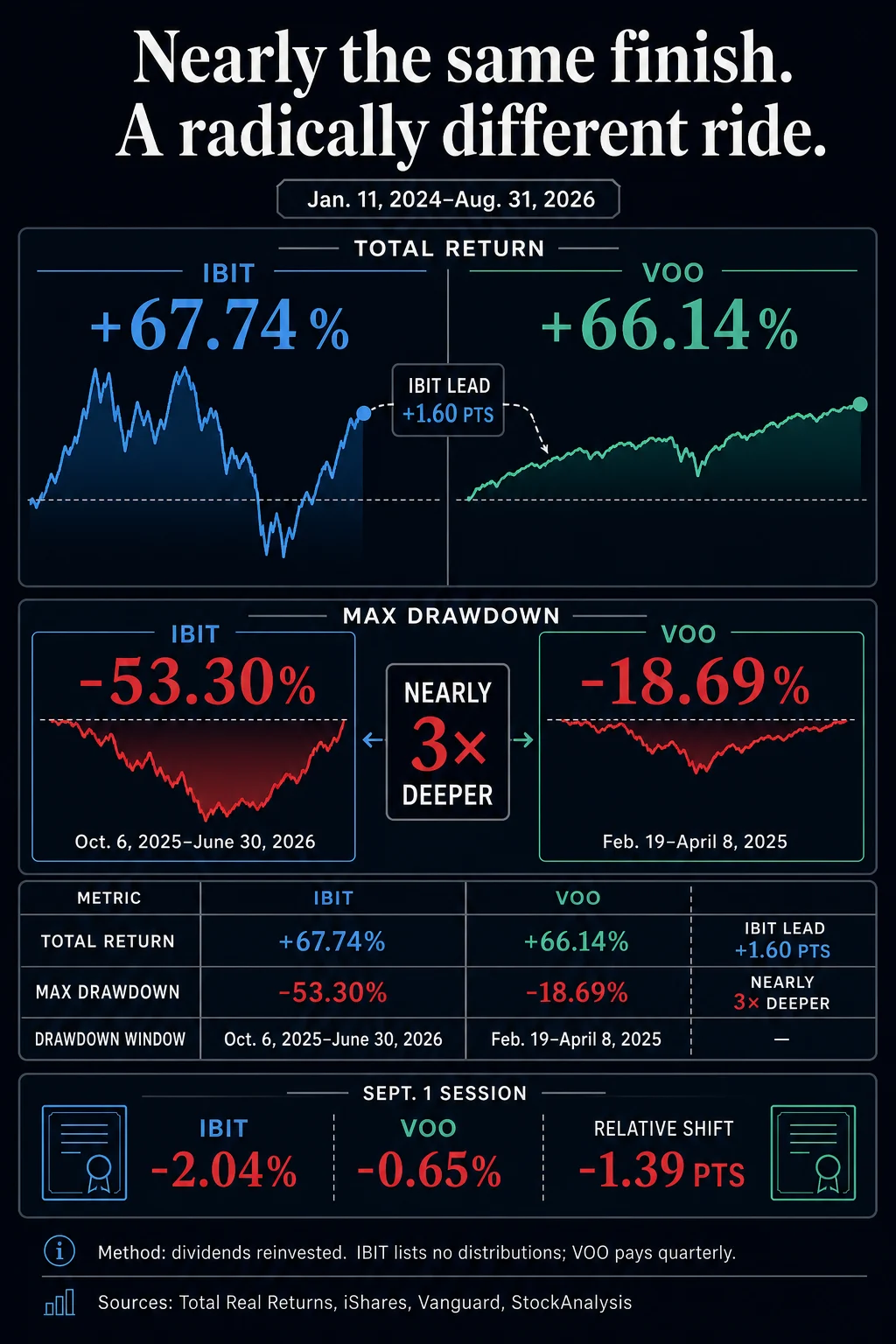
The iShares Bitcoin Trust (IBIT) has achieved a marginal performance lead over the S&P 500 since its high-profile debut in January 2024, signaling a landmark shift in the competitive landscape between digital assets and traditional equities. As of August 31, 2026, the BlackRock-managed fund recorded a total return of 67.74%, narrowly edging out Vanguard’s S&P 500 ETF (VOO), which posted a 66.14% return over the same period. While the 1.60 percentage point gap highlights the growth potential of institutional cryptocurrency products, the path to these gains has been defined by drastically different risk profiles. Investors in IBIT were forced to navigate a peak-to-trough drawdown nearly three times as severe as that experienced by those holding the broader market index, underscoring the "high-risk, high-reward" nature of the emerging asset class.
The performance comparison, measured on a total-return basis with dividends reinvested, covers a period of roughly two and a half years characterized by extreme macroeconomic shifts, political upheavals, and a maturing regulatory environment for digital assets. Despite Bitcoin reaching unprecedented price levels in 2025, the subsequent correction in early 2026 significantly compressed the lead IBIT had established over traditional market benchmarks. This narrow victory for the Bitcoin ETF serves as a case study in market psychology, institutional adoption, and the diverging volatility signatures of 21st-century investment vehicles.
The Performance Paradox: Returns Versus Risk Appetite
The headline figures—67.74% for IBIT versus 66.14% for VOO—suggest a near-parity in final outcomes, yet the internal mechanics of these returns tell a story of two different financial worlds. For Vanguard’s S&P 500 ETF, the climb was relatively steady, supported by robust corporate earnings and the continued expansion of the technology sector. In contrast, IBIT’s journey was marked by violent price swings that tested the resolve of even the most seasoned institutional participants.
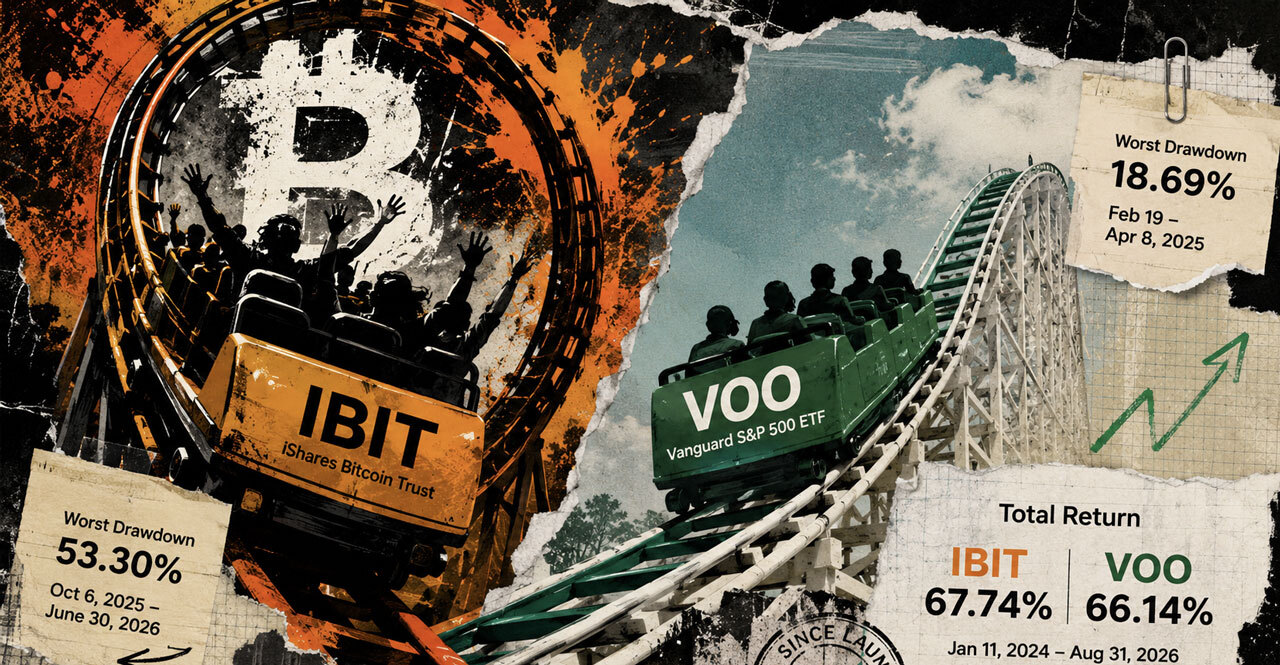
Bloomberg senior ETF analyst Eric Balchunas characterized the comparison as a study in contrast, noting that it is "hard to believe" IBIT is maintaining a lead given the bearish sentiment that plagued the cryptocurrency sector during various stretches of 2025 and 2026. Balchunas utilized a vivid analogy to describe the investor experience, likening IBIT’s trajectory to the "El Toro" wooden roller coaster at Six Flags Great Adventure—renowned for its steep drops and intense G-forces—while describing VOO’s ascent as a "walk in the park."
The data supports this assessment. IBIT’s maximum drawdown during the period reached a staggering 53.30%, occurring between October 6, 2025, and June 30, 2026. During this window, Bitcoin’s price plummeted as the market corrected from its post-election highs. Conversely, VOO’s most significant decline was a comparatively mild 18.69%, spanning from mid-February to early April 2025. This disparity suggests that while the final destination was similar, the emotional and financial cost of the journey was significantly higher for Bitcoin investors.
A Chronology of the Bitcoin-Equity Rivalry (2024–2026)
To understand how a cryptocurrency fund and a diversified equity index arrived at nearly identical returns, one must examine the chronological milestones that defined the last 32 months of trading.
The 2024 Launch and Initial Momentum
The story began on January 11, 2024, when the U.S. Securities and Exchange Commission (SEC) approved the first batch of spot Bitcoin ETFs. At the time of IBIT’s launch, Bitcoin was trading at approximately $47,000. The initial influx of institutional capital provided an immediate tailwind, driving the asset upward as wealth managers began incorporating "digital gold" into diversified portfolios.
The 2025 Surge and the "Trump Trade"
The most significant divergence between the two funds occurred following the 2024 U.S. Presidential Election. The victory of Donald Trump, who had campaigned on a platform increasingly friendly toward the domestic digital asset industry, sparked a historic rally. By 2025, Bitcoin’s price surged to a record high of approximately $126,000. During this phase, IBIT’s performance significantly eclipsed the S&P 500, leading many analysts to predict that Bitcoin would permanently decouple from traditional market cycles.
The 2026 Correction and Stabilization
The exuberance of 2025 met a harsh reality in late 2025 and the first half of 2026. A combination of profit-taking, shifting interest rate expectations, and a "long squeeze" in the futures market saw Bitcoin’s value retreat sharply, falling to a low of roughly $58,000. This 53% drawdown for IBIT coincided with a period where the S&P 500 remained relatively resilient, buoyed by the stability of large-cap American corporations. By late August 2026, Bitcoin staged a recovery to the $77,000 level, allowing IBIT to reclaim its narrow lead over VOO just as the reporting period closed.
Scaling the Heights: Asset Growth and Market Maturity
While their returns are currently neck-and-neck, the two ETFs operate on vastly different scales of maturity and total capitalization. BlackRock’s IBIT has achieved a level of growth that is unprecedented for a new financial product, yet it remains a fraction of the size of the S&P 500’s flagship vehicles.
IBIT has successfully accumulated approximately $63 billion in net inflows since its inception, bringing its total assets under management (AUM) to roughly $60 billion after accounting for price fluctuations. This scale places IBIT among the most successful ETF launches in history, proving that institutional demand for Bitcoin was not merely speculative but represented a structural shift in asset allocation. BlackRock has since reinforced this by recommending a 2% Bitcoin allocation for investors seeking long-term diversification, a move that helped legitimize the asset class within traditional brokerage circles.
However, Vanguard’s VOO operates in a different echelon of the global financial system. In June 2026, VOO became the first ETF in history to cross the $1 trillion threshold in net assets. This milestone underscores the S&P 500’s status as the foundational building block of global wealth. The fact that a $60 billion crypto fund can compete on a percentage-return basis with a $1 trillion equity fund highlights the "alpha" potential of Bitcoin, even as it illustrates the massive liquidity gap that still exists between the two.
Institutional Reactions and Investor Sentiment
The narrow performance gap has elicited a range of reactions from Wall Street strategists. Proponents of digital assets argue that IBIT’s ability to outperform the S&P 500—even by a small margin—is a victory, considering the immense regulatory and skepticism-driven hurdles the fund faced at launch.
"The real story isn’t just the 67% return; it’s the fact that Bitcoin has survived a 50% drawdown and still came out ahead of the most successful equity index in the world," said one senior portfolio manager at a New York-based hedge fund. "It proves that Bitcoin has moved past its ‘experimental’ phase and is now a legitimate macro asset that competes for the same capital as Apple, Microsoft, and Amazon."
Conversely, risk-averse analysts point to the drawdown figures as a cautionary tale. The 18.69% maximum decline for VOO is considered a standard market correction that most retirement savers can stomach. A 53.30% decline, however, is often enough to trigger panic selling among retail investors and forced liquidations among leveraged traders. The similarity in returns, they argue, does not justify the three-fold increase in risk for the average investor.
Broader Implications for Portfolio Construction
The data comparing IBIT and VOO suggests several long-term implications for the future of investment management.
- The Erosion of the 60/40 Model: The success of IBIT has accelerated the trend of moving away from the traditional 60% stock and 40% bond portfolio. Wealth managers are increasingly looking at "alternative" allocations where Bitcoin serves as a non-correlated (or semi-correlated) growth engine.
- Volatility as a Feature, Not a Bug: The IBIT experience confirms that Bitcoin’s volatility remains its defining characteristic. For investors with long-term horizons, this volatility is the price of admission for potential outperformance. For those with shorter timelines, the 53% drawdown serves as a stark reminder of the asset’s unpredictability.
- The Convergence of Finance: The rivalry between IBIT and VOO represents the final stages of the convergence between "TradFi" (Traditional Finance) and the digital asset economy. With BlackRock and Vanguard—the two largest asset managers in the world—now providing the primary vehicles for these competing strategies, the barrier between "crypto" and "stocks" has effectively vanished.
Conclusion: A New Benchmark for Success
As of late 2026, the iShares Bitcoin Trust stands as a testament to the enduring appeal of decentralized scarcity in a complex global economy. By narrowly outperforming the S&P 500 since its inception, IBIT has met the quantitative goal of many of its early backers. However, the qualitative experience of its investors—marked by the "El Toro" roller coaster of 50% price swings—remains the primary hurdle for universal adoption.
The coming years will likely determine if Bitcoin can continue to deliver this "volatility premium" or if, as the asset matures and its AUM grows toward the levels of VOO, its returns will begin to stabilize. For now, the data is clear: Bitcoin is capable of beating the market, but only for those with the stomach to endure the ride.