
 James Watt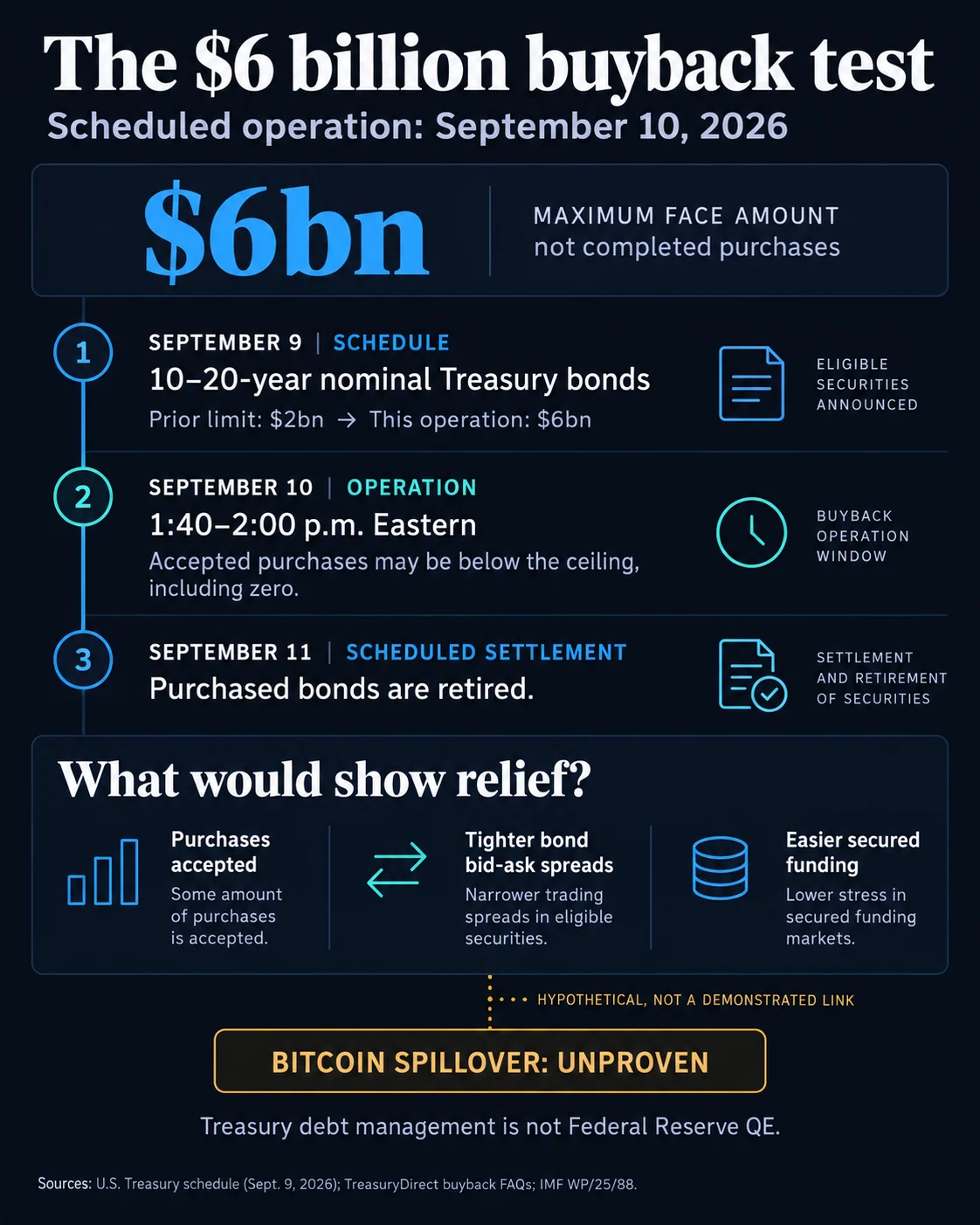
The Mechanics and Scope of the September 10 Operation
The tentative schedule, published by the Treasury on September 9, targets nominal Treasury securities with remaining maturities ranging from 10 to 20 years. Specifically, the operation includes eligible maturities spanning from September 11, 2036, through September 10, 2046. By setting a $6 billion limit, the Treasury has effectively tripled the previous $2 billion cap utilized in earlier iterations of the buyback program. Furthermore, this figure exceeds the $4 billion minimum expansion originally signaled by the Treasury in its August 19 announcement.
The operation is structured with a tight execution window, scheduled to take place between 1:40 p.m. and 2:00 p.m. Eastern Time on September 10, with a formal settlement date of September 11. The final list of eligible securities is slated for release at 11:00 a.m. Eastern on the day of the operation. Unlike "cash-management" buybacks, which are primarily intended to smooth out the government’s cash balances and manage bill issuance, these "liquidity support" buybacks are designed to provide a predictable outlet for "off-the-run" securities—older bonds that are less liquid than the most recently issued "on-the-run" equivalents.
Chronology of the Buyback Program and Policy Evolution
The reintroduction of the Treasury buyback program in 2024 represents a significant shift in US fiscal management, marking the first time such operations have been conducted with regularity in over two decades.
- May 2024: The Treasury Department officially launches its buyback program, the first of its kind since the early 2000s. The initial focus is on improving market depth and supporting the liquidity of off-the-run securities.
- August 19, 2024: Following a period of heightened volatility in the bond market, the Treasury announces its intent to expand the scale of buyback operations. It promises at least $4 billion in liquidity support operations for the upcoming quarter.
- September 9, 2024: The Treasury publishes the specific parameters for the September 10 operation, surprising some market participants by raising the ceiling to $6 billion, the highest level since the program’s inception.
- September 10, 2024: Scheduled execution of the buyback. Dealers submit offers to sell back older bonds to the government.
- September 11, 2024: Scheduled settlement of the transactions, at which point the Treasury retires the purchased debt.
This progression reflects an increasing concern within the Treasury Department regarding the ability of primary dealers—the large banks and broker-dealers mandated to facilitate Treasury auctions—to intermediate the market effectively. As the total supply of US debt continues to grow, the balance sheets of these institutions have become increasingly constrained, making it difficult for them to hold large inventories of older, less liquid bonds.
Supporting Data: Assessing Market Liquidity and Dealer Constraints
The rationale behind the $6 billion intervention is rooted in the structural health of the Treasury market. A May 2025 International Monetary Fund (IMF) working paper authored by Jing Zhou provides empirical weight to the Treasury’s strategy. The study found that such buyback operations generally lead to modest improvements in Treasury trading liquidity and a measurable reduction in dealer holdings. The research noted that these effects are most pronounced during periods when dealer inventories are high and market strain is evident.

Currently, several indicators suggest that the Treasury market is experiencing underlying friction. The "yield curve gap" between off-the-run and on-the-run securities often widens when liquidity is scarce. When dealers are saturated with inventory, they demand a higher premium to hold older bonds, which can lead to distorted pricing across the curve. By stepping in as a buyer of last resort for these $6 billion in securities, the Treasury is effectively "cleaning" the balance sheets of primary dealers.
Furthermore, the Treasury retires these purchased bonds upon settlement rather than lending them back into the market via the repo market. This reduction in the total "float" of off-the-run debt reduces the inventory burden on the private sector. While the $6 billion figure is a maximum and not a guaranteed purchase amount, the increased ceiling provides the Treasury with the flexibility to absorb a significant amount of duration if dealer offers are favorable.
Official Responses and Tactical Objectives
The Treasury Department has been careful to frame these operations as technical market-maintenance tools rather than shifts in broader economic policy. According to official Treasury guidelines, the buyback program is intended to be "neutral" in terms of its impact on the overall maturity profile of the debt. The funds used for these repurchases typically come from the proceeds of new debt sales or the Treasury General Account (TGA), meaning the operations do not constitute a net injection of new money into the economy in the way that Federal Reserve Quantitative Easing (QE) does.
However, market analysts suggest that the tactical objective is to prevent a "liquidity tailspin" where dealers, unable to move old inventory, stop participating aggressively in new debt auctions. A Treasury spokesperson previously noted that the goal of the program is to "enhance the resilience of the Treasury market by providing a regular and predictable presence."
Critics and some macro analysts, however, argue that these operations represent a form of "fiscal dominance," where the Treasury takes on roles traditionally associated with the central bank to ensure the smooth functioning of government financing. By absorbing duration and easing dealer constraints, the Treasury is arguably performing a "stealth" version of yield curve control, or at the very least, ensuring that the private sector remains capable of absorbing the massive amounts of new debt being issued to fund the federal deficit.
Broader Impact: The Bitcoin Liquidity Thesis
The intersection of Treasury operations and Bitcoin performance has become a focal point for institutional crypto-analysts. The prevailing hypothesis is that Bitcoin thrives when global liquidity expands and financing conditions ease. Although the Treasury buyback is not a direct "money printing" exercise, it facilitates easier intermediation. When dealers have cleaner balance sheets, they are more likely to extend credit and participate in the repo markets that fund a vast array of financial activities, including leveraged positions in risk assets.

For the Bitcoin liquidity thesis to hold, several conditions must be met following the September 10 operation:
- Narrowing Spreads: Market participants will look for narrower bid-ask spreads in the Treasury market and a reduction in the pricing strain of older bonds relative to newer issues.
- Funding Conditions: A more direct link would be an easing of borrowing costs in the secured financing markets (Repo). If the buyback eases dealer constraints, the "plumbing" of the financial system should operate more smoothly.
- Risk Appetite: If the bond market stabilizes and liquidity flows more freely through the banking system, Bitcoin and other "pure plays" on liquidity are historically positioned to benefit.
Conversely, if the Treasury accepts only a small fraction of the $6 billion in offers, or if bond market volatility remains high despite the intervention, it would suggest that the program’s scale is insufficient to counter the broader headwinds of high interest rates and massive debt supply. In such a scenario, the "stealth liquidity" argument for Bitcoin would lose momentum.
Implications for the Future of Fiscal Policy
The September 10 operation is a litmus test for the Treasury’s ability to manage the massive US debt load without causing systemic disruptions. As the federal deficit remains elevated, the frequency and size of these buybacks are likely to increase. For investors, the takeaway is that the "neutral" stance of the Treasury is becoming increasingly active.
The $6 billion ceiling is a clear signal that the government is willing to use its balance sheet to support market functioning. Whether this support spills over into the crypto markets remains to be proven, but the mechanism is plausible: a healthier Treasury market leads to lower systemic risk, which in turn lowers the "liquidity risk premium" across all asset classes.
As the settlement occurs on September 11, the market will quickly turn its attention to the aftermath. A sustained improvement in bond trading conditions would provide the first piece of evidence that the Treasury’s intervention has been successful. For Bitcoin, the true test will be whether this eased friction translates into a renewed influx of capital into the digital asset space, reinforcing its role as a primary beneficiary of the modern, liquidity-driven financial system.








