
 admin
admin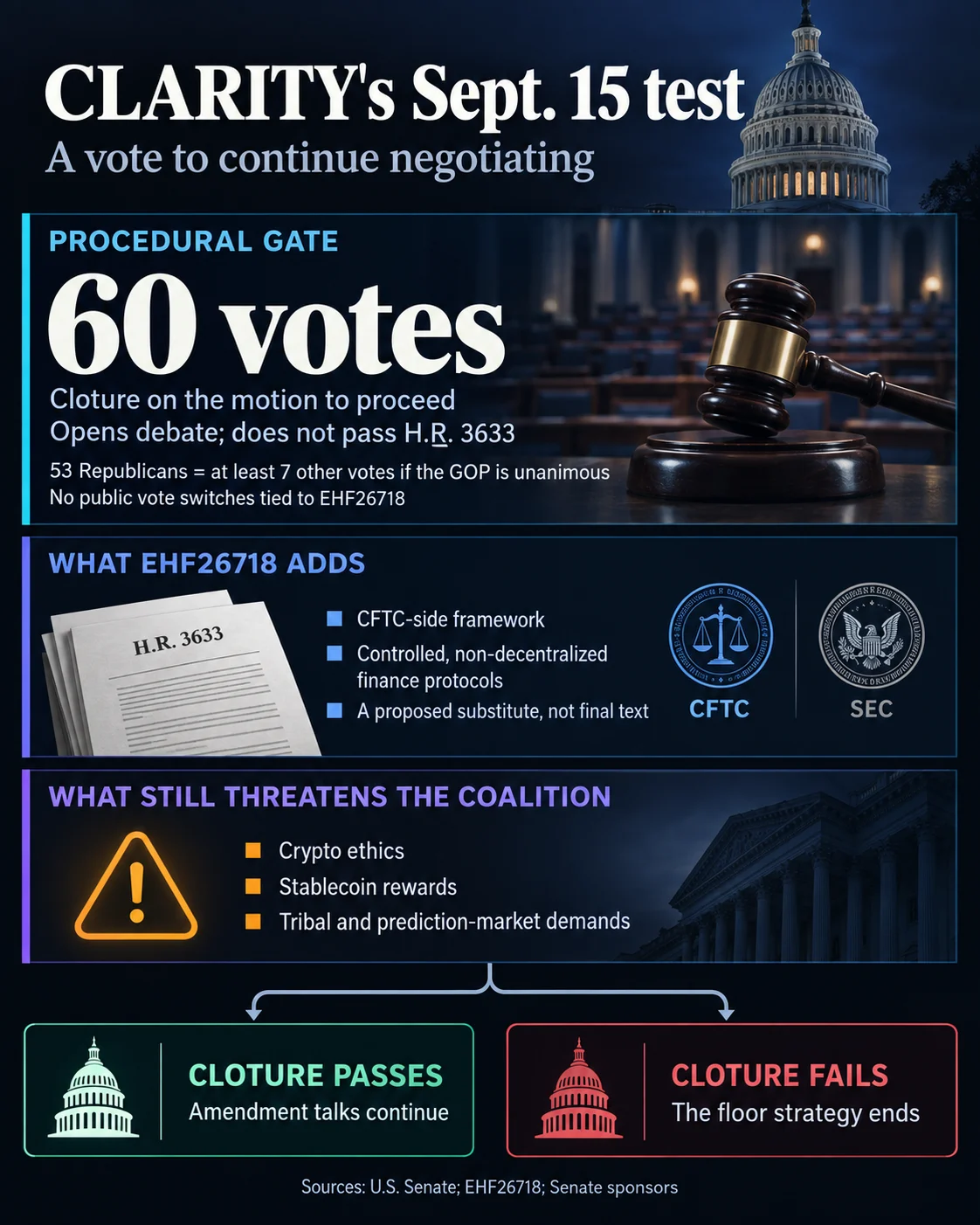
The Senate is on the precipice of a critical procedural vote on the CLARITY Act, a landmark piece of legislation aiming to establish a comprehensive regulatory framework for digital assets. White House digital assets adviser Patrick Witt has urged lawmakers to move forward with the bill, framing the upcoming Sept. 15 cloture vote not as a final endorsement, but as an opportunity to continue the vital negotiation process. "Get on the bill and let’s keep talking," Witt’s message encapsulates the administration’s stance: passing this procedural hurdle is paramount to preserving the legislative pathway for addressing complex and contentious issues surrounding cryptocurrencies, decentralized finance (DeFi), and related markets.
The immediate focus is the cloture vote, scheduled for 2:15 p.m. on September 15th, on the motion to proceed to H.R. 3633, the CLARITY Act. This procedural vote requires 60 senators to overcome a filibuster, thereby opening the floor for debate and amendment. The outcome of this vote will determine whether the Senate can engage in a thorough discussion and potential revision of the bill, or if its progress will be halted, leaving key regulatory questions unanswered.
In a significant development just four days prior to this pivotal vote, Republicans unveiled EHF26718, a proposed substitute text for the CLARITY Act. This revised draft introduces a framework overseen by the Commodity Futures Trading Commission (CFTC) specifically designed for protocols that, while presenting themselves as decentralized, remain under the control of an identifiable party. This amendment aims to address a core concern regarding the regulatory treatment of so-called "decentralized" platforms, particularly those involved in DeFi and prediction markets, by establishing clearer lines of responsibility and oversight.
The inclusion of this CFTC-centric framework is a strategic move by Republican negotiators to mend perceived gaps in the bill’s regulatory architecture. It offers a targeted response to the anxieties expressed by several senators regarding the potential for regulatory arbitrage and the need for robust oversight of emerging digital asset activities. However, as of the latest reports, none of the senators who had previously voiced concerns about prediction markets and Tribal sovereignty have publicly stated that the proposed substitute has altered their voting intentions. Furthermore, significant disputes persist concerning presidential ethics related to cryptocurrency holdings and the regulatory treatment of stablecoin rewards, indicating that substantial challenges remain in achieving a broad consensus.
Republicans are thus engaged in a strategic effort to solidify the perimeter of their legislative coalition, aiming to secure enough votes to advance the bill for further deliberation. Their immediate objective is to persuade senators who may harbor reservations about the current text to support the motion to proceed, thereby preserving the opportunity to introduce amendments and refine the legislation. This approach acknowledges that while some contentious issues may not be fully resolved at this stage, advancing the bill is crucial for keeping the legislative process alive.
A Strategic CFTC Framework for DeFi and Prediction Markets
The newly introduced text, EHF26718, is formally designated as an "amendment in the nature of a substitute intended to be proposed." Its scope has been expanded from the July draft’s "Software developer protections" to encompass "Software developer protections and non-decentralized finance trading protocols." This expansion is significant as it carves out a specific CFTC-administered regime for evaluating the decentralization claims of financial protocols. The aim is to differentiate between truly decentralized autonomous organizations and those that, despite their nomenclature, are still effectively controlled by a discernible entity or group, thus subjecting them to existing intermediary regulations.
This addition complements Section 10301 of the original bill, which tasked the Securities and Exchange Commission (SEC) with addressing "non-decentralized finance trading protocols." The revised Section 20209 now assigns a parallel responsibility to the CFTC, effectively creating a dual-pronged approach to regulating these complex entities. The operative distinction, and the crux of this new framework, lies in the concept of "control." A venue’s claim of decentralization would no longer be an automatic shield against intermediary obligations if an identifiable person or group exercises administrative control.
The July substitute had already introduced a provision in Section 20209 to protect developers administering DeFi protocols or liquidity pools, specifically limiting this protection to spot transactions. EHF26718 builds upon this by introducing the verifiable development of a CFTC framework for controlled protocols, offering a more nuanced regulatory approach.
Earlier in the legislative process, in July, a coalition of 12 Democratic senators had expressed significant concerns. They warned that broad exemptions for DeFi could inadvertently shield blockchain-based prediction markets from essential derivatives regulations. Their demands included limiting any new exemptions strictly to spot-market provisions, ensuring the preservation of the Indian Gaming Regulatory Act and existing Tribal-state compacts, and explicitly prohibiting CFTC-registered entities from offering sports wagers or casino-style contracts.
The revised framework, by introducing a CFTC test for controlled protocols, directly addresses a portion of these concerns. It makes it more challenging for centrally controlled platforms to evade regulatory scrutiny by simply adopting a "DeFi" label. However, the senators’ broader concerns extend beyond mere protocol classification, leaving the critical issues of Tribal sovereignty and the specific treatment of event contracts still very much in play. Senators Lisa Murkowski and Brian Schatz have independently advocated for the CFTC to engage in thorough consultations with Tribal nations and to uphold federal Indian gaming law as it develops its rules for prediction markets.

While the amendments may make these lawmakers more receptive to the bill, as of September 10th, none of the signatories to the July letter had publicly indicated a shift in their stance directly attributable to the EHF26718 proposal. This suggests that while progress has been made on specific fronts, the broader coalition dynamics remain delicate and subject to further negotiation.
The Unforgiving Mathematics of Coalition Building in the Senate
The Senate’s procedural rules, particularly those governing cloture, present a formidable challenge. To end debate on a legislative motion and bring a bill to a final vote, a supermajority of 60 votes is required, assuming no vacancies. With 53 Republican senators, achieving this threshold necessitates securing at least seven votes from across the aisle, even with perfect party unity. This mathematical reality underscores the intricate nature of bipartisan negotiation required for significant legislation to advance.
The National Sheriffs’ Association provides a concrete example of how targeted concessions can influence coalition dynamics. On September 3rd, following amendments that addressed concerns related to illicit finance, the association transitioned from an oppositional stance to a neutral one. This shift demonstrates the potential for specific adjustments to broaden support, even if the core disagreements remain.
Within the Republican conference itself, ethical considerations tied to public officials’ cryptocurrency interests represent a clear and present threat to the bill’s passage. Reports from Semafor indicate that Senator Thom Tillis believes the bill could falter if the White House does not actively mediate the standoff over restrictions concerning public officials’ crypto holdings. Concurrently, Senator Mike Rounds has expressed skepticism about the bill’s prospects. While these comments do not constitute a definitive whip count, they highlight a vulnerability in assuming unwavering Republican support for cloture.
Another significant point of contention that continues to strain the coalition is the issue of stablecoin rewards. The bill’s sponsors’ section-by-section summary suggests that permitted rewards could be linked to activities such as account opening, payment processing, and liquidity provision. Banking institutions argue that these programs could function analogously to interest payments, potentially siphoning deposits away from the traditional, regulated banking system. This dispute has escalated into a public lobbying campaign, with cryptocurrency advocacy groups launching a late-stage advertising blitz accusing banks of attempting to "eliminate stablecoin rewards" through their opposition.
The legislative calendar itself imposes significant constraints. While a floor date forces difficult decisions, it also sets the stage for subsequent votes and potential reconciliation efforts. The Senate’s available time in September was already limited, making the upcoming vote particularly consequential. A successful motion to proceed would keep the legislative path open, allowing these unresolved issues to be addressed on the Senate floor. Conversely, failure to achieve cloture would likely derail the bill for the foreseeable future.
A Vote to Continue the CLARITY Act Dialogue
Patrick Witt’s central argument serves as the White House’s bridge between an imperfectly drafted bill and the demanding 60-vote threshold for cloture. His perspective is that senators should vote to proceed with the CLARITY Act precisely because a failed motion would eliminate any opportunity for amendments. In his view, advancing the bill is not an act of final approval but a necessary step to engage in the democratic process of amendment and debate, which is essential for refining complex legislation.
Those senators who remain hesitant or opposed might perceive withholding their cloture vote as a means to gain greater leverage in future negotiations. Alternatively, they may view the outstanding issues concerning ethics, stablecoins, and Tribal policy as too substantial to defer without definitive resolution.
Simultaneously, Republican negotiators are providing these senators with a revised legislative text for their consideration. The inclusion of the controlled-protocol framework and the National Sheriffs’ Association’s shift to a neutral stance serve as tangible evidence that specific, discrete objections can be addressed and can influence the coalition’s perimeter, even while the central compromises remain under negotiation.
The underlying strategy hinges on securing the agreement of 60 senators to distinguish between the procedural act of continuing the legislative process and the substantive act of approving the bill’s final product. A successful cloture vote would carry the unresolved debates surrounding ethics, stablecoins, and prediction markets into another round of amendments on the Senate floor. A failure to achieve cloture, however, would effectively end this particular legislative strategy before these unfinished compromises have a chance to be debated and potentially resolved in open session. The coming vote, therefore, represents not an endpoint, but a critical juncture in the ongoing effort to shape the future of digital asset regulation in the United States.








