
 admin
admin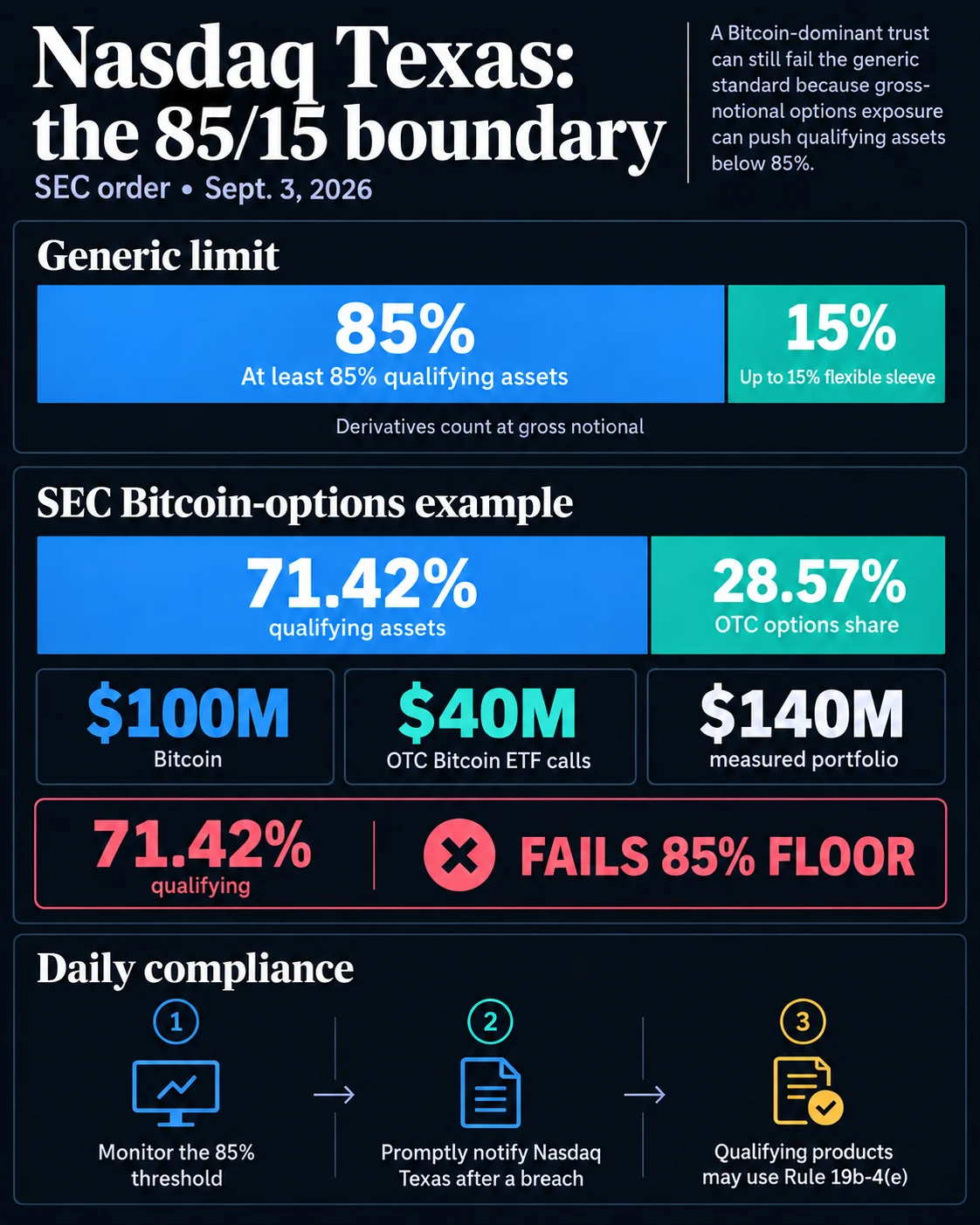
The U.S. Securities and Exchange Commission (SEC) has approved a pivotal rule change on the Nasdaq Texas exchange, granting commodity-based trusts, particularly those heavily weighted towards Bitcoin, a more flexible approach to asset allocation. This significant development allows these trusts to hold up to 15% of their net asset value in assets or derivatives that previously would have disqualified them from the exchange’s expedited listing process, thereby fostering greater innovation in the management of digital asset-focused investment vehicles.
A New Era of Flexibility for Commodity Trusts
The rule change, officially sanctioned by the SEC on September 3, 2026, revises the listing standards for "Qualifying Commodity-Based Trust Shares" on Nasdaq Texas. The core of the amendment mandates that these trusts must maintain at least 85% of their net asset value in qualifying assets. These qualifying assets are defined as cash, cash equivalents, commodities, commodity-based assets, and securities that meticulously adhere to the existing eligibility criteria set forth by the exchange. Crucially, the remaining 15% of the trust’s net asset value can now encompass a broader spectrum of assets, including specified digital commodities or securities that might not have met the stringent requirements of the 85% threshold.
This 15% "flexible sleeve" offers a significant operational advantage. For a trust predominantly holding Bitcoin, this newfound flexibility could enable the inclusion of other digital assets, such as Ether or various altcoins, or the strategic deployment of certain derivative instruments. However, it is essential to underscore that this provision does not grant sponsors carte blanche to allocate any asset into this 15% portion. The rule still imposes specific limitations and does not serve as an endorsement of any particular fund or its investment strategy. The intent is to allow for more dynamic portfolio management within defined parameters, rather than a complete deregulation of asset types.
Understanding the Constraints: Gross Notional Value and Derivatives
The 15% limit is an aggregate for all holdings that fall outside the primary 85% qualifying criteria. A particularly nuanced aspect of this rule pertains to derivatives. The SEC’s interpretation counts the total underlying exposure of these financial instruments, known as their gross notional value, rather than merely the upfront cost of an option or the initial cash outlay. This can significantly impact a trust’s ability to utilize derivatives without exceeding the 15% limit.
To illustrate the practical implications, the SEC provided a detailed example within its approval order. Consider a hypothetical trust with $100 million invested in Bitcoin. If this trust also held 5,000 over-the-counter (OTC) call options on a Bitcoin exchange-traded fund (ETF), the notional value of these options could represent an additional $40 million in exposure. Under the new rule, this would bring the trust’s total exposure to $140 million for compliance testing purposes. However, only the $100 million invested directly in Bitcoin would count towards the required 85% qualifying asset threshold. This scenario would result in the trust’s qualifying portion dropping to approximately 71.42%, falling well short of the stipulated 85% minimum. This example clearly demonstrates that even a Bitcoin-centric portfolio can breach the compliance threshold if its derivative positions become sufficiently large, highlighting the importance of careful risk management and asset allocation.
Daily Compliance and Reporting Obligations
Sponsors of these commodity-based trusts are now tasked with rigorously monitoring their portfolio’s compliance with the 85% threshold on a daily basis. Any deviation or breach must be promptly reported to Nasdaq Texas. The exchange’s filing further clarifies that only digital commodities, as defined within the scope of the rule, are permitted to occupy the non-qualifying portion of the portfolio. This ensures that the flexibility is channeled towards digital asset innovation rather than a broad influx of unrelated speculative assets.
The Benefit of Streamlined Listing
The primary advantage conferred by this rule amendment is access to a significantly faster listing process for eligible products. Historically, when the SEC approves an exchange’s rules and generic listing standards for a particular type of financial product, Rule 19b-4(e) of the Securities Exchange Act of 1934 allows products that meet these pre-defined standards to commence trading without requiring a separate, individual SEC approval process for each new product. This can dramatically reduce the time-to-market and associated costs for financial institutions looking to launch new investment vehicles. Products that do not conform to these generic standards can still pursue listing, but they must undergo a more extensive individual application and approval procedure.
A Harmonization of Exchange Rules
Nasdaq Texas’s recent rule amendments are described as being "materially identical" to rule changes previously approved by the SEC for the Nasdaq exchange in July 2026. The SEC’s approval order for Nasdaq Texas also references comparable rule modifications enacted for other major exchanges, including NYSE Arca and Cboe BZX. This suggests a broader trend towards regulatory harmonization across key U.S. exchanges concerning the listing of commodity-based trusts, rather than a novel or isolated policy shift. This alignment signifies a maturing regulatory landscape for these investment products, potentially paving the way for greater standardization and predictability.
Embracing Active Management Strategies
Beyond asset allocation flexibility, the rule amendments also permit Commodity-Based Trust Shares to employ actively managed strategies under the generic listing standards. Previously, the rule was predominantly designed for passively managed strategies, where the portfolio composition closely mirrors a specific index or benchmark. The inclusion of actively managed strategies opens up new possibilities for fund managers to adapt to market conditions, seek alpha, and potentially offer more sophisticated investment outcomes.
However, active management within this regulatory framework does not equate to unrestricted discretion for fund managers. The rule imposes stringent transparency and information-sharing requirements. Trusts employing active strategies must publicly disclose their holdings, including precise quantities and percentage weights, on a dedicated, free-access website before the commencement of regular trading hours. Furthermore, the exchange reserves the right to halt trading if essential portfolio information is not disseminated simultaneously to all market participants. Strict procedures are also mandated to prevent the misuse of non-public portfolio information by individuals with privileged access. This emphasis on transparency aims to maintain market integrity and protect investors.
Precedent and Broader Regulatory Context
This regulatory development follows a series of important advancements in the landscape of active cryptocurrency investment products. In June 2026, CryptoSlate reported on BlackRock’s innovative Bitcoin ETF, which introduced a monthly income-generating strategy, albeit with a cap on gains during periods of significant Bitcoin price surges. The SEC’s current approval for Nasdaq Texas can be seen as a logical extension of this regulatory evolution, providing a framework for more diverse and potentially more complex Bitcoin-related investment vehicles to access public markets.

Implications for the Digital Asset Ecosystem
The implications of this rule change are far-reaching for fund sponsors and the broader digital asset ecosystem. By expanding the permissible scope of assets within a defined limit, Nasdaq Texas is enhancing the attractiveness of its listing process for innovative financial products. This could lead to an increase in the number and variety of Bitcoin-focused and other cryptocurrency-related trusts seeking to list on the exchange. The 85% minimum requirement ensures that these trusts maintain a core exposure to qualifying assets, mitigating some of the inherent risks associated with digital assets, while the 15% sleeve allows for strategic diversification and the exploration of more complex investment strategies.
Ultimately, this regulatory adjustment by the SEC on Nasdaq Texas represents a significant step forward in the institutionalization of digital assets. It provides a clearer and more accommodating pathway for investment vehicles to offer exposure to cryptocurrencies and related instruments, while still maintaining a robust regulatory oversight designed to protect investors and ensure market stability. The balance between flexibility and strict adherence to core asset requirements is a critical element that will likely shape the future development of digital asset investment products.
Bitcoin Market Performance Snapshot:
As of September 3, 2026, Bitcoin (BTC) is experiencing a minor fluctuation, trading down 1.77% over the past 24 hours. Despite this short-term movement, its long-term performance remains robust, with a notable increase of 21.69% over the last 30 days. Bitcoin currently holds the prestigious #1 rank by market capitalization, standing at an impressive $1.55 trillion. The daily trading volume reflects significant market activity, reaching $29.97 billion, an increase of 4.89% in the last 24 hours. The circulating supply of Bitcoin is approximately 20.08 million, with a fully diluted valuation (FDV) of $1.62 trillion. These figures underscore Bitcoin’s continued dominance and liquidity within the global cryptocurrency market, providing a strong foundation for the investment vehicles that will leverage the new Nasdaq Texas listing rules.








