
 admin
admin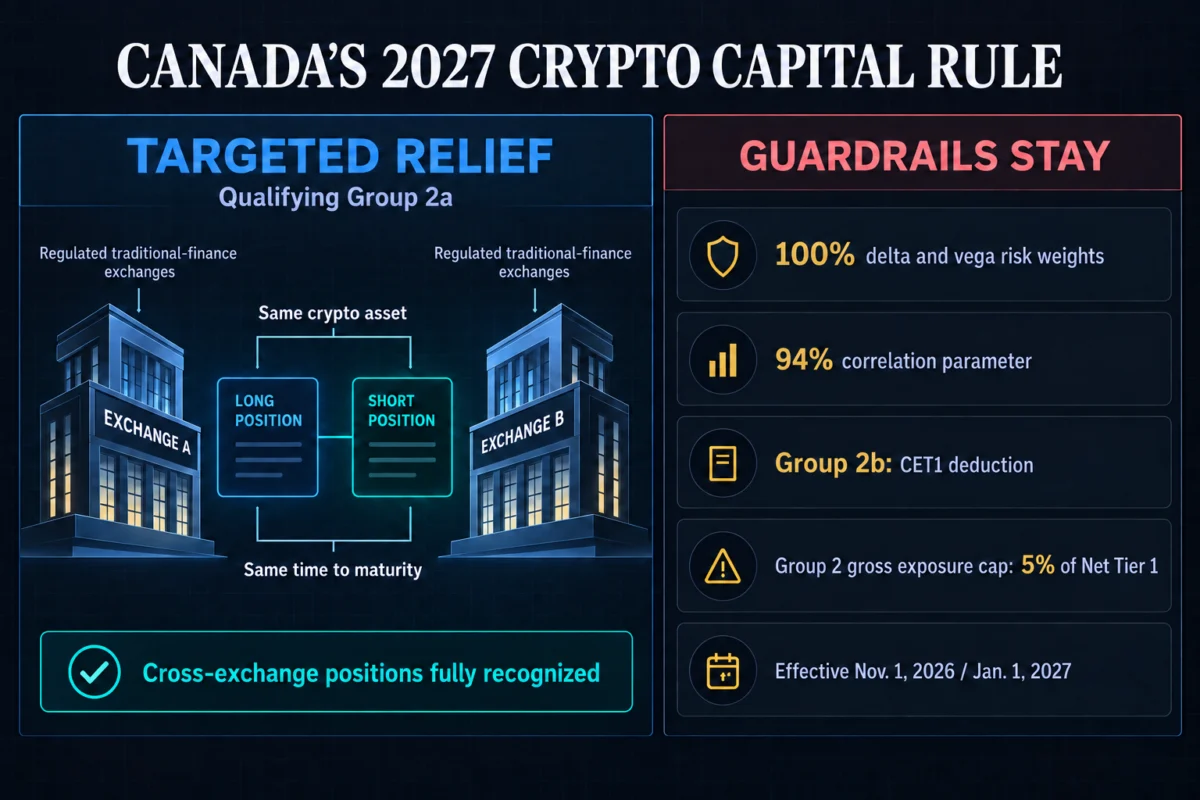
Canada’s banking regulator has finalized a narrow change to its crypto capital rules that should reduce capital overstatement for some market-neutral positions without broadly easing how banks must treat digital-asset risk. The Office of the Superintendent of Financial Institutions’ (OSFI) 2027 guideline, published September 10th, treats all regulated exchanges of traditional financial assets as one exchange when banks calculate delta risk for qualifying Group 2a crypto exposures. This allows positions in the same crypto asset on different qualifying regulated exchanges to receive full capital recognition when they also have the same time to maturity.
A Targeted Adjustment to Capital Requirements
The recent update to OSFI’s 2027 guideline represents a nuanced adjustment to the capital treatment of crypto assets for Canadian financial institutions. While not a broad liberalization of rules, it addresses a specific operational reality faced by banks engaging in sophisticated hedging strategies within the digital asset space. The core of the change lies in how cross-exchange positions are evaluated for delta risk capital calculations, specifically for a defined category of crypto exposures known as "qualifying Group 2a positions."
Previously, the regulatory framework could inadvertently lead to an overstatement of capital requirements for banks employing market-neutral strategies. This often involved holding offsetting positions in the same crypto asset across different regulated exchanges. The previous methodology, which treated each exchange as a distinct entity for capital calculation purposes, could result in banks holding more capital against these positions than the actual underlying risk warranted. The revised guideline acknowledges that prices for the same crypto asset tend to exhibit a high degree of correlation across major regulated exchanges. By allowing these tightly matched, cross-exchange positions to be treated as a single entity for delta risk assessment, OSFI aims to rectify this capital overstatement.
Understanding the Nuances: What Changes and What Remains
The impact of this regulatory adjustment is carefully circumscribed. It is crucial to understand that this change does not create an unconditional offsetting mechanism for all crypto exposures. The relief is specifically contingent upon meeting a stringent set of criteria outlined within the guideline.

Qualifying Group 2a Exposures: The Focus of Relief
The revised rule’s benefits are exclusively applicable to what OSFI designates as "qualifying Group 2a crypto exposures." These are digital asset positions that successfully navigate the guideline’s comprehensive hedging-recognition tests. These tests are designed to ensure that the positions are genuinely hedged and possess characteristics that align with traditional financial market risk management practices. Key among these conditions are:
- Product Structure: The specific nature and design of the crypto asset product must adhere to predefined parameters.
- Regulatory Approval or Qualifying Clearing: The underlying crypto asset or the trading venue must have obtained appropriate regulatory approval or be subject to a qualifying clearing process. This emphasizes the importance of regulated and transparent market infrastructure.
- Liquidity and Data-History Conditions: Sufficient liquidity and a robust history of reliable price data are essential. These factors are critical for accurate risk assessment and valuation.
Therefore, even if a bank holds offsetting positions in the same crypto asset on different exchanges, the relief will not apply if these positions do not meet the stringent requirements for Group 2a qualification.
Limitations and Enduring Capital Rigor
Conversely, the guideline maintains a conservative approach for other categories of crypto assets and hedging strategies.
- Unregulated Exchanges: Positions associated with unregulated exchanges will not benefit from this cross-exchange recognition. This underscores OSFI’s continued emphasis on dealing with regulated and transparent market participants.
- Maturity Mismatches: Differences in the time to maturity between offsetting positions will continue to be a factor in capital calculations. The relief is predicated on positions having the same maturity date, reflecting a precise hedge.
- Correlation Parameter: For calculating delta or vega capital within a Group 2a bucket, the framework retains a 94% correlation parameter. This indicates a residual level of caution, acknowledging that perfect correlation is rare.
- Risk Weights: Delta and vega risk weights for these qualifying exposures remain at a substantial 100%. This signifies that even with hedging relief, the inherent volatility and risk associated with crypto assets are still subject to significant capital charges.
- Diversification Limits: Banks are explicitly prohibited from recognizing diversification benefits across different Group 2a crypto assets. This means that capital requirements cannot be reduced by holding a variety of different qualifying crypto assets, even if they are all deemed to be Group 2a.
Group 2b: Continued Strict Treatment
The treatment for "Group 2b" exposures, which encompass crypto assets that do not meet the qualifying criteria for Group 2a, remains substantially stricter. For each Group 2b asset, a bank is mandated to deduct from its common equity tier 1 capital the greater of its absolute aggregate long or short position. If a more rigorous calculation, based on prescribed market-risk and credit-valuation-adjustment methodologies, yields a higher capital requirement, that higher amount must be applied. This stringent approach reflects OSFI’s elevated concern regarding the risks associated with less regulated or less understood digital assets.

A Chronicle of Regulatory Evolution
The publication of this final rule marks a significant step in OSFI’s ongoing efforts to develop a comprehensive and appropriate regulatory framework for crypto assets within the Canadian banking sector. The journey to this point has involved extensive consultation and a careful consideration of market practices.
- Initial Consultation and Feedback: In May, OSFI initiated a public consultation period, releasing a draft guideline and a backgrounder document. This process invited feedback from industry participants, allowing banks and other stakeholders to voice concerns and provide insights into the practical implications of the proposed rules. The backgrounder explicitly acknowledged the prevalent use of market-neutral strategies by banks for crypto exposures and the high degree of price correlation observed across major regulated exchanges. This recognition formed the basis for the subsequent adjustment.
- Addressing the "Cross-Exchange Capital Mismatch": The core issue identified during the consultation was the "cross-exchange capital mismatch." Banks argued that the previous approach, which treated each exchange as a separate entity, led to an inefficient allocation of capital. For instance, if a bank held a long position in Bitcoin on Exchange A and a short position in Bitcoin on Exchange B, and both exchanges were regulated and the positions were perfectly matched in terms of maturity, the capital charge could still be substantial due to the separate treatment. The revised guideline directly addresses this by permitting the offsetting of such positions under specific conditions.
- Final Rule Publication: The finalized guideline, published on September 10th, incorporates the feedback received and presents a more refined approach. The effective dates for the new rules have been set to align with the initial timeline, with institutions having an October 31 fiscal year-end seeing the rules take effect on November 1, 2026, and those with a December 31 fiscal year-end on January 1, 2027. This phased implementation allows financial institutions adequate time to adapt their systems and processes.
Broader Implications for Canadian Banks and the Crypto Market
The implications of OSFI’s finalized rule extend beyond the immediate adjustments to capital calculations. They signal a clear direction for the regulatory treatment of digital assets in Canada and may influence broader market developments.
- Encouraging Regulated Activities: By providing relief for qualifying positions on regulated exchanges, OSFI is indirectly incentivizing banks to engage with the digital asset market through established and regulated channels. This could foster greater transparency and accountability within the sector.
- Balancing Innovation and Stability: The approach taken by OSFI reflects a delicate balancing act. The regulator acknowledges the evolving nature of financial markets and the integration of digital assets, while simultaneously prioritizing financial stability and the protection of depositors. The targeted relief suggests a willingness to adapt to market realities without compromising prudential standards.
- Potential Impact on Trading Strategies: The refined capital treatment may encourage banks to further refine their market-neutral trading strategies for crypto assets, potentially leading to more efficient capital deployment. However, the strict conditions for qualification mean that only a subset of these strategies will benefit.
- Global Regulatory Trends: Canada’s approach is part of a broader global trend of financial regulators grappling with the complexities of digital assets. While specific implementations vary, there is a common theme of seeking to integrate these assets into existing prudential frameworks in a risk-sensitive manner. OSFI’s move provides a Canadian perspective on this evolving landscape.
The 5% Exposure Ceiling: A Persistent Constraint
A crucial element that remains unchanged is Canada’s aggregate gross exposure limit for Group 2 crypto assets, which is capped at 5% of Net Tier 1 capital. This limit serves as a significant overarching constraint on the overall exposure that Canadian banks can take to digital assets. Certain client-clearing derivatives are excluded from this calculation, offering a minor carve-out. However, a breach of this 5% ceiling triggers a severe consequence: all of the institution’s Group 2 exposures are then subject to the more stringent Group 2b treatment. This hard cap underscores OSFI’s commitment to limiting the systemic risk that digital assets could pose to the Canadian financial system. It ensures that even with the nuanced adjustments for Group 2a, the overall exposure remains controlled.
In conclusion, OSFI’s revised guideline represents a carefully calibrated adjustment to Canada’s crypto capital rules. It offers targeted relief for specific market-neutral hedging strategies on regulated exchanges, aiming to correct an overstatement of capital requirements. However, the rule’s stringent conditions and the enduring conservative treatment of other crypto exposures, coupled with the firm 5% aggregate exposure limit, indicate that OSFI remains committed to a cautious and risk-aware approach to digital assets within the banking sector. This measured evolution signals a path towards greater integration of digital assets while maintaining a steadfast focus on financial stability.








