
 admin
admin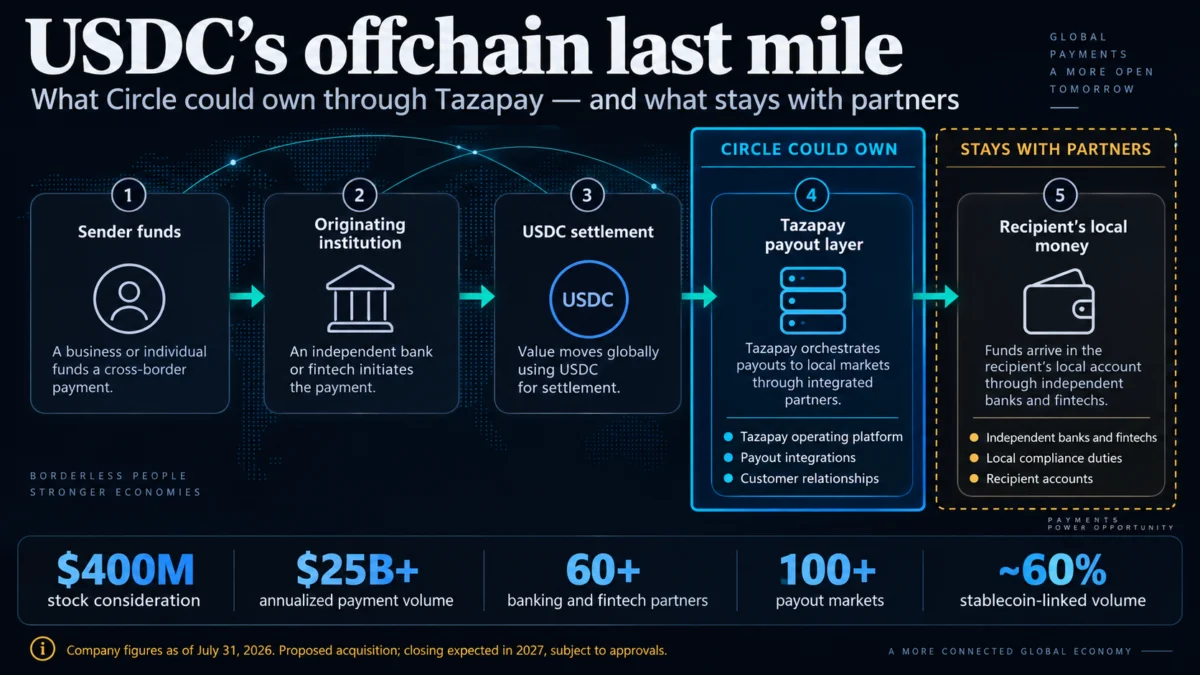
Circle, the issuer of the USDC stablecoin, has announced a significant strategic move to bolster its global payments infrastructure by agreeing to acquire Tazapay, a Singapore-based cross-border payments platform, for approximately $400 million in Circle Class A stock. This landmark deal, revealed on September 8, 2026, aims to address a critical challenge in the digital asset ecosystem: the seamless conversion of on-chain stablecoin transactions into usable local fiat currency for recipients worldwide. While stablecoins can facilitate instantaneous cross-border transfers on the blockchain, their utility is fundamentally limited if the end recipient cannot easily access their funds in their local currency through traditional banking channels.
The acquisition of Tazapay is designed to bring a vital operational layer to Circle’s existing offerings. Tazapay’s extensive network, boasting connections with over 60 banking and fintech partners and supporting payout capabilities in more than 100 markets, is precisely what Circle identifies as the missing piece in its vision for a fully integrated global payment system. These established links provide the crucial local licensing, banking access, currency conversion, and fiat delivery mechanisms that are beyond the scope of a blockchain transaction alone.
While the initial announcement did not specify a precise dollar figure, Circle’s subsequent filing on Form 8-K detailed the aggregate consideration to be in Circle Class A stock, valued at $400 million. This valuation is subject to adjustments for Tazapay’s existing debt, transaction expenses, and cash reserves. The final number of shares to be issued will be determined by Circle’s volume-weighted average closing stock price over the 20 trading days preceding the completion of the acquisition, a common practice in stock-based mergers to ensure fair valuation.
Addressing the Last Mile: What Circle is Acquiring
Circle’s core business already excels at the on-chain leg of transactions. The USDC stablecoin provides a dollar-denominated settlement asset, and the Circle Payments Network (CPN) offers the necessary rules, routing, and technical coordination among financial institutions. The proposed acquisition of Tazapay would effectively integrate an operating company at the critical "edges" of this system – where fiat currency enters and leaves the digital asset ecosystem.
In its official acquisition announcement, Circle highlighted Tazapay’s impressive track record. As of July 31, 2026, Tazapay had processed over $25 billion in annualized payment volume. Its extensive network includes over 60 banking and fintech partners and payout rails across more than 100 markets. Notably, approximately 60% of Tazapay’s transaction volume already involved stablecoins, indicating a strong alignment with Circle’s strategic direction. It is important to note that these figures are company-supplied, and the exact methodology for calculating annualized volume, whether gross or net, or if payments are counted at multiple stages, has not been detailed. Furthermore, the reported stablecoin share encompasses various stablecoins, not exclusively USDC.
Despite these caveats, the strategic rationale behind the acquisition is clear. Tazapay has been a design partner for CPN since 2025, suggesting a pre-existing collaborative relationship and a deep understanding of Circle’s network architecture. Jeremy Allaire, Circle’s co-founder and CEO, articulated his vision that the combination of USDC with Tazapay’s robust banking relationships, localized payout infrastructure, and established institutional customer base would significantly accelerate the global adoption of digital dollar payments.
The Distribution Challenge and Tazapay’s Role
The core problem Circle aims to solve is the "distribution" of digital dollars into the real economy. Simply issuing a widely adopted stablecoin like USDC does not automatically grant access to the intricate web of local banking systems worldwide. A dedicated payout operator, such as Tazapay, acts as the essential bridge, connecting the digital token to regulated entities, facilitating foreign-exchange conversions, and ensuring that funds reach recipient bank accounts. By acquiring Tazapay, Circle gains a more direct and integrated pathway to orchestrate these critical capabilities in conjunction with USDC and CPN. This integration, however, is contingent on the transaction successfully closing and the execution of an as-yet-undisclosed integration plan.
Circle’s current CPN design delineates a clear separation between network coordination and the regulated activities undertaken by participating financial institutions. In the "self-managed fiat-payout model" described in CPN’s documentation, an originating financial institution handles the sender-side responsibilities, including due diligence and the conversion of fiat to stablecoins. A beneficiary financial institution then receives the stablecoins, converts them into local currency, and disburses them to the end recipient. CPN’s role is to coordinate quotes, routing, and settlement between these entities. Circle establishes the network’s rules, and Circle Technology Services manages its operation. However, as detailed in Circle’s governance explanations, the network operator itself does not hold customer funds, manage customer accounts, or act as a direct party to transactions between the participating institutions. These institutions transact at their own risk and retain their respective responsibilities.
Navigating the Integration: A Strategic Boundary
The proposed acquisition thus operates within a precisely defined boundary. Circle stands to gain ownership of Tazapay’s operating company, its proprietary technology, and its established customer relationships. However, it would not automatically acquire ownership or direct control over Tazapay’s independent banking and fintech partners. While the acquisition will enhance Circle’s capacity to integrate Tazapay’s payout routes with USDC and CPN, it will not grant Circle control over every fiat off-ramp available through the broader CPN network. Similarly, Circle would gain direct influence over Tazapay’s platform and its licensed entities but would not automatically assume the compliance and payout duties of every independent CPN participant.

The concept of "vertical integration" often implies that every layer of a business operates under a single legal and operational umbrella. This transaction does not represent such a complete consolidation. Upon closing, Circle will own Tazapay, but Tazapay’s network of partner banks and fintech firms will continue to operate as independent entities.
Circle’s CPN documentation also outlines a "managed mode," where Circle takes on licensing, custody, compliance, treasury, and settlement responsibilities for clients seeking stablecoin payments without directly managing digital assets. In contrast, the "Fiat Payouts" service remains a self-managed product delivered through a network of payout partners. Tazapay’s infrastructure could potentially serve both aspects of this architecture. Its existing payout routes might expand the choices available within the self-managed model, while its operational entities and customer base could bolster a more integrated managed service. Circle has not yet clarified which strategic path it intends to pursue or if Tazapay will ultimately support both models.
Tazapay’s own corporate structure underscores the complexity of this integration, illustrating that it extends beyond simply connecting a new application programming interface (API). The company has stated that its stablecoin-related services are provided exclusively through Tazapay Canada, while its Singapore entity focuses on different payment activities, not digital payment token services. This segmentation highlights that the "last mile" of payment delivery is a multifaceted ecosystem comprising licensed entities, contractual agreements, and localized capabilities, rather than a singular global authorization. This intricate web of regulated permissions, banking connectivity, payout performance, and institutional relationships, built market by market, is the scarce infrastructure that Circle appears determined to acquire. While blockchain settlement can be replicated in software, these on-the-ground operational components are significantly harder to reproduce.
Unresolved Questions and Future Implications
The acquisition is not yet complete. Circle anticipates closing the deal in 2027, pending customary closing conditions and regulatory approvals, including scrutiny from the Monetary Authority of Singapore. The Form 8-K filing also clearly indicates that the final consideration and share count are subject to adjustments based on closing balances and Circle’s stock price in the period leading up to completion.
Circle has not yet disclosed key financial details, such as Tazapay’s revenue, its projected contribution to Circle’s financial results, anticipated synergies, integration costs, or its margin profile. Furthermore, the company has not specified whether Tazapay’s payout routes will remain accessible on the same terms to competing firms that do not exclusively leverage Circle’s ecosystem or USDC. While the transaction can be assessed as a significant strategic maneuver, a definitive evaluation of its financial return remains premature.
The potential benefits for enterprises could be substantial, offering a more unified payment route that spans from stablecoin settlement to local fiat payouts, provided Circle successfully integrates these systems without restricting network access for other participants. Tazapay’s existing customers could gain access to the deep liquidity of USDC and Circle’s broader product distribution capabilities. For Circle, this acquisition offers the opportunity to capture a larger share of the payment workflow, moving beyond merely providing the settlement asset and orchestration layer.
However, ownership also introduces a new dynamic for existing CPN participants who value the network’s perceived neutrality. If Circle were to direct transaction volume preferentially towards its newly acquired subsidiary, independent beneficiary institutions might find themselves competing with an entity that also plays a role in setting network rules. While the disclosed documentation does not explicitly state any intention of preferential treatment, this remains a significant governance question for the future.
The acquisition effectively sets the stage for a critical test. If the integration of broader payout coverage and tighter coordination leads to improved execution while preserving participant choice, Tazapay could significantly deepen the CPN network’s reach and utility. Conversely, if Circle-owned routes are demonstrably favored, the network could evolve into a more vertically integrated, and potentially less neutral, ecosystem.
In essence, Circle is not acquiring every bank account at the end of a USDC transaction. Instead, it is investing in the capability to orchestrate a more comprehensive journey to those accounts. This strategic objective elevates the deal beyond ordinary market adoption, recognizing regulated currency conversion and local fiat delivery as essential infrastructure, rather than merely ancillary services attached to blockchain technology. The speed of settlement on the blockchain remains a foundational element, but the true competitive advantage, and the ultimate measure of success for this acquisition, will lie in Circle’s ability to transform digital dollars into readily usable local currency for recipients worldwide.








