
 Nila Kartika Wati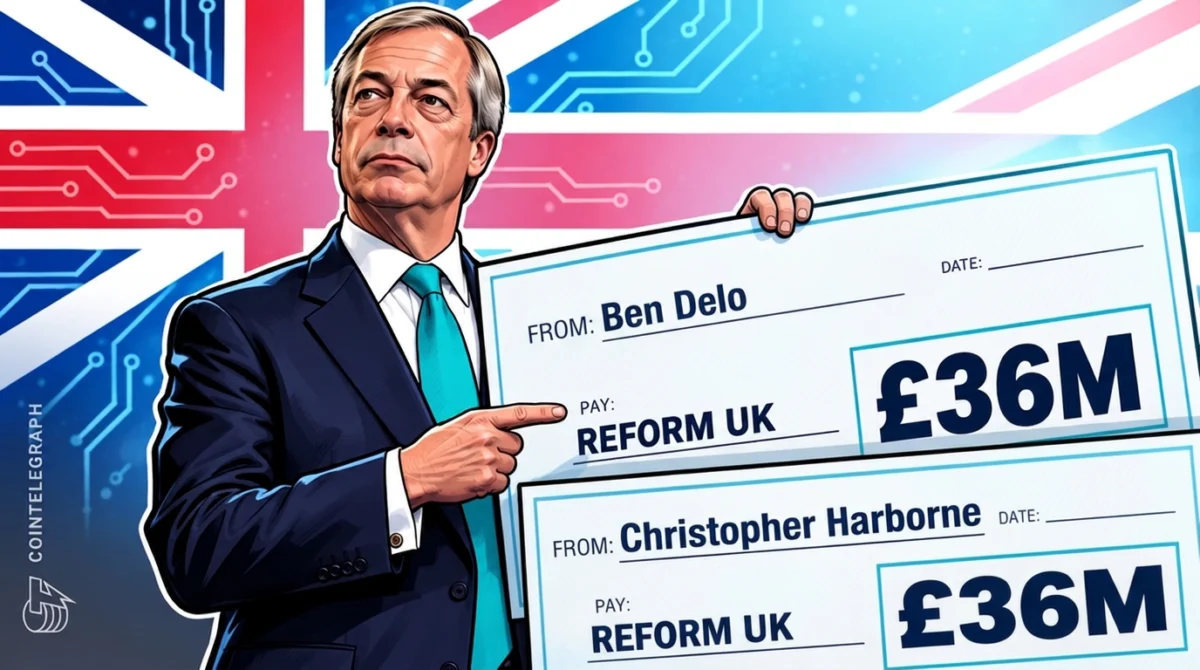
Nigel Farage’s Reform UK has received an unprecedented £72 million in donations from two prominent figures in the cryptocurrency industry, Christopher Harborne and Ben Delo, dramatically altering the financial landscape for a British political party ahead of the next general election. Each donor contributed a staggering £36 million, marking these as the largest individual donations ever recorded in British political history. The announcement, confirmed on September 12, 2026, by Christopher Harborne, came just a day after Ben Delo publicly declared his contribution, setting a new benchmark for political philanthropy and sparking intense debate across the UK’s political spectrum.
The Unprecedented Donation and Its Immediate Impact
The twin £36 million donations, totaling £72 million ($97 million USD), signify a monumental financial injection for Reform UK, a party that has steadily gained traction under the leadership of Nigel Farage. Christopher Harborne, a businessman with previous ties to the party, confirmed his matching contribution on Saturday, September 12, 2026, stating that he was inspired by Delo’s earlier announcement. Harborne explicitly addressed potential criticisms regarding the motivations behind such a substantial sum, writing in The Telegraph that he expected nothing in return: "No peerage, no policy change, just a party that is ready for government." This statement aims to preempt accusations of quid pro quo arrangements, a common point of contention in UK political funding debates.
Ben Delo, co-founder of the influential BitMEX cryptocurrency exchange, articulated his motivation as a desire to ensure a "fair fight" at the polls. Delo explained in The Telegraph that his £36 million donation was conceptually structured as £1 million per month until the anticipated general election in 2029. However, critically, Delo made the entire payment upfront. This strategic decision, he indicated, was made to circumvent potential future attempts to block or restrict the funds, underscoring the precarious and evolving regulatory environment surrounding cryptocurrency donations in UK politics. Nigel Farage, a veteran populist figure, swiftly welcomed both donations, asserting that the funding would enable Reform UK to contest the upcoming general election on "a level playing field," a common refrain from challenger parties historically outmatched by the financial might of the Labour and Conservative establishments.
Profiles of the Donors and Their Motivations
Christopher Harborne’s connection to Reform UK and Nigel Farage is not new. He had previously donated £9 million to the party in August 2025, demonstrating a sustained and significant financial commitment. His latest matching donation of £36 million elevates him to a pivotal position within the party’s financial backing. Harborne, whose background spans business and technology, has consistently expressed a desire to see a fundamental shift in UK politics, aligning with Reform UK’s platform of lower taxes, reduced immigration, and a critical stance on net-zero policies. His public declaration, emphasizing a lack of personal gain, attempts to frame his contributions as purely ideological, driven by a belief in the party’s potential to govern.
Ben Delo’s emergence as a major political donor is particularly noteworthy due to his high-profile past. As a co-founder of BitMEX, one of the earliest and largest cryptocurrency derivatives exchanges, Delo accumulated significant wealth within the nascent digital asset space. His declared motivation of fostering a "fair fight" suggests a desire to disrupt the traditional two-party dominance in British politics, potentially seeing Reform UK as a vehicle for broader systemic change. However, Delo’s philanthropic venture into UK politics comes with significant historical baggage that adds layers of complexity and scrutiny to his contribution.
Ben Delo’s Past and Presidential Pardon
The most scrutinised aspect of Ben Delo’s donation is his legal history in the United States. Delo was one of three BitMEX co-founders who pleaded guilty to federal charges in the US related to violations of the Bank Secrecy Act (BSA). The BSA is a cornerstone of US anti-money laundering (AML) legislation, requiring financial institutions to report suspicious transactions and maintain records to prevent illicit financial activities. BitMEX, under the leadership of Delo and his co-founders Arthur Hayes and Samuel Reed, was found to have operated without adequate anti-money laundering and know-your-customer (KYC) controls, allowing its platform to be used for transactions that bypassed regulatory oversight.
In 2022, Delo agreed to pay a $10 million fine as part of his plea agreement, avoiding a prison sentence. While the legal proceedings concluded with financial penalties rather than incarceration, the conviction itself raised serious questions about the origins of his wealth and his compliance with financial regulations. However, a significant development occurred in March 2025 when Delo, along with Hayes and Reed, received a full pardon from then-US President Donald Trump. Presidential pardons are executive acts of clemency, typically issued for federal crimes, that restore certain rights and relieve individuals of the remaining legal consequences of their conviction. Trump’s decision to pardon the BitMEX founders, made during a period of intense political activity following his assumed re-election, was seen by some as a move to appeal to the burgeoning cryptocurrency lobby and libertarian-leaning voters, while others criticised it as undermining financial regulatory enforcement. The pardon effectively cleared Delo’s record in the US, but the history of the conviction and the nature of the alleged financial improprieties continue to fuel questions about the suitability of such a donor in British politics.
Reform UK’s Political Trajectory and Farage’s Ambitions
Reform UK, originally founded as the Brexit Party, has undergone several transformations under Nigel Farage’s stewardship. The party positions itself as an anti-establishment force, advocating for policies such as strict immigration controls, significant tax cuts, and a re-evaluation of net-zero environmental targets. Farage, a figure synonymous with populist movements in the UK, has consistently sought to disrupt the traditional two-party system. His political career, marked by the rise of UKIP and the successful Brexit campaign, demonstrates a unique ability to mobilise a segment of the electorate often overlooked by mainstream parties.
Despite Farage’s charisma and Reform UK’s growing presence in national opinion polls—often polling in the high single digits or low teens, indicating a potential spoiler role or even a significant electoral breakthrough in certain constituencies—the party has historically struggled with funding compared to the deep pockets of the Labour and Conservative parties. The £72 million infusion represents an unparalleled opportunity for Reform UK to mount a comprehensive national campaign. This level of funding could enable them to field candidates in nearly all 650 parliamentary constituencies, invest heavily in advertising, develop sophisticated ground operations, and expand their media presence, potentially turning them into a genuine third force in British politics for the first time in decades.
A Timeline of Controversy and Scrutiny
The significant crypto donations to Reform UK arrive amidst a backdrop of ongoing scrutiny and controversy surrounding Nigel Farage and the broader influence of digital assets in UK politics.
- March 2025: Former US President Donald Trump issues pardons to Ben Delo, Arthur Hayes, and Samuel Reed, absolving them of their Bank Secrecy Act convictions. This event, though in the US, sets the stage for Delo’s later political engagement.
- August 2025: Christopher Harborne makes an initial donation of £9 million to Reform UK, signaling his early and substantial support for the party.
- March 2026 (approximate): Following a period of growing concern over the transparency and source of cryptocurrency donations, UK lawmakers announce a temporary moratorium on such contributions, pending further legislation. This reflects increasing unease within Westminster regarding the intersection of crypto and political finance.
- July 2026: Nigel Farage resigns from his position as a Member of Parliament, citing an ongoing "crypto scandal." This scandal involved an investigation into Farage receiving millions of pounds worth of donations and "gifts" from figures tied to the crypto industry, including Christopher Harborne and George Cottrell. Farage vehemently denied any wrongdoing, characterising the payments as legitimate gifts. His resignation triggered a controversial by-election in his constituency.
- July 2026 (later): In a significant political victory, Farage contests and wins the subsequent by-election with 63% of the vote, defeating a diverse field of candidates including the satirical figure Count Binface. This demonstrated his enduring popular appeal despite the surrounding controversies.
- August 2026: Cointelegraph reports that the investigation into Farage’s previous crypto-related donations and gifts from Harborne and Cottrell is ongoing, keeping the issue of digital asset funding firmly in the public and regulatory spotlight.
- September 11, 2026: Ben Delo announces his £36 million donation to Reform UK, citing the need for a "fair fight."
- September 12, 2026: Christopher Harborne matches Delo’s donation with another £36 million, bringing the total to £72 million and making headlines across the UK.
This chronological sequence highlights a continuous thread of crypto-related financial transactions and accompanying political and legal challenges for Farage and Reform UK, culminating in the current unprecedented funding.
The Broader Landscape of UK Political Funding
Political donations in the UK are overseen by the Electoral Commission, an independent body responsible for regulating party and election finance. The Commission enforces strict rules regarding the transparency of donations, requiring parties to declare contributions above a certain threshold (currently £7,500 at the national level and £1,500 at the constituency level). Donors must be "permissible," meaning they are registered UK electors, UK-registered companies, or trade unions/organisations based in the UK. While there are no upper limits on the size of individual donations, the source and nature of funds are subject to scrutiny.
The concept of a "level playing field" in UK politics, as invoked by Farage, refers to the historical dominance of the Labour and Conservative parties, which typically command vast financial resources through corporate, union, and individual donations. These established parties have sophisticated fundraising machines, long-standing donor networks, and access to significant public funds for policy development and research. For smaller parties, competing on a national scale has always been an uphill battle. The £72 million infusion represents a potential game-changer, equipping Reform UK with resources previously unimaginable for a party of its size and relative newness, potentially allowing them to challenge the financial might of the two major parties in a way few third parties ever have.
The recent controversies surrounding crypto donations have intensified calls for reform of the UK’s political funding laws. In July 2026, Labour MPs were reportedly considering making the temporary moratorium on crypto donations, announced in March, a permanent legislative ban. Their concerns stem from the perceived lack of transparency, the potential for foreign influence, and the difficulty in tracing the ultimate beneficial owners of certain digital assets, which could open avenues for illicit finance to enter the political system. This debate places the UK at the forefront of countries grappling with how to regulate the nascent but powerful crypto industry’s interaction with democratic processes.
Reactions Across the Political Spectrum
The announcement of the record-breaking donations has elicited a range of reactions from key political stakeholders.
- Nigel Farage and Reform UK: Naturally, Farage has enthusiastically welcomed the funding, framing it as essential for democratic fairness. He has reiterated his belief that the donations will allow Reform UK to compete effectively and offer a genuine alternative to the electorate.
- The Labour Party: Prominent Labour figures have swiftly condemned the donations, particularly highlighting Ben Delo’s past conviction and the US presidential pardon. They have renewed calls for a permanent ban on cryptocurrency donations, arguing that such funds undermine the integrity of the political system and open doors to untraceable or ethically dubious money. A Labour spokesperson might state, "These astronomical donations from individuals with questionable financial histories underscore the urgent need for robust reform of our political funding laws. We cannot allow our democracy to be bought by figures whose past actions raise serious concerns about financial probity."
- The Conservative Party: The ruling Conservative Party has generally adopted a more cautious stance. While not directly condemning the donations, they are likely to express concerns about transparency and the source of funds, particularly given their own efforts to maintain public trust in political finance. Some Conservative MPs might voice apprehension about the potential for external influence or the perception of the UK political system being vulnerable to wealthy individuals.
- The Electoral Commission: The Electoral Commission is expected to confirm that it will rigorously scrutinise the donations to ensure full compliance with existing UK political finance law. A spokesperson for the Commission would likely state, "We are aware of the reported donations to Reform UK and will be reviewing them in line with our statutory duties to ensure transparency and permissibility. All donations must adhere to the rules set out in the Political Parties, Elections and Referendums Act 2000."
- Public Opinion: Public reaction is likely to be divided. Supporters of Reform UK will view the donations as a legitimate means for a challenger party to gain a platform. Conversely, many will express unease about the sheer scale of the donations, the donors’ backgrounds, and the potential for undue influence, reinforcing calls for greater transparency and regulation.
Implications for the 2029 General Election and Beyond
The £72 million windfall for Reform UK could have profound implications for the next general election, slated for 2029. Financially empowered, Reform UK can now execute a truly national campaign, which was previously beyond its reach. This includes extensive advertising campaigns across television, digital platforms, and print media, sophisticated voter targeting operations, and the ability to recruit and support a full slate of parliamentary candidates. Such resources could significantly boost their vote share, potentially drawing support from both disgruntled Conservative voters and those disaffected with Labour, thus altering the electoral calculus in numerous constituencies.
Beyond the immediate electoral impact, these donations are set to intensify the ongoing debate about political funding in the UK. The sheer scale and the controversial origins of some of the funds will likely accelerate legislative efforts to tighten regulations around political donations, particularly those involving cryptocurrencies. A permanent ban on crypto donations, or at least highly stringent KYC/AML requirements for such contributions, seems increasingly probable. This could set a precedent for other nations grappling with similar challenges.
Furthermore, the saga raises fundamental questions about transparency, influence, and the integrity of the political system. It highlights the growing intersection of global finance, digital assets, and national politics, demonstrating how significant wealth generated in new industries can be deployed to reshape established political landscapes. The ability of a pardoned individual with a history of financial regulatory violations to become a major donor to a British political party will undoubtedly spark a deeper examination of who can fund political campaigns and under what conditions. As the UK approaches its next general election, the impact of this historic crypto funding on Reform UK’s fortunes and the broader political environment will be a central and hotly contested issue.









