Layla Zulfa
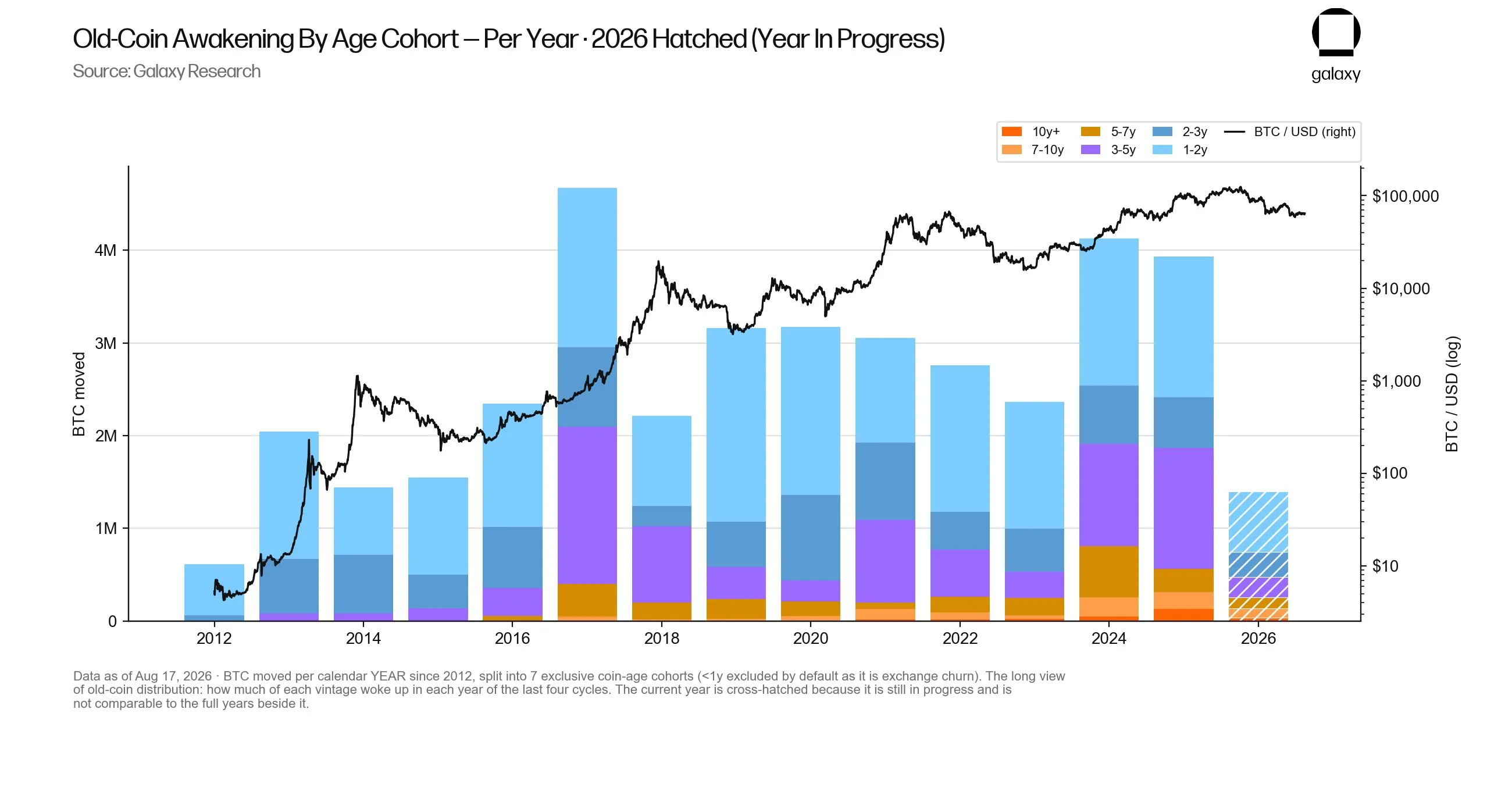
The most dormant Bitcoin on the network, consisting of coins untouched for a decade or more, is stirring at an unusual clip this year, according to fresh data from Galaxy Research that highlights a significant shift in the behavior of long-term holders. A comprehensive chart published by the firm last week tracks the volume of Bitcoin from various "vintages" that have transitioned from a dormant state to an active state in each calendar year since 2012. While the movement of older coins is a perennial point of interest for on-chain analysts, the data for 2026 reveals a burgeoning trend: a visible and expanding band of 10-year-and-older coins, rendered in red at the base of the annual activity bars, is moving with a frequency rarely seen in the history of the protocol.
Because the current calendar year of 2026 is only partially complete, Galaxy Research utilized cross-hatching on the 2026 data bar to indicate that the figures are not yet directly comparable to the full-year totals of previous periods. Despite this, the oldest cohort of coins—those that have remained stationary for at least a decade—already registers more prominently than in almost any prior year. In the preceding decade, movements from these "ancient" wallets were often so infinitesimal that they were barely perceptible on macro-level charts. The sudden visibility of this red band suggests that the "diamond hands" of the early 2010s are finally beginning to adjust their positions, whether for liquidation, security migration, or institutional custody purposes.
A Chronology of the August Awakening
The trend of ancient coin movement has accelerated significantly throughout the month of August. Galaxy Research documented that between August 16 and August 26, six distinct wallets that had been dormant since the 2011, 2012, and 2014 eras moved a combined total of 553.59 BTC. At current market valuations, this represents approximately $40.15 million in previously stagnant liquidity returning to the network’s active supply.
The specific breakdown of these movements provides a window into the staggering wealth accumulation experienced by Bitcoin’s earliest adopters. On one end of the spectrum, an address that had sat untouched since August 2012 moved 212 BTC, valued at roughly $13.66 million. This specific holder maintained their position for 14 years, witnessing a price appreciation of approximately 557,640% from a cost basis that sat near $12 per coin.
In another instance, a wallet dormant since June 2011—an era when Bitcoin was still largely an experimental project known only to a small circle of cypherpunks—shifted 10.74 BTC, worth approximately $692,000. Perhaps the most notable transaction in this batch involved 40 BTC last moved in May 2012. These funds were transferred to the German custody bank Boerse Stuttgart Digital, representing a breathtaking 1,535,911% gain. These figures underscore the transition of Bitcoin from a niche digital curiosity to a foundational institutional asset.

Analyzing the Catalysts: Legal Pressure and Security Risks
Market analysts and on-chain researchers are pointing to two primary drivers behind this flurry of activity. The first is a complex legal situation unfolding in the New York court system. Several of the reawakened wallets have been identified with a "Salomon Client Dusted" tag, which is directly linked to the "Noah Doe" case. This lawsuit seeks to have approximately 39,069 dormant Bitcoin addresses declared as abandoned property under state law.
The legal theory behind the case suggests that if a wallet shows no activity over a prolonged period, the state may have the right to claim the assets under escheatment laws. Although a judge paused the proceedings in June, the threat of state seizure appears to have prompted many long-term holders to "ping" their wallets or move funds to new addresses to demonstrate active ownership. By moving even a fraction of the balance, these holders effectively remove their addresses from the "abandoned" category, protecting their assets from potential legal forfeiture.
The second major catalyst is technical in nature. Earlier this year, a reported exploit involving Coldcard hardware wallets—long considered a gold standard for "cold storage"—sent shockwaves through the community of long-term holders. The exploit, which concerned the way certain private keys were generated or stored, prompted a mass migration of funds. Approximately 233,000 BTC are estimated to have left long-term storage wallets as users rushed to secure their holdings in multi-signature setups or alternative hardware providers. This "forced" movement has contributed significantly to the spike in activity among older coin cohorts, as veterans of the 2011-2014 era prioritize security over continued dormancy.
Institutional Migration and Market Implications
The destination of these "awakened" coins provides a crucial clue regarding the intent of the holders. While the movement of ancient supply is often viewed as a precursor to a "dump" or a mass sell-off that could depress prices, the current data suggests a different narrative. In many of the most recent cases, the funds have not flowed onto open exchanges like Coinbase or Binance. Instead, they have moved toward professional infrastructure and institutional custody providers.
The transfer of 40 BTC to Boerse Stuttgart Digital is a prime example of this trend. Boerse Stuttgart is one of Europe’s leading institutional players in the digital asset space, offering regulated custody and trading services. The migration of ancient coins to such platforms suggests that early adopters are not necessarily exiting the market, but rather "institutionalizing" their wealth. By moving funds from a 14-year-old private wallet to a regulated bank, these holders may be preparing for estate planning, seeking to leverage their holdings for traditional financial products, or simply looking for a higher level of regulatory protection for their multi-million dollar fortunes.
From a market perspective, this shift is significant. If ancient coins were moving to exchanges, it would signal an increase in sell-side pressure. However, moving to institutional custody often means the coins remain "off-market," even if they are no longer technically dormant. This distinction is vital for traders who monitor "Exchange Reserve" metrics to gauge potential price volatility.
Macroeconomic Headwinds and the Federal Reserve’s Stance
The awakening of these dormant coins coincides with a period of heightened volatility and macroeconomic uncertainty. On Friday, Bitcoin’s price fell as low as $76,877, erasing a substantial portion of its weekly gains. This downward pressure was largely attributed to the hawkish tone struck by Federal Reserve Chair Kevin Warsh during his highly anticipated keynote at the Jackson Hole Economic Symposium.
In his first Jackson Hole address as Chair, Warsh warned that inflation remains a persistent threat and is not cooling at a rate that would allow for a pivot to more accommodative monetary policy. "The central bank still has work to do," Warsh stated, emphasizing that the "last mile" of inflation control may require higher-for-longer interest rates.
The reaction from the financial markets was swift. According to the CME FedWatch Tool, the probability of a 25-basis-point rate hike in September jumped from 35% to 56% following the speech. For Bitcoin, which is often treated as a "risk-on" asset and a hedge against liquidity expansion, the prospect of tighter monetary policy and a stronger U.S. dollar created an immediate headwind. The "choppy" price action reflects a tug-of-war between institutional adoption and the restrictive macro environment.
Sentiment Remains Resilient Despite Volatility
Despite the immediate price correction following the Fed’s remarks, the underlying sentiment in the cryptocurrency market remains surprisingly bullish. The structural support for Bitcoin appears to be strengthening, driven by consistent interest from institutional investors. U.S. spot Bitcoin ETFs, for instance, recorded $2.8 billion in net inflows over an eight-day streak ending last Wednesday. This represents the longest period of sustained inflows since April, signaling that institutional appetite for the asset remains robust even as the Fed maintains a hawkish posture.
Furthermore, data from prediction markets suggests that traders are looking past the immediate volatility. On the Myriad prediction platform, a majority of traders continue to bet on a price rally toward the $84,000 level rather than a sustained slide back to the $55,000 support zone. This optimism is likely fueled by the belief that the "halving cycle" effects and institutional integration will eventually outweigh the short-term pressures of interest rate hikes.
The awakening of the network’s oldest coins adds a new layer of complexity to this outlook. While the return of long-dormant supply to the active market is a phenomenon that warrants close scrutiny, the current evidence suggests it is a sign of market maturation rather than a looming collapse. Between the legal necessity of proving wallet activity and the technical requirement of migrating to more secure custody, the "Great Awakening" of 2026 reflects a cohort of early adopters who are finally professionalizing their participation in the digital economy they helped create. As these ancient coins find new homes in regulated banks and secure institutional vaults, the "dormant" era of Bitcoin history may be coming to a close, replaced by an era of active, institutionalized wealth management.