Nila Kartika Wati
The substantial outflow from Binance, a pivotal hub for global cryptocurrency trading, suggests a potential shift in investor behavior, moving away from immediate selling pressure on the exchange. This development arrives at a critical juncture for Bitcoin, which has seen its price fluctuate significantly in recent months, attempting to consolidate gains after reaching new all-time highs earlier in the year. The ability of the market to absorb selling pressure at the $65,000 mark, even as a massive quantity of BTC leaves a major exchange, provides a nuanced perspective on the current state of Bitcoin’s demand and supply equilibrium.
Binance Witnesses Historic Outflow: A Deep Dive into the 9,000 BTC Withdrawal
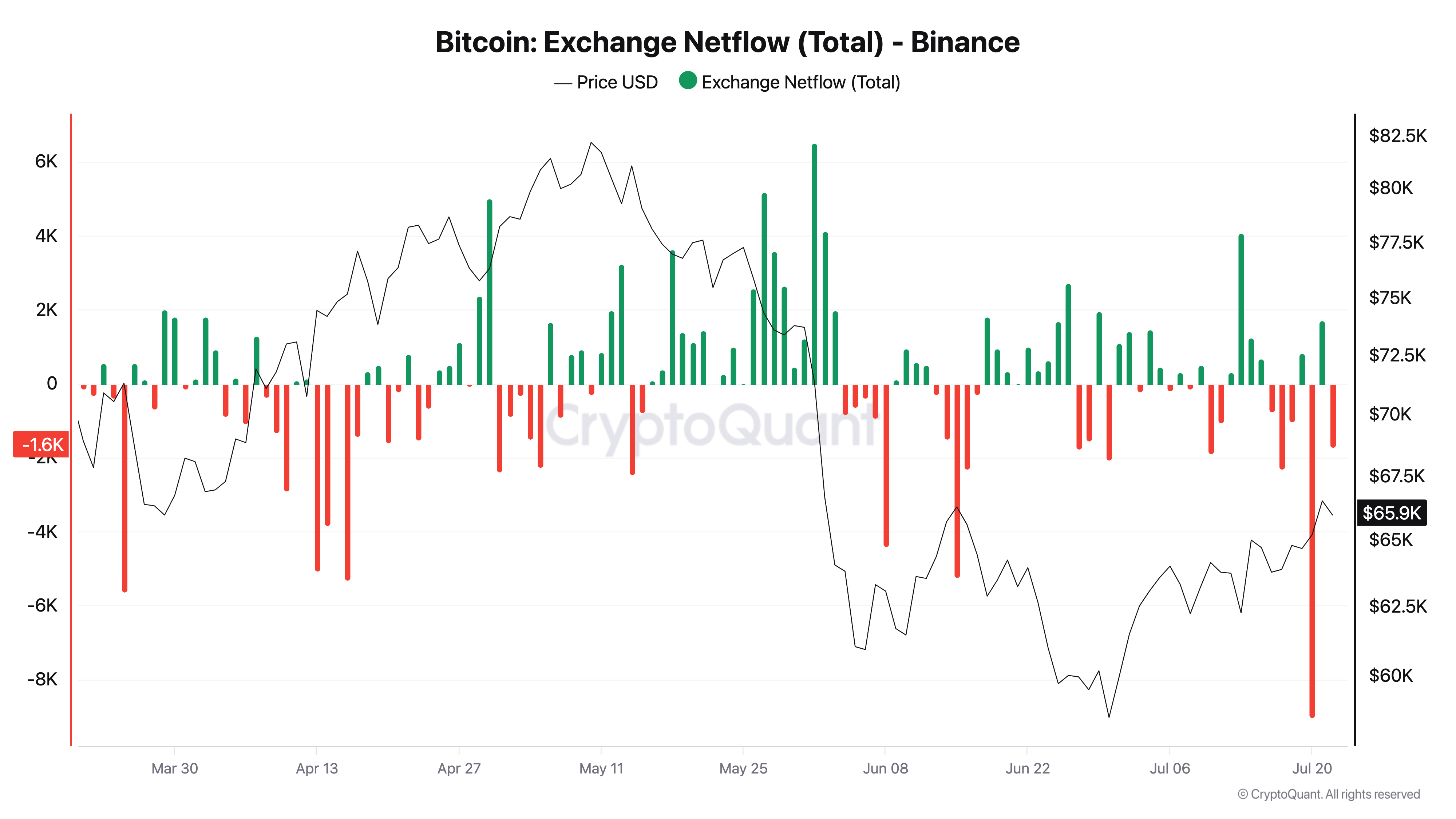
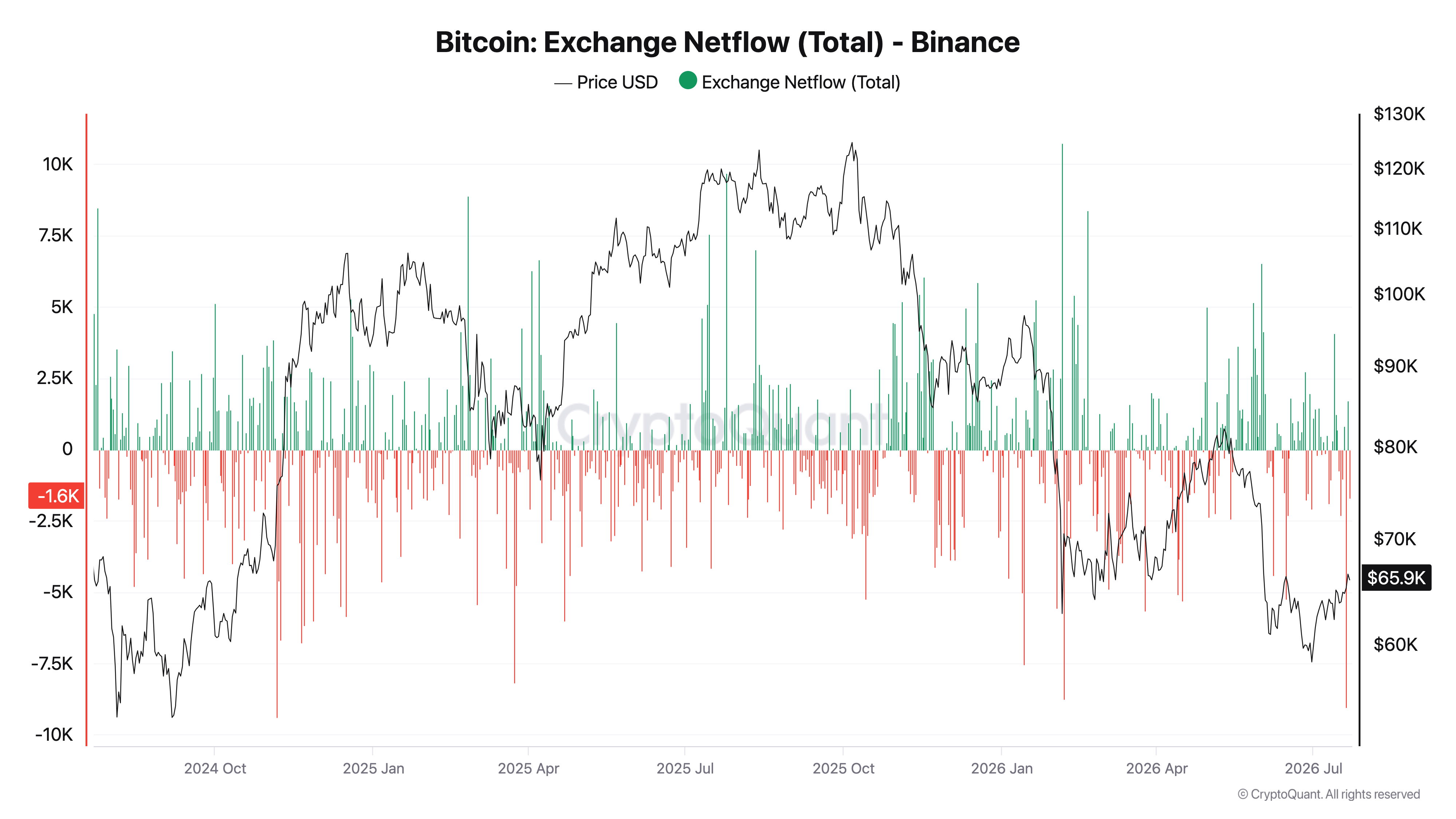
On Tuesday, a colossal 9,030 Bitcoin, valued at approximately $587 million at current prices, was withdrawn from Binance, marking the largest single-day net outflow recorded on the exchange since November 2022. This event, highlighted by on-chain analytics platform CryptoQuant, signifies a substantial movement of capital out of the exchange’s immediate trading environment. Exchange netflows, which track the difference between the amount of cryptocurrency flowing into and out of exchanges, are a crucial metric for gauging potential selling or buying pressure. A net outflow typically indicates that investors are moving their assets off exchanges, often into personal wallets for long-term holding (self-custody) or to over-the-counter (OTC) desks for private sales, thereby reducing the immediate supply available for sale on the open market.
The magnitude of this particular outflow immediately caught the attention of market watchers. For context, an outflow of over 9,000 BTC represents a significant portion of Binance’s daily trading volume and available liquidity. Such large-scale movements are often interpreted as a sign of strong conviction among holders, as it removes a substantial quantity of Bitcoin from readily accessible trading pools. This action directly contrasts with inflows, which typically precede selling events as users deposit funds onto exchanges to execute trades. The absence of aggressive inflows, coupled with significant outflows, therefore points to an easing of potential short-term supply pressure.
The Mechanics of Exchange Netflows: Understanding Supply Pressure
Exchange netflows are a fundamental tool in on-chain analysis, offering insights into the collective behavior of market participants. When netflows are positive, it means more Bitcoin is entering exchanges than leaving them. This can indicate an intention to sell, as assets need to be on an exchange to be traded for fiat currency or other cryptocurrencies. Conversely, negative netflows, or net withdrawals, imply that more Bitcoin is being moved off exchanges. This behavior is often associated with a preference for self-custody, implying a long-term holding strategy, or a move to different platforms.
CryptoQuant research, spearheaded by contributor Rei Researcher, underscored that daily BTC withdrawals from Binance have consistently outpaced inflows recently. "This usually reflects that short-term supply pressure on Binance is easing to some extent, as $BTC is not being sent to the exchange aggressively for potential selling," Rei Researcher stated. This observation is critical because Binance, being the largest exchange globally, holds a significant portion of the total circulating Bitcoin supply. Movements on this platform can therefore have a disproportionate impact on overall market sentiment and liquidity.

Historically, periods of sustained net outflows from major exchanges have often preceded or accompanied price rallies, as a reduction in readily available supply can create upward pressure on prices if demand remains constant or increases. However, the relationship is not always straightforward and requires careful interpretation alongside other market indicators.
A Chronology of Fluctuations: Binance’s Recent BTC Movement Patterns
Prior to this significant outflow, Binance’s netflows had been toggling between positive and negative readings since early June, following a period of sustained positive inflows. This fluctuating pattern suggests a market grappling with indecision, where inflows for potential selling were often offset by withdrawals, creating a dynamic equilibrium. The sudden and massive outflow on Tuesday therefore stands out as a decisive move, breaking the recent pattern of mixed signals.
The period leading up to early June saw a string of positive netflow days, indicating an increased deposition of BTC onto Binance. This accumulation of supply on the exchange could have contributed to selling pressure, potentially explaining some of Bitcoin’s price consolidation or minor dips in that timeframe. However, the subsequent shift towards more frequent net withdrawals, culminating in Tuesday’s record outflow, suggests a change in the dominant market sentiment among a segment of investors.
Ruga Research, another contributor to CryptoQuant, provided further context, noting that on rolling 30-day timeframes, netflows have consistently displayed a pattern of fluctuations. While acknowledging that a single event does not guarantee a trend reversal, Ruga highlighted the historical significance of such large withdrawals. "When outflows hit this size, someone is moving serious volume into self-custody. Coins off exchanges are coins that won’t be sold into the order book," Ruga commented, emphasizing the long-term implications of such moves. This perspective reinforces the idea that these withdrawn coins are likely being held for an extended period, rather than being prepared for immediate liquidation.
Market Absorption at $65,000: A Sign of Buyer Resilience?
The timing of this large outflow is particularly noteworthy, occurring as Bitcoin’s price recovered to the $65,000-$66,000 range. This suggests that despite the substantial amount of BTC being moved off-exchange, the market has demonstrated a robust capacity to absorb any lingering selling pressure or respond positively to perceived supply reductions. Rei Researcher elaborated on this, stating, "The notable point is that negative netflow is appearing while $BTC price has recovered to around $65K-$66K. This suggests that the market is showing better absorption compared to the previous weak phase."
The concept of "better absorption" implies that there is sufficient underlying demand to meet selling interest without significant price depreciation. This resilience at the $65,000 level is a positive indicator for market stability. It suggests that a strong cohort of buyers views this price point as an attractive entry or accumulation zone, effectively setting a floor for Bitcoin’s value in the short to medium term. This contrasts with earlier periods where similar selling pressure or exchange inflows might have led to more pronounced price drops. The ability to maintain price stability despite significant market movements underscores a maturing market with deeper liquidity and a more diverse base of committed investors.
The Self-Custody Imperative: What Large Withdrawals Signify
The movement of 9,000 BTC into self-custody is more than just an exchange metric; it’s a philosophical statement within the cryptocurrency ecosystem. Self-custody, or holding one’s own private keys, is a core tenet of Bitcoin’s decentralized ethos, granting users complete control over their assets without reliance on a third party like an exchange. This practice mitigates counterparty risk, which became a stark reality for many investors during events like the FTX collapse in late 2022 – a period that saw a surge in self-custody adoption.
When large volumes of Bitcoin are moved off exchanges into private wallets, it typically signals a long-term bullish outlook from those holders. These are investors who are not looking to trade their BTC in the near future but rather to accumulate and hold, often referred to as "HODLers." This behavior reduces the readily available supply on exchanges, which, if sustained, can contribute to a supply squeeze and upward price pressure over time. It reflects a deeper conviction in Bitcoin’s long-term value proposition and its role as a store of value, rather than merely a speculative asset. The implications extend beyond immediate price action, touching upon broader themes of financial sovereignty and trust in decentralized systems.
Expert Perspectives: Caution Amidst Optimism
While the large outflow and market absorption are positive signals, on-chain analysts maintain a cautious outlook regarding immediate trend reversals. Ruga Research, despite acknowledging the historical tendency for such events to resolve to the upside, cautioned against definitive predictions. "Can this one fail? Absolutely. Momentum has been indecisive around the zero line for two weeks. It hasn’t committed. And what happens next, honestly, nobody knows," he wrote, referring to the mixed net positive and negative inflow days leading up to the large outflow. This highlights the inherent unpredictability of market dynamics, even with strong on-chain indicators.
Rei Researcher echoed this sentiment, emphasizing that negative netflow alone does not automatically confirm a new uptrend. For a sustained upward trajectory, other crucial elements must be present. "It needs to be accompanied by spot demand, volume, and a more stable price structure," Rei Researcher explained. This means that while a reduction in supply pressure is beneficial, it must be met with genuine buying interest in the spot market and consistent trading volume to translate into a robust and lasting price appreciation. A stable price structure, characterized by lower volatility and clear support levels, would further confirm the market’s health.
These expert caveats are essential to avoid over-interpreting a single data point. The cryptocurrency market is influenced by a multitude of factors, including macroeconomic conditions, regulatory developments, and broader investor sentiment. Therefore, a holistic approach to analysis is always recommended.
Broader Market Context: Spot ETFs and Derivatives Activity
To fully understand the current Bitcoin market, it’s crucial to integrate the insights from exchange flows with other significant market indicators. The US spot Bitcoin exchange-traded funds (ETFs), launched in January 2024, have become a major driver of institutional demand. While initial enthusiasm led to record inflows, recent months have seen fluctuating net flows, with periods of significant outflows. However, there has been a recent turnaround, with net inflows into these ETFs resuming, albeit with varying intensity. This renewed interest from institutional vehicles provides a counter-narrative to any perceived weakness in retail spot demand, suggesting that different investor cohorts are behaving differently.
Simultaneously, the derivatives market, encompassing futures and options, has shown a more pronounced turnaround compared to recent months. Increased open interest and trading volumes in derivatives can indicate growing speculative interest and institutional hedging activities. While derivatives markets are often more speculative, a healthy and growing derivatives market can also provide liquidity and price discovery mechanisms that indirectly support the spot market. The confluence of these factors – large exchange outflows, resilient price absorption, and renewed institutional interest via ETFs and derivatives – paints a complex but potentially optimistic picture for Bitcoin’s near-term future.
The Road Ahead: Demand, Volume, and Price Stability
The consensus among many market analysts currently suggests that a full bull-market rebound for Bitcoin is being hampered primarily by a lack of sufficient, sustained spot demand. While the 9,000 BTC outflow from Binance reduces potential selling pressure, the question remains whether new capital will flow into the market to drive prices higher. The recovery of Bitcoin to the $65,000-$66,000 range, combined with the significant outflow, hints at a strengthening of the market’s underlying structure. However, for a decisive uptrend to materialize, this must be consistently reinforced by an increase in spot trading volume and a stable price environment that encourages new buyers.
Future price action will depend heavily on several key factors: continued institutional inflows into spot Bitcoin ETFs, a sustained trend of off-exchange accumulation, and favorable macroeconomic conditions, such as clarity on interest rates and inflation. Any significant shift in these areas could either catalyze a strong upward movement or prolong the current period of consolidation and indecision. Investors will be closely watching for signs of increased retail participation, as this is often a prerequisite for explosive bull runs.
Implications for Bitcoin’s Ecosystem and Investor Behavior
The Binance outflow event carries broader implications for the Bitcoin ecosystem and investor behavior. It underscores a growing preference for self-custody among a segment of investors, a trend that enhances the network’s decentralization and reduces reliance on centralized intermediaries. This shift towards greater individual control over assets aligns with the fundamental principles of cryptocurrency and could foster greater long-term stability and security for holders.
Furthermore, the event highlights the continued importance of on-chain analytics in understanding market dynamics. By tracking the movement of coins, analysts can gain insights into investor sentiment, supply trends, and potential market shifts that are not always immediately apparent from price charts alone. As the cryptocurrency market matures, the sophistication of these analytical tools will become increasingly vital for informed decision-making.
Ultimately, while the 9,000 BTC outflow from Binance is a significant data point signaling reduced selling pressure and strong buyer absorption at $65,000, it is one piece of a larger, intricate puzzle. The interplay of on-chain metrics, institutional flows, derivatives activity, and global economic factors will collectively determine Bitcoin’s trajectory in the coming months. The event certainly injects a dose of cautious optimism, suggesting a more resilient market structure is forming, but the path to a sustained bull run remains contingent on broader market participation and sustained demand.