Nila Kartika Wati
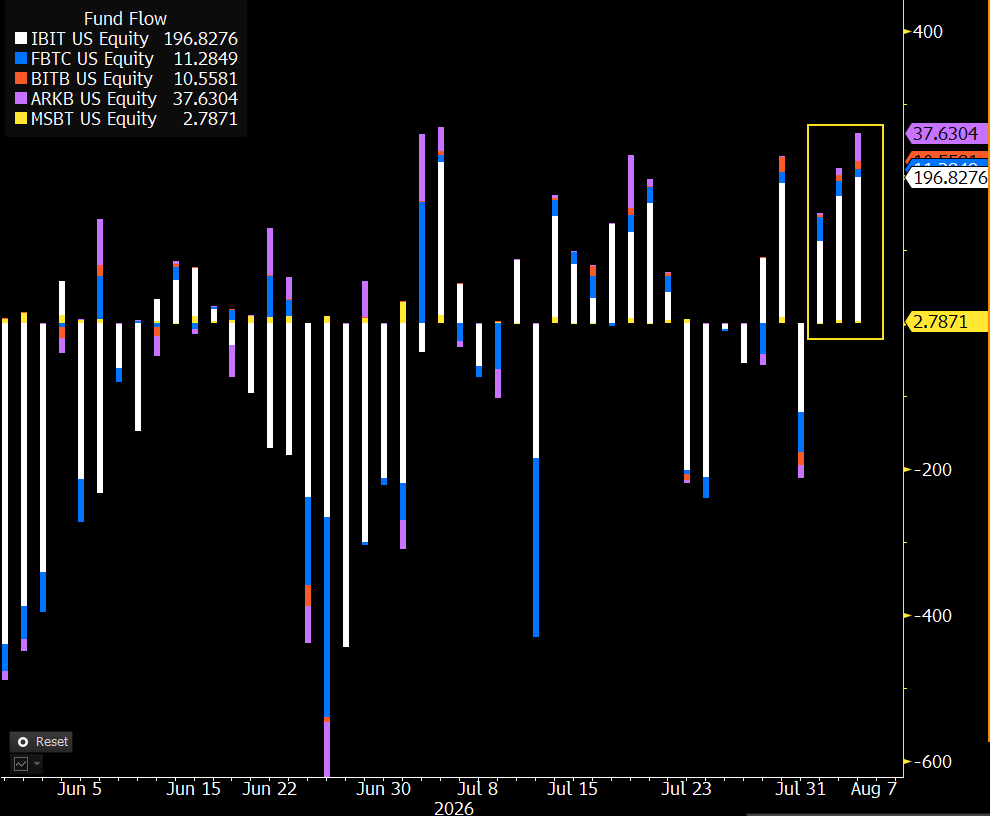
Demand for US spot Bitcoin exchange-traded funds (ETFs) has surged over the past week, recording a consistent streak of daily inflows totaling approximately $620 million. This acceleration in institutional investment coincided with the widely reported Coldcard hardware wallet exploit, an incident that saw over $116 million worth of Bitcoin drained from more than 5,200 wallet addresses. The timing has prompted significant speculation within the financial and cryptocurrency communities regarding whether some investors are actively reconsidering the complexities and inherent risks of self-custody in favor of regulated, institutionally managed investment vehicles.
The inflows into spot Bitcoin ETFs represent a notable uptick in investor confidence in these relatively new financial products. Key players such as BlackRock’s iShares Bitcoin Trust (IBIT), Fidelity Wise Origin Bitcoin Fund (FBTC), Bitwise Bitcoin ETF (BITB), and ARK 21Shares Bitcoin ETF (ARKB), alongside the Defiance Daily Target 2X Long MSTR ETF (MSBT), have all registered positive flows every trading day since the weekend exploit. This sustained accumulation is a critical indicator for the nascent spot Bitcoin ETF market, which has largely been characterized by a tug-of-war between new inflows and significant outflows from the Grayscale Bitcoin Trust (GBTC) since its conversion to an ETF earlier this year. The cumulative figure of roughly $620 million underscores a strong net positive sentiment emerging from a broad base of institutional and retail investors accessing Bitcoin through traditional brokerage platforms.
The Coldcard Exploit: A Blow to Hardware Wallet Security Perceptions
The catalyst for much of this speculation, the Coldcard exploit, sent ripples of concern throughout the cryptocurrency ecosystem. Coldcard, manufactured by Coinkite, has long been revered as oneishing of the most secure hardware wallets available, favored by experienced Bitcoin users for its advanced features like air-gapped transactions, multi-signature support, and emphasis on supply chain security. The exploit, which blockchain intelligence firm TRM Labs reported drained more than $116 million from over 5,200 wallet addresses, represents one of the largest hardware wallet compromises in recent memory. TRM Labs’ analysis indicated that the vulnerability was exploited by at least 15 attackers, suggesting a coordinated effort to capitalize on the flaw.
While the specific technical details of the Coldcard vulnerability remain under active investigation by Coinkite and security researchers, initial reports and community discussions have focused on potential firmware flaws, supply chain compromises, or sophisticated software vulnerabilities that could bypass the robust security layers Coldcard is known for. The very nature of a hardware wallet is to provide an isolated environment for private keys, making remote exploits extremely difficult. The success of this attack, therefore, points to a highly sophisticated method, potentially involving a previously unknown vulnerability (zero-day exploit) or a highly targeted social engineering campaign coupled with a technical flaw.
Expert Commentary and Market Reactions

Bloomberg senior ETF analyst Eric Balchunas, who closely tracks the performance of spot Bitcoin ETFs, highlighted the timing of the accelerated inflows. In a post on X (formerly Twitter), Balchunas remarked, "I’m not saying it’s connected, we just don’t know. [Although] long-term I can’t imagine there aren’t some who migrate over." This cautious yet suggestive observation captures the prevailing sentiment among market watchers: while direct causation is difficult to prove definitively, the confluence of events is too striking to ignore. The psychological impact of a high-profile security breach, especially involving a product known for its security, often leads investors to reassess their risk tolerance and preferred methods of asset custody.
The broader market reaction to the Coldcard exploit underscored the fragility of trust in self-custody, even among sophisticated users. Security researchers and crypto enthusiasts quickly began analyzing the potential vectors of attack, sharing advice on best practices, and emphasizing the ongoing need for vigilance in a rapidly evolving threat landscape. The incident also reignited a fundamental debate within the crypto community: the trade-offs between the autonomy and control offered by self-custody versus the perceived security and convenience provided by institutional custodians.
The Enduring Debate: Self-Custody vs. Institutional Custody
The Coldcard hack has vigorously renewed discussions about the inherent risks associated with self-custody. While the mantra "not your keys, not your coin" champions the principle of individual sovereignty over digital assets, it also places the full burden of security on the individual. This burden includes managing private keys, securing hardware, understanding complex cryptographic processes, and defending against increasingly sophisticated cyber threats. The incident highlighted that even hardware wallet users, who are generally considered to be at the forefront of robust self-custody practices, can be exposed to firmware flaws and software vulnerabilities that are beyond their direct control.
Conversely, regulated investment products like spot Bitcoin ETFs offer a different paradigm. In this model, asset custody and security are handled by institutional providers such as Coinbase Custody, BitGo, or other qualified custodians, which are subject to stringent regulatory oversight. These institutions typically employ multi-layered security protocols, including air-gapped cold storage, multi-signature schemes, regular security audits, and often, insurance policies to protect client assets. For many traditional investors, and potentially a growing segment of crypto-native investors, outsourcing these complex security responsibilities to professional entities represents a compelling value proposition, despite the associated fees and the relinquishing of direct control over private keys.
Changpeng "CZ" Zhao, co-founder of Binance, a prominent centralized exchange, also weighed in on the debate. CZ argued that storing crypto on centralized exchanges (CEXs) might now be "statistically safer" than self-custody. He cited data from analyst Willy Woo, which suggested that cumulative Bitcoin losses from self-custody incidents have surpassed those from exchange hacks. CZ further elaborated, "Hack data is easier to collect on the CEX side, usually major news. It is harder on the self-custody side, where hacks, lost coins, etc are often not reported." This perspective, while coming from a figure associated with a CEX, points to a significant blind spot in assessing the true scale of self-custody losses, which often go unreported due to privacy concerns, embarrassment, or the sheer difficulty of tracking individual incidents.
The Broader Threat Landscape: AI-Assisted Cyberattacks
The debate over custody methods unfolds against a backdrop of an escalating and increasingly sophisticated cyber threat landscape. The proliferation of artificial intelligence (AI) is adding a new dimension to these challenges, enabling attackers to develop more potent and adaptable exploits. On Monday, Bitcoin swap service Boltz announced the suspension of its non-custodial bridge, explicitly citing a "steady rise in AI-assisted exploits." Boltz indicated that these advanced attacks were allowing malicious actors to identify and exploit vulnerabilities faster than its security team could patch them, forcing a temporary shutdown to reassess and reinforce their defenses.
This trend underscores a critical concern for the entire digital asset ecosystem. AI can accelerate the discovery of vulnerabilities, automate phishing campaigns with unprecedented realism, and even generate polymorphic malware that evades traditional detection methods. For both self-custody solutions and institutional custodians, the arms race against cybercriminals is intensifying, requiring continuous innovation in security protocols, robust incident response plans, and a proactive approach to threat intelligence. The Boltz incident serves as a stark reminder that even non-custodial services, which aim to minimize counterparty risk, are not immune to the evolving sophistication of cyber threats.
Implications for the Future of Crypto Investment and Security
The Coldcard exploit and the subsequent surge in Bitcoin ETF inflows carry several significant implications for the future of cryptocurrency investment and security. Firstly, it may accelerate the mainstream adoption of Bitcoin by providing a more accessible and seemingly "safer" on-ramp for traditional investors. As more investors, particularly institutions and financial advisors, seek exposure to Bitcoin without the operational complexities of direct ownership, regulated ETFs will likely become the preferred vehicle. This shift could further entrench Bitcoin within traditional financial markets, potentially leading to greater liquidity and institutional engagement.
Secondly, the incident is a powerful reminder that security is not a static state but an ongoing process of adaptation and improvement. For hardware wallet manufacturers like Coinkite, this exploit will undoubtedly prompt an intense review of their security architectures, firmware update processes, and vulnerability disclosure mechanisms. It may lead to industry-wide re-evaluation of security testing methodologies, potentially incorporating more adversarial AI simulations or independent "red team" audits to uncover hidden flaws.
Thirdly, the renewed debate over self-custody versus institutional custody will likely lead to a more nuanced understanding of the risks and benefits associated with each approach. While fervent proponents of self-custody will continue to advocate for individual control, the practical realities of managing significant digital assets securely will push some investors towards professional custodians. This could foster the growth of specialized crypto custody solutions, offering varying degrees of decentralization and security features to cater to diverse investor needs.
Finally, the increasing role of AI in cyberattacks necessitates a collaborative industry response. Security firms, wallet developers, exchanges, and regulatory bodies will need to work together to share threat intelligence, develop advanced AI-driven defensive tools, and educate users about the evolving risks. The incidents involving Coldcard and Boltz are not isolated events but symptoms of a larger, more complex security environment that demands continuous vigilance and innovation from all stakeholders in the cryptocurrency space. The path forward for Bitcoin and the broader digital asset ecosystem hinges on its ability to evolve its security paradigms to meet these emerging challenges, ensuring both the integrity of the assets and the confidence of its investors.