James Watt
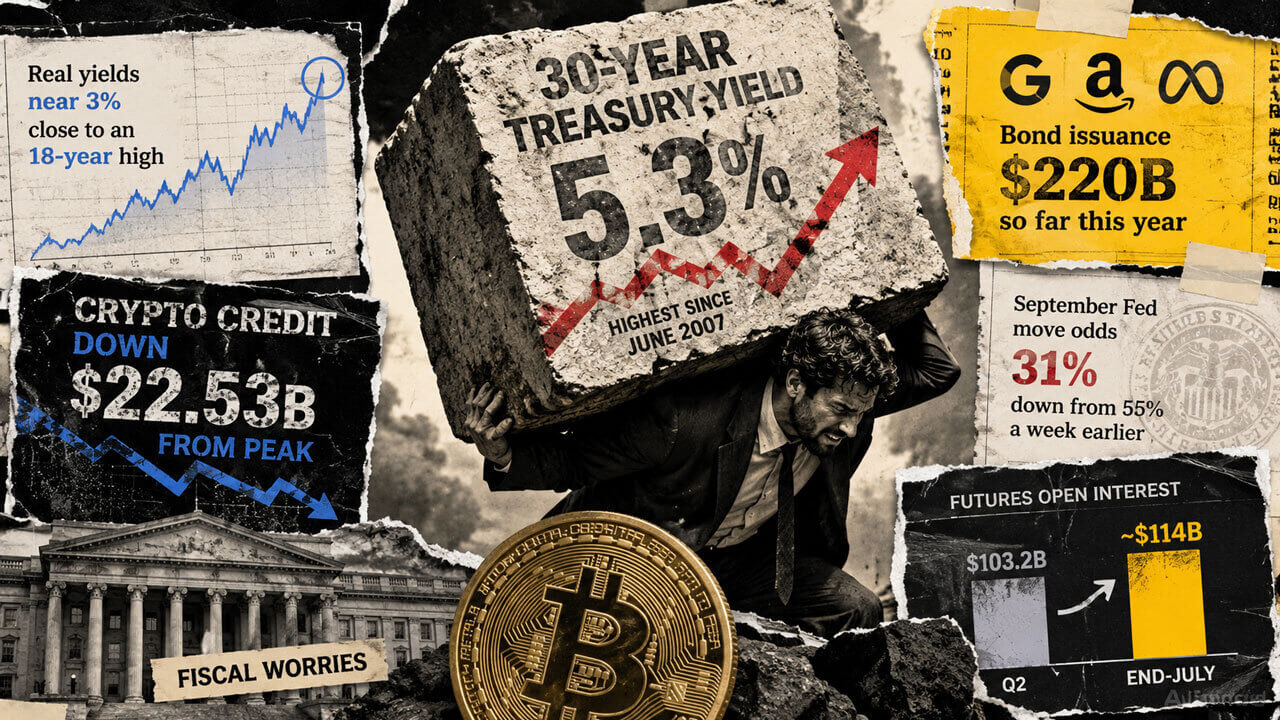
The global financial landscape underwent a significant shift on August 17, 2026, as the United States 30-year Treasury yield surged past the 5.3% threshold for the first time since June 2007. This milestone, occurring in a climate of shifting macroeconomic expectations, coincided with a pivotal report from Galaxy Research indicating that crypto-collateralized lending has contracted by more than $22 billion from its previous market peak. As long-term borrowing costs reached levels not seen in nearly two decades, Bitcoin (BTC) demonstrated resilience and volatility, reaching an intraday high of $64,610.01 while simultaneously facing a fundamental challenge to its status as a non-yielding store of value.
The ascent of the 30-year yield to an intraday peak of 5.314% marks a critical departure from traditional market correlations. Historically, long-end yields react to Federal Reserve policy expectations and economic growth data. However, this week’s move was characterized by a distinct "decoupling" from the broader macro narrative. Despite soft economic data that led traders to slash the probability of a September Federal Reserve interest rate hike to just 31%—down from 55% only a week prior—the long end of the curve continued to climb. This suggests that the pressure on the bond market is no longer a simple story of central bank hawkishness, but rather a reflection of deeper structural concerns regarding the U.S. fiscal trajectory and a massive surge in corporate debt issuance.
The Macroeconomic Anomaly: Yields vs. Fed Expectations
Under normal market conditions, a cooling economy and a reduction in the odds of a Fed rate hike would exert downward pressure on Treasury yields. As the market prices in a more accommodative monetary stance, investors typically flock to the safety of long-term government bonds, driving prices up and yields down. The current environment has inverted this logic.
The 30-year Treasury yield’s climb to 5.2954% and its subsequent intraday breach of 5.3% represent a nineteen-year high for a closing price. Analysts point to a confluence of factors: a ballooning federal deficit requiring constant debt auctions and a significant increase in private sector borrowing. When the supply of bonds exceeds investor appetite, yields must rise to attract capital. This "long-duration problem" creates a formidable hurdle for Bitcoin and other risk assets that do not provide a native yield. When an investor can lock in a nominal return of 5.3%—or a real, inflation-adjusted return of nearly 3%—the opportunity cost of holding Bitcoin increases substantially.
The Role of Big Tech and the AI Debt Wave
A primary driver behind the current yield spike is the unprecedented borrowing activity of Silicon Valley’s largest entities. Alphabet, Amazon, and Meta have collectively issued nearly $220 billion in bonds so far in 2026. To put this in perspective, this figure is more than double the $108 billion these same three companies issued during the entirety of 2025.
This borrowing spree is largely fueled by the intensive capital requirements of the Artificial Intelligence (AI) revolution. The race to build massive data centers, procure high-end semiconductors, and secure energy infrastructure has forced tech giants to tap the credit markets at a record pace. Because these companies are viewed as high-quality "blue-chip" borrowers, their massive bond supply competes directly with U.S. Treasuries for the same pool of institutional capital. This flood of high-quality corporate paper adds further upward pressure on yields, creating a liquidity vacuum that siphons funds away from the cryptocurrency markets.
Chronology of the Credit Contraction
The current stress test for Bitcoin is occurring against a backdrop of significant deleveraging within the digital asset ecosystem. According to the Galaxy Q2 2026 Leverage Report, the crypto-collateralized lending market has seen a steady and methodical decline.
- Q3 2025: The crypto lending market hits a cycle peak of $78.69 billion.
- Late 2025 – Early 2026: A series of gradual declines begin as institutional lenders tighten risk parameters.
- Q2 2026: Collateralized lending falls to $56.16 billion, representing a quarterly drop of $11.33 billion.
- July 21, 2026: Borrowing on Decentralized Finance (DeFi) lending applications hits a low of $21.94 billion, a staggering 53% decline from the $47.13 billion peak recorded the previous September.
- August 17, 2026: The 30-year Treasury yield crosses 5.3%, testing the market’s ability to absorb high rates with a reduced credit overhang.
This three-quarter streak of declining debt suggests that the "easy money" phase of the current crypto cycle has concluded, replaced by a more disciplined capital structure.
2022 vs. 2026: A Different Deleveraging Mechanism
To understand the current market stability, it is essential to compare this period with the catastrophic deleveraging event of 2022. In 2022, the crypto-backed lending market collapsed by more than 55% in a single quarter. This was a "forced" unwind, characterized by cascading liquidations, the failure of major centralized lenders like Celsius and Voyager, and a total loss of confidence in collateral valuations. The aftermath saw further declines of 9% and 29% in subsequent quarters as the contagion spread.
The 2026 contraction follows a different pattern. Galaxy Research describes the current trend as "gradual risk reduction." The declines have been more measured—roughly 10%, 5%, and 17% across three consecutive quarters. Unlike the 2022 crisis, where falling prices triggered margin calls that forced further selling, the current reduction in debt appears to be proactive. Investors and platforms are reducing their exposure before a crisis hits, rather than being forced out by insolvency.
However, while the collateralized lending market has shrunk, the derivatives market tells a different story. Futures open interest (OI) ended the second quarter at $103.2 billion but rebounded sharply to $114 billion by the end of July. Bitcoin-specific futures open interest dipped to $45 billion before recovering to $48 billion. This suggests that while long-term credit is contracting, short-term speculative interest remains high. Galaxy cautions that high open interest does not always equate to directional leverage—as many positions are hedged—but it does indicate that the market remains sensitive to sudden price shocks.
Real Yields: The 3% Hurdle
The most significant metric for institutional investors is the "real yield"—the nominal Treasury yield minus expected inflation. Currently, 30-year real yields are hovering near 3%, an 18-year high.
For Bitcoin, which is often marketed as "digital gold" and a hedge against currency debasement, high real yields are a headwind. When real yields are negative or near zero, the fact that Bitcoin pays no interest is irrelevant. However, when the safest asset in the world (U.S. Treasuries) offers a 3% return above inflation, the "hurdle rate" for Bitcoin increases. Investors must believe that Bitcoin will appreciate by at least 3% plus the risk premium just to break even compared to a "risk-free" government bond.
Market Projections: Bull and Bear Scenarios
As Bitcoin navigates this high-rate environment, analysts are watching several key signals to determine the next major move.
The Bull Case: Resilience and Recovery
If the 30-year Treasury yield retreats below the 5.1% level or if real yields begin to ease, Bitcoin could find the liquidity necessary to reclaim the $67,000 to $72,000 range. In this scenario, the fact that the market has already shed $22.5 billion in credit becomes a strength; with less "bad debt" in the system, Bitcoin can absorb the rate shock without a 2022-style collapse. Stability in futures open interest and a lack of aggressive re-expansion in lending would signal a healthy, spot-driven recovery.
The Macro-Led Bear Case: The Yield Push
The bear case involves the 30-year yield pushing toward 5.4% or even 5.7%, driven by continued government borrowing and AI-related debt issuance. If real yields hold at multi-decade highs, Bitcoin could be dragged below the psychological $60,000 support level, potentially testing the $52,000 to $58,000 range. In this scenario, the selloff would be driven by the bond market rather than internal crypto contagion.
The Credit-Cascade Case: A Return to Volatility
The most concerning scenario would be an abrupt acceleration in the decline of collateralized lending alongside a Bitcoin price drop. If futures open interest collapses suddenly, it would indicate that the "gradual risk reduction" has turned into a panic. This would mirror the 2022 cycle, though most data currently suggests the market is too deleveraged for such a sharp contagion to occur.
Conclusion: A New Frontier for Digital Assets
Bitcoin is currently walking into a Treasury-rate environment it has never faced in its seventeen-year history. The asset was born in the aftermath of the 2008 financial crisis, a period defined by zero-interest-rate policies (ZIRP) and quantitative easing. The current era of 5.3% nominal yields and 3% real yields represents a total paradigm shift.
However, the structural integrity of the crypto market appears more robust than in previous cycles. The $22.5 billion reduction in collateralized lending suggests that the industry has learned the lessons of the past, moving away from the fragile, interconnected lending loops that defined 2022. Whether Bitcoin can thrive as a "non-yielding" asset in a "high-yield" world remains the ultimate question for investors. The coming months will determine whether the bond market’s gravity will pull Bitcoin down, or if the "digital gold" narrative can survive its most rigorous economic stress test to date.