
 James Watt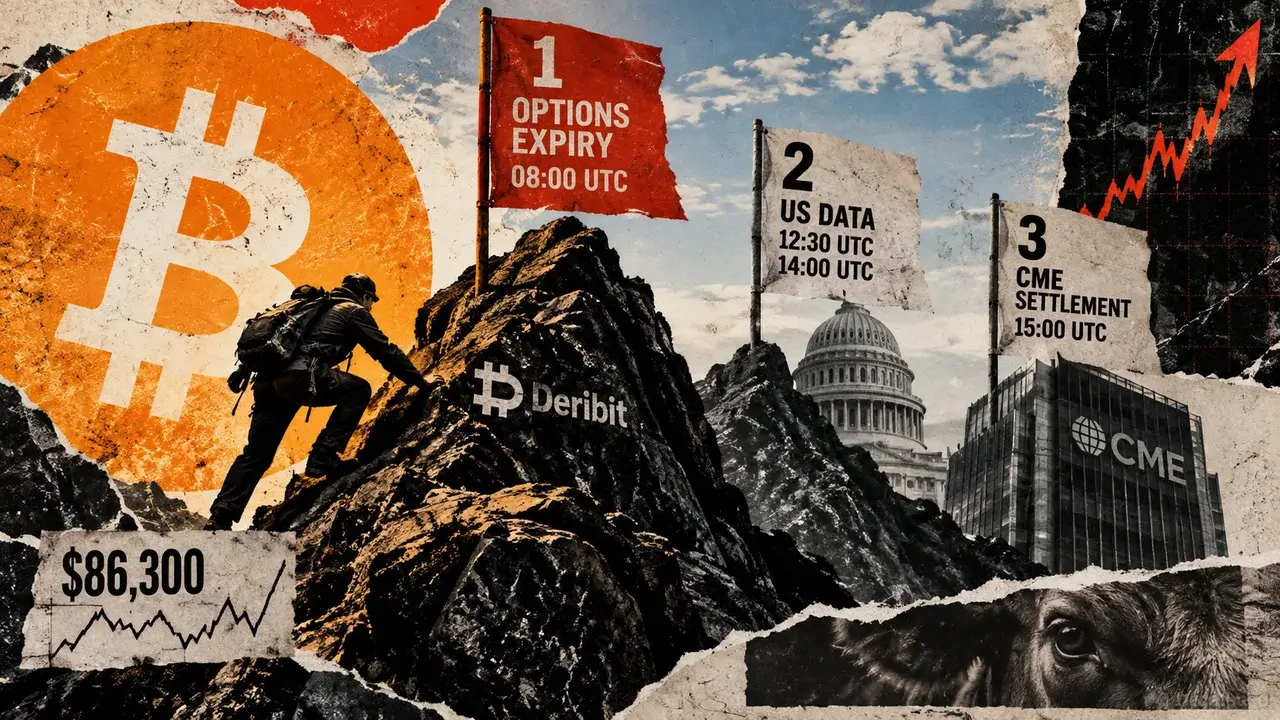
The global cryptocurrency market is approaching a pivotal liquidity juncture as Bitcoin options with a staggering $16 billion in notional value are set to expire on the Deribit exchange at 08:00 UTC on Friday, September 25. This massive settlement event, which features a heavy concentration of bullish bets, occurs as Bitcoin trades near the $86,300 mark, having recently surged past the $85,000 resistance level. The expiration represents more than just a scheduled clearing of contracts; it serves as the opening salvo in a high-stakes "triple-threat" trading day that includes critical U.S. macroeconomic data releases and the settlement of Bitcoin futures on the Chicago Mercantile Exchange (CME).
The composition of the expiring open interest reveals a market leaning heavily toward further upside, with call options accounting for approximately $9.6 billion of the total value, while put options—typically used as downside protection—represent about $6.4 billion. As the 08:00 UTC deadline nears, market participants are closely monitoring the potential for "gamma hedging" activities by institutional dealers, which could either stabilize the current price range or catalyze a volatile breakout.
The Two-Act Expiry Cycle: From Wall Street to Deribit
The upcoming settlement is being characterized by industry analysts as the second half of a broader quarterly expiration cycle. Mauricio Di Bartolomeo, co-founder of the digital asset lending platform Ledn, notes that the current market dynamics were set in motion last week on Wall Street. The first "act" of this cycle involved the record-breaking expiration of options on BlackRock’s iShares Bitcoin Trust (IBIT), the world’s largest spot Bitcoin ETF.
According to Di Bartolomeo, the IBIT options book was significantly skewed toward call options. As Bitcoin’s price rallied through the $80,000 threshold, a large portion of these calls moved "into the money," forcing institutional dealers who were short those contracts to purchase IBIT shares to remain delta-neutral. This mechanical buying pressure eventually spilled over into the underlying spot Bitcoin market. Because the creation of new IBIT shares requires authorized participants to acquire physical Bitcoin, the hedging of ETF options effectively acted as a vacuum, pulling spot liquidity into the fund and fueling the climb toward $86,000.
"If the move continues, the large call blocks at $85,000 and $100,000 are where the same dynamic kicks in on the Deribit book," Di Bartolomeo observed. This suggests that the Deribit expiration could mirror the IBIT event, where the need for dealers to hedge their exposure creates a feedback loop of buying activity.
Decoding the Gamma Map: Key Levels and Dealer Positioning
To understand how Friday’s expiration might influence price action, analysts rely on gamma models to estimate the "pain points" for market makers. Data from ByKaranteli’s open-source gamma model provides a roadmap of potential hedging flows. The model indicates that the largest "call wall"—a price level where a high concentration of call options exists—is situated at $95,000. Conversely, the largest "put wall," providing a floor for the market, sits at $60,000.
A critical metric in this analysis is the "zero-gamma" level, currently estimated to be near $71,000. In options theory, the zero-gamma level is the point where the behavior of dealer hedging undergoes a fundamental shift:
- Positive Gamma Territory (Above $71,000): When the market is above the zero-gamma level, dealers are generally "long gamma." In this environment, they tend to sell into price rallies and buy during dips to maintain their hedges. This behavior acts as a stabilizing force, dampening volatility and pulling the price back toward major strikes.
- Negative Gamma Territory (Below $71,000): If the price drops below this level, dealers become "net short gamma." To hedge, they must sell as the price falls and buy as it rises, which can significantly amplify market moves and lead to "cascading" volatility.
With Bitcoin currently trading comfortably in the $86,000 zone, the market remains in a positive gamma environment. This suggests that, barring a massive external shock, the hedging flows associated with the $16 billion expiry may actually serve to keep Bitcoin pinned within a specific range rather than triggering a wild swing.
Implied Volatility and the Expected Trading Range
Despite the massive notional value of the expiring contracts, Deribit’s volatility metrics suggest that professional traders are not anticipating a catastrophic move in the immediate term. The Deribit Bitcoin Volatility Index (DVOL) stood at 38.1 on September 22, a level characterized as "very low" relative to the past five years of historical data.
The implied volatility for Friday’s at-the-money options also matches this reading at 38.1%, with the "skew"—the difference in cost between puts and calls—remaining near neutral. Based on these figures, the market is pricing in a one-standard-deviation move of approximately 3.15%, or $2,720. This creates an implied trading band between $83,600 and $89,100 heading into the settlement.
While the $95,000 call wall remains a significant long-term target, the current options pricing suggests it is unlikely to be reached before the Friday morning settlement. The delivery price for these contracts will be determined by a 30-minute time-weighted average price (TWAP) of the Deribit Bitcoin Index between 07:30 and 08:00 UTC.
The Afternoon Handoff: Macroeconomic Catalysts and CME Settlement
The Deribit expiration is only the first hurdle in a sequence of events dubbed "the afternoon handoff." Once the $16 billion in Deribit contracts are settled at 08:00 UTC, the market will lose the stabilizing influence of the existing hedge structures. This leaves Bitcoin vulnerable to new directional moves as fresh macroeconomic data hits the wires.
The timeline for the remainder of the day is as follows:
- 12:30 UTC: The release of U.S. Durable Goods Orders. This data provides a snapshot of industrial demand and economic health, influencing expectations for future interest rate cuts.
- 14:00 UTC: The University of Michigan’s final September Consumer Sentiment reading. This report includes critical data on inflation expectations, which the Federal Reserve closely monitors.
- 15:00 UTC: The CME September Bitcoin futures settlement. These contracts settle against the CME CF Bitcoin Reference Rate, marking the final major derivatives event of the day.
The Federal Reserve recently adjusted its target interest rate range to 3.75%–4.00% on September 16. Because Bitcoin is increasingly viewed as a "macro asset" sensitive to liquidity and interest rate shifts, any surprise in the Durable Goods or inflation expectation data could trigger significant volatility just as the CME futures are preparing to settle.
Institutional Momentum: ETF Inflows and Short Squeezes
The backdrop for this week’s volatility is one of sustained institutional demand. Data from Farside Investors reveals that U.S. spot Bitcoin ETFs have seen a massive surge in capital. On September 17, the funds took in $159.5 million, followed by $433 million on September 18, and a staggering $999 million on September 21.
This influx of "real-money" buying has been accompanied by a dramatic flush-out of bearish speculators. The rally that took Bitcoin above $85,000 earlier this week triggered $647.9 million in short liquidations within a single 24-hour window. Meanwhile, aggregate crypto open interest has climbed by 7.59% to reach $156 billion, indicating that fresh leverage is entering the system alongside the spot buying.
Divergent Paths: Bull and Bear Scenarios
As the market approaches the Friday deadline, two primary scenarios have emerged among analysts.
The Bull Case: In this scenario, Bitcoin maintains its momentum and pushes toward the $90,000 mark before the Deribit settlement. Sustained ETF inflows provide a floor for the price, and funding rates for perpetual futures remain at healthy, moderate levels. As the Friday options expire, traders aggressively roll their positions into October and December call options, keeping the "call wall" dynamic alive. If the U.S. economic data at 12:30 UTC suggests a "soft landing" or cooling inflation, Bitcoin could clear the CME settlement with a renewed path toward $100,000.
The Bear Case: The bear case suggests that Bitcoin’s rally may have overextended itself. If ETF inflows begin to taper and perpetual futures open interest remains dangerously high, the market could be ripe for a "sell-the-news" event following the 08:00 UTC settlement. Once the stabilizing hedges of the $16 billion options book are removed, a firmer-than-expected inflation reading from the University of Michigan could send prices sliding back toward the lower edge of the implied band at $83,600. A breach of $83,000 could then lead to a test of the $80,000 psychological support level.
Historical Context and Market Behavior
Research into historical Deribit expirations provides some clues as to what traders might expect. A 2026 study published in Finance Research Letters analyzed intraday price behavior around these windows and found evidence of statistically significant price reversals. These reversals were most pronounced when at-the-money open interest was high and dealer gamma was negative.
While the current market is in a positive gamma state—which typically suggests less explosive volatility—the study also noted that trading volume in both perpetual swaps and spot markets tends to spike during the 30-minute settlement window. This suggests that even if the price remains range-bound, the internal "churn" of the market will be exceptionally high on Friday morning.
Ultimately, the durability of Bitcoin’s current rally will be tested not by the expiration itself, but by what happens after the hedges are cleared. If the underlying spot demand from ETFs and institutional buyers remains robust after $16 billion in contracts leave the board, the path of least resistance for the digital asset remains decidedly upward.









