admin
admin
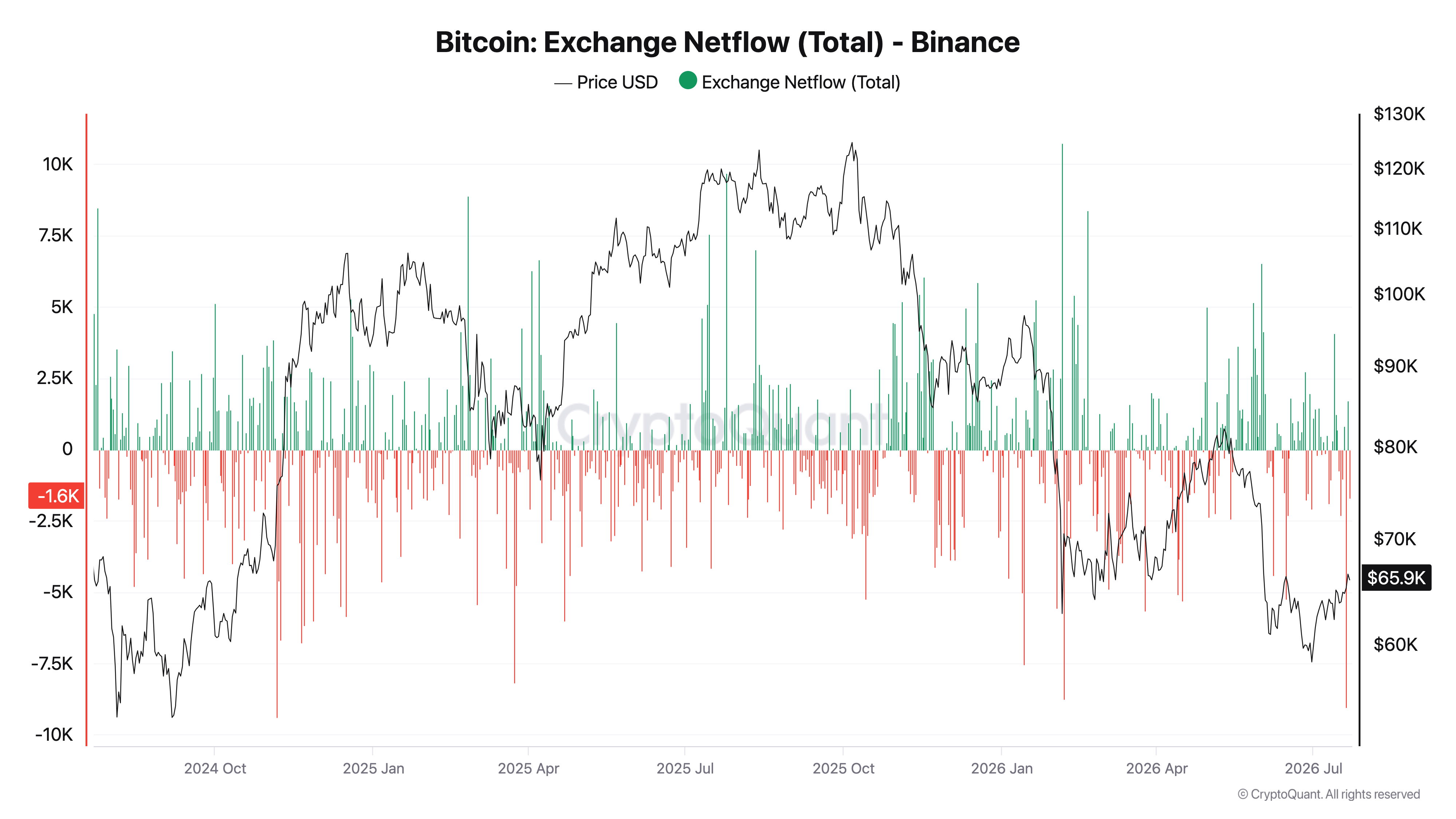
The global cryptocurrency market is witnessing a significant shift in liquidity distribution as Bitcoin (BTC) buyers demonstrate increased resilience at the $65,000 price threshold. This development coincides with a massive liquidity event on Binance, the world’s largest cryptocurrency exchange by trading volume, which recorded a net outflow of more than 9,000 BTC in a single 24-hour period. This movement represents the largest single-day withdrawal from the platform since November 2024, signaling a potential transition from active trading to long-term self-custody among high-net-worth investors and institutional players.
The surge in outflows comes at a critical technical juncture for the digital asset. After several weeks of indecisive price action and fluctuating sentiment, on-chain data suggests that the market’s ability to "absorb" selling pressure has improved significantly. While the price of Bitcoin has struggled to maintain a definitive upward trajectory in recent months, the current stabilization between the $65,000 and $66,000 range, paired with declining exchange reserves, offers a new lens through which to view the current market cycle.
Unpacking the Binance Liquidity Shift: A Two-Year Milestone
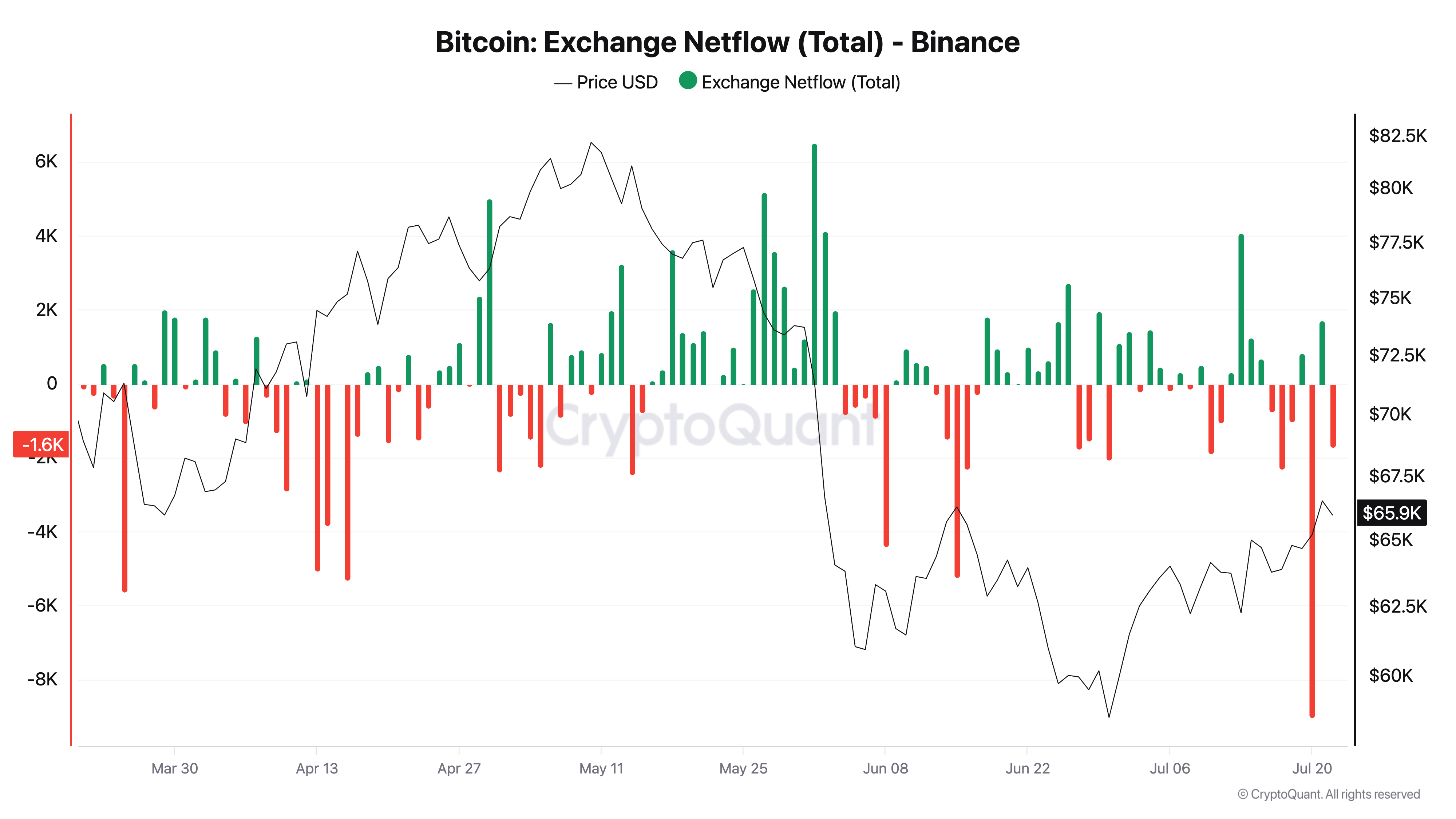
According to the latest research from on-chain analytics firm CryptoQuant, the withdrawal of 9,030 BTC from Binance on Tuesday marks a pivotal moment in the 2026 market narrative. For much of early June and July, Binance’s netflow—the difference between the amount of Bitcoin entering and leaving the exchange—had been characterized by a series of positive days, suggesting that traders were moving assets onto the platform, likely in preparation for sale or to use as collateral in derivatives trading.
However, the tide turned sharply this week. When netflows turn negative to this magnitude, it typically indicates that "whales" or institutional entities are moving their holdings into cold storage. This process, often referred to as moving to self-custody, effectively removes those coins from the "liquid supply." Assets held in private wallets are not immediately available to be sold into the exchange’s order book, thereby reducing the immediate overhead resistance that can stifle price rallies.

Ruga Research, a prominent contributor to the CryptoQuant platform, noted that the sheer scale of this movement is difficult to ignore. In an analysis of the event, Ruga highlighted that such large-scale withdrawals often serve as a precursor to a supply shock, provided they are not immediately followed by a reversal of flows. The researcher pointed out that the 30-day momentum for exchange flows is currently recovering from extreme negative territory toward the "zero line," a technical crossover that has historically preceded bullish price resolutions.
Chronology of Exchange Reserves and Market Sentiment
The path to this week’s massive outflow began in early June 2026, following a period of relative stagnation in the crypto markets. Throughout the mid-year period, Bitcoin faced several headwinds, including regulatory scrutiny and a lack of clear catalysts for a breakout.
- Early June 2026: Binance saw a string of net positive inflows. During this phase, Bitcoin’s price was volatile, and the influx of coins to exchanges suggested a lack of confidence among short-term holders who were ready to exit their positions at the first sign of weakness.
- Mid-June to Early July 2026: Netflows began to toggle between positive and negative, reflecting a period of high indecision. This "choppy" behavior mirrored the price action, as BTC repeatedly tested the $60,000 support level without establishing a clear trend.
- July 15–20, 2026: Market momentum began to stabilize around the zero line. On-chain analysts observed that while price recovery was slow, the "aggression" with which sellers were moving coins to exchanges had begun to wane.
- July 21, 2026: The definitive break occurred. The 9,030 BTC outflow was recorded, signaling a major departure from the previous month’s trend.
This timeline suggests that the current $65,000 price level is being viewed by some large-scale participants as a fair value or a strategic entry point for long-term accumulation, rather than a level at which to take profits and exit.
Analyzing Market Absorption and Spot Demand
A critical component of the current market environment is the concept of "absorption." In financial markets, absorption refers to the ability of buyers to purchase the supply being offered by sellers without the price collapsing. Rei Researcher, another analyst at CryptoQuant, emphasized that the recent negative netflow is particularly notable because it is occurring as Bitcoin recovers to the $65,000–$66,000 range.
In previous months, similar price recoveries were often met with a wall of selling pressure, as "trapped" investors used the bounce to exit their positions. The fact that coins are now leaving the exchange during a price recovery suggests that the "weak hands" have largely been flushed out, and the current cohort of buyers is more committed to holding.
However, analysts remain cautious. Rei Researcher warned that while negative netflows reduce supply pressure, they do not "automatically confirm a new uptrend." For a sustained bull market to materialize, the reduction in supply must be met with a corresponding increase in spot demand. Spot demand refers to the actual purchase of the underlying asset (Bitcoin) rather than speculating on its price through futures or options contracts.
The Role of US Spot Bitcoin ETFs and Institutional Inflows
The demand side of the equation is currently being driven largely by institutional vehicles, specifically the United States-based spot Bitcoin Exchange-Traded Funds (ETFs). Data from Farside Investors indicates that while the broader market has lacked momentum, ETF inflows have remained relatively consistent, providing a steady baseline of demand that helps stabilize the price.
The interaction between exchange outflows and ETF inflows is significant. As Bitcoin is moved off retail-focused exchanges like Binance and into the custody of institutional providers (such as Coinbase Custody or Gemini, which serve many ETF issuers), the total amount of BTC available for retail trading continues to shrink. This "institutionalization" of Bitcoin supply is a fundamental theme of the 2026 market.
Despite these positive signals, some market commentators point to a "derivatives-led" recovery rather than a "spot-led" one. In a derivatives-led market, price movements are often driven by liquidations and leverage, which can lead to high volatility and "fake-out" rallies. For the current $65,000 support to turn into a launchpad for $70,000 and beyond, a more stable price structure supported by high spot trading volume is required.
Broader Implications and the Path to the 2026 Bear-Market Bottom
Looking further ahead, the current on-chain data is being weighed against long-term cyclical predictions. A recent report from Glassnode suggested that current buyer behavior—specifically those purchasing at the $100,000+ levels earlier in the year—may be providing "early signals" of where the eventual 2026 bear-market bottom might lie.
The crypto market has historically moved in four-year cycles, often dictated by the "halving" events. As the market navigates the latter half of 2026, the behavior of exchange reserves will be a primary indicator of whether the industry is entering a prolonged cooling-off period or if it is consolidating for a final "blow-off top."
The 9,000 BTC outflow from Binance serves as a reminder that despite the maturation of the market and the entry of Wall Street, the core ethos of "Not your keys, not your coins" remains a powerful driver of investor behavior. When large amounts of capital move into self-custody, it reflects a fundamental trust in the asset’s long-term value proposition, independent of the short-term fluctuations of the exchange order books.
Conclusion: A Market in Transition
The convergence of record-breaking outflows from Binance and the stabilization of Bitcoin at $65,000 marks a significant chapter in the 2026 fiscal year for digital assets. While the "indecisive" momentum around the zero line suggests that the market has not yet fully committed to its next major move, the underlying metrics are shifting in favor of those with a long-term horizon.
Investors and analysts will be closely watching the following factors in the coming weeks:
- Consistency of Outflows: Will the 9,000 BTC withdrawal be a one-off event, or the start of a sustained trend of exchange depletion?
- Spot Trading Volume: Will the reduction in supply be met with the high-volume spot buying necessary to break through the $67,000 resistance?
- Macroeconomic Factors: How will upcoming central bank decisions and global economic data impact the "risk-on" sentiment required for a Bitcoin rally?
For now, the "better absorption" noted by researchers provides a glimmer of optimism for a market that has spent much of the year searching for a bottom. While the road ahead remains fraught with the typical volatility of the crypto sector, the exodus of Bitcoin from the world’s largest exchange suggests that the "smart money" is preparing for a future where Bitcoin is a scarce, tightly held reserve asset.