James Watt
Bitcoin climbed back above the $65,000 threshold this week, extending an unusual stretch of market resilience as the leading cryptocurrency absorbed a sequence of developments that would typically exert significant downward pressure on prices. The premier digital asset rose approximately 2% over a 24-hour period, reaching a peak of $65,212, marking its strongest price performance since late July. This recovery comes at a critical juncture for the digital finance sector, as market participants navigate a complex landscape of legislative delays, security vulnerabilities, and shifting institutional sentiment.
The upward movement in price coincided with a significant wave of liquidations in the derivatives market. According to data from CoinGlass, crypto liquidations exceeded $191.6 million across more than 80,000 individual traders. Notably, this included a single $1.66 million Bitcoin position on the Hyperliquid platform. Despite these liquidations, the spot market remained robust, suggesting that the underlying demand for Bitcoin is currently outpacing the selling pressure from over-leveraged traders.
A Convergence of Negative Macro and Technical Triggers
The recent price performance is particularly noteworthy because it occurred while investors were digesting a series of potentially destabilizing events. Among these was a significant security breach involving a major hardware wallet provider, further delays to the landmark CLARITY Act legislation in the United States Senate, and months of stagnant price action that had previously forced many short-term holders to exit their positions at a loss.

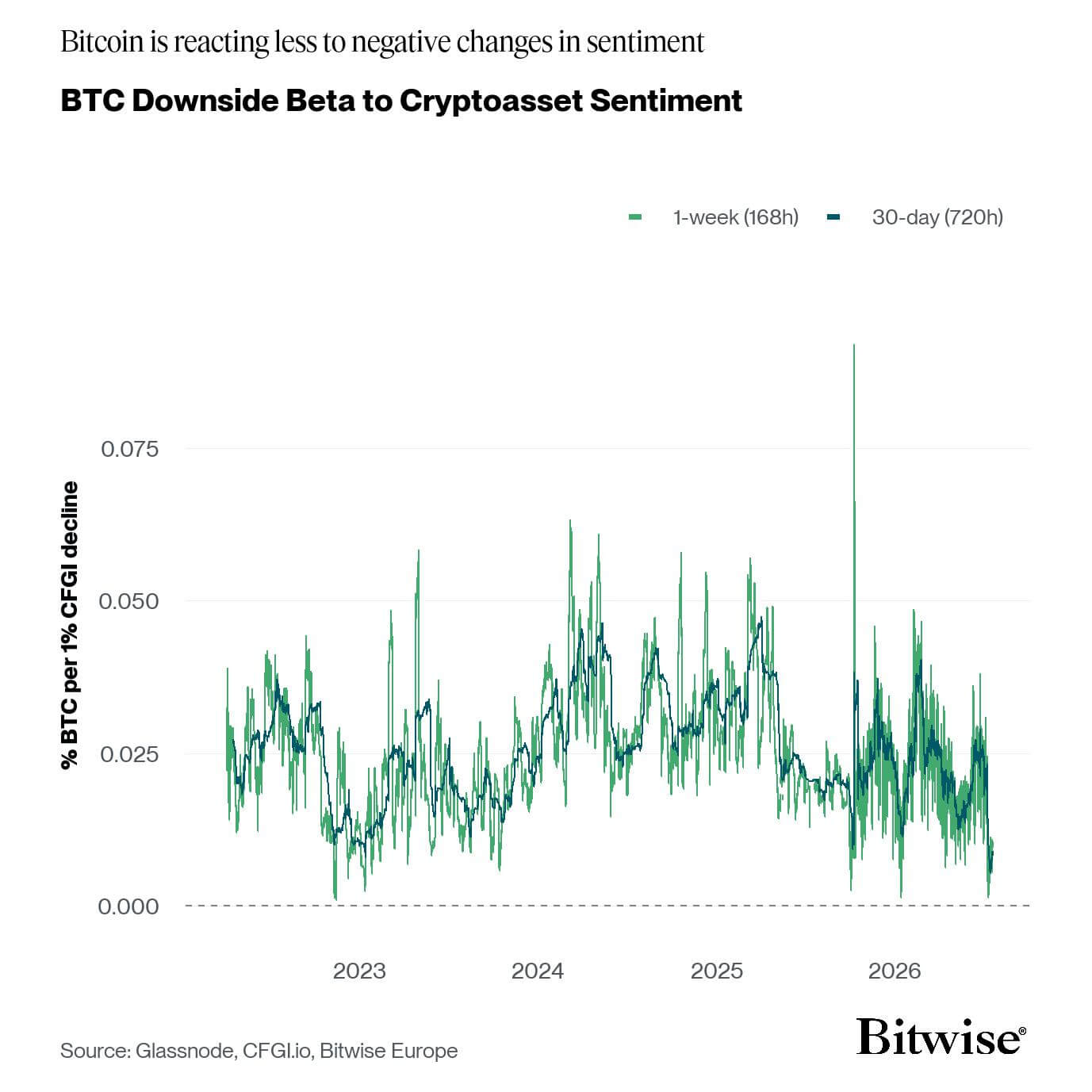
Historically, Bitcoin has shown a high degree of sensitivity to news concerning security and regulation. However, the current market cycle appears to be breaking this trend. Andre Dragosch, Head of Research at Bitwise Europe, noted that Bitcoin’s muted reaction to these negative developments has pushed its sensitivity to "bad news" close to historical lows. Dragosch interprets this as a definitive signal that much of the market’s readily available or "marginal" supply has already been exhausted. In essence, those inclined to sell on negative headlines have likely already done so, leaving the market in the hands of more conviction-driven investors.
Chronology of Recent Market Pressure Points
To understand the significance of the current $65,000 support level, it is essential to review the timeline of events that Bitcoin has successfully weathered over the past fortnight:
- July 29 – August 1: Reports emerged regarding a vulnerability in Coldcard hardware wallets, specifically related to "weak randomness" used in generating seed phrases. This sparked concerns over the safety of long-term "cold" storage.
- August 2 – August 4: Legislative momentum for the CLARITY Act—a bill designed to provide a stable regulatory framework for stablecoins and digital assets—stalled in the U.S. Senate. This delay dampened hopes for immediate institutional clarity.
- August 5 – August 7: Bitcoin faced a "macro test" as private hiring data in the U.S. showed a sharper-than-expected decline, fueling fears of a broader economic slowdown.
- August 8 – Present: Bitcoin successfully reclaimed the $65,000 level, supported by a surge in U.S. spot ETF inflows and aggressive accumulation by "whale" addresses.
Diminishing Sell-Side Intensity and Realized Losses
While Bitcoin holders continue to realize losses, the intensity of this selling has diminished significantly compared to the capitulation events seen earlier in the year. Data from CryptoQuant indicates that Bitcoin’s weekly average net realized profit and loss remains in negative territory, hovering around $368 million. This suggests that a portion of the market is still "underwater," with investors selling coins at prices lower than their initial acquisition cost.
However, this figure is a fraction of the losses recorded during previous downturns. For instance, a price decline in February saw net realized losses peak at approximately $2 billion, while a bout of capitulation in June resulted in $1.2 billion in realized losses. The current, much lower figure of $368 million suggests that while some holders are being worn down by months of horizontal price movement, there is no longer a concentrated "rush for the exits." The lack of panic selling has prevented the kind of cascading liquidations that drove sharper declines in the first half of 2024.
The Coldcard Security Incident: A Case Study in Market Maturity
The security vulnerability linked to Coldcard hardware wallets provided a rigorous test of market stability. The flaw, which affected the randomness of seed phrase generation, forced many owners of previously dormant Bitcoin to move their assets to new, secure addresses.
Initial blockchain forensics suggested a massive spike in activity, raising fears that long-dormant supply might be hitting the market for sale. Between July 30 and August 2, Glassnode estimated that roughly 119,000 BTC—coins that had been held for at least one year—were moved. In a typical bear market or high-sensitivity environment, such a movement would often precede a major sell-off.
However, on-chain analysis revealed that only a small fraction of these coins actually reached exchange wallets. Instead of liquidating, the vast majority of these holders were simply migrating their assets to new self-custody solutions or institutional-grade vaults. This distinction highlights a maturing investor base that prioritizes security over panic-selling, even when faced with technical vulnerabilities in their primary storage methods.
Institutional Absorption via Spot ETFs
As the intensity of retail selling fades, it is being replaced by a steady stream of institutional demand. U.S.-listed spot Bitcoin ETFs have emerged as a primary engine for price support. According to data from SoSoValue, these ETFs attracted approximately $754.7 million in net inflows this week alone. This represents the strongest weekly performance for these products since April.
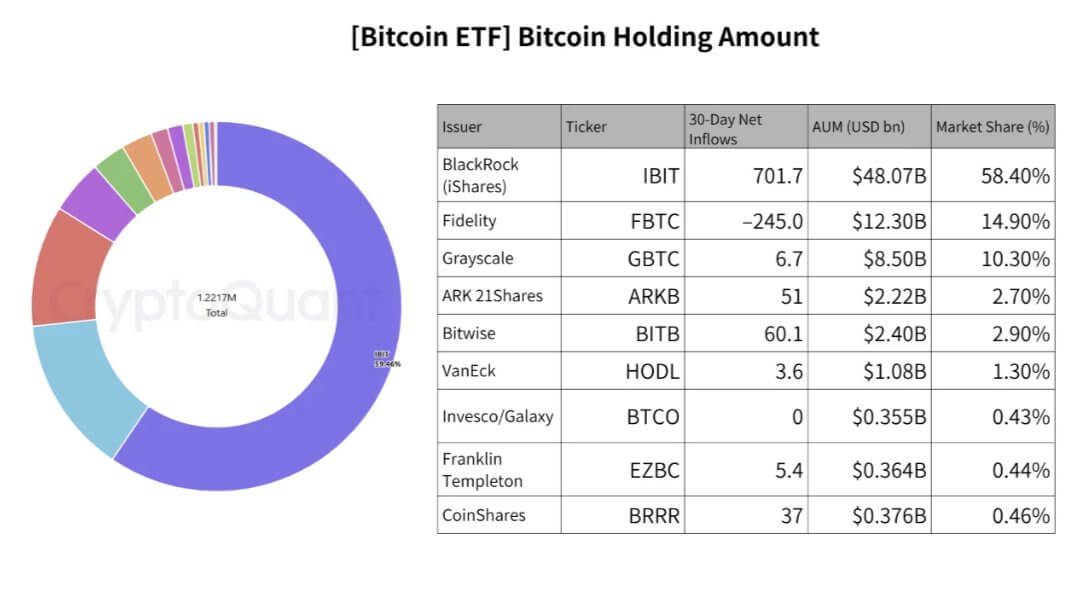
The timing of these inflows is significant. It demonstrates that institutional appetite for Bitcoin remains resilient even during periods of regulatory uncertainty and technical security scares. The fact that products managed by firms like BlackRock and Fidelity continue to draw capital suggests that Bitcoin is increasingly viewed as a "macro asset" rather than a speculative tech play. This institutional floor has been instrumental in preventing Bitcoin from sliding back toward the $50,000 range during the recent period of consolidation.
Whale Accumulation and the Transfer of Supply
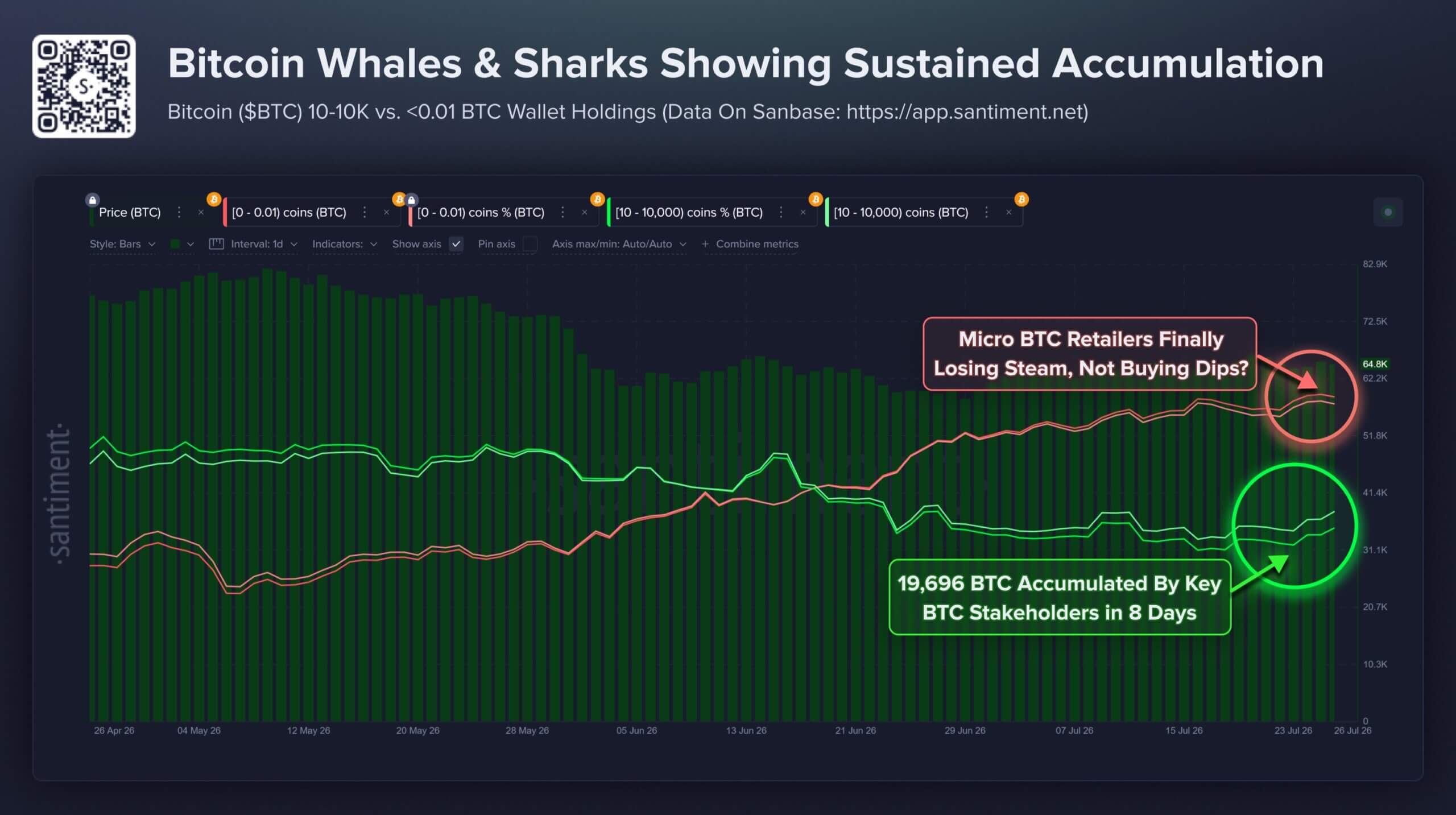
Parallel to the ETF inflows, large-scale on-chain holders—often referred to as "whales"—have been aggressively increasing their positions. Santiment data reveals that wallets holding between 10 BTC and 10,000 BTC have collectively added more than 20,000 Bitcoin to their balances since July 29. At current market prices, these purchases are valued at more than $1.2 billion.
Conversely, smaller retail wallets have seen a steady reduction in their balances. This trend indicates a massive transfer of supply from "weak hands"—smaller investors discouraged by stagnant prices—to "strong hands" with longer-term investment horizons and larger balance sheets. Historically, such a concentration of supply in larger wallets has been a precursor to sustained bullish trends, as it reduces the amount of liquid supply available on exchanges.
The Derivatives Market: A Cautious Outlook
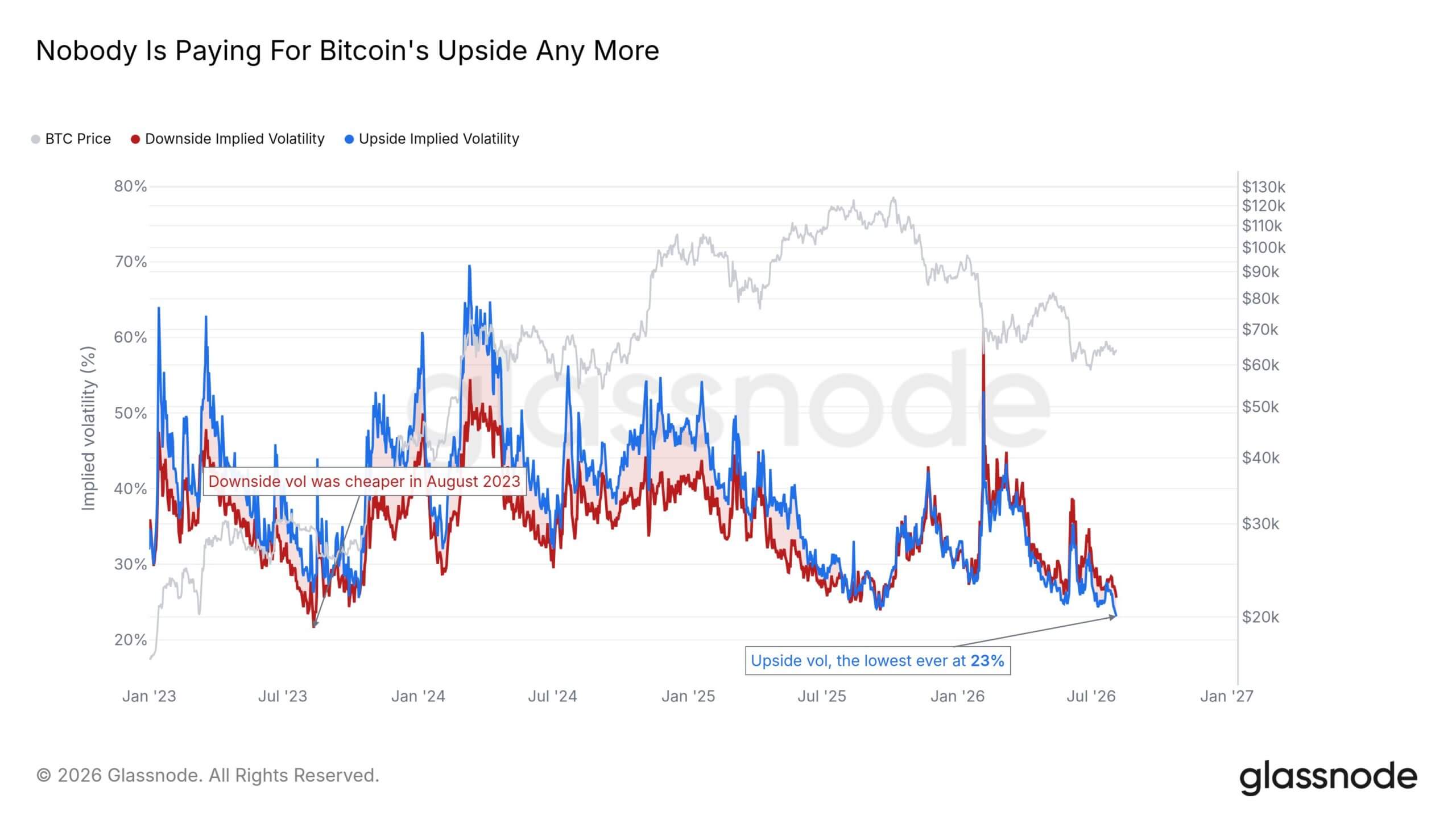
Despite the positive developments in the spot market and on-chain accumulation, the derivatives market remains strikingly cautious. Traders appear hesitant to bet on a definitive breakout above the $70,000 mark.
Data from Glassnode shows that Bitcoin’s upside implied volatility has dropped to approximately 23%, its lowest recorded level. This metric suggests that traders are unwilling to pay high premiums for call options, indicating a lack of conviction regarding a near-term "moonshot" rally. Similarly, demand for downside protection through put options is also muted, suggesting a market that expects continued range-bound trading rather than a dramatic move in either direction.
In the CME Bitcoin futures market, the positioning of leveraged funds remains heavily net short. CryptoQuant data shows that these short positions are currently near the upper end of their three-year historical range. While a heavy short position can often be interpreted as a bearish signal, analysts note that these positions are frequently part of "basis trades." In a basis trade, institutional investors buy spot Bitcoin (often via ETFs) and simultaneously sell futures to capture the price difference, or "carry." Therefore, the high short interest may actually be a reflection of high ETF demand rather than an outright bet against Bitcoin’s price.
Implications for Future Price Discovery
The divergence between spot market strength and derivatives market caution creates a unique setup for the coming months. If Bitcoin continues to hold above $65,000 and begins to challenge the $70,000 resistance level, the high concentration of short positions in the futures market could trigger a "short squeeze." Such an event would force short-sellers to buy back Bitcoin to cover their positions, potentially accelerating a move toward new all-time highs.
However, for a sustained breakout to occur, the market likely needs to see an expansion in open interest and broader participation across both retail and institutional sectors. While the "supply side" of the equation looks increasingly constrained due to whale accumulation and ETF absorption, the "demand side" still lacks the speculative fervor typically seen during the peak of a bull cycle.
For now, Bitcoin’s ability to withstand a "wall of worry"—comprising security breaches, legislative gridlock, and macro-economic uncertainty—serves as a testament to its growing role within the global financial ecosystem. The market has reached a state where negative news no longer triggers the reflexive sell-offs of years past, suggesting that Bitcoin has entered a new phase of institutional maturity and structural stability.