admin
admin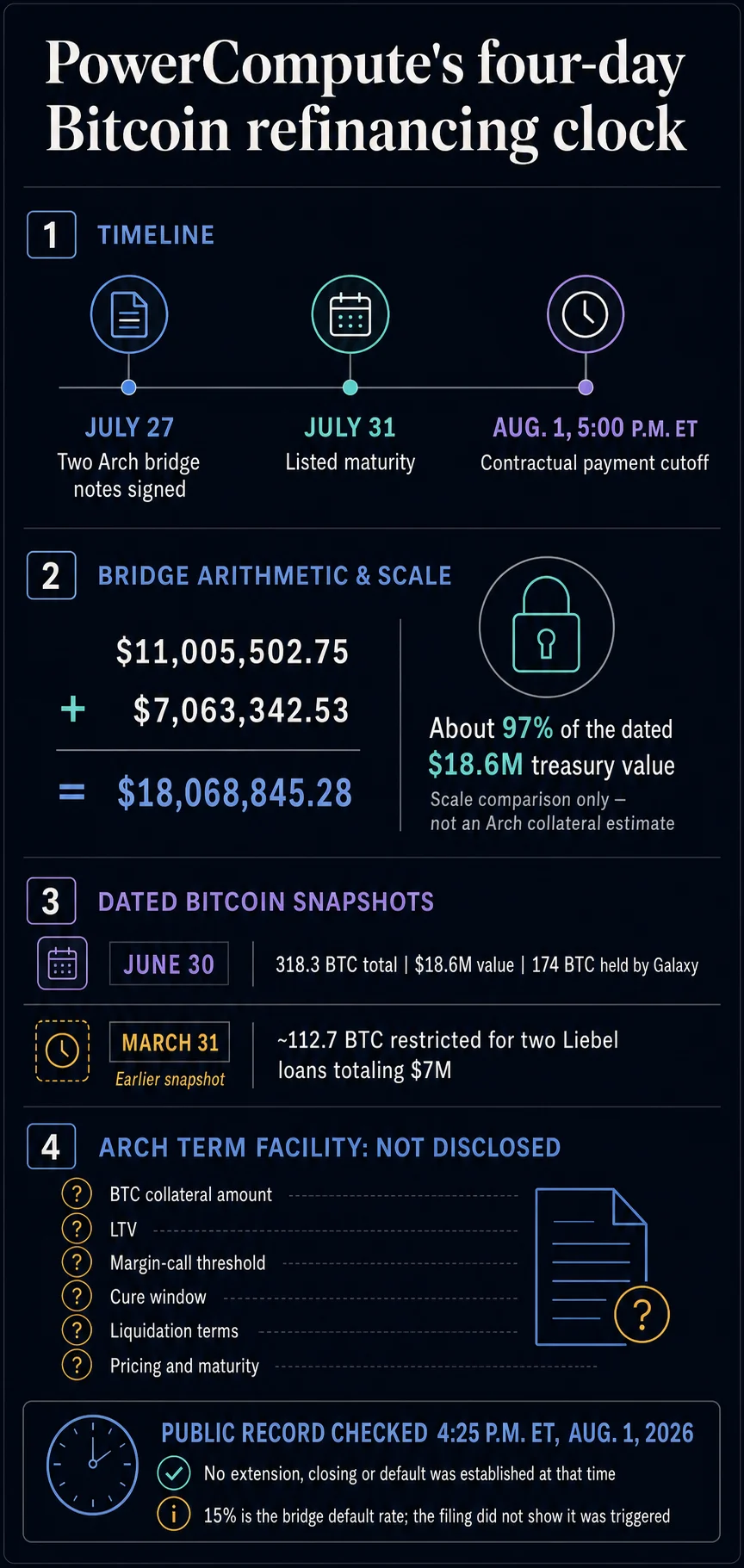
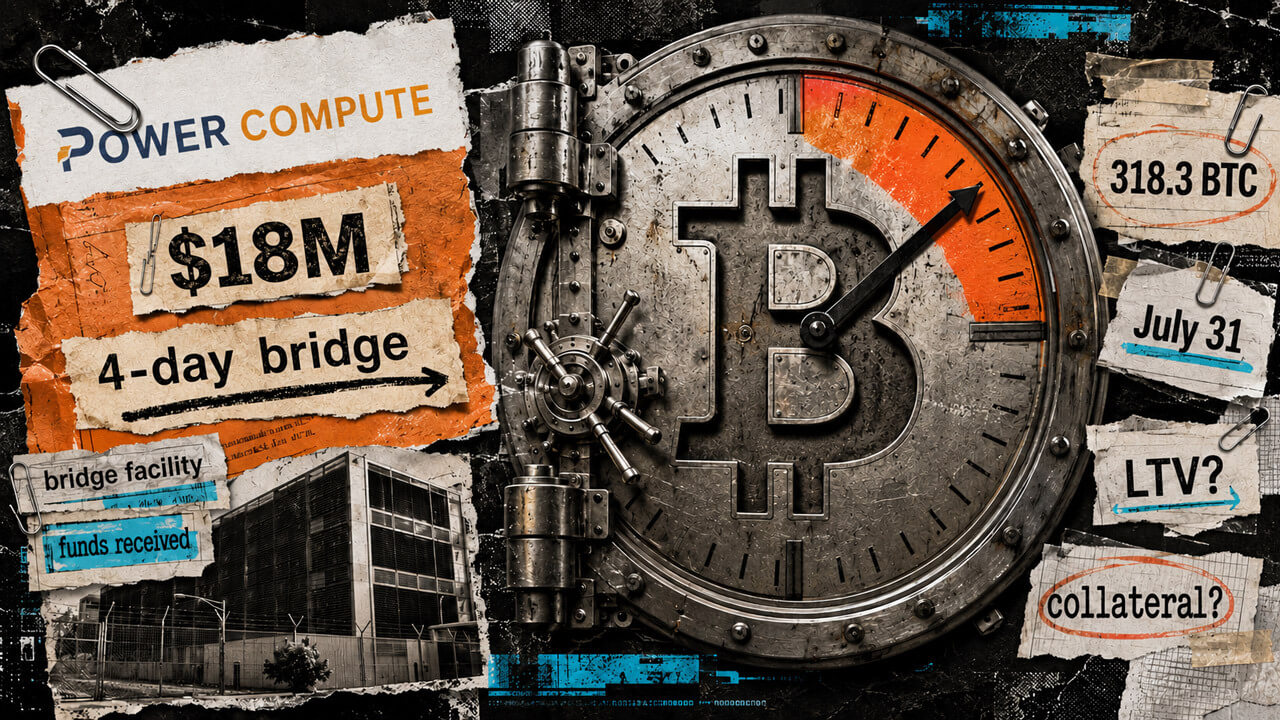
PowerCompute, a prominent Bitcoin miner with strategic ambitions in high-performance computing, has found itself at a critical juncture following a high-stakes, short-term financing maneuver. The company, through its subsidiary US Digital, secured approximately $18.07 million in bridge financing from Arch Lending, a transaction that now hangs precariously in the balance as the repayment deadline has passed without immediate public resolution. This audacious gamble, representing nearly all of the company’s Bitcoin treasury value, underscores the intense financial pressures and agile maneuvering often characteristic of the cryptocurrency mining sector.
The Bridge Loan: A High-Stakes, Four-Day Gamble
The two bridge notes, executed on July 27, carried an exceptionally short maturity date of July 31, granting PowerCompute a mere four days to secure its financial footing. The terms of these notes allowed for repayment until 5 p.m. Eastern Time on August 1, with the explicit purpose of retiring existing debt owed to Galaxy Digital and Liebel. This short-term capital infusion was intended as a stop-gap measure while PowerCompute finalized a more substantial, anticipated term facility secured by its Bitcoin holdings.
The critical disclosure regarding these bridge notes arrived on the very day of their maturity. However, as of the latest available public records, the terms of the proposed, longer-term Bitcoin-secured facility remained largely undisclosed. PowerCompute’s live SEC filings exhibit no subsequent filings after the July 31 Form 8-K, which detailed the bridge loan. Furthermore, the company’s investor relations portal had not published any press releases pertaining to the financing arrangements following an update on July 29. This silence from the company, juxtaposed with the expired payment cutoff, has left stakeholders in a state of uncertainty regarding the loan’s resolution, potential defaults, extensions, or the successful refinancing.
Financial Tightrope: The Value of Bitcoin and Existing Debt
The magnitude of the bridge loan is particularly striking when considered against PowerCompute’s reported Bitcoin treasury. At the close of business on June 30, the company valued its entire Bitcoin holdings at approximately $18.6 million. The aggregate principal of the two bridge notes, totaling $18,068,845.28, thus represented a staggering 97% of this treasury value. This indicates an extreme reliance on its digital asset reserves to meet immediate financial obligations.
The disclosed figures reveal a detailed breakdown of the two bridge notes. The first note carries a principal amount of $11,005,502.75, while the second is for $7,063,342.53. The sum of these two amounts exceeds the rounded figure of $18 million provided in the 8-K filing by $68,845.28, a minor discrepancy that does not alter the overall high-stakes nature of the transaction.
Unpacking the Debt: Galaxy Digital and Liebel Obligations
The proceeds from the Arch Lending bridge facility were earmarked for the complete repayment of outstanding debts owed to Galaxy Digital and Liebel. PowerCompute’s financial disclosures provide some insight into these prior obligations. The company’s first-quarter filing indicated that approximately 112.7 BTC were held in restricted custody to secure two loans from SE & AJ Liebel, totaling $7 million. While the June update did not reconfirm this specific BTC amount, the July filing referred to the creditor as "DE & AJ Liebel," a subtle yet unexplained change in nomenclature that could warrant further clarification.
Moreover, PowerCompute’s annual report and first-quarter filing detailed the collateral arrangements with Galaxy Digital. At the end of December 2025, Galaxy Digital held 145 BTC. This amount had increased to 174 BTC by March 31, 2026. The terms of the Galaxy Digital agreement allowed the lender to utilize or re-hypothecate the pledged Bitcoin, with the stipulation that an equivalent quantity and type of Bitcoin would be returned upon full repayment of the loan. The increase in collateral suggests either additional borrowing or a rise in the value of the pledged assets, necessitating a higher BTC allocation.
The Unfolding Narrative: Uncertainty and Potential Implications
The silence surrounding the resolution of the bridge loan and the finalization of the Arch term facility creates a palpable sense of uncertainty. The bridge notes stipulate a 15% annual default interest rate. The absence of any public announcement suggesting this rate has been triggered could imply a variety of scenarios: the loan may have been repaid, an extension might have been quietly agreed upon, or the refinancing with Arch may have been successfully completed, albeit without immediate public disclosure.
Crucially, the terms of the anticipated Arch facility remain largely opaque. PowerCompute has not disclosed the specific amount of Bitcoin that will serve as collateral, the loan-to-value (LTV) ratio, the thresholds for margin calls, the cure periods, or the precise liquidation terms. The maturity date and pricing of this facility also remain undisclosed. Furthermore, it is unclear whether the Bitcoin previously pledged to Galaxy Digital and Liebel has been returned to PowerCompute, transferred directly to Arch as collateral, or if additional Bitcoin has been added to the collateral pool.

The lack of clarity regarding the collateral stack means that PowerCompute’s reported Bitcoin holdings as of June 30—a total of 318.3 BTC—cannot be definitively considered as unencumbered liquidity. Until the refinancing outcome is officially communicated and the specifics of the Arch facility’s collateral are elucidated, the company’s financial liquidity remains subject to speculation.
Broader Industry Context: Navigating Volatility and Capital Access
PowerCompute’s situation is emblematic of the challenges and strategies prevalent within the Bitcoin mining industry. These companies often operate with significant capital expenditures and fluctuating revenues, driven by the volatile price of Bitcoin and evolving operational costs, such as electricity and hardware. To manage cash flow, expand operations, or navigate market downturns, miners frequently engage in a variety of financing strategies, including debt financing secured by their Bitcoin assets.
Short-term bridge loans, while providing rapid access to capital, carry inherent risks, especially when they represent a substantial portion of a company’s asset base and are tied to the successful execution of a larger, more complex financing deal. The tight four-day window for repayment in this instance highlights an aggressive approach to financial management, likely driven by an urgent need to meet existing obligations before the anticipated term facility could be finalized.
The delay in disclosure could also reflect ongoing negotiations or a period of internal assessment as the company works to secure its longer-term financial stability. The market will be keenly watching for PowerCompute’s next official communication, which will shed light on the resolution of this high-stakes financing gamble and provide a clearer picture of its operational and financial trajectory. The implications of this event extend beyond PowerCompute, serving as a reminder of the financial intricacies and risks inherent in the rapidly evolving Bitcoin mining sector, where capital access and asset management are paramount to survival and growth. The company’s expansion into high-performance computing further adds a layer of diversification, but the immediate focus remains on resolving this critical financing juncture.