James Watt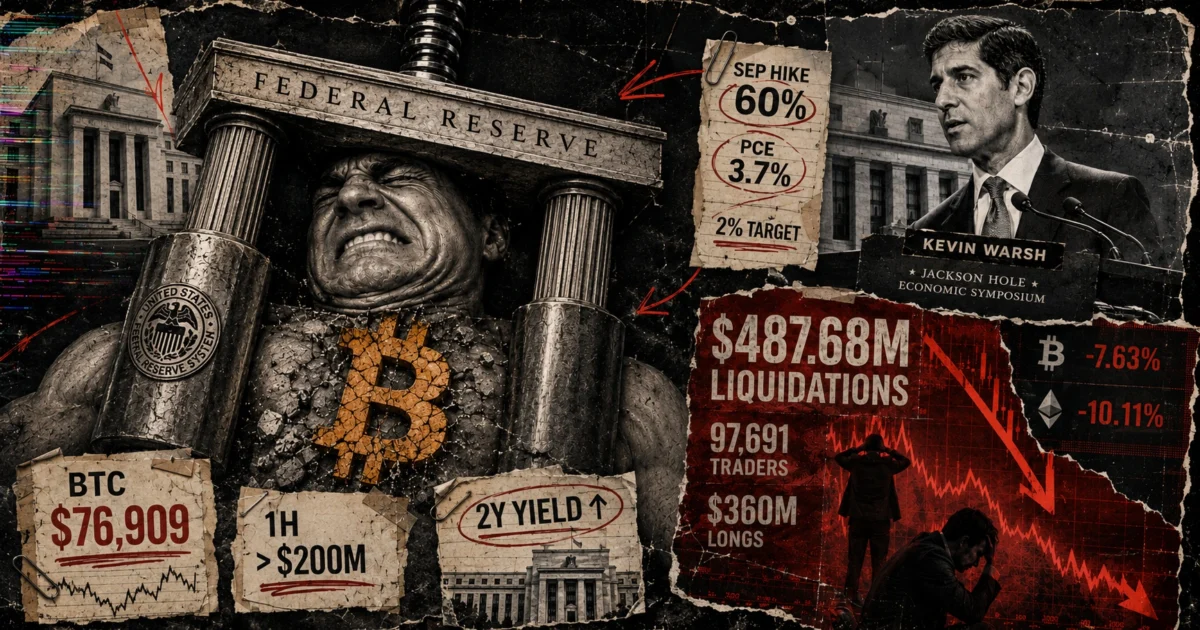
The global cryptocurrency market experienced a sharp correction on Friday as Bitcoin, the world’s largest digital asset by market capitalization, plummeted below the critical $77,000 threshold. The selloff was triggered by a surprisingly hawkish address from Federal Reserve Chairman Kevin Warsh at the Jackson Hole Economic Symposium, where he effectively dampened hopes for a near-term pivot toward easier monetary policy. According to real-time data from CryptoSlate, Bitcoin fell to a session low of $76,909 before staging a modest recovery to approximately $77,712 at the time of reporting. This represented a 4% decline within a 24-hour window, a move that catalyzed a massive wave of liquidations across the broader digital asset ecosystem.
The volatility observed on Friday underscores the continued sensitivity of risk assets to macroeconomic signaling. For much of the preceding week, market participants had been pricing in a more dovish tone from the central bank, with many anticipating that cooling inflation figures would lead to a rate cut or at least a pause in the tightening cycle. However, Chairman Warsh’s remarks fundamentally altered that narrative, prompting a rapid repricing of Federal Reserve expectations. Traders quickly adjusted the probability of a interest rate hike in September, which surged to roughly 60%, up significantly from the 35% probability seen prior to the speech.
The Jackson Hole Catalyst: A Shift in Monetary Philosophy
The Jackson Hole Economic Symposium, an annual gathering of central bankers, finance ministers, and academics in Wyoming, has historically served as a platform for major policy shifts. This year, the focus was squarely on whether the Federal Reserve believed it had done enough to quell inflation. Chairman Warsh’s address provided a definitive, if uncomfortable, answer for investors. He argued that despite recent improvements in price stability readings during the summer months, inflation remains stubbornly above the central bank’s long-term 2% target.
Warsh specifically highlighted the Personal Consumption Expenditures (PCE) price index, the Fed’s preferred metric for measuring inflation. Currently, the PCE is running at a 3.7% annual rate, with a more concerning 4.1% annualized pace recorded over the past six months. These figures, Warsh noted, suggest that the "underlying trend" of inflation has not yet been broken. "We must be confident that underlying inflation is moving to our objective, clearly and at sufficient speed," Warsh stated during his address. "Otherwise, we have work to do."
Beyond the raw inflation data, Warsh challenged the prevailing market sentiment that current borrowing costs are already restrictive enough to cool the economy. He pointed toward credit markets, noting that corporate bond spreads remain historically narrow and bank lending standards have stayed relatively accessible. From the Fed’s perspective, these indicators suggest that financial conditions may still be too loose to effectively bring inflation back to heel. "I would be hard pressed to describe broad financial conditions as restrictive," he added, a statement that sent a clear signal to both equity and crypto markets that the era of high interest rates may persist longer than anticipated.
Cascading Liquidations and the Impact on Leveraged Traders
The sudden shift in the interest rate outlook had immediate and devastating consequences for leveraged traders in the cryptocurrency market. Bitcoin had recently enjoyed a rally that took it above the $80,000 mark, a psychological milestone that had encouraged many retail and institutional investors to take on significant debt-funded exposure. When the price began its descent following the Jackson Hole remarks, it triggered a "long squeeze"—a phenomenon where falling prices force the automatic closure of long positions, further accelerating the downward momentum.
Data from the analytics platform CoinGlass revealed that the market-wide deleveraging event resulted in the liquidation of $487.68 million in positions over a 24-hour period. The scale of the wipeout was immense, affecting nearly 98,000 individual traders. Notably, over $200 million of these liquidations occurred within just one hour of Chairman Warsh’s speech. Long positions, which are bets on rising prices, accounted for more than $360 million of the total losses. Bitcoin-specific positions alone saw $141 million in liquidations, while the largest single liquidation event was recorded on the Binance exchange, involving an $11.66 million ETH-USDT position.
This level of forced selling highlights the inherent fragility of a market built on high leverage. When macro catalysts shift the fundamental outlook, the technical structure of the crypto market often exacerbates the move. The liquidation of long positions creates a feedback loop of selling pressure that can decouple the asset’s price from its long-term value proposition in the short term.
Cross-Asset Contagion: Beyond the Crypto Sphere
While the headlines focused on Bitcoin’s retreat, the "Warsh Shock" reverberated across all major asset classes. The traditional safe-haven markets of gold and silver were not immune to the hawkish rhetoric. Reports following the speech indicated that the precious metals market saw a collective loss of more than $700 billion in market value. The rationale behind this move is rooted in the relationship between interest rates and non-yielding assets. When interest rates rise, the opportunity cost of holding gold or Bitcoin—neither of which pays a dividend or interest—increases, making interest-bearing assets like US Treasuries more attractive.
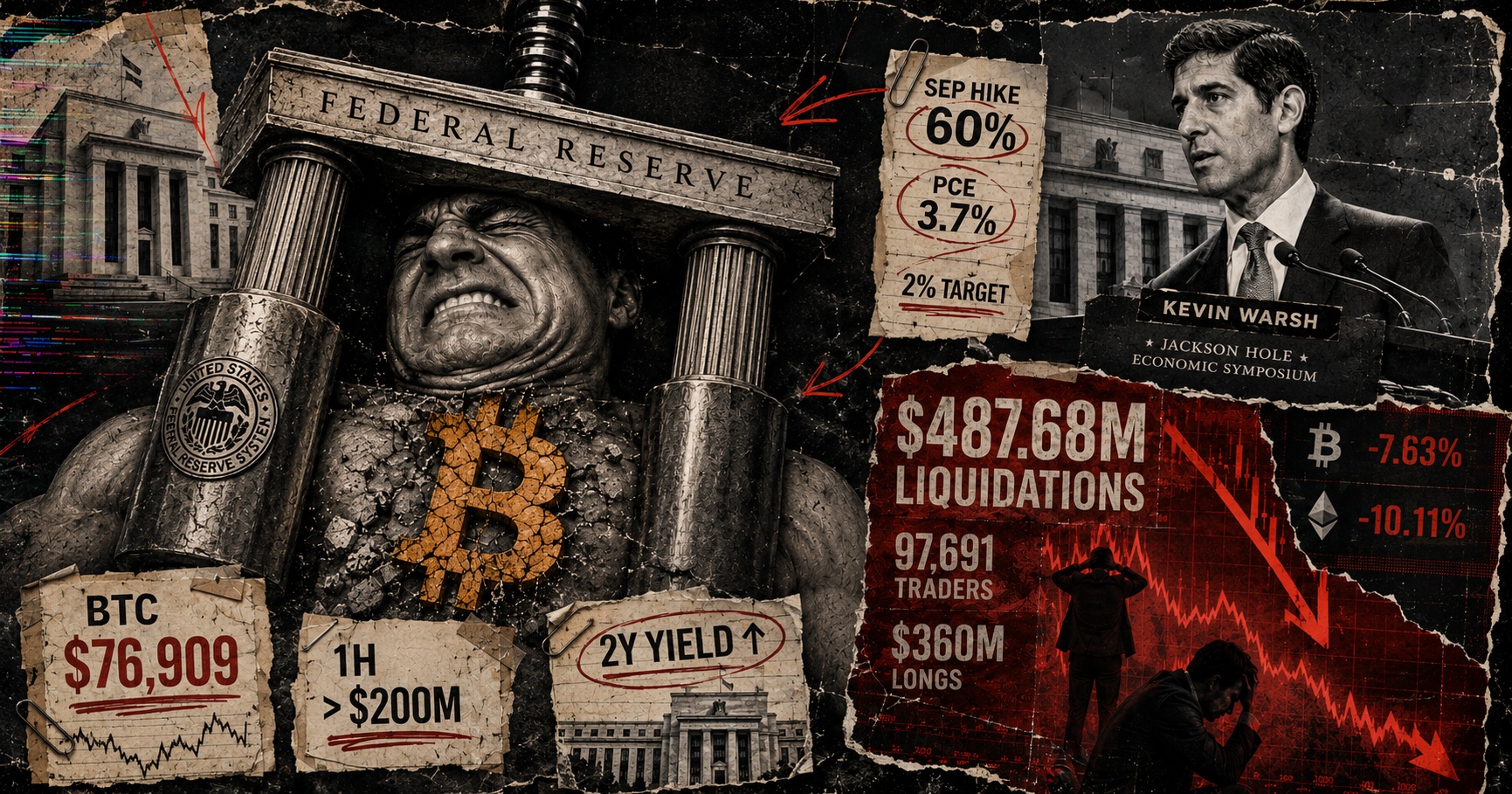
The bond market reacted with equal vigor. The two-year Treasury yield, which is particularly sensitive to changes in Fed policy, climbed to a one-month high as investors priced in the increased likelihood of a September rate hike. Simultaneously, the US Dollar Index (DXY) strengthened against a basket of major currencies. A stronger dollar typically acts as a headwind for Bitcoin, which is priced globally in USD; as the dollar’s purchasing power increases, the nominal price of the digital asset often faces downward pressure.
Furthermore, the tightening of financial conditions reduces the overall liquidity available in the global financial system. Bitcoin has historically thrived in high-liquidity environments, often acting as a "liquidity barometer." As the Fed signals a commitment to maintaining a restrictive stance, the "excess" capital that typically flows into speculative or high-growth assets begins to dry up, leading to the stagnation or reversal of price trends.
The End of Forward Guidance and the Rise of Data Volatility
One of the most significant takeaways from Warsh’s Friday address was his explicit move away from "forward guidance." For nearly three decades, Federal Reserve chairs have used carefully messaged forecasts to telegraph future policy moves, aiming to minimize market volatility and provide a predictable path for investors. Warsh, however, argued that this practice can be counterproductive, potentially distorting market signals and boxing the central bank into decisions that may no longer be appropriate as economic conditions evolve.
By rejecting a mechanical reaction function—where specific data points lead to guaranteed policy responses—Warsh has introduced a new era of uncertainty. He emphasized that markets should form their own expectations based on the raw data rather than looking to the Fed for their "next trade."
Apollo Global Management Chief Economist Torsten Slok has previously noted that such a regime change could lead to increased volatility on non-meeting days. In this new environment, every major economic release—whether it be the Consumer Price Index (CPI), non-farm payrolls, or retail sales data—becomes a high-stakes event. Without the "cushion" of Fed guidance, investors are forced to continuously reprice assets in real-time. Friday’s reaction in the Bitcoin market served as a potent example of this new reality: a single speech, devoid of a specific commitment to a rate hike, was enough to erase billions in market value because it removed the safety net of anticipated easing.
Implications for the Future of Digital Assets
The current macroeconomic backdrop poses a unique challenge for Bitcoin’s "digital gold" narrative. While proponents argue that Bitcoin serves as a hedge against currency debasement and central bank mismanagement, its short-term price action remains deeply tethered to traditional financial cycles. As long as the Federal Reserve prioritizes price stability over market liquidity, Bitcoin is likely to face continued headwinds.
However, some analysts suggest that this period of "cleansing" is necessary for the long-term health of the market. The removal of excessive leverage and the exit of "weak hands" can create a more stable foundation for future growth. Moreover, the resilience of the US economy, cited by Warsh as a reason for keeping rates high, is a double-edged sword. While it allows the Fed to remain hawkish, it also suggests that the fundamental demand for alternative assets could return once the inflation genie is back in the bottle.
As the market looks toward the September FOMC meeting, all eyes will be on the incoming labor and inflation reports. If employment remains strong and PCE figures do not show a significant deceleration, the threat of a rate hike will remain a dominant theme. For Bitcoin, the path back to $80,000 and beyond now appears to be contingent not just on internal industry developments like ETF inflows or halving cycles, but on the broader battle between the Federal Reserve and the persistent forces of global inflation.
In conclusion, Friday’s market activity was a stark reminder that Bitcoin does not exist in a vacuum. The hawkish pivot by Kevin Warsh has re-established the Federal Reserve as the primary driver of crypto price action, setting the stage for a volatile autumn as the market grapples with the reality of "higher for longer" interest rates. Investors are now forced to navigate a landscape where the central bank has stopped providing a roadmap, leaving the data—and the market’s interpretation of it—to dictate the next move.