Layla Zulfa
Bitcoin experienced a violent upward trajectory on Wednesday, decisively reclaiming the $69,000 level and reaching an intraday peak of $69,749. This 8.7% surge represents the most significant single-day price appreciation for the world’s largest cryptocurrency since March 4, effectively erasing months of stagnant price action and returning the asset to heights not seen since early June. The suddenness of the move caught market participants off guard, transforming a period of bearish consolidation into a high-volatility breakout that has recalibrated expectations across the digital asset landscape.
The catalyst for this rally appears to be a confluence of macroeconomic shifts and shifting regulatory tides in the United States. Unlike previous rallies driven by internal crypto-sector developments, this particular move was precipitated by a significant policy adjustment from the U.S. Treasury and a series of high-level meetings in Washington D.C. that suggest a potential softening of the adversarial relationship between the federal government and the blockchain industry.
The Macroeconomic Trigger: Treasury Buybacks and ‘QE Lite’
The primary driver for Wednesday’s market volatility was an unexpected announcement from the U.S. Treasury Department regarding its debt management strategy. Officials confirmed that the Treasury will significantly expand its long-bond buyback program, doubling the size of its operations from $2 billion to $4 billion per session, effective September 9. By purchasing its own long-dated securities, the Treasury effectively injects liquidity into the financial system and exerts downward pressure on long-end bond yields.
Market analysts have characterized this maneuver as "QE Lite"—a reference to Quantitative Easing—because it achieves similar results to central bank intervention by loosening financial conditions without a formal change in interest rate policy from the Federal Reserve. As yields on long-term Treasuries fell following the announcement, the opportunity cost of holding non-yielding assets like Bitcoin decreased. Simultaneously, the U.S. Dollar Index (DXY) showed signs of weakness, making dollar-denominated assets more attractive to international investors. Historically, Bitcoin has maintained a strong inverse correlation with the dollar and Treasury yields, and Wednesday’s price action served as a textbook validation of that relationship.
Regulatory Thaw: White House Engagement and SEC Proposals
While the Treasury’s move provided the economic fuel, the political environment provided the spark. On Wednesday, senior executives from the cryptocurrency industry met with White House officials and representatives from various regulatory bodies. While the specific details of the closed-door meeting remain confidential, participants described the tone as "constructive," focusing on establishing a clearer framework for digital asset custody and domestic mining operations.
Adding to the bullish sentiment, the Securities and Exchange Commission (SEC) released a fresh proposal aimed at streamlining the registration process for certain digital asset offerings. The proposal seeks to ease the compliance burden for firms looking to issue tokens under specific exemptions, potentially opening the door for a new wave of regulated capital formation within the United States. For an industry that has spent years embroiled in "regulation by enforcement," these developments were interpreted by traders as a signal that the regulatory "war on crypto" may be entering a period of de-escalation.

The Liquidation Event: A Billion-Dollar Short Squeeze
The rapid ascent of Bitcoin’s price triggered a massive short squeeze, a market phenomenon where traders who bet against the asset are forced to buy back their positions as prices rise, further accelerating the upward momentum. Data from the liquidation panel at CoinGlass revealed that over $1.14 billion in short positions were wiped out across the entire crypto market within a single hour.
Bitcoin alone accounted for approximately $677.64 million of these liquidations. This "cascading effect" saw the price jump through several resistance levels in minutes, as automated stop-loss orders were triggered and margin calls forced bears to exit their positions. The intensity of the squeeze suggests that the market was heavily skewed toward the downside prior to the Treasury announcement, leaving a large portion of professional traders "off-sides" and vulnerable to a sharp reversal.
Synchronized Rally in Crypto-Linked Equities
The optimism in the spot Bitcoin market quickly spilled over into traditional equity markets, particularly for companies with significant balance sheet exposure to digital assets or those providing infrastructure for the ecosystem. MicroStrategy (Strategy), the largest corporate holder of Bitcoin, saw its stock price climb nearly 12% on the day. The company’s aggressive acquisition strategy has made its stock a de facto proxy for Bitcoin for institutional investors who prefer trading through traditional brokerage accounts.
Other major players in the space followed suit. Coinbase, the leading U.S. cryptocurrency exchange, gained 9%, while Circle and the mining firm BitMine both saw gains ranging between 9% and 10%. The synchronized move across both spot markets and equities indicates a broader return of risk appetite among institutional investors, who are increasingly viewing crypto-linked stocks as high-beta plays on a loosening monetary environment.
Sentiment Flip in Prediction Markets
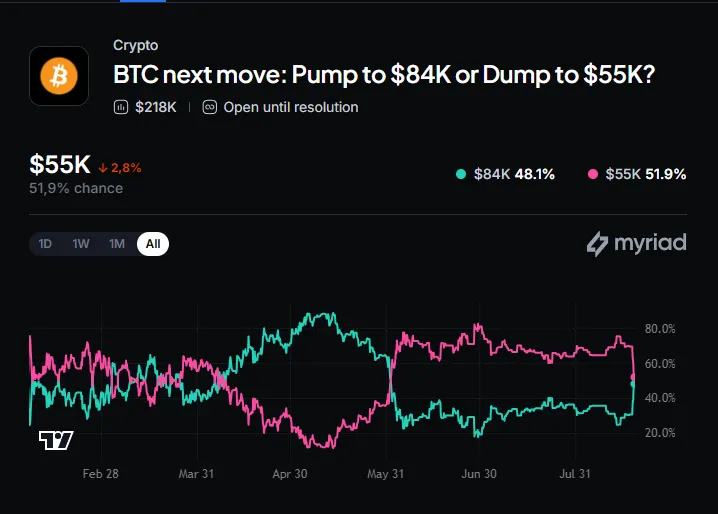
One of the most striking aspects of Wednesday’s rally was how quickly it forced a reassessment of future price targets. Prediction markets, which allow users to wager on specific outcomes, serve as a real-time barometer for market sentiment. Prior to the rally, traders on the Myriad platform—a prediction market operated by the parent company of Decrypt—were overwhelmingly bearish. Just 48 hours ago, participants assigned a 70% probability to Bitcoin "dumping" to the $55,000 level before it could reach $84,000.
By Wednesday afternoon, that sentiment had undergone a total reversal. The odds on Myriad shifted to a near-perfect 50/50 split, with $55,000 holding a slight 51.9% lead over the $84,000 "pump" target at 48.1%. This rapid realignment highlights the "shock and awe" nature of the move; traders who were convinced of further downside were forced to hedge their bets or abandon their bearish theses entirely.
Similar trends were observed on other platforms. Polymarket’s flagship 2026 Bitcoin price market had previously priced in a 56% chance of Bitcoin touching $55,000 before the end of the year. Following the surge past $69,000, those odds plummeted as the probability of a run toward $75,000 and beyond began to climb. On Kalshi, traders who had given Bitcoin only a 31% chance of hitting $70,000 in August were forced to watch as the asset blew through that threshold with ease, illustrating a significant disconnect between market positioning and actual price delivery.
Technical Analysis and Future Resistance
From a technical perspective, Bitcoin’s move has significantly altered the daily and weekly charts. The asset has successfully broken out of a descending channel that had constrained price action since the June 1 highs. However, the path to a new all-time high is not without obstacles.
The next major "line in the sand" for bulls is the $70,284 mark. This level represents the lower boundary of a historical resistance band that has acted as a ceiling for the market over the last several months. A daily close above $70,284 would likely signal the start of a sustained trend toward the $73,245 level, which sits just below the previous all-time high.
Conversely, market analysts warn that the move was so rapid that a period of consolidation or a "retest" of previous resistance-turned-support is likely. If Bitcoin fails to maintain its footing above $68,000, it risks falling back into the range-bound chop that characterized the mid-summer months. The $68,000 level is now viewed as a critical support zone; as long as the price stays above this threshold, the technical bias remains firmly bullish.
Broader Implications for the 2026 Market
The events of August 19, 2026, may be remembered as a turning point for the current market cycle. The combination of Treasury-led liquidity and a more conciliatory regulatory environment suggests that the "macro-crypto" bridge is strengthening. As the U.S. government grapples with debt management, its maneuvers in the bond market are inadvertently creating a favorable environment for "hard money" assets like Bitcoin.
Furthermore, the record-breaking volumes seen in prediction markets like Polymarket and Myriad suggest that these platforms are becoming integral to how price discovery occurs. Traders are no longer just looking at order books; they are looking at the collective wisdom—and the collective errors—of the betting public to gauge where the next "short squeeze" might occur.
As the market digests the gains from this 8.7% move, the focus shifts to the sustainability of the rally. If the Treasury continues its aggressive buyback program into September and the SEC follows through on its promise of eased registration rules, the $84,000 target favored by the bulls may soon move from a "coin flip" to a consensus expectation. For now, the "green candle" of Wednesday has served as a potent reminder of Bitcoin’s ability to punish complacency and redefine the financial narrative in a single afternoon.