James Watt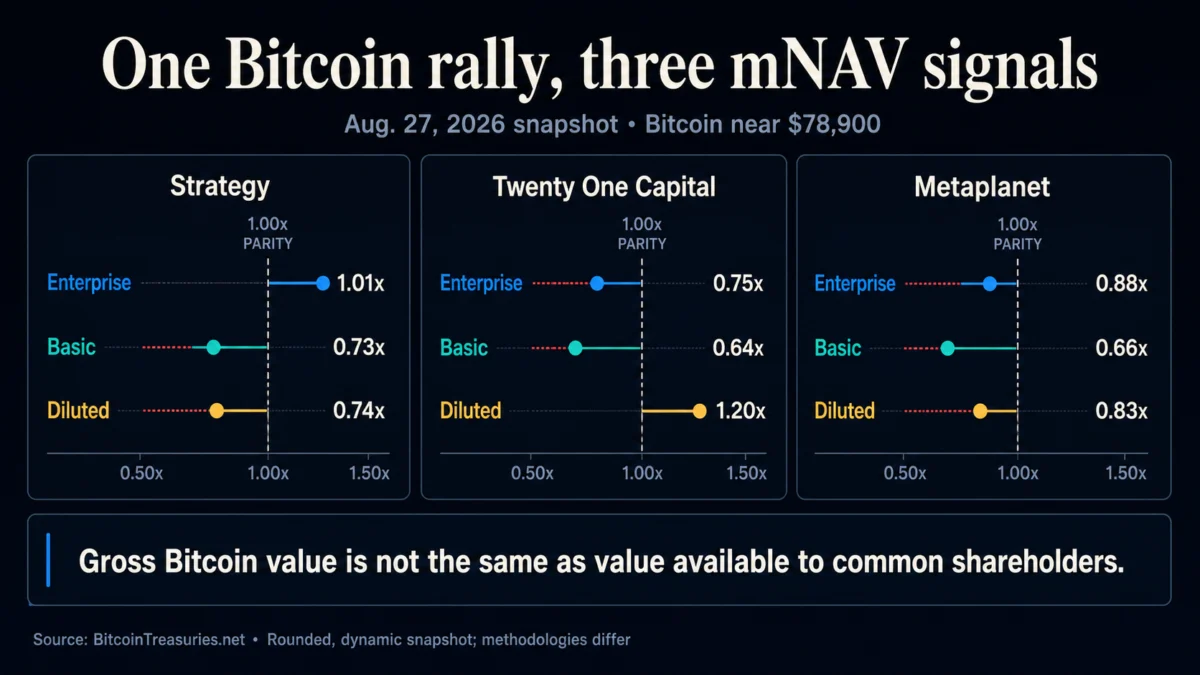
Bitcoin price is trading near $78,900, close enough to the psychological $80,000 threshold to revive the long-standing pitch for corporate treasuries: higher Bitcoin prices should theoretically lift the market value of corporate holdings, pull shares back above their net asset value (NAV), and reopen common-stock issuance as a sustainable source of capital for fresh acquisitions. However, as the market entered the final week of August 2026, this expected sequence failed to materialize. At Strategy, Twenty One Capital, and Metaplanet—three prominent listed companies built around aggressive digital asset treasuries—common market capitalization remained significantly below the gross value of reported Bitcoin holdings. This disconnect suggests that the "equity flywheel," which previously allowed these firms to accumulate Bitcoin through accretive share issuance, has stalled, creating a complex valuation puzzle for investors and a funding challenge for management.
The apparent discount observed across these firms is not uniform, nor does it represent a simple opportunity for investors to acquire "cut-price" Bitcoin through the equity markets. Instead, the gap between market capitalization and Bitcoin value is a reflection of complex capital structures. Factors such as outstanding debt, preferred stock, pledged coins, cash balances, and various warrant structures have fundamentally altered the residual value available to common shareholders. Consequently, the relationship between a company’s share price and its underlying Bitcoin stack has become increasingly opaque, leading to a breakdown in the traditional premium-based funding model.
The Mechanics of mNAV and the Valuation Disconnect
To understand the current state of Bitcoin treasury companies, analysts rely on the Market Net Asset Value (mNAV) ratio. This metric compares a company’s valuation to the value of its Bitcoin holdings through three distinct lenses: Basic, Diluted, and Enterprise mNAV. According to an analytical snapshot taken on August 27, 2026, these ratios revealed a stark divergence in how the market values different treasury strategies.
Basic mNAV compares the basic common market capitalization directly against the gross Bitcoin value. Diluted mNAV expands the share denominator to include potential shares from warrants, options, and convertible debt. Enterprise mNAV provides the most comprehensive view by adding total debt and preferred stock to the market cap and subtracting cash before comparing the resulting enterprise value to the Bitcoin stack.
The August 27 data highlighted significant discrepancies. Strategy, for instance, showed an Enterprise mNAV of 1.01x, suggesting its total corporate value is roughly on par with its Bitcoin holdings. However, its Basic and Diluted mNAV hovered much lower at 0.73x and 0.74x, respectively. Twenty One Capital presented an even more extreme case, with a Basic mNAV of 0.64x but a Diluted mNAV of 1.20x. These variations underscore the danger of the "market cap below Bitcoin value" narrative; a share is a residual interest in a complex entity, not a direct claim or withdrawal ticket for the underlying coins. Common holders sit behind creditors and preferred investors, absorb the impact of future dilution, and remain exposed to operating costs, taxes, and governance risks.
Strategy: Prioritizing Liquidity Over Accumulation
Strategy, the largest of the three entities with a reported holding of 840,447 BTC, provides the clearest evidence that the equity flywheel is currently inactive. Despite its enterprise value returning to parity with its Bitcoin holdings, the company’s common equity continues to trade at a steep discount to the gross value of its coins.
Between August 17 and August 23, 2026, Strategy sold 18.26 million shares, generating approximately $2.0065 billion in net proceeds. In a departure from previous cycles where such proceeds were immediately channeled into Bitcoin purchases, the company’s August 24 SEC filing revealed no new Bitcoin acquisitions for that period. Instead, Strategy allocated $136.4 million to repurchase its STRC preferred stock, moved $300 million into a USD Reserve, and funneled the remainder into USD Cash.
This strategic shift is significant. By the end of the reporting period, Strategy held a $5.10 billion USD Reserve and $1.59 billion in cash, alongside its massive Bitcoin stack. The decision to bolster liquidity and retire senior securities rather than buy more Bitcoin indicates a focus on balance sheet fortification. With approximately $6.75 billion in debt principal and an estimated $1.76 billion in annual preferred dividends and debt interest, the company is prioritizing the management of its senior claims.
For common investors, this means that share issuance no longer mechanically increases the amount of Bitcoin held per share. When a company issues stock while trading at a discount to its Bitcoin holdings, it risks diluting the "Bitcoin-per-share" ratio unless the proceeds are used in a way that creates disproportionate value. Strategy’s current stance suggests that while it can still sell shares for corporate purposes, it cannot assume that every dollar raised will be accretive to the Bitcoin stack for existing shareholders.
Twenty One Capital: The Constraints of Collateralization
Twenty One Capital offers a different perspective on the limitations of the treasury model, specifically regarding financial flexibility. As of June 30, 2026, the company reported 43,514 BTC. However, a deep dive into its second-quarter filings reveals that a significant portion of this stack is encumbered.

The company holds $486.5 million in convertible-note principal. To secure these notes, Twenty One Capital has pledged approximately 16,116 BTC—roughly 37% of its total holdings. These pledged coins are unavailable for general liquidity, meaning the company’s "gross holdings" significantly overstate its actual operational flexibility. This encumbrance is a primary reason why the market applies a discount to the shares; an investor valuing the company based on its total coin count is ignoring the fact that a large portion of those assets is tied up as collateral for senior creditors.
Furthermore, Twenty One Capital reported a net loss of $1.273 billion for the first half of 2026. While the vast majority of this loss ($1.249 billion) was attributed to a fair-value decline in Bitcoin prices rather than a cash drain, it highlights the volatility inherent in the treasury-heavy business model. The company illustrates the necessity of separating accounting equity from cash liquidity. While debt can fund further Bitcoin acquisitions without immediate dilution of the common share count, it creates senior claims and interest obligations that can limit a company’s choices during market downturns.
Metaplanet: Structural Gates and Operating Realities
Metaplanet, holding 43,000 BTC, has attempted to address the valuation problem by building financing constraints directly into its corporate structure. The company’s warrant system includes a "gate" that prevents certain rights from being exercised unless the mNAV is at least 1.01x. This is an explicit attempt to prevent dilutive issuance when the stock is trading below the value of its Bitcoin.
However, Metaplanet faces its own set of challenges, primarily the scale of its operating revenue compared to its treasury ambitions. In the first half of 2026, the company generated only ¥349 million in operating cash, a negligible amount compared to its ¥99.782 billion in Bitcoin purchases. This disparity underscores a fundamental truth for all Bitcoin treasury firms: without a massive increase in operating cash flow or a return to premium equity pricing, the pace of Bitcoin acquisition is unsustainable.
Metaplanet is also in the process of a strategic expansion through its Super League investment. This deal, expected to contribute an additional 2,100 BTC and $2.5 million in capital, will result in Super League becoming a consolidated subsidiary. While this adds to the total coin count, it also introduces non-controlling interests into the valuation equation, further complicating the mNAV calculation for common shareholders.
Chronology of Key Events: August 2026
The following timeline outlines the critical data points and filings that defined the market sentiment during this period:
- August 17–23: Strategy executes a major share sale, offloading 18.26 million MSTR shares for $2.0065 billion.
- August 24: Strategy files with the SEC, confirming that no Bitcoin was purchased with the share sale proceeds, opting instead for debt management and cash reserves.
- August 27: Bitcoin price stabilizes near $78,900. Analytical snapshots of Strategy, Twenty One Capital, and Metaplanet reveal that all three are trading at significant discounts to their basic mNAV.
- August 27: Market data confirms Twenty One Capital’s diluted mNAV (1.20x) sits in stark contrast to its basic mNAV (0.64x), highlighting the impact of its convertible debt structure.
- Late August: Metaplanet confirms that its 27th-series rights remain unexercisable as the company’s mNAV fails to clear the 1.01x threshold required for issuance.
Broader Impact and Market Implications
The current environment signals a maturation—and perhaps a cooling—of the corporate Bitcoin treasury trend. The "flywheel" effect, which relied on a virtuous cycle of premiums and acquisitions, has been replaced by a more sober reality where capital structure and liquidity management take center stage.
For the broader market, this shift suggests that simply holding Bitcoin on a balance sheet is no longer a guaranteed path to equity outperformance. Investors are becoming more sophisticated, look beyond gross coin counts, and analyze the "claims" against those coins. The presence of high debt loads, preferred shares, and restrictive collateral agreements means that a company’s Bitcoin stack is rarely "clean" for the common shareholder.
The surviving engine for these companies is now smaller and less automatic. Retained operating cash is the most sustainable way to grow a treasury without dilution or debt, but as seen with Metaplanet and Strategy, operating revenues are currently dwarfed by the scale of the treasuries they are meant to support. Debt remains an option, but it brings the risk of encumbering the very assets the company seeks to accumulate.
Ultimately, while Bitcoin’s rally toward $80,000 has repaired the "numerator" of the value equation by increasing the dollar value of the holdings, it has not yet repaired the financing terms for the companies themselves. Until these entities can either generate significantly more cash from operations or regain a defensible premium in the equity markets, the era of rapid, accretive Bitcoin accumulation may be on a forced hiatus. The next phase of corporate Bitcoin adoption will likely depend less on the price of the asset and more on the structural integrity of the companies holding it. Existing common holders are left waiting for a shift in market sentiment that once again values the corporate wrapper as more than the sum of its digital parts.