
 James Watt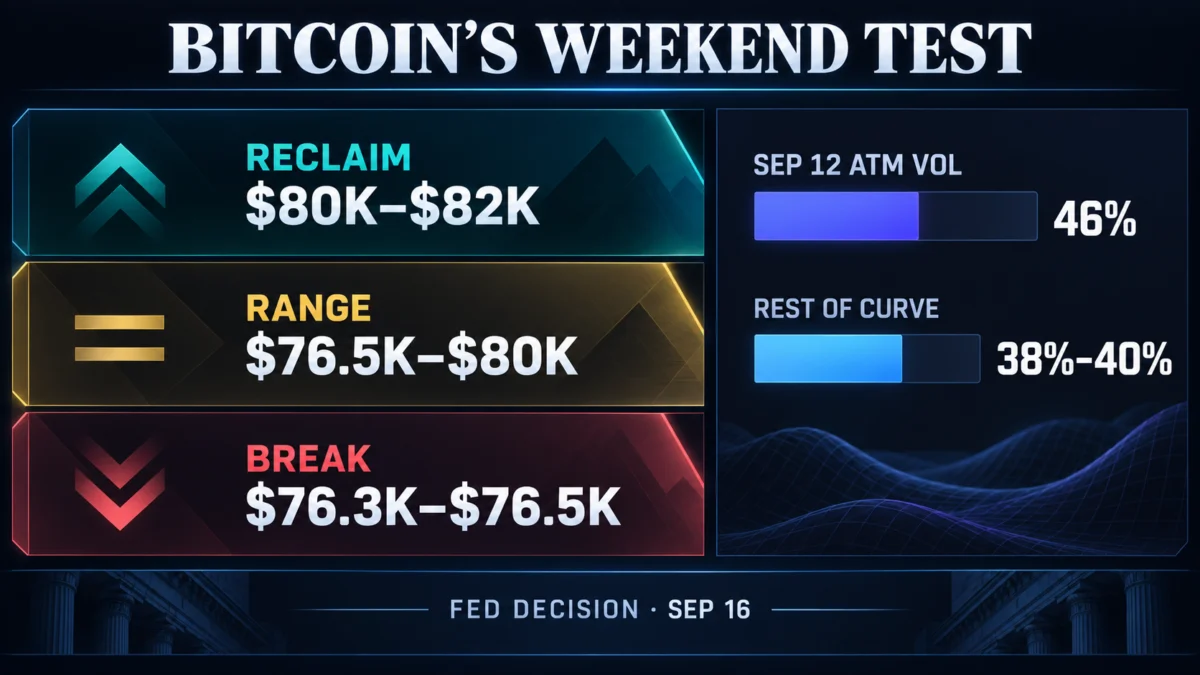
The current market environment is defined by a complex interplay of inflationary data and aggressive bond market movements. According to digital asset trading firm QCP, the resistance zone between $80,000 and $82,000 remains the primary obstacle for Bitcoin’s short-term trajectory. As the market prepares for the Federal Reserve’s mid-September policy meeting, the technical and fundamental signals are painting a picture of a market in a state of high-tension consolidation.
Macroeconomic Headwinds and the Bond Market Surge
The primary driver of the current market volatility is the release of the August Consumer Price Index (CPI) data, which showed that core inflation rose by 0.3% on a monthly basis. This figure, while largely within expectations, solidified the narrative that the Federal Reserve will maintain a restrictive monetary policy for the foreseeable future. The immediate reaction was felt most acutely in the fixed-income markets, where long-dated Treasury yields surged to levels not witnessed in decades.
The 10-year Treasury yield, a global benchmark for borrowing costs, briefly touched 4.9915%, nearing the 5% milestone for the first time in nearly three years. Simultaneously, the 30-year Treasury yield reached a 19-year peak of 5.424%. Although these yields eventually saw a modest pullback to 4.95% and 5.341%, respectively, the underlying message to investors remains clear: the era of "higher for longer" interest rates is firmly entrenched. Typically, such high yields act as a gravitational pull on risk assets like Bitcoin, as the "risk-free" return on government debt becomes increasingly attractive compared to the volatile returns of the crypto market.
Despite these tightening conditions, the equity markets chose to focus on the stability of the core CPI rather than the absolute level of yields. The S&P 500’s 1% climb suggests that stock investors are pricing in a "soft landing" scenario. Bitcoin’s inability to follow suit has raised questions about its current correlation with equities. If Bitcoin continues to struggle while stocks rise, it may indicate that the cryptocurrency is facing internal liquidity constraints or a localized exhaustion of buyers at the $80,000 level.
Chronology of the September Resistance
To understand the significance of the current stalemate, it is necessary to examine the timeline of Bitcoin’s price action throughout the early part of September. Following a period of relative stability in late August, Bitcoin began a steady climb, buoyed by institutional inflows and a general sense of optimism regarding the eventual easing of central bank policies.
On September 8 and 9, Bitcoin began testing the upper $70,000 range, finding consistent support at the $76,000 level. By September 10, anticipation of the CPI data led to a surge in trading volume, with the price pushing toward $79,000. However, the momentum failed to convert into a breakout. On September 11, the day of the CPI release, Bitcoin made its most determined run at the ceiling, reaching $79,890 before a wave of automated sell orders and profit-taking pulled the price back toward the $77,000 range.
This chronology suggests that the $80,000 level is not merely a technical resistance point but a significant psychological barrier where many long-term holders have set their exit targets. The failure to reclaim this level on a day when equities were bullish provides a cautionary signal that the "path of least resistance" for Bitcoin may not be upward in the immediate term.
Options Market Dynamics and Volatility Outlook
Data from the options market provides a deeper look into how professional traders are positioning themselves for the coming week. QCP reported that the Bitcoin options expiry scheduled for September 12 carried an at-the-money implied volatility of approximately 46%. This is notably higher than the 38% to 40% volatility observed across the rest of the forward curve, indicating that traders expect a sharp move—either up or down—in the very near future.
The concentration of turnover in calls for the $78,500 and $80,000 strikes suggests that there is still a significant contingent of traders betting on a breakout. However, this optimism is being hedged by steady demand for $75,000 puts expiring on September 11 and September 18. This "straddle" in sentiment reflects an uncertain market where participants are paying a premium for downside protection while simultaneously keeping their upside exposure active.
The options data effectively sets a "two-level test" for the market. On the downside, the $76,300 to $76,500 zone has emerged as a critical support floor. On the upside, the $80,000 to $82,000 range remains the gauntlet that Bitcoin must run to prove the validity of its recovery. A breach of the support floor would likely trigger a cascade of liquidations, potentially pushing the price toward the $70,000 mark, whereas a sustained move above $82,000 would likely signal a new leg of the bull market.
The Federal Reserve as the Ultimate Arbiter
While technical levels and options positioning provide the framework for the weekend’s price action, the Federal Reserve’s upcoming meeting on September 15-16 is the "verification event" that the market is truly waiting for. Investors are currently pricing in an 85% probability of a 25-basis-point rate hike. However, the interest rate decision itself may be secondary to the release of the new Summary of Economic Projections (SEP).
The SEP, often referred to as the "dot plot," will provide the Fed’s updated outlook on inflation, unemployment, and the future path of interest rates. If the Fed signals that it is nearing the end of its tightening cycle, Bitcoin could see a massive relief rally that easily clears the $80,000 hurdle. Conversely, if the Fed adopts a more hawkish tone—perhaps suggesting that further hikes are necessary into 2027—the $80,000 ceiling could transition from a fragile barrier into a multi-month peak.
Federal Reserve Chairman Jerome Powell’s post-meeting press conference will be scrutinized for any shift in rhetoric regarding the "neutral rate" of interest. For Bitcoin, which thrives in environments of high liquidity and low real yields, a hawkish Fed is the ultimate headwind.

Institutional Sentiment and Market Implications
The current stagnation near $80,000 also reflects a shift in institutional sentiment. After months of aggressive accumulation via spot Bitcoin ETFs, there are signs that institutional buyers are becoming more price-sensitive. The massive volume seen in earlier months has given way to more calculated, opportunistic buying.
Market analysts suggest that the $80,000 level represents a "fair value" assessment for many institutional models under current interest rate conditions. Until there is a clear catalyst—such as a definitive shift in Fed policy or a significant geopolitical event—these large-scale players may be content to let the market consolidate within the current range.
Furthermore, the impact of Bitcoin’s struggle is being felt across the broader digital asset ecosystem. Altcoins, which typically follow Bitcoin’s lead but with higher beta, have shown mixed results. While some "blue-chip" DeFi tokens have mirrored the equity market’s gains, the majority of the market remains tethered to Bitcoin’s gravitational pull. A failure of Bitcoin to break $80,000 could lead to a period of underperformance for the entire sector as capital rotates back into the perceived safety of high-yielding government bonds or resilient large-cap tech stocks.
Conclusion: A Market at a Crossroads
As the weekend approaches, the Bitcoin market finds itself at a pivotal crossroads. The evidence from the Treasury market suggests that the macro environment is as challenging as it has been in decades, yet the resilience of the S&P 500 provides a glimmer of hope for risk-on sentiment. Bitcoin’s "fragile" ceiling at $80,000 is the focal point of this tension.
The coming days will determine whether Wednesday’s failure was a temporary setback or a sign of deeper exhaustion. If Bitcoin can maintain its footing above the $76,300 support zone through the weekend, it will enter the Federal Reserve meeting with a chance to reclaim its momentum. However, if the support fails, the narrative of a "damaged recovery" will likely take hold, forcing investors to re-evaluate their outlook for the remainder of the year.
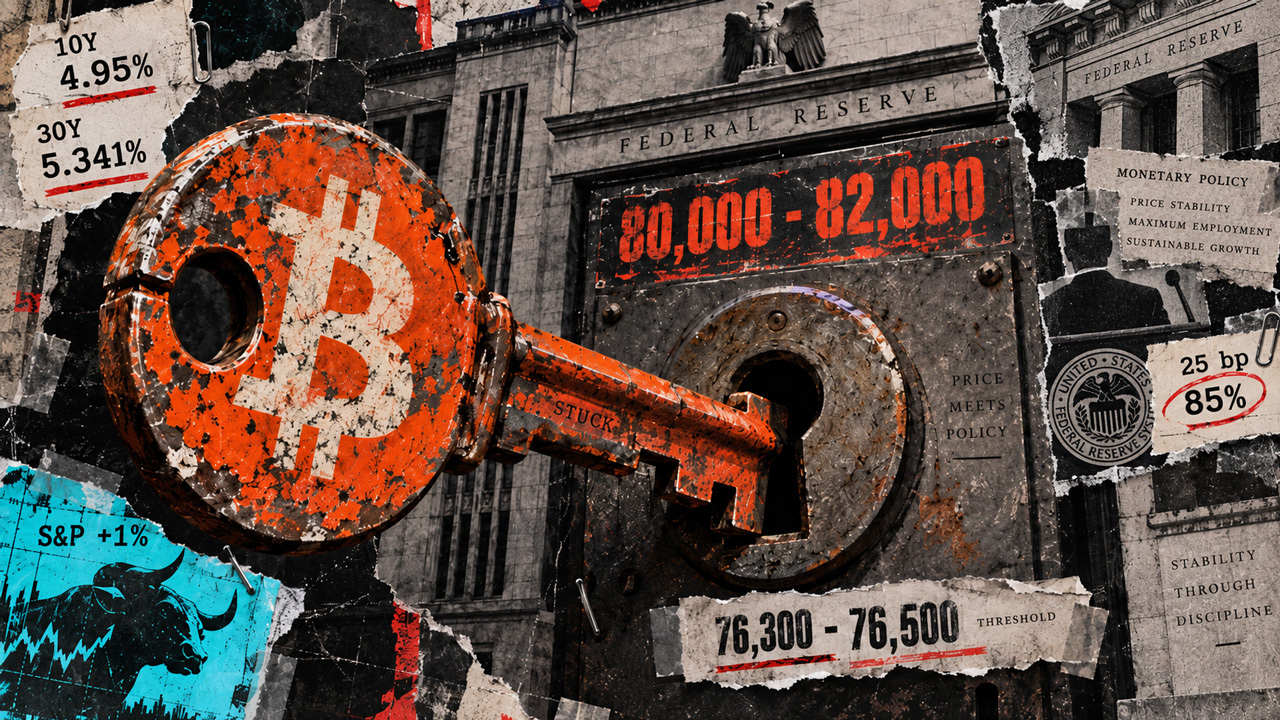
Ultimately, the $80,000 mark is more than just a number; it is a barometer for the market’s appetite for risk in a high-yield world. Whether the Bitcoin "key" finally turns in the Federal Reserve’s lock or remains jammed depends on the delicate balance between inflationary reality and investor optimism. For now, the market remains in a watchful pause, waiting for the one catalyst that can break the stalemate.









