admin
admin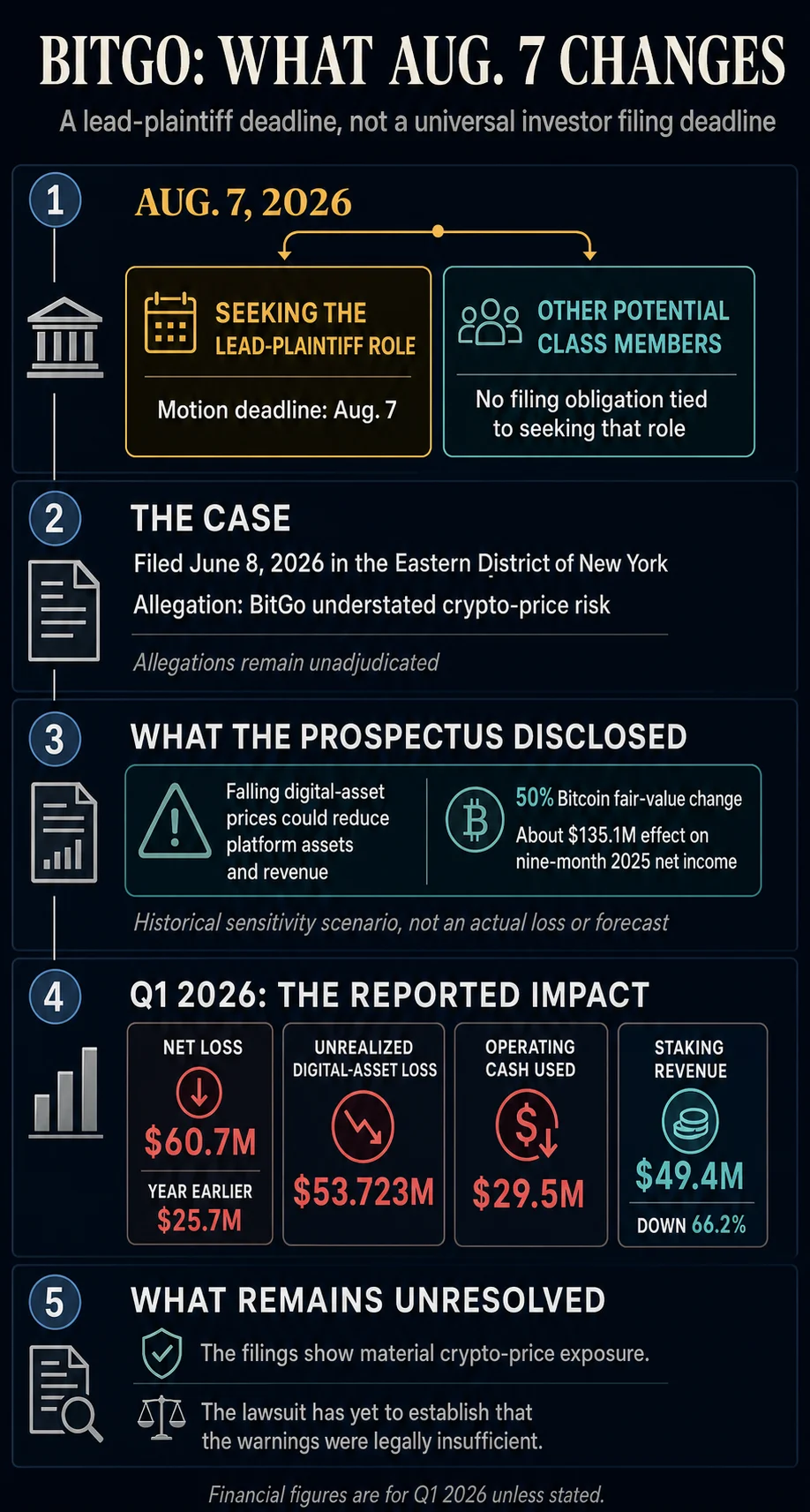
A significant number of BitGo investors are currently receiving urgent advisories from various law firms regarding an August 7th deadline. This date, however, is specifically for individuals who wish to petition the court for the role of lead plaintiff in a proposed securities class action lawsuit filed against the prominent cryptocurrency custodian. It is crucial for investors to understand that this deadline does not preclude them from participating in any potential financial recovery if the litigation progresses.
The flurry of notifications has been issued by legal entities such as DJS Law Group, Faruqi & Faruqi, and Schall Brown & Schwartz, among others. These firms are actively informing shareholders of BitGo Holdings, Inc. about the impending cutoff. The primary objective of these alerts is to guide investors through the procedural requirements for becoming the lead plaintiff, a role that carries significant responsibility in the management and direction of class-action litigation.
Understanding the Lead Plaintiff Process
The Private Securities Litigation Reform Act of 1995 (PSLRA) established a structured framework for securities class actions, including a 60-day period for potential lead plaintiffs to come forward. This timeframe is designed to allow aggrieved investors to present themselves to the court, express their interest in leading the litigation, and propose counsel. The PSLRA generally prioritizes a lead plaintiff who can demonstrate the largest financial interest in the outcome of the lawsuit, provided they also meet other class certification requirements.
For BitGo investors, this means that while August 7th is critical for those seeking to actively manage the lawsuit, it is not an absolute cutoff for all participants. Investors who are not interested in assuming the lead plaintiff role are not required to take action by this date. Subsequent deadlines may emerge for other aspects of the litigation, such as opting out of the class or submitting proof of claim, should the case move forward through discovery and potential settlement or trial.
The Genesis of the Lawsuit: Allegations Against BitGo

The class action, officially titled Arsenault v. BitGo Holdings, was formally lodged on June 8, 2026, in the U.S. District Court for the Eastern District of New York. At the heart of the litigation are accusations that BitGo and its executive leadership misrepresented the company’s resilience to market downturns in its initial public offering (IPO) prospectus. The complaint contends that the prospectus presented a misleadingly robust picture of the company’s business fundamentals, failing to adequately disclose the inherent risks associated with its reliance on volatile digital assets.
According to the lawsuit’s filing, "The Offering Documents were negligently prepared and, as a result, contained untrue statements of material fact or omitted to state other facts necessary to make the statements made not misleading and were not prepared in accordance with the rules and regulations governing their preparation." This charge suggests a systemic failure in the disclosure process, leading investors to make decisions based on incomplete or inaccurate information.
Furthermore, the plaintiffs argue that BitGo understated the potential impact of cryptocurrency market volatility on its financial performance. They assert that these undisclosed vulnerabilities contributed significantly to the volatility experienced by the company’s stock, identified as BTGO. This points to a direct causal link being drawn between the alleged misrepresentations and the financial losses incurred by investors.
BitGo’s IPO Prospectus and Subsequent Financial Performance
A closer examination of BitGo’s IPO prospectus, however, reveals that the company did, in fact, include disclosures regarding its exposure to digital-asset price fluctuations. The prospectus explicitly warned investors that a significant hypothetical change in Bitcoin’s fair value could materially impact the company’s financial results. For instance, it estimated that a 50% change in Bitcoin’s fair value during the first nine months of 2025 could have altered its net income by approximately $135.1 million. This suggests that while the company did acknowledge the risk, the plaintiffs believe the magnitude and potential consequences were not adequately conveyed or were deliberately downplayed.
The financial realities that followed the IPO appear to have validated some of these concerns. BitGo subsequently reported a substantial net loss of $60.7 million for the first quarter of 2026. A significant portion of this loss, $53.7 million, was attributed to unrealized digital-asset losses. Concurrently, the company experienced a sharp decline in its staking revenue, which fell by 66.2%, directly correlated with the prevailing lower token prices in the market. These figures highlight the sensitive interplay between BitGo’s financial health and the broader cryptocurrency market conditions.
Background of BitGo’s Public Debut and Market Context

BitGo, a recognized player in the digital asset custody space, managing assets valued at over $100 billion, embarked on its public market journey this year. Its IPO was part of a broader trend of cryptocurrency-focused companies, including Circle, seeking to tap into public markets. This surge in crypto IPOs was initially fueled by a period of intense market optimism and significant investor interest in the burgeoning digital asset ecosystem.
However, the landscape for such offerings has shifted considerably. The post-IPO performance of several crypto-related companies has been disappointing, leading to a broader recalibration of market expectations. Weakening market conditions and a general risk-off sentiment among investors have contributed to a more challenging environment for recent public listings. This broader market context likely plays a role in the increased scrutiny and legal actions faced by companies like BitGo.
The legal action against BitGo is not an isolated incident but reflects a growing trend of investor litigation in the cryptocurrency sector. As the industry matures and attracts significant institutional and retail investment, the legal and regulatory frameworks governing it are being tested. Class-action lawsuits, in particular, serve as a mechanism for investors to seek recourse when they believe they have been misled or harmed by corporate actions or disclosures.
Implications for Investors and the Crypto Custody Sector
The outcome of this lawsuit, and the broader trend of legal challenges against crypto firms, could have significant implications for the digital asset industry. For BitGo, a successful class action could result in substantial financial penalties and reputational damage. It could also lead to increased regulatory scrutiny and potentially necessitate changes in corporate governance and risk management practices.
For the cryptocurrency custody sector, this litigation underscores the critical importance of transparent and accurate disclosures regarding the inherent risks of the digital asset market. Custodians, by their nature, are entrusted with significant value and are expected to manage risks effectively. Any perceived failure in this regard can have far-reaching consequences.
Investors in BitGo, and indeed in other publicly traded cryptocurrency companies, are advised to carefully review the details of any class-action lawsuit and consult with legal counsel to understand their rights and options. While the August 7th deadline is specific to the lead plaintiff role, staying informed about the progression of the litigation and any future deadlines is paramount for all affected shareholders. The legal battles underscore the evolving nature of financial regulation in the digital age and the increasing accountability expected from companies operating within this dynamic and often volatile market.