Lina Irawan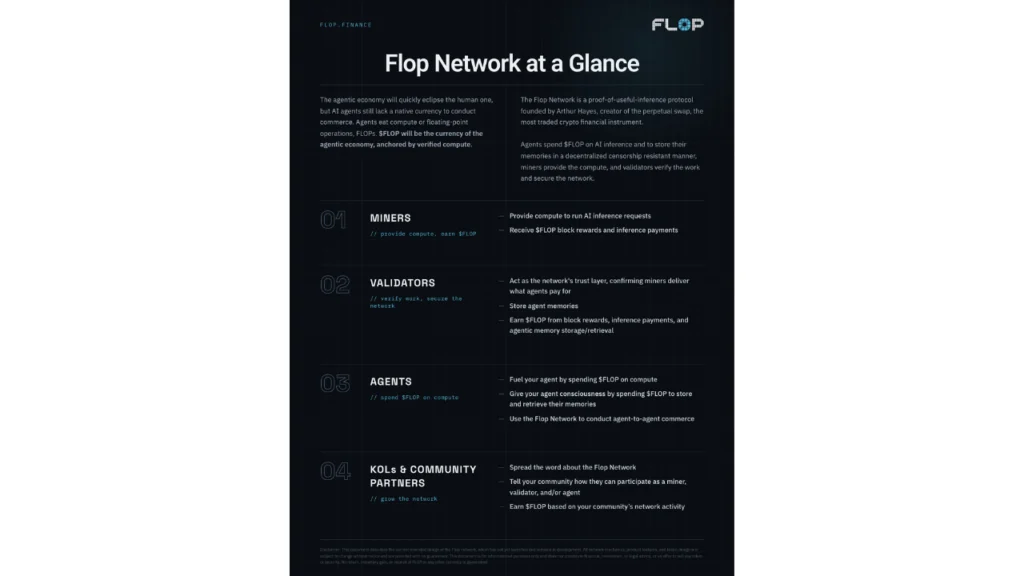
Arthur Hayes, the prominent co-founder of the cryptocurrency derivatives exchange BitMEX, is making a significant return to an active operating role within the blockchain industry. Hayes announced on August 18th that he will be at the helm of Flop Labs, a nascent startup dedicated to developing blockchain infrastructure specifically engineered to support autonomous artificial intelligence (AI) agents. This strategic move signals a deliberate "coming out of retirement," as Hayes himself characterized it, and sees him assume the position of Chief Executive Officer at Flop Labs, a title he has already updated on his social media profile.
The timing of Hayes’s reentry into project leadership coincides with Flop Labs’ ambitious plans to develop the Flop Network. This proposed blockchain aims to provide a dedicated ecosystem where AI agents can seamlessly interact and transact. Central to this vision is the network’s native cryptocurrency, the FLOP token, which is intended to facilitate payments for essential services such as computing power, AI inference processing, and decentralized data storage.
Flop Labs has outlined a phased rollout for its ambitious project, with a "massive airdrop" currently slated for the fourth quarter of 2026. This distribution event is planned to precede the network’s targeted genesis block, which is scheduled for the first quarter of 2027. It is important to note that these dates are currently considered targets and are subject to change as development progresses.
Hayes’s Resurgence in the Blockchain Arena
Arthur Hayes’s journey in the cryptocurrency space is deeply intertwined with the founding of BitMEX in 2014. He steered the company as its CEO until his departure in October 2020. Since stepping down from BitMEX’s operational leadership, Hayes has maintained a visible and influential presence in the industry. He has actively engaged as a seasoned investor, a vocal market commentator, and most recently, as the Chief Investment Officer of the Maelstrom Fund. His new role at Flop Labs marks a definitive transition back into the daily grind of project development and strategic execution, moving beyond advisory and investment capacities.
The implications of Hayes’s new leadership role on his ongoing responsibilities at the Maelstrom Fund have not yet been publicly clarified. Furthermore, details regarding his compensation, equity stake in Flop Labs, and the precise scope of his operational duties remain undisclosed. This announcement also arrives at a particularly poignant moment for the broader BitMEX ecosystem, as the exchange itself is scheduled to cease its cryptocurrency exchange operations on September 23rd, following a July announcement of its strategic pivot.

Flop Labs’ Vision: Empowering AI Agents as Economic Actors
At its core, Flop Labs is driven by a forward-thinking thesis: that as AI agents become increasingly sophisticated and autonomous, they will require their own robust economic infrastructure to operate independently. The current paradigm often necessitates human oversight for every transaction. Flop Labs aims to transcend this limitation by enabling autonomous AI agents to utilize the FLOP token to procure vital computational resources, access AI inference capabilities, and utilize decentralized memory services directly from providers within the network.
The project has introduced a novel consensus mechanism concept termed "proof of useful inference." Under this proposed model, network participants, referred to as miners, would be responsible for executing AI inference requests. Simultaneously, validators would be tasked with verifying the accuracy and completion of these computations. The overarching objective of this framework is to foster a self-sustaining economy where AI agents can efficiently secure the resources they require, while service providers are appropriately rewarded for their contributions.
However, Flop Labs has yet to release comprehensive technical documentation that would allow for a thorough assessment of the practical implementation of its proposed system. Significant questions remain unanswered regarding the methodologies for validator verification of AI inference, the handling of potentially inconsistent AI outputs, and the mechanisms for identifying and mitigating fraudulent or erroneous computations. To date, the project has not yet launched its testnet, a crucial step in demonstrating the viability of its technology.
A "100% Fair Launch" Promise and Tokenomics Uncertainty
Arthur Hayes has explicitly stated that the FLOP token will be launched without a presale or any allocation to venture capital firms. He has characterized this distribution model as a "100% fair launch," aiming to differentiate Flop Labs from numerous other cryptocurrency projects that often reserve significant token allocations for early investors prior to public availability. Despite this commitment to fairness, the project has yet to provide the detailed information necessary for a comprehensive evaluation of its token distribution strategy.
Crucially, Flop Labs has not yet published complete tokenomics, which would typically include details on the total supply, allocations for core contributors, treasury holdings, emission schedules, and vesting periods for team members and advisors. The absence of a full whitepaper and an official token contract further contributes to the current lack of transparency. Consequently, there is no established market price for FLOP at this juncture. Any tokens or trading pairs claiming to represent the official FLOP asset should be approached with extreme caution until officially confirmed by Flop Labs.
The Q4 2026 Airdrop: The Next Significant Milestone
The forthcoming airdrop in the fourth quarter of 2026 is poised to be the most immediate catalyst for attention surrounding Flop Labs. Hayes has teased a "massive airdrop," but specific details regarding the scale of this distribution and the precise criteria for user eligibility remain undisclosed. Key information such as eligibility requirements, necessary wallet configurations, and anti-bot measures have yet to be announced. It is also unclear whether participation will necessitate interaction with a testnet, contributions of computing resources, the utilization of AI agents, or engagement within the project’s community.

The sequencing of events also presents a point of interest. Flop Labs plans to conduct the airdrop of FLOP tokens before the network’s genesis block, targeted for Q1 2027. The project has not yet elaborated on the initial holding mechanism for these tokens or the process by which they will transition to the native network upon its official launch. These critical details are anticipated to be clarified as the project progresses in releasing its technical documentation and definitive airdrop rules.
Betting on the Future of the AI-Agent Economy
Flop Labs is strategically positioning itself at the rapidly expanding intersection of cryptocurrency and artificial intelligence. The foundational premise is that increasingly capable AI agents will evolve into autonomous economic participants, capable of procuring data, computing power, access to Application Programming Interfaces (APIs), and a myriad of other digital services without the need for constant human intervention in every transaction.
Blockchain technology, with its inherent security and transparency, is envisioned to provide the essential settlement infrastructure for these complex interactions. Concurrently, decentralized networks are poised to supply the fundamental resources that these AI agents will require to operate and expand.
Hayes has previously articulated a compelling argument regarding the substantial investments being channeled into AI infrastructure, suggesting that this could eventually lead to an oversupply of computing capacity. Flop Labs appears designed to capitalize on this potential excess by enabling computing providers to directly monetize their resources by selling them to autonomous AI agents.
Despite the ambitious vision and the significant attention garnered by Hayes’s involvement, Flop Labs remains in its nascent stages. The project has unveiled an ambitious roadmap and attracted considerable interest, yet critical components – including the underlying technical architecture, detailed tokenomics, the core development team, and the mechanics of the airdrop – are yet to be fully disclosed.
For the foreseeable future, the Q4 2026 airdrop and the Q1 2027 genesis block represent the two paramount milestones for Flop Labs. The ultimate success of the project will hinge on its ability to translate this compelling narrative at the confluence of AI and cryptocurrency into a functional and robust technological infrastructure by the time these key dates arrive. The crypto world will be watching closely to see if Hayes can replicate his past successes in this new and highly promising domain.