admin
admin
The landscape of US-listed cryptocurrency exchange-traded funds (ETFs) witnessed a significant resurgence on Monday, as spot Bitcoin funds successfully pivoted back to positive net inflows, largely propelled by the overwhelming dominance of BlackRock’s iShares Bitcoin Trust. This recovery follows a brief period of profit-taking and volatility, signaling a robust appetite for digital assets among institutional and retail investors alike. While Bitcoin reclaimed its upward momentum, the broader crypto ETF market showed remarkable resilience, with Ethereum, XRP, and Solana funds extending their respective winning streaks, reflecting a diversifying interest across the blockchain ecosystem.
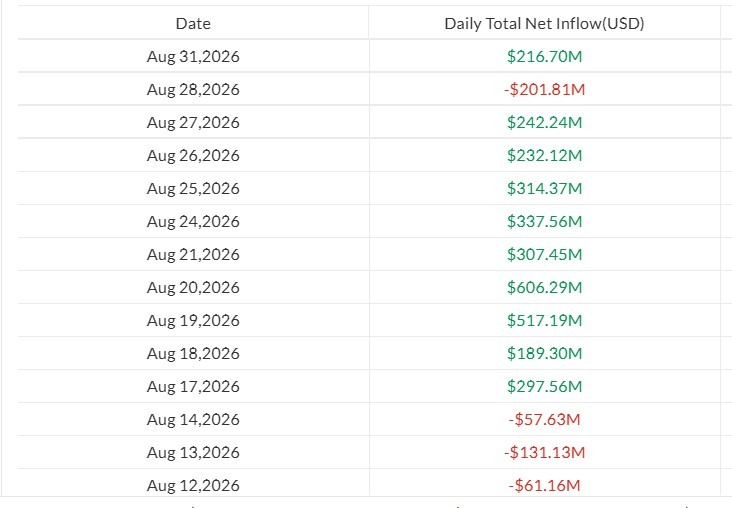
According to the latest data from SoSoValue, spot Bitcoin ETFs recorded a collective $216.7 million in net inflows during Monday’s trading session. This figure effectively neutralized the $201.8 million in net withdrawals observed on Friday, which had briefly halted a record-breaking momentum. The Friday outflows represented a rare blemish on a recent performance record that saw more than $3 billion flow into these products over a nine-session period. As of Monday evening, Bitcoin (BTC) was trading near the $78,700 mark, representing a 1.5% increase over a 24-hour window, as market participants reacted favorably to the renewed capital injections.
BlackRock Leads the Charge in Bitcoin ETF Recovery
The primary catalyst for Monday’s rebound was BlackRock’s iShares Bitcoin Trust (IBIT), which continues to cement its position as the undisputed leader in the spot Bitcoin ETF space. Farside Investors data indicates that IBIT alone attracted $205.9 million in net inflows, a figure that represents approximately 95% of the total daily inflows for the entire Bitcoin ETF category. This level of concentration underscores the significant trust and liquidity that BlackRock provides to institutional players seeking exposure to the world’s largest cryptocurrency.
While BlackRock dominated the headlines, other major issuers also reported positive movements, albeit on a smaller scale. Fidelity’s Wise Origin Bitcoin Fund (FBTC) recorded $6.9 million in new capital, while the Bitwise Bitcoin ETF (BITB) saw $4.3 million in inflows. Morgan Stanley’s Bitcoin Trust and Grayscale’s Bitcoin Mini Trust also contributed to the positive tally, adding $3.6 million and $9.4 million, respectively. The Grayscale Bitcoin Mini Trust, in particular, has become a focal point for investors looking for a lower-fee alternative to the original Grayscale Bitcoin Trust (GBTC).
Conversely, VanEck’s Bitcoin ETF (HODL) stood out as the sole fund to report negative movement on Monday, posting $13.4 million in net outflows. Other funds in the category, including those managed by Ark Invest/21Shares and Invesco/Galaxy, reported neutral flows for the day. This disparity among issuers highlights a competitive environment where brand reputation, fee structures, and liquidity continue to dictate investor preferences.
Chronology of Market Sentiment and Capital Flows
The recent fluctuations in ETF flows provide a clear timeline of shifting investor sentiment. Throughout early November, the crypto market benefited from a sustained nine-day inflow streak that brought in more than $3 billion in fresh capital. This surge was driven by several factors, including favorable macroeconomic indicators, a stabilizing regulatory outlook in the United States, and the continued integration of digital assets into traditional financial portfolios.
However, this momentum faced a hurdle on Friday when the market experienced a cooling-off period. The $201.8 million in outflows on Friday was largely attributed to tactical profit-taking as Bitcoin approached psychological resistance levels near $80,000. Market analysts noted that such pullbacks are common during extended rallies, allowing the market to consolidate before attempting further gains.

The swift reversal on Monday suggests that the underlying demand remains strong. The fact that the market was able to recover more than the previous session’s losses in a single day indicates that institutional buyers view price dips as entry opportunities. This "buy the dip" mentality has been a recurring theme since the SEC’s landmark approval of spot Bitcoin ETFs in January 2024, which transformed the asset class from a niche interest into a mainstream financial instrument.
Ethereum ETFs Maintain Consistent Momentum
While Bitcoin remains the primary driver of market sentiment, spot Ether (ETH) ETFs have demonstrated an impressive level of consistency. Monday marked the 11th consecutive trading session of positive inflows for Ether funds, a streak that suggests a growing institutional conviction in the utility and long-term value of the Ethereum network.
Total inflows for spot Ether ETFs reached $87.7 million on Monday. BlackRock once again led the category, with its iShares Ethereum Trust ETF (ETHA) securing $59.9 million. Grayscale’s Ethereum Mini Trust followed with $13.5 million, while Fidelity’s Ethereum Fund rounded out the top three with $9.3 million. The success of the Ethereum Mini Trust is particularly noteworthy, as it suggests that investors are increasingly migrating toward cost-efficient vehicles within the Ethereum ecosystem.
The 11-session streak for Ether ETFs is significant because it outpaces the recent 9-session streak seen in Bitcoin funds. This divergence may indicate a rotation of capital or a broadening of interest as investors seek to diversify their crypto holdings beyond Bitcoin. Ethereum’s role as the foundation for decentralized finance (DeFi) and non-fungible tokens (NFTs) continues to be a compelling narrative for those looking for exposure to blockchain innovation.
XRP and Solana Funds Reach Milestones
The appetite for digital asset ETFs is not limited to the "Big Two." XRP and Solana funds also recorded their 10th consecutive positive sessions on Monday, marking a decade of trading days characterized by net capital gains.
XRP ETFs saw $5.64 million in net inflows, continuing a trend that has seen these funds attract capital during every single US trading session since August 18. This sustained interest in XRP comes amid ongoing legal and regulatory developments surrounding Ripple Labs, suggesting that investors are becoming more comfortable with the asset’s regulatory standing.
Solana (SOL) ETFs also maintained their positive streak, though the pace of inflows showed signs of deceleration. On Monday, Solana funds posted $925,010 in net inflows, a sharp decline from the $18.1 million recorded on Friday. This figure represents the weakest daily inflow during the current 10-day run. Despite the slowdown, the fact that the streak remains intact is a testament to Solana’s growing reputation as a high-performance blockchain capable of competing with Ethereum.
Institutional Reactions and Market Analysis
The dominance of BlackRock in the ETF space has drawn significant attention from market analysts. The firm’s ability to capture 95% of daily Bitcoin ETF inflows on Monday reflects its immense distribution power and the high level of comfort that institutional fiduciaries have with the BlackRock brand. Analysts suggest that for many institutional investors, BlackRock’s IBIT has become the "gold standard" for Bitcoin exposure, offering a combination of deep liquidity and competitive fees.
Furthermore, the participation of Morgan Stanley’s Bitcoin Trust in the inflow tally is indicative of a broader trend: the entry of major wirehouses and wealth management firms into the crypto space. As these large institutions begin to offer crypto ETFs to their massive client bases, the potential for sustained, long-term capital inflows increases significantly.
The "mini trust" strategy employed by Grayscale also appears to be paying dividends. By offering lower-fee versions of their flagship products, Grayscale has managed to stem the tide of outflows that plagued its original trusts earlier in the year. This move has allowed Grayscale to remain a relevant player in an increasingly crowded and competitive market.
Broader Implications for the Financial Ecosystem
The continued success of crypto ETFs has profound implications for the broader financial ecosystem. First and foremost, these products provide a regulated, secure, and accessible way for a wide range of investors to gain exposure to digital assets without the complexities of managing private keys or navigating unregulated exchanges.
The consistent inflows into Ether, XRP, and Solana funds also suggest that the market is maturing. Investors are no longer viewing "crypto" as a monolithic entity but are beginning to distinguish between different blockchain protocols based on their specific use cases, governance models, and technical capabilities. This nuance is a hallmark of a maturing asset class.
Moreover, the resilience of these funds in the face of price volatility suggests that crypto ETFs are being used as long-term investment vehicles rather than just speculative tools. The "stickiness" of the capital—evidenced by the long inflow streaks for Ether, XRP, and Solana—points toward a shift in investor behavior, where digital assets are increasingly viewed as a permanent component of a diversified portfolio.
Future Outlook
Looking ahead, the market will likely focus on whether Bitcoin can break through its current price levels and establish a new all-time high. The role of ETFs in providing the necessary liquidity and buying pressure for such a move cannot be overstated. If BlackRock and other major issuers continue to see hundreds of millions of dollars in daily inflows, the upward trajectory for Bitcoin and the broader crypto market remains the path of least resistance.
Additionally, the industry is closely watching for any signs of a spot Solana or XRP ETF approval from the SEC. While the current products are largely available through different structures or in specific jurisdictions, a full spot approval in the US for these assets would likely trigger a massive wave of capital, similar to what was seen with Bitcoin and Ethereum.
In conclusion, Monday’s ETF performance serves as a powerful reminder of the growing institutionalization of the cryptocurrency market. With BlackRock leading the way and altcoin funds demonstrating remarkable consistency, the stage is set for a dynamic and potentially record-breaking conclusion to the trading year. As the boundaries between traditional finance and digital assets continue to blur, the success of these ETF products remains a critical barometer for the health and future of the global crypto economy.