admin
admin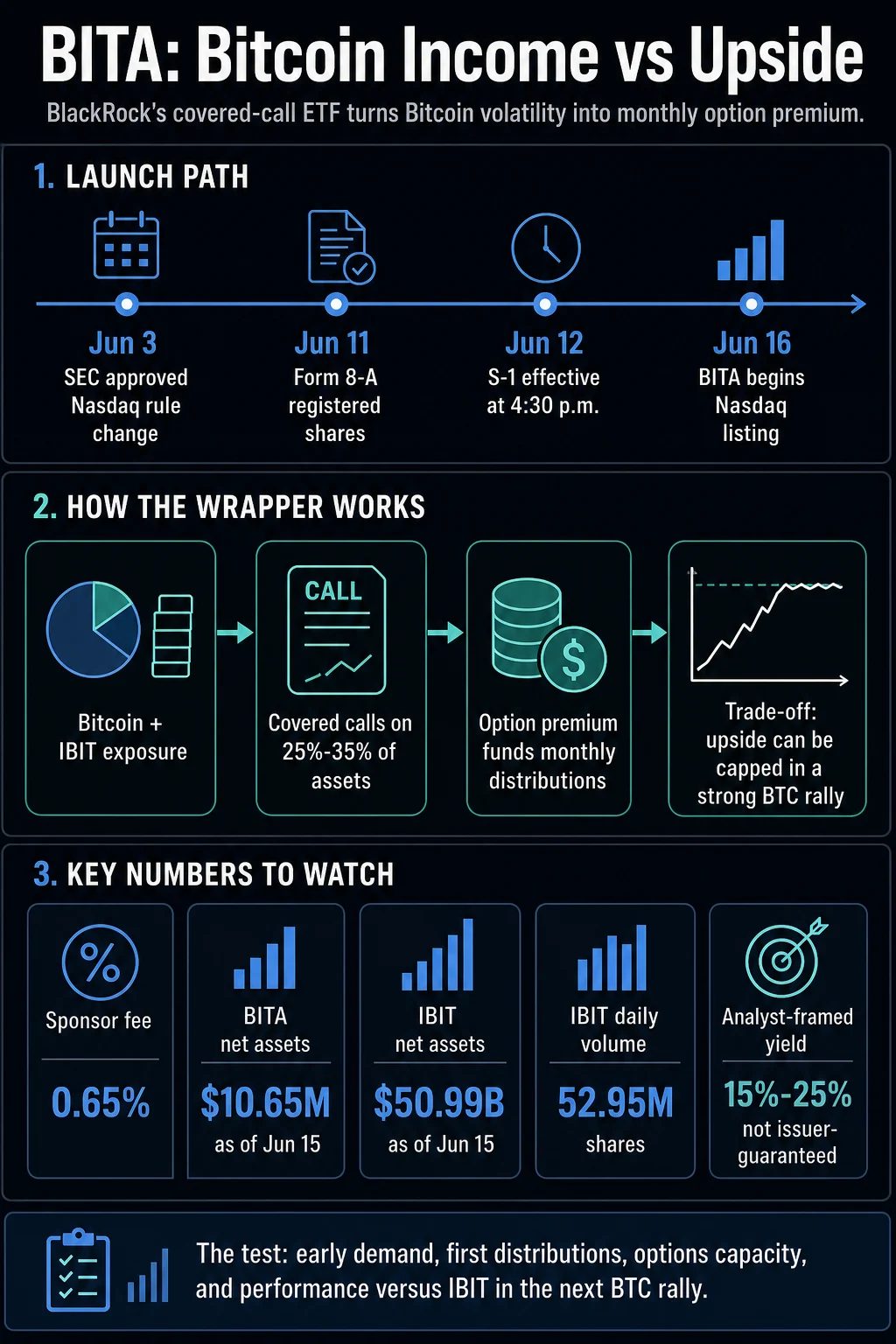
The financial landscape for Bitcoin investors has expanded significantly with the official launch of BlackRock’s iShares Bitcoin Premium Income ETF (BITA). Moving from its initial "launch watch" status to live market trading on Nasdaq, BITA introduces a new dynamic for those seeking to engage with the digital asset. This innovative ETF offers investors a choice beyond simply holding spot Bitcoin exposure directly. Instead, BITA provides a covered-call strategy designed to generate monthly income by leveraging a portion of Bitcoin’s inherent volatility. This marks a pivotal moment, suggesting a maturation of Bitcoin investment vehicles as traditional finance firms explore structured income-generating products tied to the cryptocurrency.
The fund commenced trading on Nasdaq on June 16, under the ticker symbol BITA. The Securities and Exchange Commission (SEC) had previously signaled its approval through a notice of effectiveness for the fund’s S-1 registration statement on June 12. This was preceded by a Form 8-A filing on June 11, which formally registered the trust’s shares with the SEC under Section 12(b) of the Securities Exchange Act of 1934. The foundational approval for Nasdaq to list and trade such a product was granted earlier by the SEC, clearing the path for BITA’s market debut. Susquehanna Securities has been designated as the liquidity provider for the ETF, a crucial role in ensuring smooth trading operations and market depth.
This launch positions BITA distinctly from a conventional spot Bitcoin ETF. While it provides underlying Bitcoin exposure, its core innovation lies in the overlay of an options-income strategy. This structure aims to convert the liquidity and significant price swings characteristic of Bitcoin, and by extension, BlackRock’s colossal $50 billion-plus iShares Bitcoin Trust ETF (IBIT), into a predictable monthly distribution. However, this income generation comes with a significant trade-off: the revenue is derived from selling call options. While this strategy can cushion volatility in stable or moderately appreciating markets, it also inherently caps the potential upside for investors during periods of sharp Bitcoin rallies.
BlackRock Transitions from Spot Access to Structured Income Generation
BITA entered the market with a defined set of characteristics. As of its inception date of June 9, the ETF had garnered $10.65 million in net assets by June 15. Its sponsor fee is set at 0.65%, and it is structured to provide monthly distributions. The fund’s strategy is multifaceted, aiming to deliver both the performance of spot Bitcoin and the income generated from option premiums. To achieve this, BITA can hold Bitcoin directly or invest in IBIT, while simultaneously writing covered calls on approximately 25% to 35% of its portfolio assets.
In practical terms, this means BITA is strategically selling a portion of its potential upside gains in exchange for the premiums collected from these options contracts. These premiums are then intended to support the fund’s monthly distributions to shareholders. This approach signifies a progression in the evolution of Bitcoin ETF offerings. The initial wave of US spot Bitcoin ETFs focused on establishing fundamental market access, addressing issues related to custody, brokerage availability, and institutional-grade packaging. BITA, on the other hand, explores a more sophisticated application: can Bitcoin’s inherent volatility be harnessed to create an income stream without excessively sacrificing the asset’s growth potential?
The timing of BITA’s launch offers BlackRock a strategic advantage. Its predecessor, IBIT, has achieved remarkable scale, boasting over $51 billion in net assets and averaging approximately 53 million shares traded daily as of June 15. While BITA is a considerably smaller entity at its inception, it benefits from being integrated into the established iShares Bitcoin ecosystem. The options market surrounding IBIT has already become a notable component of the broader trading infrastructure, providing a fertile ground for a product like BITA.
| Product | Core Exposure | Income Method | Main Trade-off |
|---|---|---|---|
| BITA | Bitcoin and IBIT exposure | Covered calls on roughly 25%-35% of assets | Monthly income potential in exchange for capped upside on overwritten exposure |
| IBIT | Spot Bitcoin exposure | Direct price participation | More direct participation in Bitcoin price moves, without an option-premium buffer |
| Goldman Sachs Filing (Pending) | Indirect Bitcoin ETP-linked exposure | Options overwrite expected around 40%-100% | Broader income overlay, still exposed to capped-upside and options execution risk |
This comparative framework is crucial for asset allocators evaluating BITA. It is essentially a hybrid investment tool: offering a degree of Bitcoin access, implementing an options-income strategy, and serving as a test case for whether the scale of IBIT can effectively support a recurring distribution wrapper. The initial asset base of BITA, while modest, underscores its role as a supplementary product to the much larger IBIT. This disparity highlights the significance of early trading volumes, bid-ask spreads, and the initial monthly distribution levels as key indicators of market reception, potentially more so than the launch assets alone.
The Yield Hook’s Reliance on an Upside Cap
The emergence of terms like "Bitcoin yield supercycle" reflects a broader Wall Street objective: to reframe Bitcoin from a purely speculative, directional bet into a component of income-generating portfolios. BITA is a prime example of this strategic pivot, with its operational mechanics being relatively straightforward. The option premiums that fund its distributions are generated by foregoing a portion of the potential gains during strong upward price movements in Bitcoin.

BlackRock’s official product literature deliberately avoids promising fixed returns. The product brief states that the fund aims to generate monthly income and participate in the majority of Bitcoin’s upside, while acknowledging that actual upside participation can fluctuate. Crucially, the issuer’s risk disclosures warn that covered calls can limit gains beyond the option’s strike price. The brief explicitly notes that the fund may underperform IBIT during significant Bitcoin rallies.
Industry analysts, such as Bloomberg’s ETF expert Eric Balchunas, have framed BITA’s potential with targets suggesting an annualized yield of 15%-25% and at least 70% upside participation. These figures, while providing market context, should be clearly distinguished from direct issuer claims. The verifiable facts provided by BlackRock include the monthly distribution frequency, the targeted 25%-35% covered-call overwrite, the 0.65% sponsor fee, and the stated objective of seeking majority upside participation, with the caveat that actual outcomes are contingent on prevailing market conditions.
For investors, the fundamental question revolves around the acceptability of this cost. In a market characterized by sideways price action, an options-income overlay can appear attractive, with premiums potentially offsetting volatility while the fund maintains its Bitcoin exposure. Conversely, in a strong bull market, this structure can lead to underperformance compared to a direct spot Bitcoin investment, as a portion of the potential gains has already been effectively sold.
The risk profile extends beyond headline yield figures. BITA’s performance remains intrinsically linked to Bitcoin’s price trajectory, the liquidity of IBIT, the effectiveness of options execution, the tax implications for investors, and whether distributions stem from consistent premium capture or a favorable market environment that may not persist. The monthly payout structure could facilitate easier integration into income-focused portfolios. Ultimately, its success will be judged by its total return relative to IBIT across various market conditions, including both rallies and downturns, and whether this performance justifies its associated fees.
The Market Test Begins with Demand and Distribution Analysis
The launch of BITA represents a significant development in a trend that has been closely observed. Earlier coverage on June 11 highlighted the competitive race between BlackRock and Goldman Sachs to develop Bitcoin volatility into premium income products. Subsequent analysis on June 16 contextualized BITA within a broader industry push to normalize Bitcoin yield strategies. BITA’s listing transforms this debate from theoretical filings into observable market dynamics.
The pending filing by Goldman Sachs for its own Bitcoin Premium Income ETF further indicates that this product category is still in its formative stages, rather than being a standardized offering. Goldman Sachs’ registration filing describes a strategy involving indirect Bitcoin exposure and a significantly wider expected overwrite range, potentially between 40% and 100%. This divergence in approaches underscores Wall Street’s ongoing experimentation with various methods to package Bitcoin’s volatility, option liquidity, and investor demand for distributions.
The current market environment provides a receptive backdrop for such products. Bitcoin has been trading in the mid-$66,000s, showing gains over the past week but experiencing a slight decline over the preceding 30 days. Broader market data indicates Bitcoin’s dominance remains robust, hovering around 58.6%. This mixed trend is precisely the type of market scenario where income-generating wrappers gain traction. Investors may remain committed to Bitcoin exposure but seek mechanisms to earn returns during periods of consolidation or moderate price movement.
However, the allure of income generation carries the risk of obscuring the underlying risks. BITA’s performance is fundamentally dependent on Bitcoin’s price, the underlying liquidity of IBIT, the execution of options trades, tax considerations, overall market liquidity, and the unpredictable path of future price movements. The effectiveness of BITA’s distributions will only tell part of the story unless investors can clearly ascertain the proportion of returns derived from premium income versus underlying Bitcoin exposure, and crucially, how much upside was forfeited during rallies.
This is the central challenge moving forward. Early trading volumes will be a key indicator of investor appetite for a BlackRock-backed Bitcoin income wrapper at scale. The initial monthly distributions will provide tangible dollar-denominated insights into the strategy’s performance. The capacity of the options market will determine if this approach can evolve beyond a niche launch product into a sustainable offering. Ultimately, the next significant Bitcoin rally will serve as the ultimate test, revealing whether BITA’s income generation is perceived as a shrewd volatility harvest or an expensive method to disguise Bitcoin exposure as yield.