
 Nila Kartika Wati
Across Asia, the landscape of cryptocurrency adoption and regulation is rapidly evolving, marked by a striking dichotomy: a deepening crackdown in China juxtaposed with progressive strides in major financial hubs like Singapore, South Korea, Japan, and Hong Kong. Beijing’s Ministry of State Security (MSS) has significantly intensified its rhetoric, branding cryptocurrencies as "accomplices" in espionage and other illicit activities, asserting that these digital assets are not as anonymous as widely perceived. This stark warning comes as other Asian economies are either witnessing unprecedented growth in crypto activity, contemplating crucial regulatory adjustments, or integrating digital currencies into mainstream commerce, reflecting a continent grappling with the opportunities and challenges presented by the decentralized finance revolution.
China’s Unyielding Stance: Crypto as a National Security Threat
China’s Ministry of State Security, the nation’s principal civilian intelligence agency, recently published a forceful article on social media, dramatically escalating its condemnation of cryptocurrencies. The MSS explicitly labeled digital assets as "accomplices" in espionage, money laundering, and cyberattacks, asserting their use by "overseas anti-China hostile forces" to destabilize financial order and undermine national security. This pronouncement, reported by the South China Morning Post, marks a significant hardening of Beijing’s long-standing skepticism towards decentralized digital currencies, shifting the narrative from mere financial risk to a direct threat to state security.
The core of the MSS’s warning hinged on dispelling the myth of absolute anonymity in cryptocurrency transactions. While acknowledging that "overseas intelligence agencies would try to dispel the concerns of people they were trying to recruit as spies by claiming that the circulation of virtual currencies was hard to verify," the Ministry countered with a clear message: "We’re watching the blockchain." This statement is a thinly veiled warning to potential foreign agents or individuals engaging in activities deemed hostile to the state, suggesting that authorities possess the capability to trace transactions on public blockchains. For widely used cryptocurrencies like Bitcoin and Ethereum, transactions, though pseudonymized, are recorded on public ledgers, making them amenable to sophisticated blockchain forensics tools that can de-anonymize users through various analytical techniques. However, the MSS’s broad claim overlooks the existence of privacy-focused cryptocurrencies such as Monero or Zcash, which, when used correctly, employ advanced cryptographic techniques to obscure transaction details, offering a higher degree of anonymity.
A Chronology of China’s Crypto Crackdown
China’s journey towards a comprehensive ban on cryptocurrencies has been a gradual yet relentless process, driven by concerns over capital flight, financial stability, energy consumption, and now, national security.
- 2013: The People’s Bank of China (PBOC) issues a notice prohibiting financial institutions from handling Bitcoin transactions, signaling the initial cautious approach.
- 2017: A pivotal year saw the PBOC and other regulators issue a sweeping ban on Initial Coin Offerings (ICOs), followed by the closure of all cryptocurrency exchanges operating within China. This effectively severed the direct fiat-to-crypto on-ramps for retail investors.
- 2018-2020: The crackdown broadened to target over-the-counter (OTC) trading desks, crypto-related social media accounts, and foreign exchanges serving Chinese users.
- 2021: The most comprehensive phase began with a nationwide ban on cryptocurrency mining, citing environmental concerns and power consumption. This was soon followed by a declaration that all cryptocurrency-related business activities, including trading, order matching, token issuance, and derivatives, were illegal. This cemented China’s position as one of the world’s strictest regulators of crypto.
Implications for China’s Digital Future
The MSS’s latest rhetoric reinforces China’s firm resolve to maintain tight control over its digital financial ecosystem. By linking cryptocurrencies to espionage and national security, Beijing not only justifies its existing bans but also sends a chilling message to any individual or entity considering engagement with these assets within its borders. This approach is intrinsically linked to China’s broader strategy of digital sovereignty, aiming to control information flow and financial transactions within its digital borders. It also implicitly bolsters the state’s push for the digital yuan (e-CNY), its central bank digital currency, which offers the government unprecedented oversight and control over financial transactions, contrasting sharply with the decentralized nature of cryptocurrencies. The move effectively solidifies a future where digital finance in China is predominantly state-controlled, leaving virtually no room for the independent, anonymous, or globally interconnected crypto economy.
Singapore’s Ascendancy: A Regional Crypto Powerhouse
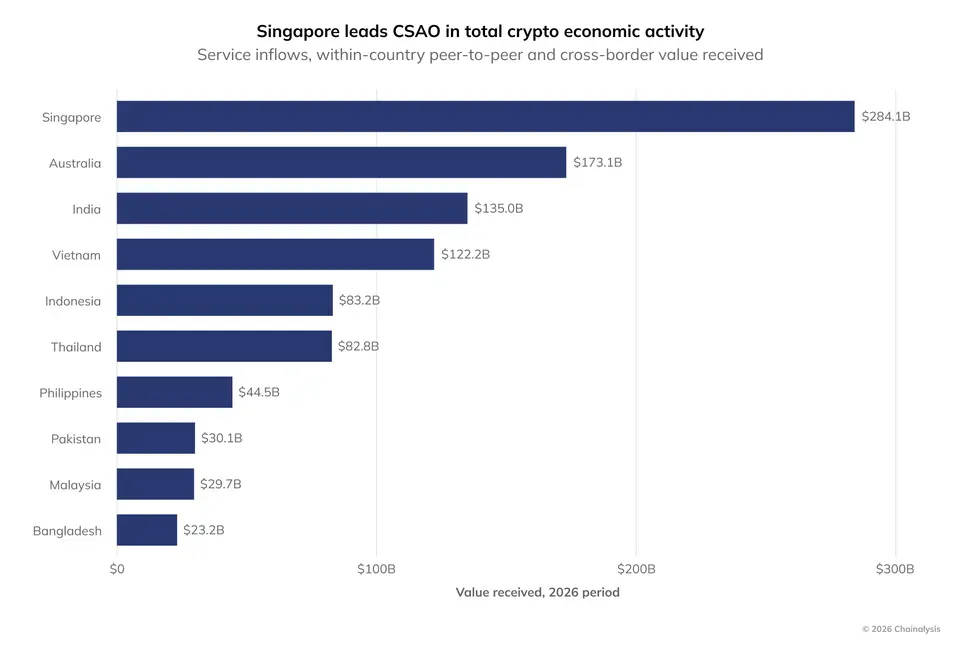
In stark contrast to China’s prohibitive stance, Singapore has firmly cemented its position as a leading global and regional hub for cryptocurrency and blockchain innovation. The city-state’s crypto activity surged by an impressive 55.4% to reach $284 billion in the year ending June 2026, according to a report by Chainalysis. This remarkable growth not only bucked a broader regional contraction but also allowed Singapore to regain its status as the largest crypto economy in Central and Southeast Asia and Oceania (CSAO), surpassing its peers amidst a challenging global market.
Much of Singapore’s growth was fueled by institutional platform activity, which witnessed a staggering 94% increase, reaching $60 billion over the same period. This institutional influx was heavily concentrated among a select group of established market makers, over-the-counter (OTC) trading firms, and institutional brokerages. These entities are crucial for providing liquidity and facilitating large-volume transactions for corporate clients, signalling a mature and robust institutional infrastructure. Chainalysis noted that "the growth in Singapore’s institutional platform ecosystem was very concentrated and marked by mostly high-volume activity by existing platforms rather than the dynamic entry of new services," suggesting a deepening of engagement from established players rather than a proliferation of new startups. This points to a preference for stability and proven track records among institutional investors in Singapore.
Why Singapore Thrives: A Conducive Ecosystem
Singapore’s success as a crypto hub is not accidental but a result of a deliberate, forward-thinking regulatory strategy coupled with a pro-business environment. The Monetary Authority of Singapore (MAS) has adopted a balanced approach, seeking to foster innovation while ensuring robust regulatory oversight, particularly through its Payment Services Act. This framework provides clarity and certainty for crypto businesses, attracting licensed entities that value regulatory compliance and stability.
The broader CSAO crypto economy, however, experienced a 6.8% contraction during the same period, highlighting Singapore’s exceptional performance. This regional downturn could be attributed to various factors, including persistent market volatility, regulatory uncertainties in other jurisdictions, and a general tightening of capital in the wake of global economic headwinds. Singapore’s ability to not only withstand these pressures but to significantly expand its crypto footprint underscores its unique advantages: a well-educated talent pool, world-class infrastructure, political stability, and a government committed to digital innovation. The city-state is effectively leveraging its strengths as a traditional financial center to become a digital asset hub, attracting global players seeking a safe and regulated environment to operate.
Implications for Regional Dominance
Singapore’s sustained growth reinforces its position as a beacon for institutional crypto adoption in Asia. This trend is likely to attract further investment, talent, and innovation, creating a virtuous cycle that could solidify its long-term dominance. As other nations in the region continue to navigate the complexities of crypto regulation, Singapore’s clear framework and strong institutional interest provide a compelling model. However, the concentration of growth among existing high-volume players also suggests that while the ecosystem is robust, new entrants might face higher barriers to entry, further professionalizing the industry in the city-state.

South Korea’s Regulatory Balancing Act: Market Makers and Stability
South Korea, a nation with one of the highest per capita rates of cryptocurrency adoption, is grappling with the complexities of regulating its dynamic digital asset market. The country’s Financial Services Commission (FSC) is now actively considering the introduction of a market-making system for digital assets, a move that could significantly enhance the efficiency and stability of its crypto exchanges. This consideration follows a recent incident where JPYC, a stablecoin pegged to the Japanese yen, traded for as much as four times its intended value on Upbit, one of South Korea’s largest crypto exchanges.
The JPYC incident occurred on September 17 when Upbit opened trading for the yen-backed stablecoin. The market opened at 12 Korean won per JPYC but swiftly surged to a high of 37.6 Korean won within an hour, representing a dramatic deviation from its stablecoin peg. This spike was largely attributed to limited liquidity on the Upbit platform for JPYC. Stablecoins are designed to maintain a stable value relative to a fiat currency, and such significant price deviations undermine their fundamental purpose and can erode investor trust.
The Role of Market Makers in Digital Asset Markets
The volatility experienced with JPYC highlighted a critical gap in South Korea’s current regulatory framework: the absence of provisions for market making. Market makers are essential participants in financial markets, providing liquidity by continuously quoting both buy and sell prices for an asset. This activity narrows the bid-ask spread, reduces price volatility, and ensures that trades can be executed efficiently without significant price impact. In traditional finance, market makers are crucial for healthy, functioning markets.
Yoo Young-joon, director of digital finance policy at the FSC, acknowledged this need, stating, "We will also review the need to introduce systems such as market-making activities to increase the efficiency and stability of the digital asset landscape." Currently, South Korea’s Virtual Asset User Protection Act, designed primarily to prevent market manipulation and protect investors, does not contain an explicit exemption for market-making activities from its market manipulation provisions. This legislative gap effectively deters legitimate market makers from providing much-needed liquidity, inadvertently contributing to the very volatility the act seeks to mitigate. The challenge for the FSC lies in crafting regulations that differentiate between genuine market-making activities that enhance market health and manipulative trading practices.
MoonPay’s Entry and Market Maturation
Adding another layer to South Korea’s evolving crypto scene, United States-based payments and infrastructure firm MoonPay has launched a South Korean subsidiary. MoonPay aims to collaborate with local financial institutions to offer services such as remittances, payments, settlements, and digital asset distribution. While the firm is still in the process of securing the necessary regulatory approvals, its entry signals growing international confidence in the long-term potential of the South Korean crypto market. MoonPay’s focus on foundational financial services like remittances and payments suggests a move towards integrating crypto more seamlessly into everyday financial transactions, aligning with the broader trend of institutionalization and utility.
Implications for Investor Protection and Market Efficiency
The FSC’s consideration of a market-making system signifies a crucial step towards maturing South Korea’s digital asset markets. By introducing regulated market-making, the country can aim to reduce price volatility, improve liquidity, and create a more predictable trading environment for both retail and institutional investors. This move, combined with the entry of established international players like MoonPay, suggests a future where South Korea’s crypto market is more integrated, stable, and subject to comprehensive regulatory oversight, balancing investor protection with market efficiency. The careful implementation of such a system will be vital in preventing unintended consequences and fostering sustainable growth in its vibrant crypto ecosystem.
Japan’s Progressive Path: Integrating Crypto into Everyday Payments
Japan, a nation often lauded for its technological prowess and early adoption of cashless payment solutions, is now taking significant strides to integrate cryptocurrencies into its mainstream economy. Binance Pay, the crypto payment service from the world’s largest cryptocurrency exchange, is set to allow eligible overseas users visiting Japan to spend over 100 different cryptocurrencies at the vast majority of PayPay-supported merchants. This initiative, launching on a Wednesday, marks a substantial leap in making crypto payments a practical reality for international visitors in Japan.
The service operates through HIVEX, a sophisticated payment interoperability framework that bridges overseas QR payment services with Japan’s ubiquitous PayPay network. When an overseas visitor uses Binance Pay, their chosen cryptocurrency is converted into Tether USDt (USDT), which serves as Binance Pay’s backend settlement layer. HIVEX then facilitates the settlement with PayPay, which in turn settles with merchants in Japanese yen. This multi-layered conversion and settlement process ensures that merchants receive their payments in fiat currency, eliminating the need for them to directly handle or understand cryptocurrencies. Binance has highlighted its pioneering role, stating it is the first crypto payment service to access PayPay-supported merchants through HIVEX, and crucially, merchants will not need to opt in separately to accept these payments, ensuring broad accessibility.
PayPay’s Dominance and HIVEX’s Role
PayPay is a dominant force in Japan’s cashless payment landscape, accepted at millions of locations nationwide. Its extensive network includes major retail chains, small businesses, vending machines, taxis, and public transportation, making it an indispensable payment method for daily life in Japan. The integration with Binance Pay via HIVEX significantly expands the utility of cryptocurrencies for tourists and business travelers, offering them a seamless way to spend their digital assets. HIVEX itself is not new to facilitating international payments; it already supports nine other overseas payment services, predominantly from China, Hong Kong, and Taiwan, underscoring Japan’s commitment to accommodating international payment methods.
Japan’s "Web3 National Strategy" and Implications
This development aligns with Japan’s broader "Web3 national strategy," which seeks to promote the growth of the blockchain and digital asset industry. After a period of cautious regulation following the Mt. Gox hack, Japan has gradually adopted a more progressive stance, aiming to position itself as a global leader in Web3 innovation. By enabling crypto payments for tourists, Japan is not only enhancing convenience for international visitors but also showcasing its commitment to embracing digital currencies within a regulated framework.
The implications are significant: it could boost crypto adoption for tourism, making Japan an even more attractive destination for tech-savvy travelers. It also sets a precedent for how other countries might integrate crypto payments into their mainstream economies without requiring widespread merchant education or infrastructure overhaul. This move could encourage other crypto payment providers to seek similar integrations, further normalizing the use of digital assets in everyday commerce and solidifying Japan’s reputation as a forward-thinking economy in the digital age.
Hong Kong’s Dual Approach: Bolstering Oversight and Fostering Innovation
Hong Kong, a global financial powerhouse, is meticulously crafting its path to become a leading international hub for virtual assets, adopting a dual strategy of robust regulatory oversight alongside active innovation. This commitment was recently underscored by an agreement between the Securities and Futures Commission (SFC) and the Accounting and Financial Reporting Council (AFRC) to enhance cooperation on financial reporting and audits of licensed cryptocurrency firms. Simultaneously, HSBC, a banking giant with deep roots in the city, is preparing to launch its Hong Kong dollar-backed stablecoin, RedCoin, signaling a strategic integration of traditional finance with the burgeoning digital asset space.
The memorandum of understanding (MOU) between the SFC and AFRC establishes a comprehensive framework for collaboration. This includes information sharing, case referrals, mutual assistance, and coordinated inspections and investigations specifically targeting licensed crypto firms. The SFC is the primary regulator for Hong Kong’s securities and futures markets, including virtual asset service providers (VASPs) under its new licensing regime. The AFRC, on the other hand, is the independent oversight body for auditors and accountants in Hong Kong. By formalizing their cooperation, the two regulators are ensuring that licensed crypto firms are subjected to the same stringent financial reporting and auditing standards as traditional financial institutions. This move is crucial for enhancing market integrity, protecting investors, and building confidence in Hong Kong’s virtual asset ecosystem. It signals a clear intent to prevent illicit activities and ensure transparency, which are foundational to attracting institutional capital and fostering sustainable growth in the crypto sector.
HSBC’s RedCoin: A Stablecoin for the Digital Era
In a significant development for the integration of traditional finance and blockchain, HSBC is preparing for a phased rollout of its new Hong Kong dollar-backed stablecoin, dubbed RedCoin. This initiative by one of the world’s largest banking and financial services organizations is a testament to the growing interest of established players in leveraging blockchain technology for enhanced financial services.
HSBC’s rollout strategy for RedCoin will begin with person-to-person (P2P) and merchant payments, aiming to facilitate everyday transactions. Following this initial phase, the stablecoin is expected to expand into corporate and institutional use cases, potentially revolutionizing areas such as cross-border payments, tokenized assets, and instant settlements. A crucial aspect of HSBC’s launch plan includes an extensive public education campaign. This proactive measure is designed to inform the public about RedCoin, its functionalities, and importantly, how to avoid potential scams, reflecting a responsible approach to introducing new financial technologies to a broad user base.
Implications for Hong Kong’s Financial Future
The dual developments in Hong Kong — enhanced regulatory oversight and the launch of a major bank-backed stablecoin — paint a clear picture of its ambition to become a leading virtual asset hub. The SFC and AFRC’s agreement will likely increase the compliance burden for licensed crypto firms, but in return, it offers a credible and trusted environment, which is paramount for attracting institutional investors who prioritize regulatory certainty and accountability. This strategic move aims to distinguish Hong Kong from less regulated jurisdictions, reinforcing its reputation as a sophisticated and reliable financial center.
HSBC’s RedCoin, meanwhile, represents a significant step towards bridging traditional finance with the blockchain economy. A HKD-backed stablecoin issued by a major bank could become a cornerstone of Hong Kong’s digital economy, facilitating more efficient and cheaper transactions, and potentially serving as a foundation for future tokenized financial products. It also places HSBC at the forefront of exploring central bank digital currency (CBDC) concepts and private stablecoin innovation. This comprehensive strategy positions Hong Kong not just as a follower but as a proactive shaper of the global digital finance landscape, aiming to balance innovation with robust regulatory frameworks to secure its future as a competitive financial capital.
Conclusion: Asia’s Divergent Paths in the Crypto Era
The diverse developments across Asia underscore a continent navigating the complex, often contradictory, forces of cryptocurrency innovation and regulation. China’s intensified crackdown, framed within the discourse of national security and espionage, highlights a deep-seated state imperative for control and digital sovereignty. This approach stands in stark contrast to the strategic embrace of digital assets seen in other major Asian economies.
Singapore continues its impressive ascent as a beacon for institutional crypto adoption, propelled by clear regulatory frameworks and a welcoming business environment. Its remarkable growth, especially in institutional activity, solidifies its position as a regional leader, attracting significant capital and talent. South Korea, with its highly engaged retail investor base, is cautiously evolving its regulatory landscape, considering crucial mechanisms like market making to enhance stability and efficiency, demonstrating a commitment to maturing its vibrant crypto markets. Japan is progressively integrating cryptocurrencies into its mainstream economy, exemplified by Binance Pay’s integration with PayPay, facilitating seamless crypto payments for tourists and aligning with its broader Web3 ambitions. Meanwhile, Hong Kong is forging a sophisticated path, simultaneously tightening financial oversight for licensed crypto firms and fostering innovation through initiatives like HSBC’s RedCoin, aiming to secure its future as a premier virtual asset hub.
Collectively, these narratives illustrate Asia as a dynamic theater for the global cryptocurrency experiment. While Beijing doubles down on its restrictive policies, driven by national security concerns, other regional powerhouses are strategically positioning themselves to harness the transformative potential of digital assets. The ongoing tension between state control and decentralized innovation, investor protection and market efficiency, and traditional finance and blockchain technology will continue to shape the future of crypto in this pivotal economic region, influencing global trends and setting precedents for how nations adapt to the digital age.









