Nila Kartika Wati
A groundbreaking working paper from the Federal Reserve Bank of Cleveland presents a compelling explanation for the unique behavior of cryptocurrency markets, asserting that the primary driver behind crypto ownership is not merely varying demographics or risk appetites among investors, but fundamentally divergent beliefs about the future returns of digital assets. This significant finding offers crucial insights into the persistent volatility characterizing the crypto landscape and the mechanisms by which market rallies can attract a surge of new participants, potentially initiating a self-reinforcing feedback loop where escalating prices cultivate increasingly bullish expectations, thereby drawing more capital into the market.
The comprehensive research, titled “Do You Even Crypto, Bro? Cryptocurrencies in Household Finance,” was spearheaded by a team including Michael Weber, Bernardo Candia, Olivier Coibion, and Yuriy Gorodnichenko. Their methodology involved repeated surveys of up to 25,000 US households per wave, enabling a detailed examination of investor sentiment and behavior. The study unequivocally demonstrates that expectations regarding future crypto returns account for a greater proportion of the variation in cryptocurrency ownership than a wide array of conventional demographic characteristics. This challenges long-held assumptions in financial economics, where demographic and financial profiles typically serve as the strongest predictors of asset allocation in traditional markets.
Understanding Crypto’s Distinctive Investment Profile
The paper’s core revelation positions cryptocurrency as an outlier in the investment world. For traditional assets such such as stocks, bonds, and gold, an individual’s decision to invest is largely explicable through observable attributes like age, income, gender, education level, and existing wealth. These factors, alongside standard measures of risk tolerance, form the bedrock of understanding investment behavior in conventional finance. However, the Cleveland Fed study reveals a stark reversal for crypto: individual beliefs about potential gains and perceived risks eclipse these demographic markers in their explanatory power for ownership.
The researchers elaborated on this phenomenon, highlighting that a one-percentage-point increase in an individual’s expected crypto return was statistically associated with a 0.8-percentage-point increase in the probability of owning cryptocurrency. This strong correlation underscores the profound influence of subjective expectations on investment decisions within the digital asset space. When combined, expected returns and risk perceptions collectively explained significantly more variance in crypto ownership than the comprehensive suite of demographic and financial characteristics typically used to profile investors.
The Knowledge Gap and Divergent Expectations
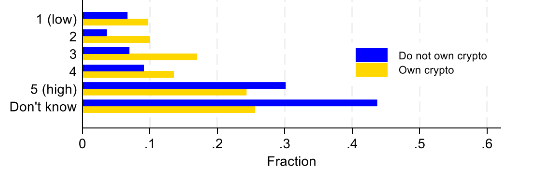
One of the most striking findings from the survey data pertains to the widespread lack of concrete return expectations, particularly among non-owners. In their 2021 survey, a staggering 87% of individuals who did not own crypto admitted they had no idea what return to expect from it over the following year. While this figure was lower among crypto owners, it remained substantial at 54%, indicating that even active participants often navigate this nascent market with considerable uncertainty regarding future performance.
However, for those willing to venture a forecast, the divergence in expectations was profound. Crypto owners anticipated an average return of 22% over the subsequent year, a figure drastically higher than the mere 7% expected by non-owners. This chasm in perceived potential returns is critical to understanding the bifurcated nature of the crypto market. Furthermore, owners tended to view crypto as less risky than non-owners did, suggesting a self-selection bias or a learning effect where exposure to the asset class may alter risk perception.
This significant knowledge gap and the wildly differing return expectations create fertile ground for the unique market dynamics observed in crypto. Unlike mature asset classes with centuries of data and established valuation models, cryptocurrencies often lack fundamental metrics that are universally understood or agreed upon. This ambiguity allows for a wider spectrum of beliefs to form, driving speculative behavior that is less anchored to traditional economic indicators.
The Information Feedback Loop and Speculative Bubbles

Beyond identifying the primacy of return expectations, the paper delves into the mechanisms that can amplify these beliefs and drive market movements. A pivotal component of the research involved a randomized information experiment conducted in 2025. In this experiment, households were randomly assigned to receive information about Bitcoin (BTC), stocks, GameStop, or inflation. The results were highly illuminating.
Participants who were presented with Bitcoin’s previous 12-month return demonstrated a significant shift in their investment intentions. They increased their desired crypto portfolio allocation by approximately 2 percentage points, representing a substantial 47% increase relative to the 4.3% desired allocation observed in the control group. More importantly, this shift in intention translated into tangible action: actual subsequent crypto purchases among this group also rose by about 2.5 percentage points.
The authors concisely summarized this outcome, stating that "providing information about recent Bitcoin returns induces some households to start buying cryptocurrency." This finding is particularly consequential for understanding speculative bubbles. It suggests a powerful feedback loop: positive past performance, when communicated, can directly attract new investors. These new purchases, in turn, push prices higher, potentially reinforcing bullish expectations among existing and new investors, and attracting still more buyers into the market. This dynamic creates a cycle that can rapidly inflate asset values, often decoupled from underlying fundamentals, a hallmark of speculative episodes.
Crucially, the effect of this information treatment was not universal. It was predominantly concentrated among individuals who had previously indicated that their non-ownership of crypto stemmed from a lack of sufficient information. Those who already harbored negative beliefs about crypto as a "bad investment" were largely unresponsive to the information about past returns, suggesting a degree of cognitive bias or firmly entrenched skepticism. This nuance highlights the importance of initial perceptions and the role of education or lack thereof in shaping market participation.
Demographic Undercurrents in a Belief-Driven Market
While the study emphasizes that beliefs about returns overshadow demographics in explaining crypto ownership, it does not entirely dismiss the role of demographic factors. The demographic profile of crypto investors still exhibits distinctive characteristics, albeit secondary to return expectations.
The research found that younger individuals are significantly more inclined towards crypto. People under 40 were 13 percentage points more likely to own cryptocurrency than those over 60, even after controlling for other confounding characteristics such as income and wealth. This suggests a generational divide, potentially linked to greater digital literacy, openness to new technologies, or different long-term financial goals and risk tolerances among younger cohorts.
Gender also played a role, with men being approximately 4 percentage points more likely than women to own crypto. Furthermore, households with higher incomes and greater wealth were more prone to participate in the cryptocurrency market. These demographic patterns align with broader trends observed in early adoption phases of new and often high-risk investment opportunities, where higher-income individuals may have more disposable capital for speculative ventures, and certain demographics might exhibit greater risk propensity or technological affinity.
Crypto Wealth and Consumption: A "Gambling Income" Analogy
The study also ventured into the implications of crypto wealth on household consumption, yielding another intriguing finding. It observed that a doubling in Bitcoin’s price made a household whose entire financial portfolio was held in crypto 1.4 percentage points more likely to purchase a durable good. This represents roughly a 7% increase relative to the unconditional probability of such a purchase.
However, the researchers found that this effect did not extend to ordinary, day-to-day spending. This stark distinction led them to draw a provocative comparison: crypto gains, in terms of their impact on consumption patterns, appear to be treated more akin to "gambling income" or lottery winnings than a permanent, sustainable increase in wealth. This behavioral nuance suggests that investors may perceive crypto gains as transient or windfall profits, making them more likely to be allocated towards discretionary, one-off purchases rather than integrated into ongoing consumption budgets. This perspective underscores the speculative nature often associated with crypto investments and how investors mentally account for these volatile gains.
Broader Implications for Market Stability, Regulation, and Financial Literacy
The findings of this Federal Reserve working paper carry profound implications for various stakeholders, including policymakers, financial institutions, educators, and individual investors.
For policymakers and regulators, the study highlights a critical challenge in consumer protection. If investment decisions are largely driven by subjective, often wildly optimistic, return expectations rather than informed understanding or robust financial planning, it increases the vulnerability of retail investors to market fluctuations and potential losses. The feedback loop identified—where past gains fuel new investment—could be interpreted as a mechanism for rapid market expansion followed by equally rapid contraction, posing risks to financial stability, particularly if crypto adoption continues to grow and its linkages with traditional finance deepen. Regulators may need to consider enhanced disclosure requirements, clearer risk warnings, and targeted investor education campaigns that address the unique psychological drivers of crypto investment.
For financial educators and advisors, the research underscores the urgent need for comprehensive financial literacy initiatives specifically tailored to digital assets. The high percentage of individuals lacking return expectations, even among owners, points to a significant knowledge gap. Education efforts should focus not just on the technical aspects of blockchain or cryptocurrencies, but also on the principles of risk management, diversification, and the potential for speculative bubbles, drawing clear distinctions between crypto and traditional asset classes.
For the cryptocurrency industry, the paper offers a candid assessment of market dynamics. While bullish sentiment fueled by past performance can drive adoption, the inherent volatility stemming from disparate beliefs and information asymmetry could hinder the asset class’s long-term maturation and broader institutional acceptance. Efforts to provide clearer, more standardized information, and to foster a more grounded understanding of crypto’s value propositions beyond speculative gains, could be beneficial.
The "gambling income" analogy also offers a lens through which to view the integration of crypto wealth into the broader economy. If crypto gains are largely treated as discretionary windfalls, their macroeconomic impact on aggregate consumption may be less stable and predictable than gains from traditional assets, which are often perceived as more permanent additions to wealth.
The Future of Crypto Volatility
The authors conclude that cryptocurrency stands out precisely because it is poorly understood by a large segment of the population. This lack of common information and the formation of sharply different views about its prospects mean that new information about past returns can dramatically alter both investor expectations and subsequent behavior.
This fundamental disagreement and the dynamic learning process among investors, rather than solely market fundamentals, appear to be deeply embedded in crypto’s persistent volatility. As the researchers aptly put it, "The absence of common information and beliefs about crypto across investors suggests that price volatility will continue to be one of the most defining characteristics of this new asset for the foreseeable future."
Ultimately, the study suggests a potentially uncomfortable but crucial conclusion for the crypto markets: the trajectory of the next wave of retail demand may depend not only on the actual price movements of assets like Bitcoin but significantly on how investors are informed about and perceive those past price movements. This underscores the powerful role of narrative, information dissemination, and behavioral economics in shaping the future of the digital asset landscape. As cryptocurrencies continue their journey from niche investment to a more integrated part of the global financial system, understanding these psychological and informational drivers will be paramount for all participants.