 admin
admin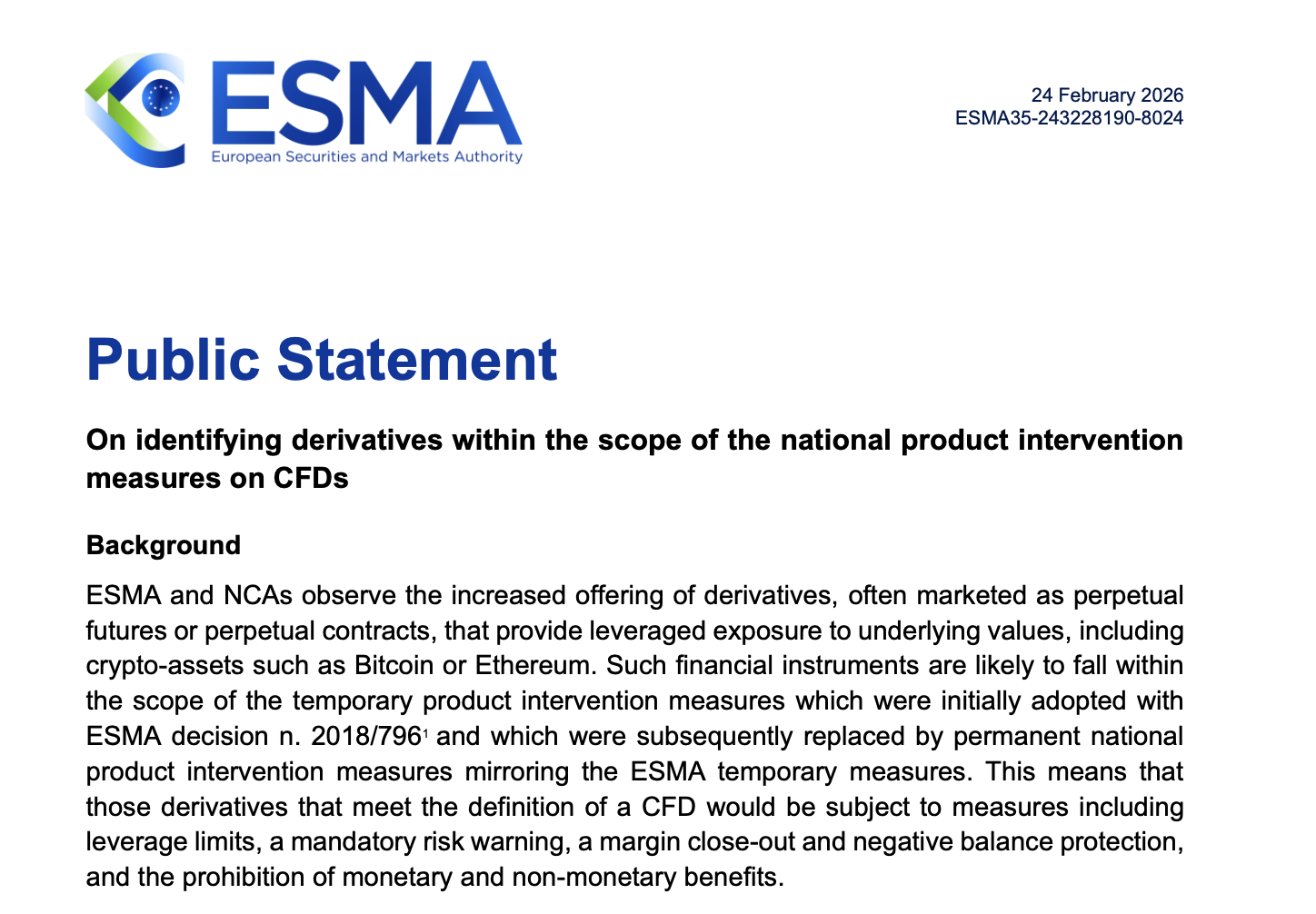
The European Securities and Markets Authority (ESMA), the primary financial markets regulator and supervisor for the European Union, has issued a comprehensive public notice aimed at entities offering leveraged crypto-asset products to retail investors. In a statement released on Tuesday, the regulator cautioned that investment vehicles marketed under labels such as “perpetual futures” or “perpetual contracts” likely fall under the stringent regulatory umbrella of Contracts for Differences (CFDs). This classification subjects these products to a rigorous suite of investor protection measures, leverage caps, and transparency requirements that many crypto-native platforms have historically sought to circumvent through creative branding.
The notice serves as a significant signal of the EU’s intent to enforce the Markets in Crypto-Assets (MiCA) framework with a focus on substance over form. ESMA emphasized that firms must take proactive steps to identify and manage conflicts of interest, particularly when offering high-risk derivative products that provide leveraged exposure to volatile assets like Bitcoin (BTC) and Ether (ETH). The move highlights a growing global trend of regulators scrutinizing the "perpetual" model—a staple of the decentralized and centralized finance sectors—which allows traders to maintain positions indefinitely without an expiry date.
The Regulatory Classification: Perpetuals as CFDs
At the heart of ESMA’s warning is the technical and legal alignment between crypto-linked perpetual contracts and traditional CFDs. A Contract for Difference is a derivative product where the parties agree to exchange the difference between the opening and closing prices of an underlying asset. Because perpetual futures in the crypto space lack a settlement date and rely on a "funding rate" mechanism to keep the contract price tethered to the spot price, their economic function is virtually identical to that of a CFD.
ESMA clarified that where these derivatives meet the definition of a CFD, they are strictly subject to the EU’s existing product intervention requirements. These requirements include:
- Leverage Limits: Restrictions on the amount of borrowed capital a retail trader can use, intended to prevent rapid and total capital depletion.
- Mandatory Risk Warnings: Standardized disclosures that inform retail clients of the high percentage of accounts that lose money when trading these products.
- Margin Close-out Rules: Automated mechanisms to close positions before a client’s losses exceed their initial investment.
- Negative Balance Protection: A guarantee that a retail client cannot lose more than the total funds in their account.
- Prohibition of Incentives: A ban on monetary and non-monetary benefits (such as trading bonuses) used to entice retail participation in high-risk trading.
By categorizing perpetuals as CFDs, ESMA is effectively closing a loophole that some offshore or non-compliant exchanges have used to offer 50x, 100x, or even 125x leverage to European residents—levels that far exceed the 2:1 or 5:1 ratios typically permitted for volatile assets under EU law.
Historical Context and the Rise of MiCA
The establishment of ESMA in 2011 was a direct response to the 2008 global financial crisis, designed to ensure a harmonized approach to financial supervision across the European Union. Over the last decade, ESMA has increasingly focused on the intersection of traditional finance and digital assets. In 2018 and 2019, the authority introduced temporary and then permanent restrictions on the sale of CFDs to retail investors, citing significant concerns regarding investor losses.
The introduction of the MiCA framework represents the EU’s most ambitious attempt to date to regulate the crypto-asset ecosystem. While MiCA provides a clear pathway for the issuance of stablecoins and the licensing of Crypto-Asset Service Providers (CASPs), it also grants ESMA and national competent authorities (NCAs) the power to intervene when products pose a threat to market integrity or investor protection.
This latest notice follows a series of proactive measures by ESMA. In January, the regulator targeted "financial influencers" or "finfluencers," warning that the promotion of volatile cryptocurrencies on social media must comply with advertising standards and disclosure rules. The current focus on derivatives suggests that ESMA is moving from the "outreach" phase of crypto regulation into an "enforcement" phase, targeting the sophisticated financial instruments that drive much of the market’s speculative volume.
Industry Reaction and Legal Analysis
The legal community and industry stakeholders have been quick to interpret the implications of ESMA’s stance. Bill Hughes, Senior Counsel and Director of Global Regulatory Matters at Consensys, provided a candid assessment of the regulator’s message. In a public statement, Hughes noted that the notice "clearly broadcasts that European authorities are closely watching the leveraged crypto-derivatives space."
Hughes warned that the mere rebranding of a product would not serve as a legal shield. "Rebranding a product as a ‘perpetual future’ will not insulate it from CFD restrictions if its characteristics match the definition," he stated. He further advised that firms offering these products to EU retail clients must immediately revisit their distribution strategies and governance frameworks. "Firms must do it themselves—or EU regulators will do it for them," Hughes added, suggesting that audits and enforcement actions could be the next logical step for the agency.

Legal analysts point out that this "substance over form" approach is a hallmark of EU regulation. If an instrument functions like a CFD, it is regulated like a CFD, regardless of the underlying technology—be it a smart contract or a centralized matching engine.
Case Study: Kraken’s Global Strategy and EU Exclusion
The timing of ESMA’s notice coincided with a major product announcement from Kraken, one of the world’s longest-standing cryptocurrency exchanges. On Tuesday, Kraken announced the listing of "perpetual futures tracking tokenized versions" of major equity indices, gold-backed ETFs, and leading public companies. This product represents a bridge between traditional equity markets and the crypto-native perpetual trading model.
Notably, Kraken’s new offering is available to residents of more than 110 countries globally, yet it explicitly excludes the United States and, significantly, the European Union at launch. A Kraken spokesperson confirmed to Cointelegraph that the product is "not available to EU clients" for the time being.
This strategic exclusion highlights the "Brussels Effect," where the EU’s stringent regulatory standards force global companies to either modify their products for the European market or bypass the region entirely to avoid the high cost of compliance and the risk of regulatory friction. Kraken’s decision to avoid the EU with its tokenized equity perpetuals underscores the exact concerns raised by ESMA: that these products carry a high regulatory burden that requires specific infrastructure for leverage limits and investor protections.
Supporting Data: The Risk of Leveraged Trading
ESMA’s hardline stance is supported by years of data regarding retail performance in the CFD and derivatives markets. Statistical reports from various national regulators within the EU, such as the AMF in France and BaFin in Germany, have consistently shown that between 70% and 85% of retail investors lose money when trading CFDs.
In the crypto-asset market, these risks are amplified by extreme volatility. During "flash crash" events, where Bitcoin or Ether prices may drop 10% or more within minutes, leveraged positions are frequently liquidated. According to data from market analytics platforms like Coinglass, hundreds of millions of dollars in "long" or "short" positions are often liquidated in a single 24-hour period across the global crypto derivatives market. By enforcing CFD-style protections, ESMA aims to ensure that retail investors are not exposed to "negative balance" scenarios where they owe the exchange more money than they deposited.
Timeline of Recent ESMA Actions in the Crypto Space
To understand the trajectory of EU regulation, it is helpful to view the recent timeline of ESMA’s interventions:
- June 2023: MiCA is officially entered into the Official Journal of the European Union, starting the countdown for implementation.
- October 2023: ESMA publishes a second consultation package on MiCA, focusing on the technical standards for CASPs.
- January 2024: ESMA issues a warning regarding the risks of crypto-asset promotion by social media influencers, highlighting the need for transparent disclosure.
- February 2024 (Early): ESMA releases a report on the "contagion risk" between crypto-assets and traditional financial markets.
- February 2024 (Current): The Tuesday notice specifically targeting perpetual futures and their classification as CFDs is published.
Broader Implications for the Crypto Market
The implications of ESMA’s warning extend beyond simple compliance. For crypto exchanges operating in Europe, this may necessitate a complete overhaul of their user interfaces and backend risk management systems. Platforms will likely need to implement "geofencing" to prevent EU retail users from accessing high-leverage products, or alternatively, apply for specific licenses that allow for the sale of CFDs—a process that is far more rigorous than a standard crypto-asset service provider registration.
Furthermore, the focus on "conflicts of interest" suggests that ESMA is concerned with exchanges that act as both the venue for trading and the market maker. In the CFD world, the broker often takes the opposite side of the retail client’s trade. If crypto exchanges are doing the same with perpetual futures, ESMA will require strict separation of duties and transparent disclosure to ensure that the exchange does not have a financial incentive to liquidate its own customers.
As the MiCA framework continues to roll out through 2024 and 2025, the industry can expect further clarifications on decentralized finance (DeFi) and non-fungible tokens (NFTs). However, for now, the message is clear: the era of unregulated, high-leverage crypto derivatives for the European public is coming to an end. ESMA has signaled that it will prioritize consumer protection and market stability, even if it means slowing down the pace of "innovation" in the high-risk derivatives sector.
In conclusion, ESMA’s latest move is a definitive step toward integrating the crypto-asset market into the broader framework of European financial law. By treating perpetual futures as CFDs, the regulator is applying a "same risk, same regulation" philosophy that aims to shield retail investors from the most predatory aspects of leveraged trading while providing a clear, albeit difficult, path for compliant firms to operate within the European Union.