admin
admin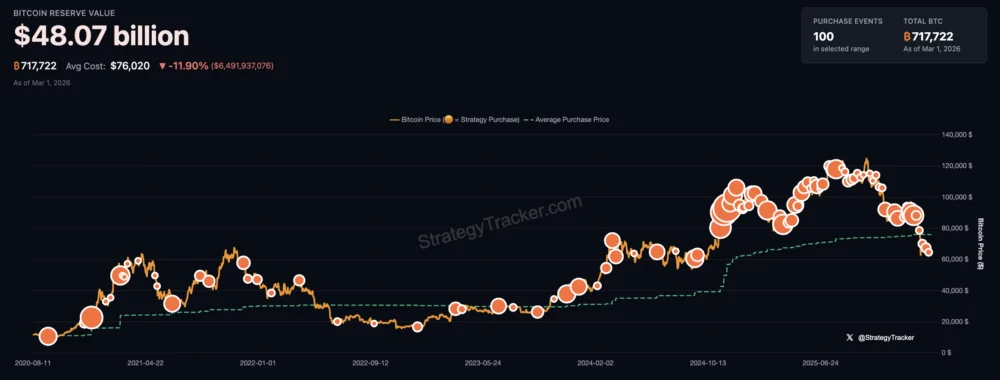
Strategy Chairman Michael Saylor announced via social media on Sunday that the corporation, currently the world’s largest corporate holder of Bitcoin (BTC), is raising the dividend on its STRC preferred stock—frequently referred to by the moniker “Stretch”—to 11.50% for the month of March 2026. This represents an increase from the previous rate of 11.25%, signaling a continued commitment to incentivizing investment in its preferred equity tier as the company navigates a volatile digital asset market.
The STRC instrument is a perpetual preferred stock, a financial structure that does not obligate the company to buy back or redeem the shares at any specific future date. A key feature of the STRC shares is their variable yield, which is recalibrated on a monthly basis. According to an official update posted on the company’s website on Friday, the dividend rate is adjusted periodically to encourage trading around the STRC par value of $100. By modulating the yield, the company aims to strip away price volatility and maintain a stable valuation for shareholders. The next dividend payout is scheduled for March 31, 2026, for shareholders of record.
A Fundamental Shift in Capital Structure
The decision to raise the dividend coincides with a broader strategic pivot articulated by Strategy CEO Phong Le. During a February briefing, Le disclosed that the company is actively moving away from the issuance of common stock as its primary vehicle for funding Bitcoin acquisitions. Instead, the firm is prioritizing the issuance of preferred shares.
“Last year, Stretch and our perpetual preferreds raised $7 billion. That’s 33% of the entire preferred market,” Le stated during a recent industry presentation. He emphasized that the company expects this specific financial structure to remain a cornerstone of its capital-raising efforts throughout the current fiscal year. “We will start to transition from equity capital to preferred capital,” Le added, highlighting a maturation in how the company interacts with traditional credit and equity markets to support its digital asset treasury.

This transition is significant for institutional investors. While common stock (MSTR) offers direct exposure to the company’s growth and Bitcoin’s price appreciation, it also carries the risk of dilution and higher volatility. Preferred stock, by contrast, sits higher in the capital structure, offering a fixed-income-like profile through regular dividends, which may appeal to a different class of yield-seeking investors who are less inclined to hold the more volatile common shares.
Financial Performance and Q4 2025 Disclosures
The adjustment to the STRC dividend comes on the heels of a challenging financial quarter. In early February, Strategy reported a staggering net loss of $12.4 billion for the fourth quarter of 2025. This disclosure triggered an immediate reaction in the public markets, with the company’s share price dropping 13% to approximately $107 per share shortly after the announcement.
Despite the massive net loss—primarily attributed to the impairment of its digital asset holdings—the company’s core business operations showed signs of stability. Revenue for the quarter rose 1.9% year-over-year to approximately $123 million. However, the disconnect between operational revenue and the valuation of the company’s Bitcoin treasury has led to significant fluctuations in its common stock price.
Strategy’s common stock (MSTR) has experienced extreme volatility over the past 18 months. After reaching a peak of $543 per share in November 2024, the stock entered a period of steady decline, falling below $300 by February 2025. As of the most recent market close on Friday, the stock was trading at $129.50, representing a 75% decline from its 2024 high.
Bitcoin Treasury Holdings and Market Context
Strategy remains undeterred by the current market drawdown. The company has continued its aggressive accumulation of Bitcoin even as the asset’s price has nearly halved since October 2024. This market-wide correction has significantly impacted the share prices of all digital asset treasury companies and related investment vehicles.

Year-to-date, Bitcoin has lost approximately 23.2% of its value. This downward trend is mirrored in the performance of broader market instruments, such as the Bitwise Bitcoin Standard Corporations ETF (OWNB), which has declined 16.1% over the same period. The OWNB ETF is designed to provide investors with exposure to public companies that maintain significant Bitcoin reserves on their balance sheets, making it a benchmark for the sector in which Strategy is the dominant player.
The company’s most recent acquisition occurred during the week of February 16, 2026, when it purchased 592 BTC for more than $39.8 million. This transaction marked the company’s 100th Bitcoin acquisition, bringing its total holdings to 717,722 BTC. However, the current market price of Bitcoin remains well below the company’s average purchase cost, which is calculated at $76,020 per Bitcoin.
Chronology of Recent Events
The following timeline illustrates the sequence of events leading to the current dividend adjustment and the company’s financial standing:
- November 2024: Strategy’s common stock (MSTR) reaches an all-time high of $543 per share amid a surging Bitcoin market.
- February 2025: MSTR stock falls below $300 as the initial phases of a market drawdown begin to take hold.
- January 2026: Bitcoin experiences a 23.2% year-to-date loss, creating pressure on corporate treasuries holding the asset.
- February 2026: Strategy reports a $12.4 billion net loss for Q4 2025. CEO Phong Le announces the shift toward preferred stock (STRC) over common equity.
- February 16, 2026: The company completes its 100th Bitcoin purchase, bringing total reserves to 717,722 BTC.
- March 2026: Michael Saylor announces an increase in the STRC dividend to 11.50% to maintain the stock’s $100 par value and manage volatility.
Implications for Corporate Treasury Strategy
The move to raise dividends on preferred stock is a tactical maneuver designed to stabilize the company’s secondary capital tier. By offering a high, variable yield, Strategy aims to ensure that the STRC shares remain attractive to investors even when the underlying value of Bitcoin is depressed. This provides the company with a reliable source of liquidity that does not depend on the performance of its common stock or the immediate recovery of the cryptocurrency market.
Industry analysts suggest that Strategy’s heavy reliance on preferred capital could serve as a blueprint for other public companies looking to integrate digital assets into their treasuries. However, the strategy is not without risks. The obligation to pay high monthly dividends requires consistent cash flow or the continued ability to raise funds through new issuances. Furthermore, the massive $12.4 billion loss reported in Q4 2025 highlights the accounting complexities and balance sheet risks inherent in holding large amounts of volatile assets.

The "Stretch" product (STRC) essentially functions as a hybrid between debt and equity. It offers the company the permanence of equity (since it is perpetual) while providing investors with the income certainty of a high-yield bond. For Michael Saylor and the board, this instrument is a vital tool for maintaining the "Bitcoin standard" they have adopted for the corporation’s finances.
Broader Market Reaction and Future Outlook
The broader investment community remains divided on Strategy’s approach. Supporters argue that the company is front-running a global shift toward Bitcoin as a primary reserve asset and that the current drawdown is a temporary hurdle in a long-term upward trajectory. Critics, however, point to the company’s massive unrealized losses and the high cost of servicing its preferred dividend obligations as potential points of failure.
Some market observers have even characterized Michael Saylor’s liquidation threshold as a potential "bull catalyst" for the market. The theory suggests that if the company were ever forced to liquidate its holdings, it would clear the way for a more decentralized and less leveraged market structure. However, the company’s recent move to shore up its preferred stock dividends suggests that it is nowhere near a liquidation event and is instead doubling down on its long-term strategy.
As the next payout date of March 31 approaches, investors will be closely watching the trading volume of STRC. If the dividend hike succeeds in keeping the stock near its $100 par value, it will validate the company’s transition toward preferred capital. If volatility persists, the board may be forced to consider even higher yields or alternative financing methods to sustain its 717,722 BTC treasury.
For now, Strategy remains the most prominent experiment in corporate treasury management in the digital age. The shift from common equity to preferred shares, spearheaded by the 11.50% dividend on STRC, represents a sophisticated attempt to decouple the company’s fundraising capabilities from the immediate price fluctuations of its primary asset, Bitcoin.