
 admin
admin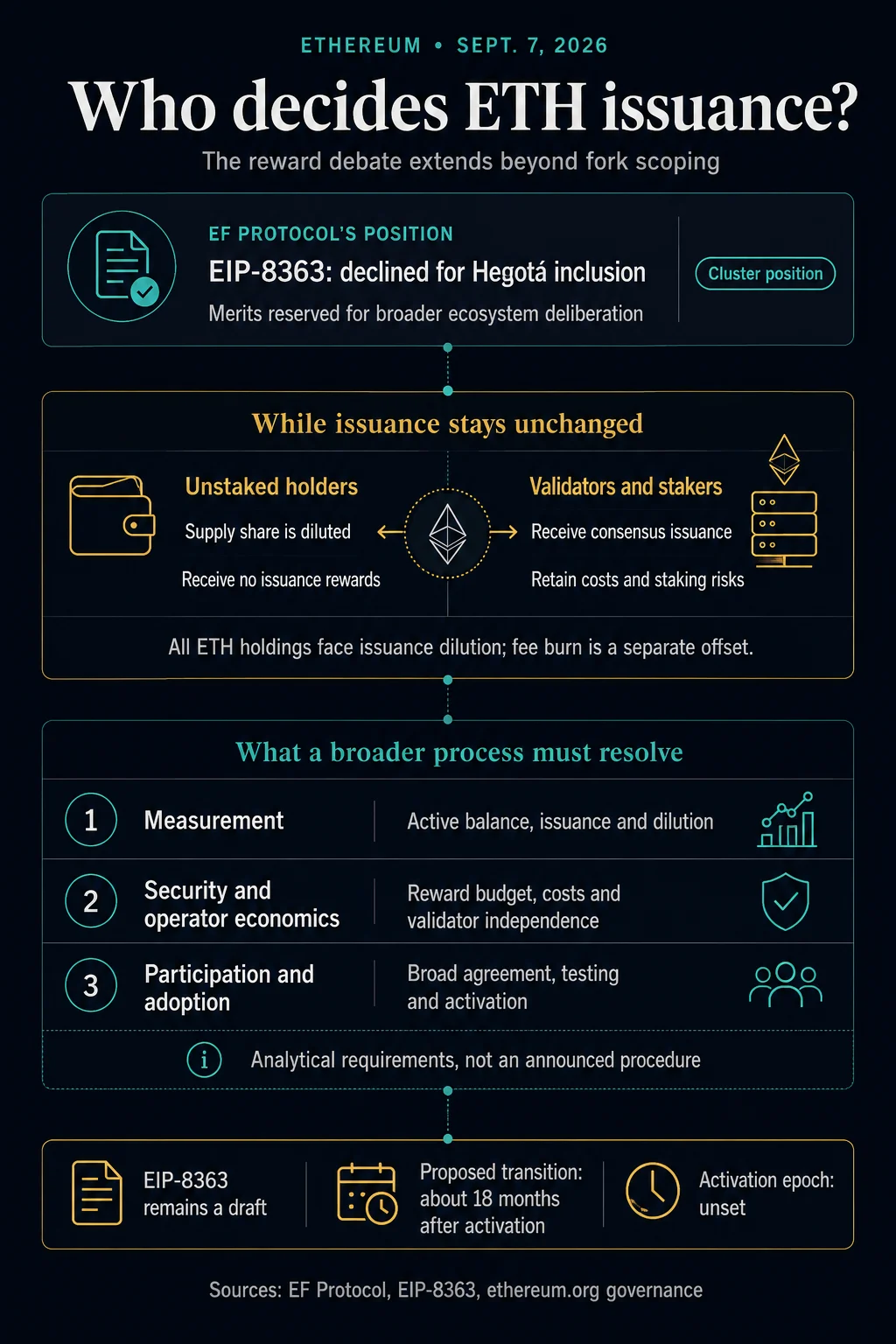
The Ethereum Foundation’s (EF) Protocol cluster has declared that decisions regarding Ethereum’s issuance policy should transcend the narrow confines of protocol upgrade (fork) scoping and instead be addressed through a more inclusive, ecosystem-wide deliberative process. This stance was articulated in a recent assessment of proposals submitted for the upcoming "Hegotã" upgrade, where the cluster explicitly declined to prioritize EIP-8363, a proposal aimed at reducing validator issuance rewards by burning a portion thereof. While the proposal’s technical merits remain open for discussion, the EF Protocol cluster emphasized that any policy impacting stakers, token holders, and the network’s overall security budget necessitates a broader consensus than what can be achieved within the Protocol group alone. This decision leaves a critical economic question—the balance between network security funding and token dilution—in a state of ongoing deliberation, awaiting a comprehensive governance resolution.
The Economic Realities of Unchanged Issuance
At the core of the debate lies the fundamental economic mechanism of Ethereum’s new ETH issuance. Newly minted ETH, distributed as rewards to validators for securing the network, directly increases the total supply. This expansion of supply inherently dilutes the proportional ownership of existing ETH holdings. Holders who do not participate in staking, and thus do not receive these issuance rewards, bear the brunt of this dilution without any corresponding compensation. While stakers also experience dilution, they are compensated for their commitment, capital lock-up, and the inherent risks associated with validating transactions.
The net effect on ETH’s total supply is a dynamic interplay between issuance and the base-fee burn mechanism, introduced with EIP-1559. This mechanism destroys a portion of transaction fees, effectively counteracting new issuance. However, the net supply growth remains a distinct metric from ETH’s market performance, which is influenced by a myriad of other factors.
The current landscape of staked ETH underscores the significance of this issuance policy. As of September 7th, at 15:37 UTC, the Validator Queue data indicated that approximately 42.9 million ETH, representing 35.13% of the total supply, was staked. An additional 1,975,361 ETH was in the entry queue, facing an estimated wait time of 34 days and seven hours before activation as validators. This pending ETH remains in limbo until validator slots become available.
These figures align closely with the total ETH supply of approximately 122.03 million, as tracked by CryptoSlate. A 35.13% staking share translates to roughly 42.87 million ETH, confirming the dashboard figures as a reasonable approximation. While these rounded figures provide a general overview, the precise calculations for proposals like EIP-8363 require the exact active effective balance of staked ETH. Applying a proposed reward-cut percentage directly to these approximations would imply a level of precision not yet supported by current data aggregation.
To illustrate the financial implications of the current issuance policy and the potential impact of changes, a series of hypothetical scenarios have been constructed. These calculations assume perfect participation, a constant active balance, and a starting supply of 122.03 million ETH. They deliberately exclude compounding effects, execution income, fee burns, operational costs, taxes, and penalties, focusing solely on the annualized impact of the consensus issuance policy. It is crucial to note that future staking participation remains a variable that could significantly alter these outcomes.
| Hypothetical Active Stake / Starting Supply | Current Consensus APR | Gross Annual Issuance / Starting Supply | Proposed Consensus APR After Transition (EIP-8363) |
|---|---|---|---|
| 30% | 2.75% | 0.82% | 1.45% |
| 35% | 2.54% | 0.89% | 1.03% |
| 40% | 2.38% | 0.95% | 0.64% |
Source: CryptoSlate calculations based on EIP-8363 formulas and the provided supply reference. Proposed returns are derived from the draft EIP’s fixed 60.25 million ETH saturation balance.
Under the existing issuance curve, a higher percentage of staked ETH leads to a lower Annual Percentage Rate (APR) on individual stakes but results in a greater total amount of ETH issued annually. In the scenario where 35% of the supply is staked, approximately 1.086 million ETH would be issued over a year. Before accounting for the fee burn, an unstaked holding would experience a dilution of its share in the total supply by approximately 0.88%.
For an individual validator operating with the minimum required 32 ETH stake, this same 35% staking scenario would yield around 0.81 ETH in annual consensus rewards, before any deductions for operational expenses or potential penalties. This distribution—where unstaked holders bear dilution without receiving compensatory issuance—is the status quo that leaving the current policy unchanged would preserve.
The Nuances of EIP-8363 and the Solo-Validator Test
EIP-8363, currently in draft form, proposes a mechanism to reduce validator rewards by burning a portion of what would otherwise be distributed. The amount burned would be a calculated fraction of idealized rewards, increasing proportionally with the active balance until issuance is effectively offset at a predetermined "saturation threshold."
This threshold is specified within the EIP as 60.25 million ETH, a figure intended to represent roughly half of the total supply at the time of a potential fork. Crucially, this balance remains fixed in the proposal, meaning its percentage of the total supply will fluctuate as the overall ETH supply changes. This variability is a significant factor when estimating the precise impact of the proposed reward reduction.

The transition period outlined in the proposal also plays a vital role. Upon activation, the base reward factor would initially increase from 64 to 128, before gradually returning to 64 over an approximate 18-month period. This phased approach is designed to cushion the immediate impact of the change, with initial validator returns varying based on their staking level. In the illustrative 35% staking scenario, the consensus APR would commence near 2.05% and subsequently settle to approximately 1.03% post-transition, a notable decrease from the current 2.54% under the existing formula.
Consequently, the annual consensus reward for a 32 ETH stake would decrease to approximately 0.33 ETH after the transition. This calculation is designed to isolate the policy’s effect by holding the stake constant, though real-world validator participation might adapt in response to these altered economic incentives. It is important to note that MEV (Maximal Extractable Value) and priority fees from execution transactions would remain unaffected by this proposed issuance burn. Furthermore, additional ETH could still be staked up to the saturation balance, and validators would continue to earn income from execution-layer activities. EIP-8363 specifically targets the issuance component of validator compensation, and its activation epoch is yet to be determined.
The arguments in favor of reducing ETH issuance extend beyond simply mitigating dilution for holders. Proponents of EIP-8363 contend that an unchecked increase in staking participation could foster an over-reliance on custodians and other intermediaries, potentially rendering Ethereum more susceptible to centralization and capture. The core of this argument revolves around who ultimately controls the staked ETH and how that control influences the network’s independence.
Conversely, a counter-argument questions whether reducing validator rewards would genuinely enhance the decentralization of stake control. In public discussions surrounding the proposal, community members have raised concerns that higher operational costs for solo validators could render them economically unviable before larger, institutional providers who can amortize costs across a greater number of validators. This could paradoxically lead to increased stake concentration.
Resolving this fundamental dispute necessitates robust empirical data concerning the operational costs faced by different types of validators. These costs directly influence the profit margins derived from validator rewards, and they can vary significantly even when the protocol’s reward distribution appears uniform. Consequently, the same reduction in rewards could have disproportionately different impacts on an independent validator operating a single node versus an intermediary managing stakes for numerous clients.
The interests of ETH holders and stakers are not entirely disparate. Stakers are also ETH owners, and thus stand to benefit from reduced dilution of their holdings. However, unstaked holders are intrinsically linked to the network’s security, which is directly funded by the very issuance rewards they do not receive. A decision that genuinely serves the ecosystem must carefully weigh these overlapping and sometimes conflicting interests, rather than prioritizing either reduced issuance or preserved yield as the sole metric of success.
The Governance Framework and the Path to Authorization
Ethereum’s governance, as documented on its official website, is an off-chain, multi-stakeholder process involving a diverse array of participants. This includes ETH holders, users of decentralized applications, developers, node operators, validators, and protocol developers. Achieving community consensus requires broad-based participation, transcending any single metric or mechanism, including direct coin voting. The process of writing a technical specification, agreeing on its inclusion in a protocol upgrade, and subsequently activating tested software are distinct stages, each requiring its own form of consensus.
In light of this established governance model, the EF Protocol cluster’s decision to defer the issuance policy decision creates a practical test for the broader ecosystem process it advocates. For meaningful deliberation to occur, participants require a shared, reliable baseline for calculating active stake and issuance rates. Furthermore, transparent evidence regarding the network’s security budget and a clear understanding of how varying operator costs influence validator viability are essential. Without these foundational elements, the same reward calculation can be framed either as a protective measure against stake centralization or as a catalyst for increased concentration, leading to unproductive debate.
Representation within the governance process is equally critical. A forum dominated by reward recipients might inadvertently undervalue the dilution experienced by unstaked holders. Conversely, a discourse focused solely on scarcity could overlook the essential costs associated with operating and securing the network. A truly deliberative process must diligently account for both sets of risks without assuming that any single group has undue influence over the decision-making.
The distinction between endorsement and execution, as exemplified by Solana’s governance framework, offers a useful point of comparison. Solana’s SGP-0002 governance proposal, for instance, was marked as "Accepted," but its implementation was explicitly contingent on the acceptance and activation of SIMD-0550. The technical document for SIMD-0550, as of September 7th, remained in the "Review" stage, with key implementation and tracking features unset. This indicates a clear separation between the community’s political endorsement of a proposal and the subsequent technical steps required for its realization.
Similarly, Ethereum requires a transparent and demonstrable pathway from broad community agreement to rigorous testing, implementation, and eventual activation before ETH holders can confidently view altered reward structures as established policy.
The Ethereum Foundation Protocol cluster has announced a Reddit AMA scheduled for September 16th at 14:00 UTC, inviting challenges to its tier list. This event offers a forum for discussion, but the ultimate decision on issuance policy and a concrete activation schedule remain outstanding.
The central challenge facing Ethereum is to reconcile the potential dilution savings from a revised reward budget with the imperative of maintaining a viable and sufficiently independent validator set. Until this complex interplay is adequately resolved through a broad and inclusive consensus, the current allocation will persist: validators will continue to receive issuance rewards for their network participation, while unstaked holders will retain their ETH without directly sharing in these rewards.








