
 Reza Arap Oktovian
This summer marks a pivotal moment for the Ethereum network, the second-largest blockchain by market capitalization, as it prepares for a monumental shift from its current Proof-of-Work (PoW) consensus mechanism to the energy-efficient Proof-of-Stake (PoS) model. This transition, often referred to as "The Merge," is an intricate process that involves merging the existing Ethereum mainnet with the beacon chain, a separate PoS chain that has been operational since December 2020. The undertaking is widely likened to an aircraft’s engine being overhauled mid-flight, with the critical requirement that Ethereum must continue to produce valid blocks without interruption throughout this complex evolution.
The development of the PoS protocol has been a collaborative effort, spearheaded by the Ethereum Foundation and involving a diverse community of developers. Unlike some other major blockchains, such as Bitcoin, Ethereum has embraced a multi-client strategy for its PoS implementation, often termed "Ethereum 2.0." This approach sees various independent teams developing different client software implementations, written in distinct programming languages, all adhering to the same PoS protocol. This decentralization in client development is a deliberate strategy to bolster network resilience and security.

The Technical Architecture of The Merge
At its core, The Merge signifies a fundamental restructuring of how the Ethereum network operates. Currently, every node on the network is responsible for both executing transactions and validating them. Post-Merge, this responsibility will be bifurcated. Two distinct types of nodes will emerge:
- Execution Nodes: These nodes will continue to interact with users and smart contracts, manage the Ethereum Virtual Machine (EVM), and execute transactions. However, instead of validating these transactions themselves, they will forward them to validator nodes for consensus. The EVM, the computational engine of Ethereum, will remain largely unchanged, allowing for backward compatibility.
- Validator Nodes (Consensus Layer): These nodes will operate on the beacon chain and will be solely responsible for validating transactions proposed by the execution nodes. This separation of duties is a key design choice aimed at enhancing robustness by compartmentalizing functions into different logical layers.
While the execution clients will undergo minor modifications to accommodate The Merge, the core components, including the EVM, are designed for reusability. The existing PoW chain will effectively cease its validation role, with the beacon chain assuming this critical function. The "merge" itself is not a fusion of two separate chains into one, but rather a point in time, defined by a specific block height, where the validation duties transition from the current PoW miners to the new PoS validators.
The Criticality of Client Diversity
The multi-client strategy for Ethereum’s PoS transition is rooted in a fundamental principle of distributed systems: redundancy and fault tolerance. By having multiple, independently developed clients, the network aims to mitigate the risk of a single point of failure. If a bug or vulnerability is discovered in one client, it is less likely to impact the entire network, as other clients, built on different codebases and potentially in different programming languages, will remain unaffected.
This approach contrasts with the development model of Bitcoin, whose protocol and primary client implementation are considered significantly simpler than Ethereum’s. Ethereum’s inherent complexity, a result of its extensive smart contract capabilities and vast ecosystem, naturally introduces a higher risk of vulnerabilities. The multi-client strategy serves as a crucial safeguard against these risks.
However, the effectiveness of this strategy hinges on a balanced distribution of network participation across these different clients. The ideal scenario involves an even distribution of staking power, ensuring that no single client controls a disproportionate amount of the network’s validation capacity. Specifically, it is crucial that no client commands more than 33% of the total staking power. If one client were to exceed 66% of the staking power, the entire concept of client diversity would be significantly undermined.
The implications of an uneven client distribution are profound. Should a critical bug be discovered in a client used by a small minority (less than 33%), the network can continue to operate smoothly, with the affected client being patched and reintegrated. A bug in a client with a substantial share (between 33% and 50%) would be more serious, potentially causing noticeable disruptions, though automatic recovery mechanisms are expected to manage the situation.
The most precarious situation arises when a bug affects a client with a majority of the staking power (over 50%). In such a scenario, the network could experience significant complications and disturbances, impacting users. The worst-case scenario, however, occurs if a bug impacts a client holding a supermajority (over 66%) of the staking power. This could lead to a consensus failure, forcing the network to either permanently split into two distinct chains – one potentially compromised – or to finalize on the buggy chain, accepting the consequences of the flaw.
The Prysm Dominance: A Significant Concern
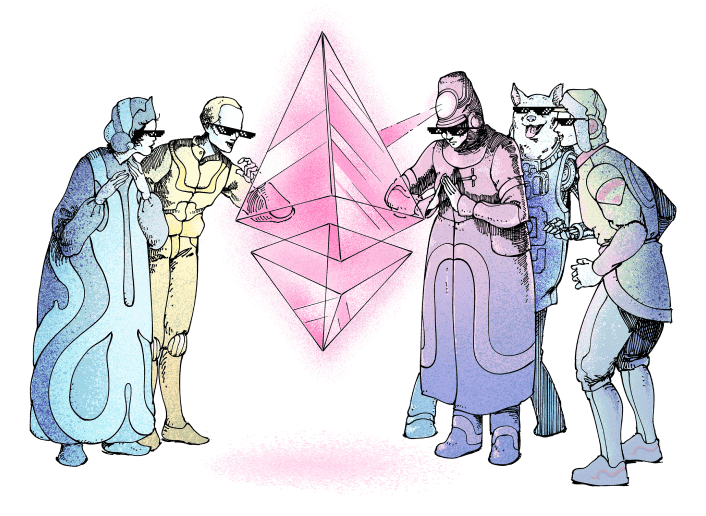
As The Merge approaches, a significant concern has emerged regarding the distribution of client software used by validators on the beacon chain. Currently, the Prysm client, developed by Prysmatic Labs, commands a substantial majority of the network’s staking power, hovering around 33% of the total. While this is just below the critical 66% threshold, it represents a considerable concentration of power in a single client.
The other prominent clients include Lighthouse, Teku, and Nimbus, with Grandine and Loadstar holding negligible market shares. The distribution, as of recent data, shows Prysm leading, followed by Lighthouse and Teku. This dominance is particularly concerning given that any critical, exploitable bug in Prysm could pose a significant threat to the network’s stability.
The reasoning behind Prysm’s significant adoption is attributed to several factors, as explained by Marius van der Wijden, an Ethereum core developer:
- First-Mover Advantage: Prysm was one of the earliest prototype implementations of a beacon client, allowing its developers ample time for optimization and development of supporting tools and documentation.
- Golang Programming Language: The use of Golang, a performant and developer-friendly language, has made Prysm accessible to a broad range of developers, including those already familiar with Go-ethereum (Geth), a dominant PoW execution client.
- Tooling and Documentation: Prysm has benefited from robust tooling, such as a Web UI, and comprehensive documentation, which simplifies its adoption and use.
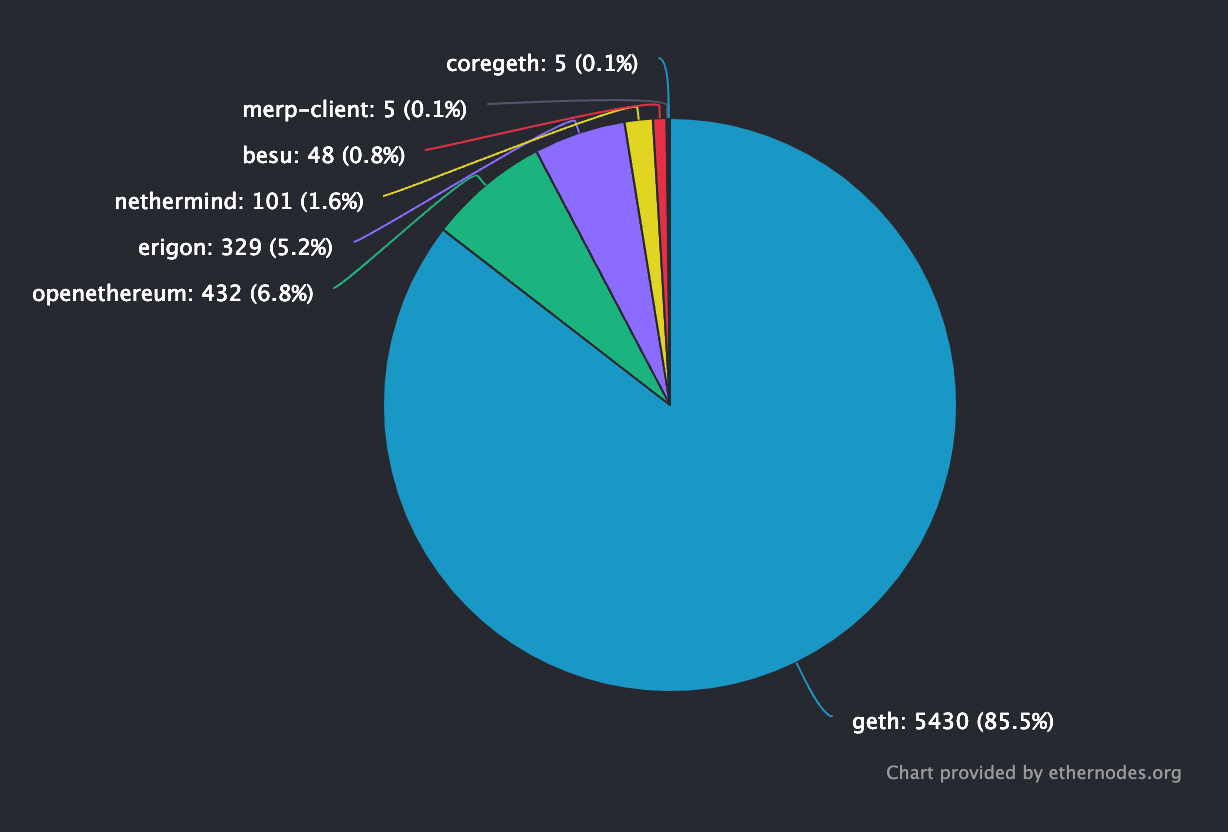
While the dominance of Geth on the execution layer (over 85%) is also notable, its impact post-Merge is considered less critical, as execution nodes will not be responsible for network security.
The Role of Major Staking Services
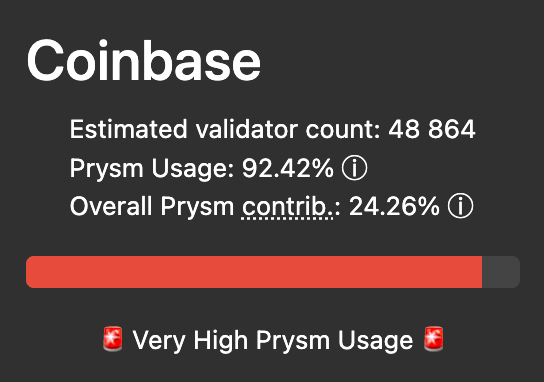
The concentration of staking power on the Prysm client is largely driven by the operational choices of major staking services and pools. These entities, which allow users to stake Ether without requiring the full 32 ETH, have become significant contributors to Prysm’s dominance. Prominent among these are Coinbase, Kraken, and Binance.
Coinbase, with a substantial portion of its validators running Prysm, contributes significantly to the client diversity issue. The company has stated that its initial choice of Prysm was driven by security considerations, particularly its support for remote signers, which allows for keys to be stored in isolated environments, thereby enhancing security. Coinbase has also indicated efforts to support other clients, such as Lighthouse, and integrate remote signer capabilities there.
Kraken has also acknowledged the importance of client diversity and is actively migrating some of its validators to the Teku client, in collaboration with Staked. This move aims to bolster the resilience of their staking services. Binance, another major player, did not provide a comment on its client diversity strategy when approached.
Lido, the largest staking service by validator count, also exhibits a significant, though not overwhelming, reliance on Prysm. In contrast, decentralized staking pools like Rocket Pool demonstrate a much healthier client distribution, underscoring the potential for more diversified approaches.
Mitigation Efforts and the Path Forward
Discussions are actively underway between major staking services and the Ethereum Foundation to address the client diversity challenge. While transitioning infrastructure for large-scale operations can be complex, progress is reportedly being made. Ethereum core developers are emphasizing that switching client software is generally not risky or difficult for individual node operators, provided proper procedures are followed.
Despite the less-than-ideal client distribution, the Ethereum core development team remains committed to pursuing The Merge. The robust testing and fuzzing infrastructure in place is designed to continuously identify discrepancies between clients. In the unlikely event of a consensus failure, the community is confident in its ability to swiftly release patches and manage any resulting forks. Crucially, there is a strong consensus within the community not to bail out stakers who might suffer losses due to running a majority client that encounters issues.
The transition to Proof-of-Stake represents a monumental step for Ethereum, promising enhanced energy efficiency and scalability. While the client diversity challenge presents a notable risk, the proactive discussions and ongoing efforts by various stakeholders suggest a determined push towards a more decentralized and secure future for the network. The success of The Merge will hinge not only on the technical execution but also on the community’s ability to collectively address and mitigate these critical distribution challenges.







