Reza Arap Oktovian
Ethereum, the world’s second-largest blockchain by market capitalization, is poised for a monumental shift later this year. The network, which underpins hundreds of billions of dollars in digital assets and decentralized applications, will transition from its current Proof-of-Work (PoW) consensus mechanism to a more energy-efficient Proof-of-Stake (PoS) system. This complex undertaking, often likened to "changing the engine of an airplane while flying it," necessitates that Ethereum continue to produce valid blocks without interruption throughout the process.
The Ethereum community, guided by the Ethereum Foundation and prominent figures, has embraced a multi-client strategy for the Proof-of-Stake protocol, colloquially known as Ethereum 2.0. Unlike monolithic systems, Ethereum’s PoS implementation is being developed by multiple independent teams using diverse programming languages, creating separate client software versions. This approach is designed to enhance robustness and prevent single points of failure.

The Genesis of "The Merge": A Technical Overhaul
At its core, the transition, widely referred to as "The Merge," involves the integration of the existing Ethereum network nodes with the "beacon chain," a separate PoS chain that has been operational since December 2020. This merger will fundamentally redefine the roles of nodes within the network. Currently, nodes are responsible for both executing and validating transactions. Post-Merge, these duties will be bifurcated.
Execution nodes will continue to handle transaction processing and interact with the Ethereum Virtual Machine (EVM), serving as the interface for users and smart contracts. However, the critical task of validating these transactions will be delegated to validator nodes operating on the consensus chain. While execution clients will retain much of their current functionality, with the EVM being a core reusable component, the validation logic tied to the PoW chain will eventually be deprecated. This separation of concerns represents a significant architectural enhancement, bolstering the network’s resilience.
The Peril of Client Monoculture: A Critical Vulnerability
The decision to develop multiple, distinct client software implementations stems from a fundamental security principle: diversity as a bulwark against systemic risk. The theory posits that a bug or vulnerability in one client, written in a different language and developed by a separate team, will not cascade to compromise the entire network. This stands in contrast to systems like Bitcoin, where a simpler protocol and a more unified development community lead to a higher degree of code similarity across implementations.

Ethereum’s inherent complexity, an order of magnitude greater than Bitcoin’s, naturally increases the attack surface and the potential for vulnerabilities. The multi-client strategy aims to mitigate this risk, but its effectiveness hinges on balanced distribution of network participation across these clients. The critical threshold for concern is identified at the 33% mark of staking power. If a single client commands less than one-third of the network’s staking power, any bug affecting it is unlikely to have catastrophic consequences. The network can continue to operate, and the affected client can be patched and updated.
The situation becomes more precarious as a client’s share approaches or exceeds 50% of the staking power. While automatic mechanisms are designed to address such scenarios, significant network disruptions and user impact are likely. However, the most dire scenario, described as "game over" by industry observers, occurs when a single client garners more than two-thirds (66%) of the staking power. In such a situation, the client with a supermajority possesses the power to finalize blocks, effectively dictating the state of the blockchain. The only recourse for non-buggy clients would be to either permanently fork the chain, creating two separate Ethereums, or to capitulate and adopt the buggy chain, inheriting its compromised state.
Prysm’s Dominance: A Lingering Concern
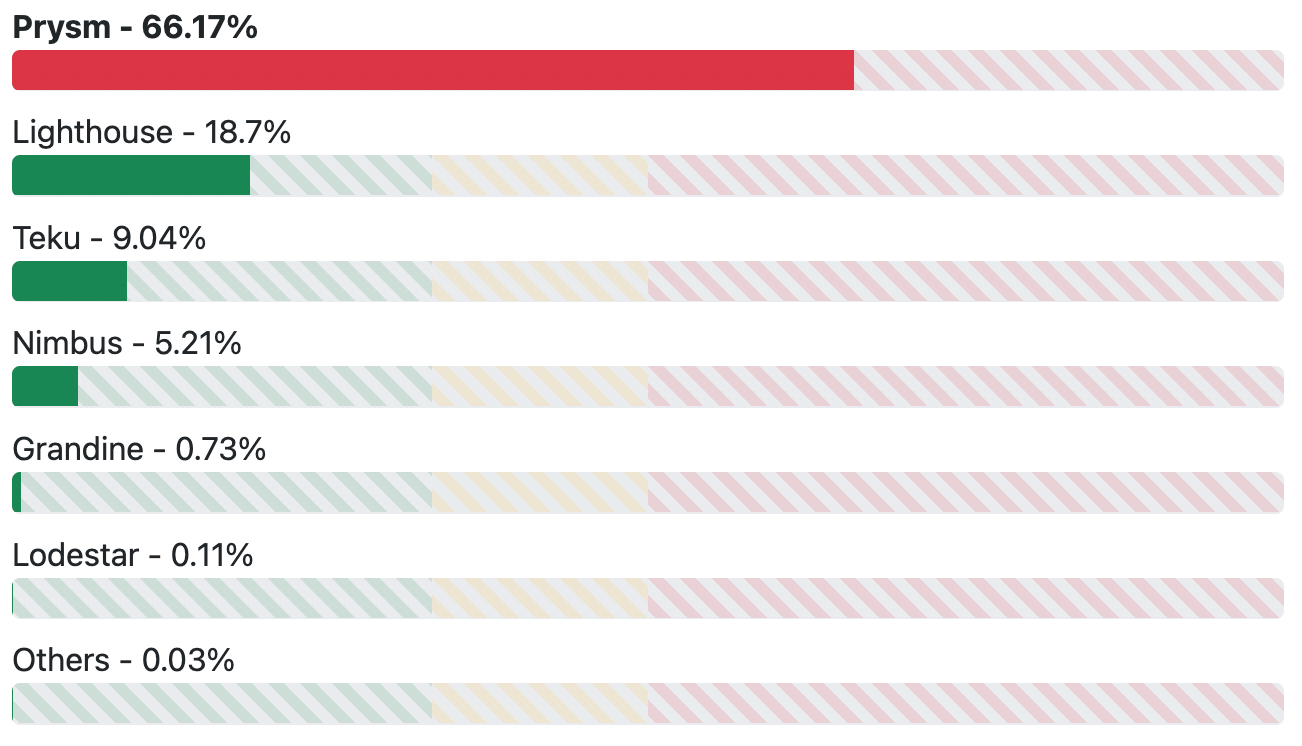
As of the latest available data, the Prysm client, developed by Prysmatic Labs, accounts for approximately 48% of the network’s staking power. While this is not yet the critical 66% threshold, it represents a significant concentration of power and a departure from the ideal scenario of diversified client usage. Other notable clients include Lighthouse, Teku, and Nimbus, alongside smaller players like Grandine and Loadstar.
The dominance of Prysm raises concerns due to its "first-mover advantage." Marius van der Wijden, an Ethereum core developer, attributes Prysm’s success to its early development, optimization, robust tooling (including a user-friendly Web UI), and comprehensive documentation. Furthermore, Prysm’s implementation in Go (Golang) is cited as a significant advantage. Go is a performant and relatively easy-to-develop-in language, making it accessible to developers familiar with Go-ethereum, a leading PoW execution client.
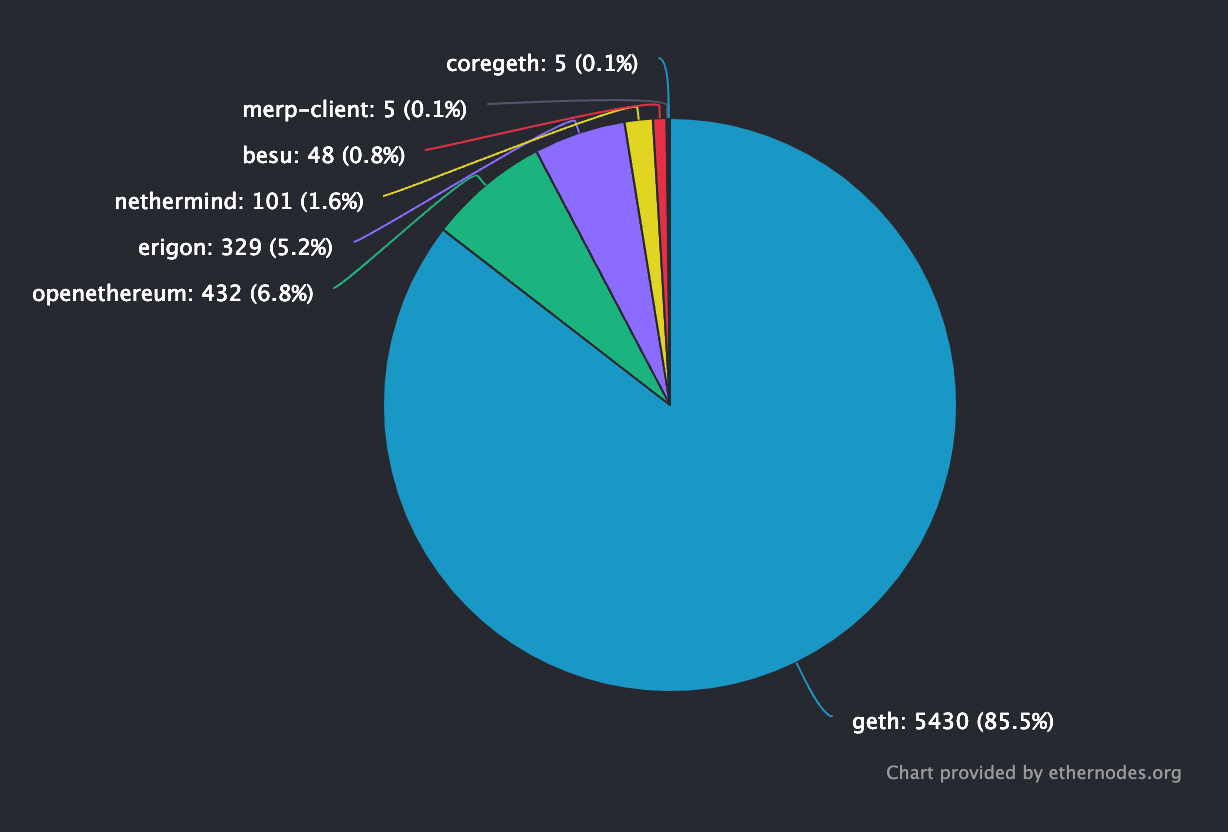
While the distribution of PoW execution clients is even more concentrated, with Go-ethereum holding over 85% of the market share, this is considered less problematic in the post-Merge environment. Execution nodes, while vital for transaction processing, do not provide the core security guarantees that consensus clients do.
The Role of Staking Services in Client Diversity
The concentration of staking power on Prysm is largely driven by major staking services and pools. These entities enable users to stake Ether without the need to acquire the full 32 ETH required for individual validator operation. Prominent among these are Coinbase, Kraken, and Binance.
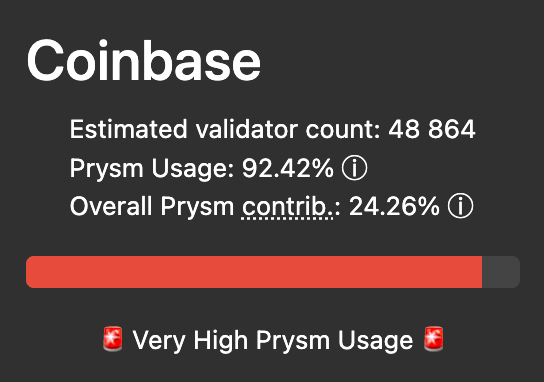
Coinbase, with a substantial portion of its validators running Prysm, contributes significantly to the client diversity issue. The company states that its initial choice of Prysm was driven by security considerations, specifically its support for "remote signers." This feature allows keys to be generated and stored in isolated environments, enhancing security and enabling double-signing protection. Coinbase has indicated efforts to support other clients, such as Lighthouse, and to integrate remote signer capabilities for them.
Kraken, another major player, has also acknowledged the dominance of Prysm but is actively working to diversify by rolling out new validators on the Teku client and migrating some existing ones. Binance, the third-largest staking service, has not yet provided a public statement on its client diversity strategy. Lido, a decentralized staking pool, while having a large validator count, shows a comparatively lower Prysm usage, contributing less to the overall concentration.
In contrast, decentralized staking pools like Rocket Pool demonstrate significantly better client diversity, with a very small percentage of their validators running Prysm. This highlights a potential path forward for improving the overall health of the network’s client distribution.
Moving Forward: Discussions and Mitigation Strategies
The Ethereum Foundation and core developers are actively engaged in discussions with major staking services to address the client diversity challenge. While the transition to a more balanced distribution may take time for these large operators due to the complexity of their infrastructure, there is a recognized need to mitigate the risks associated with Prysm’s current dominance.
Switching client software is generally considered a low-risk and straightforward process for individual node operators. However, for larger staking entities, the integration with existing monitoring and API systems requires careful planning and execution.
Despite the less-than-ideal client distribution, the Ethereum community remains committed to pursuing The Merge. Core developers express confidence in the network’s testing and fuzzing infrastructure, which continuously works to identify discrepancies between clients. Even in the unlikely event of a consensus failure or a fork, the community is prepared to respond swiftly with new releases and resolution strategies. Furthermore, there is a clear consensus that stakers running a majority client will not be bailed out in the event of misbehavior or failure by that client.
Broader Implications and the Future of Ethereum
The successful transition to Proof-of-Stake represents a paradigm shift for Ethereum, promising a significant reduction in energy consumption – estimated to be over 99.9% compared to its current PoW model. This move aligns Ethereum with a more sustainable future and addresses a long-standing criticism of blockchain technology.
Beyond energy efficiency, The Merge is expected to lay the groundwork for future scalability upgrades, including sharding. By decoupling transaction execution from consensus, the network can evolve to handle a much higher volume of transactions, paving the way for broader adoption of decentralized applications and services.
The current client diversity challenge, while significant, is a testament to the proactive approach of the Ethereum community in identifying and addressing potential risks. The ongoing dialogue between developers, staking services, and the Ethereum Foundation indicates a collective commitment to navigating this complex transition with a focus on security, resilience, and the long-term health of the Ethereum network. The coming months will be crucial in observing how the community addresses this critical aspect of decentralization as Ethereum embarks on its next evolutionary chapter.