
 Reza Arap Oktovian
In a monumental undertaking described as "changing the engine of an airplane while flying it," the Ethereum network, the world’s second-largest blockchain by market capitalization and a critical infrastructure supporting hundreds of billions of dollars in assets, is on the cusp of a radical transformation. By mid-year, Ethereum will transition from its current Proof-of-Work (PoW) consensus mechanism to a significantly more energy-efficient Proof-of-Stake (PoS) system, a process colloquially known as "The Merge." This transition is imperative, as Ethereum cannot cease block production under any circumstances.
Unlike many other prominent blockchains, such as Bitcoin, Ethereum’s developer community, bolstered by the Ethereum Foundation and influential figures within the ecosystem, has embraced a multi-client strategy for its PoS implementation, often referred to as Ethereum 2.0. This approach involves the development of several distinct client software versions, each implemented by different teams and written in various programming languages. This diversification is a deliberate strategy to enhance network resilience by mitigating the risk of a single point of failure.

The Mechanics of The Merge: A Separation of Duties
The Merge itself is not a fusion of two separate chains into one. Instead, it represents a critical juncture where the existing Ethereum network nodes, which currently include miners performing both transaction execution and validation, will integrate with the "beacon chain." The beacon chain, which has been operational since December 2020, serves as the PoS consensus layer.
Following The Merge, the roles of nodes will be bifurcated. A new paradigm will emerge with two primary types of nodes:
- Execution Nodes: These nodes will continue to interact with users and smart contracts through the Ethereum Virtual Machine (EVM). They will be responsible for executing transactions and then submitting them to validator nodes for attestation. Essentially, execution nodes will perform a role similar to their current function, but their validation responsibilities will be handed over to the consensus layer.
- Validator Nodes (on the Consensus Chain): These nodes will take on the crucial role of validating transactions and securing the network through the PoS mechanism. They will be responsible for proposing new blocks and ensuring the integrity of the blockchain.
While execution clients will require minor adjustments to accommodate The Merge, much of their existing codebase, particularly the EVM, can be retained. Over time, execution clients may even shed the legacy code associated with the PoW consensus. The core of The Merge is the seamless handover of the validation responsibility from PoW miners to PoS validators at a predetermined block height, a testament to enhanced robustness through architectural separation.
The Criticality of Client Diversity: A Battle Against Monoculture
The multi-client strategy is a cornerstone of Ethereum’s security architecture. The rationale is straightforward: if a critical bug or vulnerability emerges in one client implementation, the existence of multiple, independently developed clients written in different languages significantly reduces the likelihood of a widespread network failure. A flaw in one client would not compromise others due to their distinct codebases.
This contrasts sharply with the approach of Bitcoin, whose protocol and implementation are considerably simpler. Ethereum’s inherent complexity, described as an order of magnitude greater than Bitcoin’s, necessitates this more robust approach to mitigate the increased risk of vulnerabilities and attack vectors.
However, the effectiveness of this strategy hinges on a balanced distribution of staking power across these clients. The ideal scenario is one where no single client controls more than 33% of the network’s staking power. A critical threshold is the 66% mark; if one client were to command more than two-thirds of the staking power, the entire premise of client diversity as a security measure would be severely undermined.
The implications of a significant bug impacting a dominant client are stark:
- Below 33% Staking Power: A bug in a client used by less than a third of validators would have minimal impact. The network would continue to operate smoothly, the bug would be fixed, and normal operations would resume.
- Between 33% and 50% Staking Power: A bug in a client within this range would be more serious, but automatic network mechanisms would likely mitigate user-facing disruptions.
- Above 50% Staking Power: A bug affecting over half of the staking power would trigger automated responses aimed at rectifying the situation. However, this would likely result in network disturbances and affect users.
- Above 66% Staking Power: A bug in a client used by more than two-thirds of the staking power represents a catastrophic scenario. The buggy client would possess a supermajority, enabling it to finalize blocks, potentially leading to a permanent chain split or forcing non-buggy clients to adopt the compromised chain. This could effectively mean "game over" for the network’s integrity.
The Prysm Predominance: A Lingering Concern
As of early 2022, a significant portion of the network’s staking power, approximately 66%, was concentrated on the Prysm client implementation, developed by Prysmatic Labs. This situation presents a considerable risk, as any exploit or bug within Prysm could have a cascading, detrimental effect on the entire Ethereum network. While the likelihood of such a scenario is considered low, it is not zero.
Other notable consensus clients include Lighthouse, Teku, and Nimbus, with Grandine and Loadstar having minimal market shares. It is worth noting that Grandine is the only client published under a closed-source license, a factor that can limit transparency and community auditing.
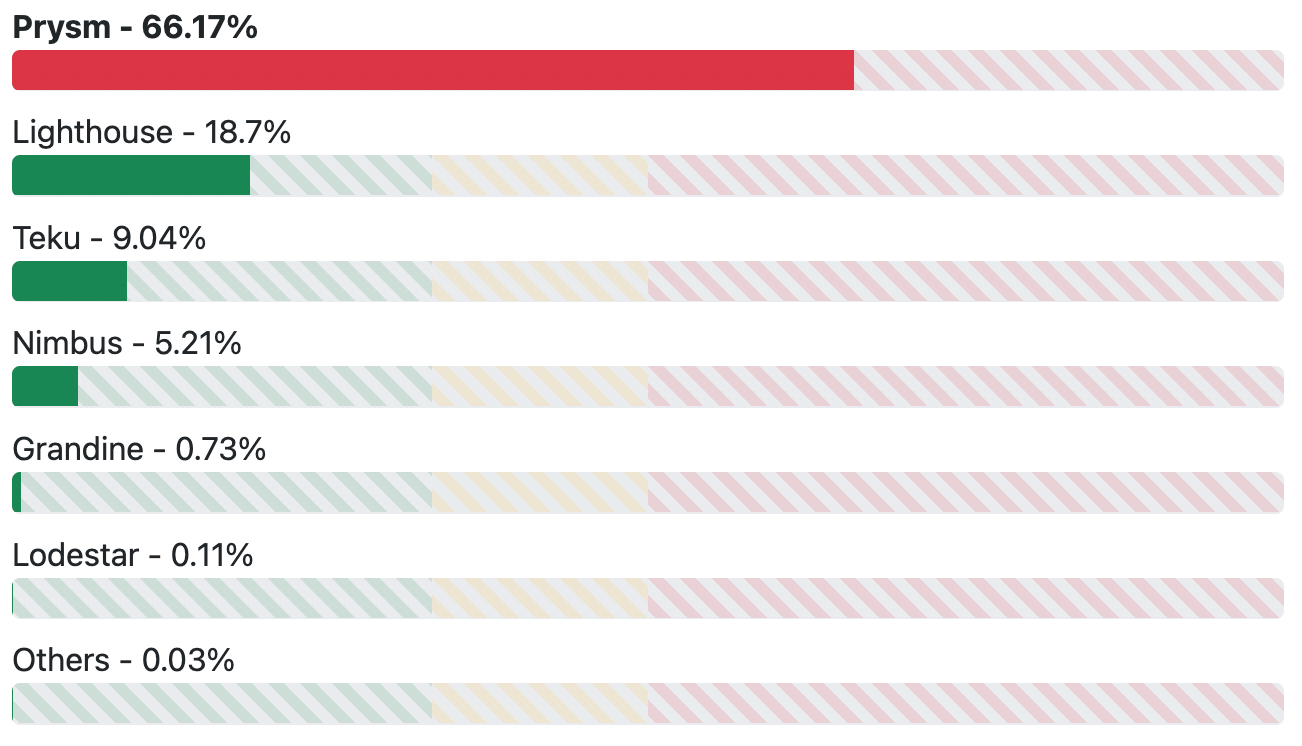
The distribution of consensus clients, as of the time of reporting, highlighted Prysm’s dominance, hovering just below the critical 66% threshold but significantly exceeding the ideal 33%. For real-time data and resources on client distribution, the community relies on platforms like clientdiversity.org.
Understanding Prysm’s Dominance: A First-Mover Advantage
The question of why Prysm has achieved such a commanding market share is a natural one. Marius van der Wijden, an Ethereum core developer specializing in the Geth (Golang Ethereum) Proof-of-Work client, attributes Prysm’s success to several key factors:
- First-Mover Advantage: Prysm was among the earliest prototype implementations of a beacon client, allowing its developers to optimize and refine their software ahead of competitors.
- Robust Tooling and Documentation: The team behind Prysm invested heavily in developing comprehensive tooling, including user-friendly interfaces like the Web UI, and providing detailed documentation, which significantly lowered the barrier to entry for operators.
- Golang Programming Language: Prysm is written in Golang, a programming language known for its performance and ease of development. This familiarity also extends to developers already working with Geth, another popular client written in Golang, facilitating code auditing and understanding.
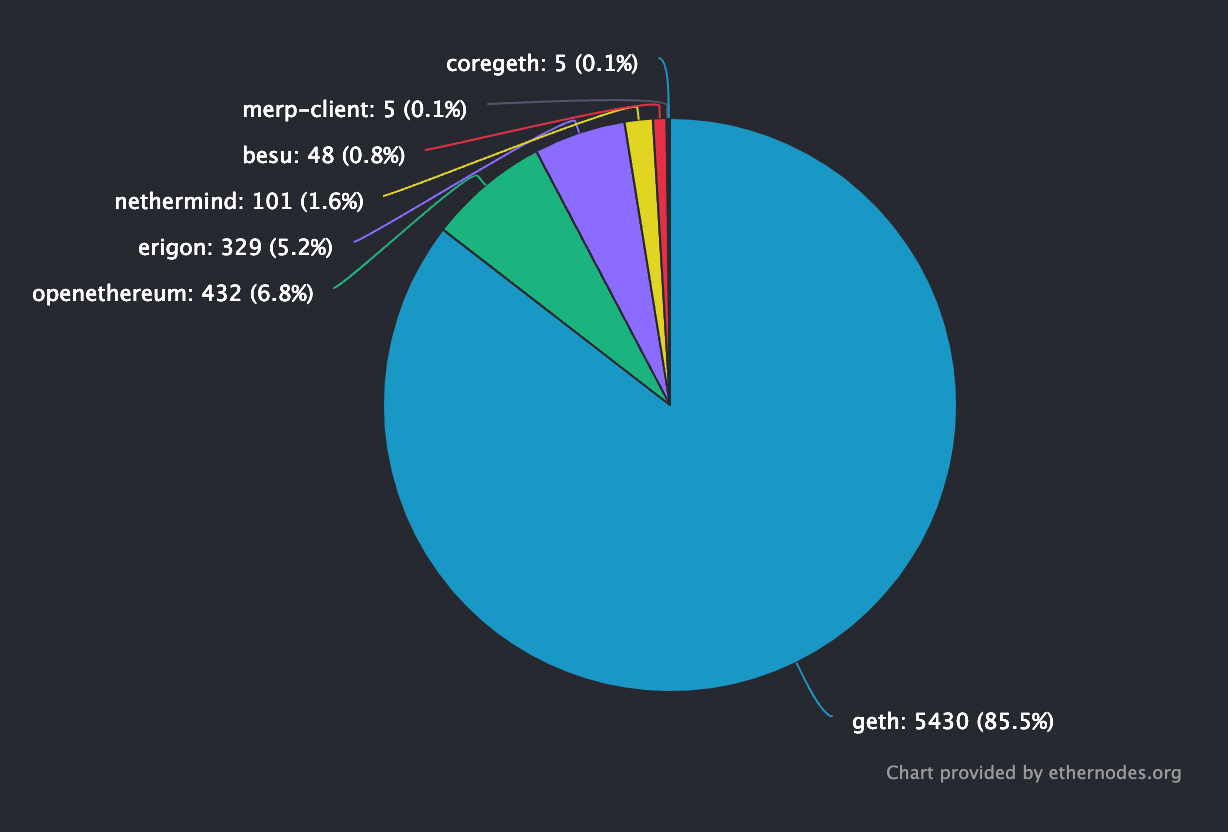
Van der Wijden also pointed out that the distribution of Proof-of-Work execution clients is even more skewed, with Geth holding over 85% of the market share. However, he emphasized that this imbalance is less concerning post-Merge, as execution nodes will primarily focus on transaction execution rather than providing network security.
The Role of Staking Services: Centralization Concerns
A significant driver of Prysm’s dominance is its adoption by major staking services and pools. These services enable individuals to stake Ether without the need for the full 32 ETH required for solo staking, thereby democratizing participation. However, this also concentrates significant staking power in the hands of a few entities.
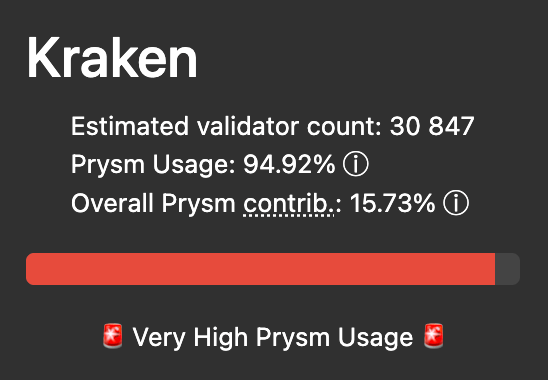
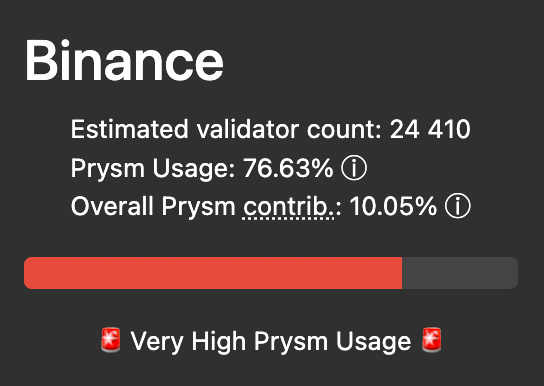
Major staking providers such as Coinbase, Kraken, and Binance have been substantial contributors to Prysm’s market share. For instance, Coinbase, with a significant number of validator nodes, runs a vast majority of them on Prysm. Their stated reason for this choice often centers on security, particularly the support for remote signers, which allows for keys to be stored in isolated, more secure environments.
Coinbase, in a statement, highlighted that their evaluation of clients at the time of launching ETH2 staking led them to Prysm due to its "only viable client supporting remote signers." This feature is crucial for enhancing the security of their validators by preventing keys from being stored directly on the validator hardware. They have since begun supporting other clients like Lighthouse, working to integrate remote signer capabilities.
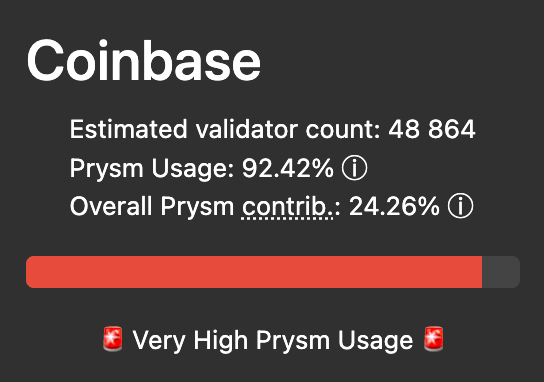
Kraken, another prominent exchange, also initially favored Prysm for its "maturity and stability." However, in response to client diversity concerns and discussions with the Ethereum Foundation, Kraken, alongside Staked, has begun to deploy validators on Teku and migrate existing ones, aiming to foster greater diversity.
Binance, while not providing a direct comment to CryptoSlate, also shows a significant reliance on Prysm. The third-largest staking service, Lido, while having a larger validator count than Binance, exhibits a lower Prysm usage percentage, contributing less to the overall dominance of the client.
Decentralized Alternatives: Rocket Pool’s Approach
In contrast to these centralized entities, decentralized staking pools like Rocket Pool demonstrate a more distributed approach. Rocket Pool boasts a considerably lower percentage of validators running Prysm, contributing a minimal fraction to the overall Prysm dominance. This highlights that a more decentralized model can inherently lead to better client diversity.
The significant influence of these large staking services underscores the potential for concentrated power. Fortunately, discussions are reportedly underway between these major staking providers and the Ethereum Foundation to address the client diversity issue. Marius van der Wijden indicated that these discussions are progressing positively, with major staking pools actively working on migrating parts of their infrastructure to alternative clients. While the transition might take longer for larger operations due to the need to adapt their monitoring and metrics infrastructure, the intent to diversify is present.
Switching client software is generally not considered risky or difficult for individual node operators, provided they follow proper procedures such as persisting their slashing database. The primary challenges arise for larger stakers due to API differences between clients.
The Road Ahead: Navigating The Merge with Calculated Risk
With The Merge imminent, the Ethereum community faces the reality of a less-than-ideal client distribution, with Prysm’s dominance unlikely to fall below the critical 33% mark in the short term. Despite this, core developers remain committed to proceeding with The Merge.
Marius van der Wijden expressed confidence in the safety of pursuing The Merge, citing the robust testing and fuzzing infrastructure in place to identify discrepancies between clients. He believes that even in the event of a consensus failure, the community possesses the agility to rapidly deploy new releases and resolve forks. Crucially, he stated, "We also have strong consensus that we will not bail out stakers that run a majority client if their clients misbehave," underscoring the network’s commitment to decentralized principles and the inherent risks associated with concentrated power.
The successful execution of The Merge will mark a pivotal moment in Ethereum’s evolution, ushering in an era of increased energy efficiency and scalability. However, the ongoing challenge of client diversity remains a critical factor to monitor, as the long-term health and security of the network depend on a truly decentralized and resilient ecosystem. The collaborative efforts of developers, staking services, and the broader community will be essential in navigating these complexities and ensuring a secure and prosperous future for Ethereum.







