
 Reza Arap Oktovian
Ethereum, the world’s second-largest blockchain by market capitalization and a foundational layer for hundreds of billions of dollars in digital assets, is poised for a monumental transformation. In the coming months, the network will transition from its current Proof-of-Work (PoW) consensus mechanism to a more energy-efficient Proof-of-Stake (PoS) system. This complex undertaking, often likened to "changing the engine of an airplane while flying it," demands that Ethereum continue to produce valid blocks seamlessly throughout the process.
Unlike many other major blockchains, such as Bitcoin, Ethereum’s development community, with strong backing from the Ethereum Foundation (EF) and influential figures, has embarked on building multiple client software versions to implement the PoS protocol, commonly referred to as Ethereum 2.0. These distinct client implementations are developed by various teams and differ in their programming languages, a strategy designed to enhance network resilience.

The Merge: A Bifurcation of Node Responsibilities
The transition, officially termed "The Merge," signifies the integration of the current Ethereum network nodes with the already operational beacon chain, which has been running since December 2020. This integration will also lead to a fundamental separation of duties among network nodes. Presently, a single node is responsible for both executing and validating transactions. Post-Merge, this responsibility will be divided.
Two primary types of nodes will emerge: execution nodes and validator nodes. Execution nodes will continue to interface with users and smart contracts via the Ethereum Virtual Machine (EVM), process transactions, and forward them to validator nodes for validation. Essentially, execution nodes will retain their current roles, with the critical validation function being offloaded to validator nodes operating on the consensus layer (the beacon chain). This separation of duties is a classic architectural enhancement aimed at bolstering robustness by creating distinct logical layers.
While these execution clients share some code and programming languages, they will undergo minor adjustments to accommodate The Merge. Core components like the EVM are largely reusable with modifications. It is anticipated that execution clients will eventually shed the validation code pertaining to the legacy Proof-of-Work chain. The Merge, therefore, is not a fusion of two chains into one but rather a precise point in time, at a specific block height, when current nodes cease validation duties, which are then assumed by validators.
The Criticality of Client Diversity: A Defense Against Vulnerabilities
The rationale behind fostering multiple, independently developed client software versions is to mitigate the risk of a single point of failure. A bug, fault, or vulnerability in one client implementation should not cripple the entire network, as these clients do not share identical codebases or programming languages.
This contrasts with Bitcoin, whose protocol and its singular primary implementation (Bitcoin Core) are considerably simpler. Ethereum’s complexity, being orders of magnitude greater than Bitcoin’s, inherently introduces a higher probability of vulnerabilities and a broader attack surface.
The effectiveness of this multi-client strategy hinges on an even distribution of network participation across these clients. A critical threshold exists: if any single client controls more than one-third (33%) of the network’s staking power, its vulnerability poses a significant risk. Should one client surpass two-thirds (66%) of the staking power, the intended benefit of diverse codebases becomes largely negated.
The consequences of a severe bug hitting a client with varying levels of staking power are as follows:
- Below 33%: A bug in a client with less than one-third of the staking power would cause minimal disruption. The network would continue operating smoothly, the bug would be addressed, and normalcy would be restored.
- Between 33% and 50%: A bug affecting a client in this range would be more serious but likely unnoticed by most users, with automatic mechanisms mitigating the impact.
- Above 50%: A bug impacting a client with over half the staking power would trigger a cascade of automatic corrective mechanisms. While these would eventually mend the situation, the network would experience complications and disturbances, affecting users.
- Above 66% (Supermajority): If a bug strikes a client used by more than two-thirds of the staking power, it represents a "game over" scenario. The buggy client holds a supermajority, granting it ultimate control. The flawed chain would finalize, forcing non-buggy clients to either permanently fork the chain, resulting in two distinct Ethereums, or accept the buggy chain and its consequences.
Prysm’s Dominance: A Growing Concern for Network Stability
As of recent data, the Prysm client implementation, developed by Prysmatic Labs, commands approximately 48% of the network’s staking power. This concentration is a significant concern, especially if the Prysm client were to harbor an exploitable bug leading to a consensus failure. While such a scenario is considered unlikely, it remains a non-zero risk.
Other notable consensus clients available to network participants include Lighthouse, Teku, and Nimbus. Grandine and Loadstar possess very small market shares, each below 1%, with Grandine being the sole client available under a closed-source license.
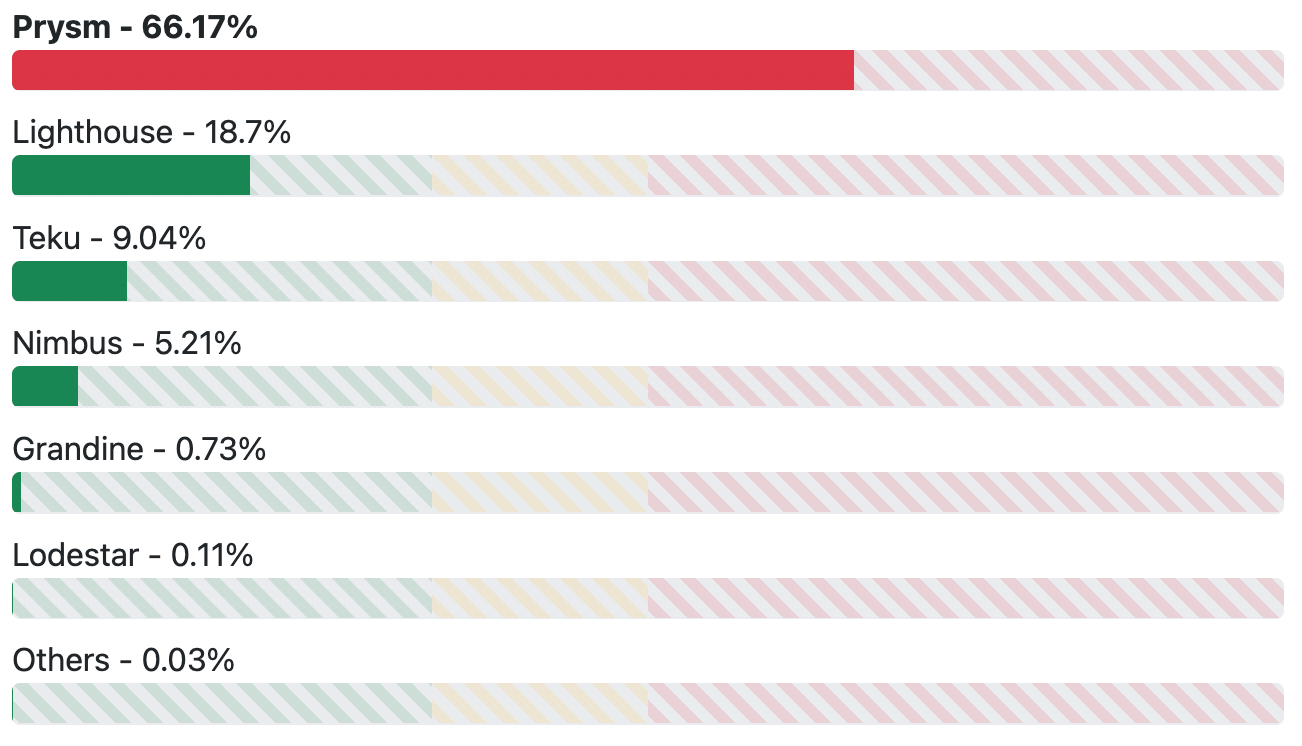
The distribution of consensus clients at the time of this report indicates Prysm’s substantial lead, though still marginally below the critical 66% threshold. Resources like clientdiversity.org provide up-to-date statistics and information on client distribution.
The First-Mover Advantage: Why Prysm Leads
The dominance of the Prysm client can be attributed to several factors, as explained by Marius van der Wijden, an Ethereum core developer specializing in the Geth (Golang Ethereum) Proof-of-Work client. He highlights a "first-mover advantage," stating that Prysm was the initial prototype implementation of a beacon client. This allowed the team to begin optimization early, develop additional tooling such as a Web UI, and produce comprehensive documentation.
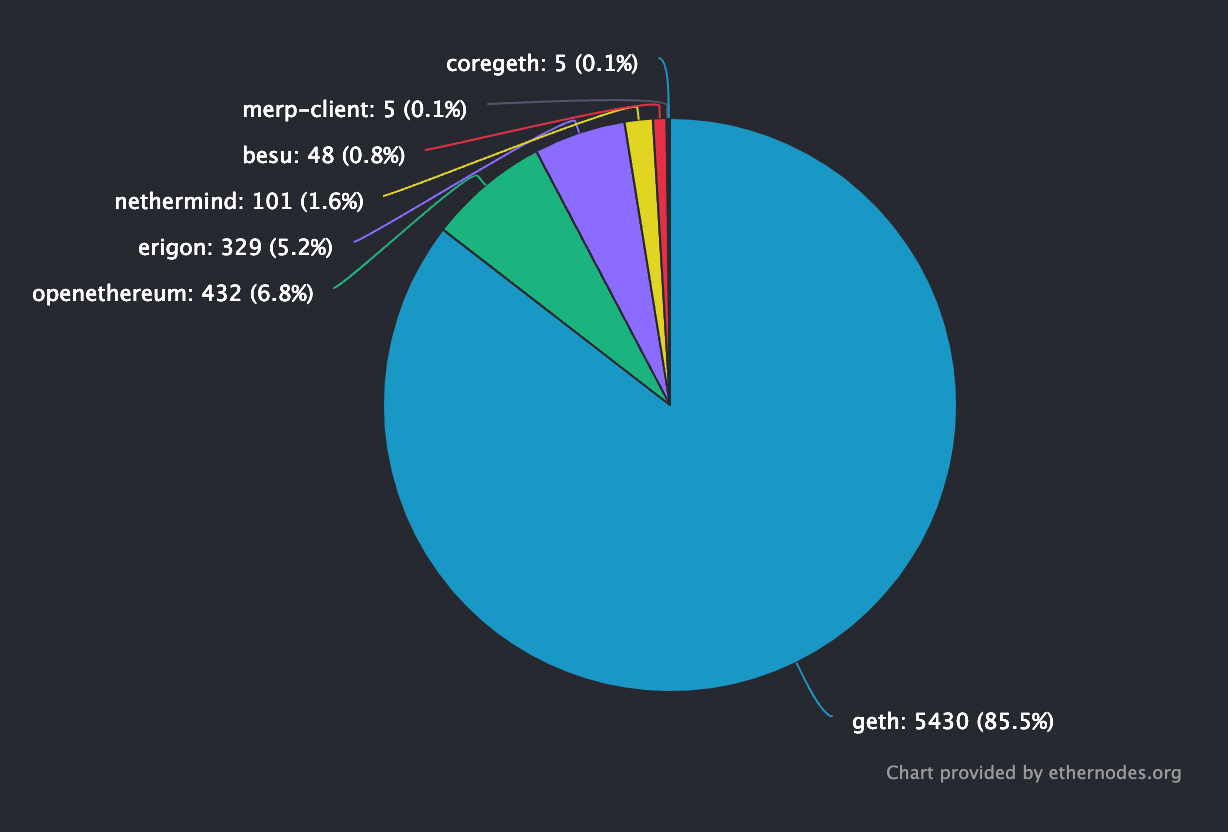
Furthermore, Prysm’s use of Go (Golang), a performant and developer-friendly language, is a significant advantage. As Go-ethereum is also written in Go, developers familiar with Geth can more easily understand and audit Prysm’s codebase. This familiarity is crucial, especially considering the even more pronounced client distribution imbalance on the execution layer, where Geth currently holds over 85% of the market share for Proof-of-Work clients. However, post-Merge, this imbalance on the execution layer is less critical, as execution nodes primarily handle transaction processing rather than network security.
The Role of Major Exchanges in Prysm’s Dominance
A key factor exacerbating the client diversity issue lies with major staking services and pools. These entities aggregate vast amounts of staked Ether, effectively wielding significant staking power without requiring individual users to commit the full 32 ETH required for independent validation. The widespread adoption of the Prysm client by these major players is a primary driver of the current imbalance.
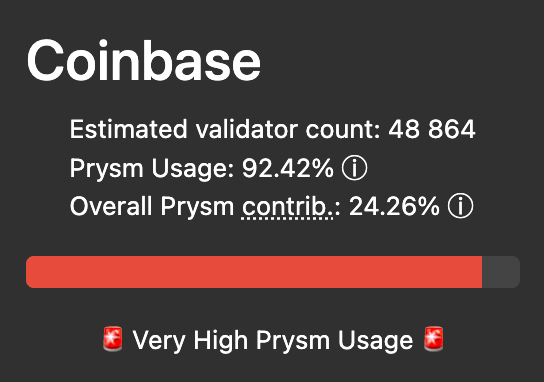
Prominent among these are Coinbase, Kraken, and Binance. Coinbase, with a substantial portion of its 24.3% contribution to the diversity issue stemming from its 48,864 validators running Prysm, emphasizes security as the primary driver for its client choice. A spokesperson for Coinbase Cloud cited the need for remote signer support, a feature initially exclusive to Prysm, which enhances validator security by isolating private keys. While Coinbase has since begun supporting Lighthouse with remote signer capabilities, its initial reliance on Prysm significantly contributed to its current position.
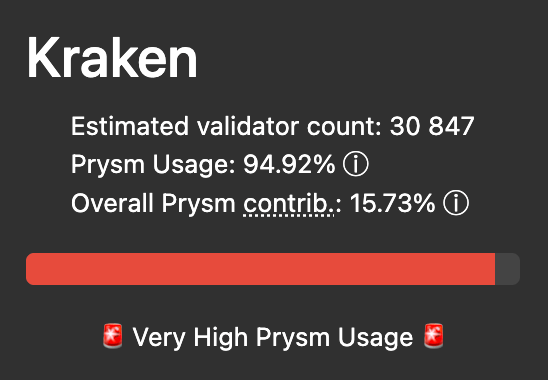
Kraken, another major exchange, initially opted for Prysm due to its perceived maturity and stability. However, in consultation with the Ethereum Foundation, Kraken has begun migrating some validators to the Teku client to improve diversity. Binance, a significant player in the staking landscape, did not provide a comment regarding its client distribution strategy.
Lido, a prominent decentralized staking pool, while having a larger validator count than Binance, exhibits a lower Prysm usage rate, contributing less to the overall dominance of the client.
Decentralized Solutions Lead the Way in Client Diversity
In contrast, decentralized staking pools like Rocket Pool demonstrate a significantly healthier client distribution. With a smaller validator count, a much lower percentage of its validators utilize Prysm, thus contributing minimally to the concentration issue.
The significant staking services and pools hold the collective power to rectify the client distribution imbalance. Discussions are reportedly underway between these entities and the Ethereum Foundation, with core developer Marius van der Wijden describing the progression as "good." He notes that these larger entities are working on migrating parts of their infrastructure to alternative clients, a process that may take longer due to the need to update their metrics and monitoring systems.
Van der Wijden assures that switching client software is neither risky nor difficult for individual node operators, provided they follow proper procedures to avoid slashing penalties. Major client implementations are well-tested and maintained.
The Merge: Proceeding Despite Client Distribution Concerns
With The Merge only months away, the Ethereum community faces the reality of a less-than-ideal client distribution. The probability of Prysm’s dominance falling below the critical 33% threshold in the near term appears low. However, this situation does not deter the Ethereum core developers from their commitment to The Merge.
Marius van der Wijden expresses confidence in the safety of proceeding, citing the robust testing and fuzzing infrastructure designed to identify inter-client discrepancies. He believes that even in the event of a consensus failure, new releases can be swiftly deployed to resolve forks. Furthermore, he emphasizes a strong consensus within the community that stakers running a majority client will not receive bailouts if their chosen client misbehaves. The developers are committed to the integrity and security of the network, even in the face of potential challenges presented by the current client distribution landscape.







