Reza Arap Oktovian
Ethereum, the world’s second-largest cryptocurrency by market capitalization and the foundational layer for a vast ecosystem of decentralized applications and digital assets valued in the hundreds of billions of dollars, is on the cusp of a transformative upgrade. Sometime around the middle of this year, the network will execute "The Merge," a long-anticipated transition from its current energy-intensive Proof-of-Work (PoW) consensus mechanism to a more sustainable and efficient Proof-of-Stake (PoS) model. This monumental undertaking, often likened to "changing the engine of an airplane while flying it," requires Ethereum to continue producing valid blocks without interruption throughout the process.
The shift to PoS is not merely a technical adjustment; it represents a fundamental re-architecting of how the Ethereum network achieves consensus and security. Unlike many other blockchains, such as Bitcoin, Ethereum’s development has been a collaborative effort driven by a robust community, significantly influenced by the Ethereum Foundation (EF) and prominent figures within the ecosystem. This collective agreement has led to the development of multiple client software implementations for the future PoS-based Ethereum, often referred to as Ethereum 2.0. These clients are distinguished by their programming languages and the distinct development teams behind them, a deliberate strategy to enhance network resilience.

The Genesis of The Merge: A Long Road to Proof-of-Stake
The journey toward Proof-of-Stake for Ethereum has been a multi-year endeavor, born out of a desire to address the scalability limitations and significant energy consumption associated with Proof-of-Work. As early as 2013, Vitalik Buterin, the co-founder of Ethereum, proposed PoS as an alternative consensus mechanism. The vision was to create a blockchain that was not only secure but also environmentally conscious and capable of handling a much larger volume of transactions.
The development of the PoS consensus layer, known as the Beacon Chain, began in earnest several years ago. Launched on December 1, 2020, the Beacon Chain has been running in parallel to the existing Ethereum mainnet, acting as a testbed and a foundational component for the eventual merge. This parallel existence allowed developers to iterate, test, and refine the PoS mechanisms without disrupting the live network. The Beacon Chain operates independently, validating transactions and building its own chain of blocks, but it has not yet been responsible for processing user transactions or executing smart contracts.
A Tale of Two Chains: The Mechanics of The Merge
The Merge itself is conceptualized as a union of the current Ethereum Proof-of-Work chain and the existing Proof-of-Stake Beacon Chain. However, it’s crucial to understand that this is not a simple merging of two separate blockchains into one. Instead, it involves a pivotal moment where the current Ethereum nodes, which include miners responsible for block creation and validation, will cease their PoW duties. Their responsibilities will be entirely handed over to the validators operating on the Beacon Chain.

Post-Merge, the operational roles of nodes within the Ethereum network will be distinctly separated. Currently, a single node often handles both the execution of transactions and their subsequent validation. After The Merge, this dual role will be bifurcated into two primary types of nodes:
- Execution Nodes: These nodes will continue to interact with users and smart contracts, presenting the Ethereum Virtual Machine (EVM) – the runtime environment for smart contracts on Ethereum. They will execute transactions and forward them to validator nodes for consensus. Essentially, their core function of processing and relaying transactions will remain largely the same as it is today, with the critical difference being that the ultimate validation will be performed by a different set of entities.
- Consensus Nodes (Validators): These nodes, running on the Beacon Chain, will be solely responsible for validating transactions and securing the network. They will stake their ETH to propose and attest to new blocks, thereby replacing the energy-intensive mining process of PoW.
While the execution clients will undergo minor modifications to accommodate the merge, much of their existing codebase, particularly components like the EVM, can be reused. The ultimate goal is to decouple the execution layer from the PoW consensus mechanism entirely. This separation of duties is a strategic enhancement of network robustness, creating distinct logical layers for transaction processing and security consensus.
The Imperative of Client Diversity: A Critical Vulnerability
A cornerstone of Ethereum’s resilience strategy, particularly in the context of the multi-client PoS architecture, is client diversity. The rationale is straightforward: by developing and deploying multiple, independent client software implementations, the network mitigates the risk of a single point of failure. If a bug or vulnerability were to exist in one client, it would not compromise the entire network because other clients, written in different programming languages and developed by separate teams, would continue to operate unaffected.
This approach is a significant departure from the development model of Bitcoin, which, while robust, relies on a more homogenous client implementation. Ethereum’s inherent complexity, being a far more sophisticated platform than Bitcoin with its expansive smart contract capabilities and EVM, necessitates a more distributed approach to software development to manage the increased risk of vulnerabilities.
However, the effectiveness of this client diversity strategy hinges critically on the distribution of staking power across these various clients. The ideal scenario is an even distribution, or at least a distribution where no single client commands an overwhelming majority of the network’s hashing power (in PoW) or staking power (in PoS).
The Critical Thresholds: Understanding the Risks
The Ethereum community has identified specific thresholds for staking power distribution that dictate the network’s resilience:
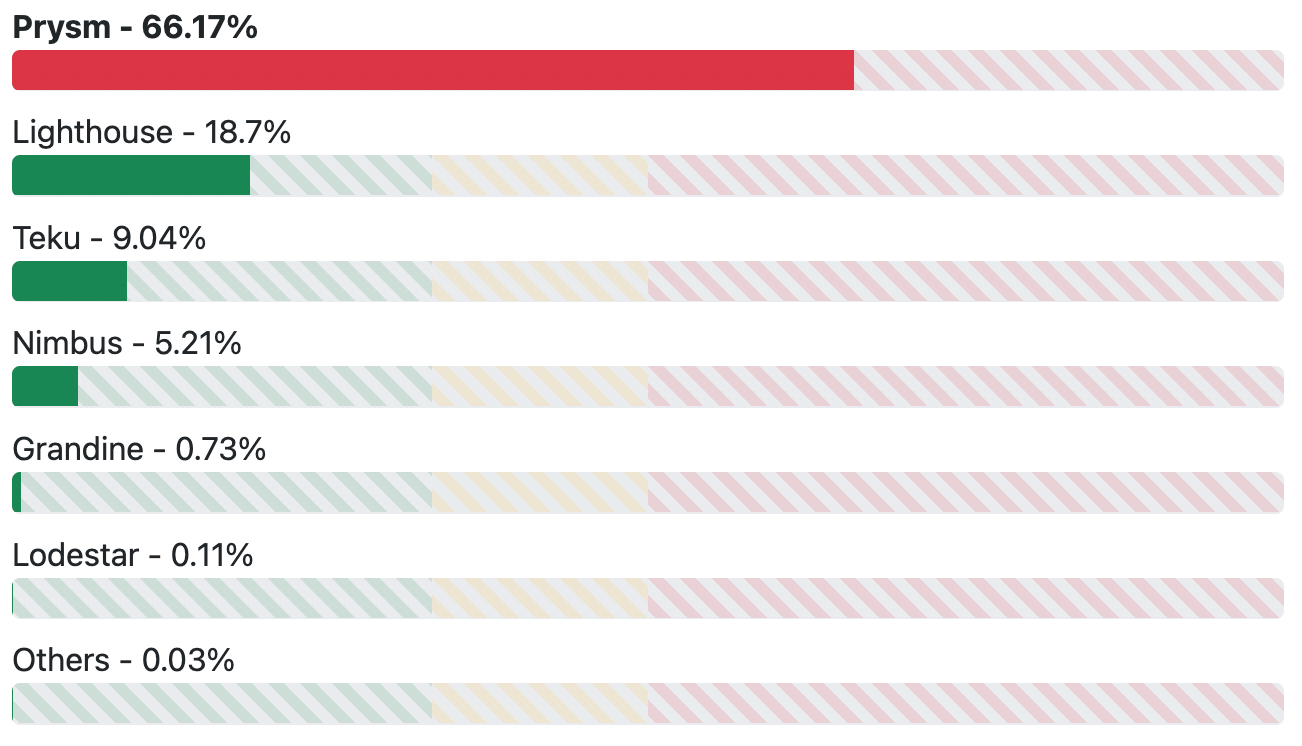
- Below 33% Staking Power on a Single Client: If a client controlling less than one-third of the total staking power experiences a significant bug, the impact on the network is minimal. The network will continue to operate smoothly, the bug can be addressed, and normalcy can be restored.
- Between 33% and 50% Staking Power: A bug in a client within this range would be more serious, but automatic network mechanisms are expected to manage the situation without significant user-facing disruptions.
- Above 50% Staking Power: If a bug affects a client holding more than half of the staking power, automatic mechanisms will be triggered to rectify the situation. However, this scenario would likely lead to complications and disturbances within the network, potentially impacting users.
- Above 66% Staking Power (Supermajority): This is the most critical threshold. If a bug affects a client that controls more than two-thirds of the network’s staking power, the situation becomes dire. Such a client would possess a "supermajority," granting it disproportionate control. In this scenario, the buggy chain would likely finalize, leading to a potential network split where non-buggy clients would either have to fork off, creating two separate Ethereum networks, or be forced to join the compromised chain. This outcome would effectively render the multi-client diversity strategy moot for that particular vulnerability.
The Prysm Predicament: A Dominant Client Raises Concerns
As The Merge approaches, a significant concern has emerged regarding the distribution of consensus clients. As of early 2022, the Prysm client, developed by Prysmatic Labs, commanded a substantial portion of the network’s staking power, hovering around 33% of the total. While this figure is below the critical 66% threshold, it is still considered an "undesirable situation" by many in the community. A consensus failure triggered by a bug in Prysm, though considered unlikely, could still lead to network instability and complications.
The competitive landscape for Ethereum consensus clients includes other notable implementations such as Lighthouse, Teku, and Nimbus. However, two clients, Grandine and Loadstar, have very minimal market shares, with Grandine being notably closed-source. The overwhelming reliance on a single client, even if it’s just below the critical supermajority, presents a tangible risk to the network’s long-term health and decentralization.
Understanding Prysm’s Dominance: A First-Mover Advantage
The reasons behind Prysm’s leading position are multifaceted. Marius van der Wijden, an Ethereum core developer, attributes Prysm’s success to several key factors:
- First-Mover Advantage: Prysm was one of the earliest functional prototypes of a Beacon Chain client. This early start allowed the team to optimize their client and build out robust tooling and documentation ahead of competitors.
- Golang Development: The choice of Golang (Go) as the programming language for Prysm is another significant advantage. Go is known for its performance, ease of development, and readability, making it accessible to a broader developer base. Since Go-ethereum, the dominant PoW execution client, is also written in Go, developers familiar with Geth could more readily understand and audit Prysm.
- Tooling and Documentation: A strong suite of accompanying tools and comprehensive documentation further lowers the barrier to entry for users and developers alike.
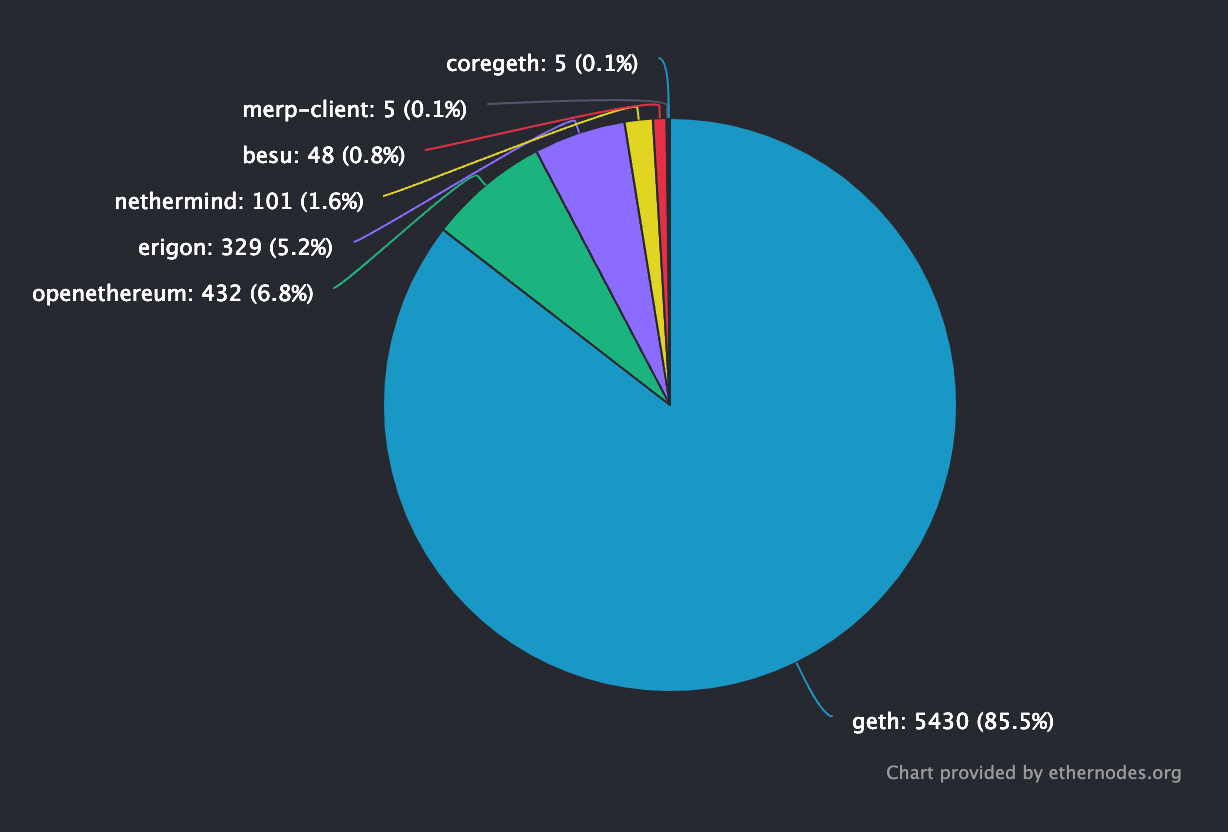
While Prysm’s dominance on the consensus layer is a concern, the situation on the execution layer is even more pronounced. Geth, the primary PoW execution client, historically holds over 85% of the market share. However, post-Merge, this concentration is considered less critical, as execution nodes will no longer be responsible for network security. Their role will be primarily transactional.
The Role of Staking Services: A Concentration of Power
A deeper examination of client distribution reveals that the concentration of power is largely driven by major staking services and pools. These entities enable individuals to stake ETH without needing to commit the full 32 ETH validator deposit, thereby democratizing participation. However, when these large staking services predominantly utilize a single client, their collective stake can significantly skew the overall distribution.
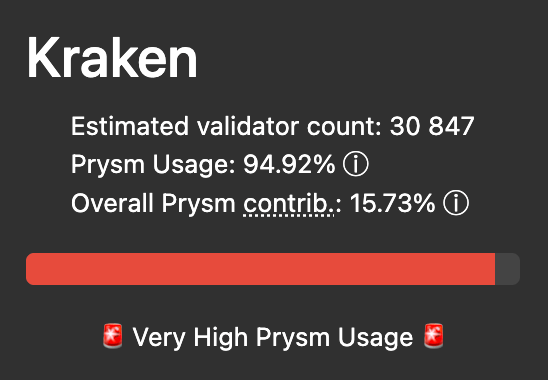
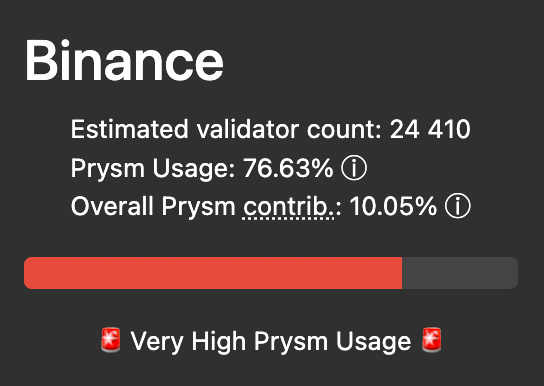
Prominent staking providers like Coinbase, Kraken, and Binance have been identified as major contributors to Prysm’s dominance. For instance, Coinbase, with a substantial number of validators, runs a high percentage of them on Prysm. This reliance on a single client by these large players amplifies the risk associated with any potential bugs or vulnerabilities.
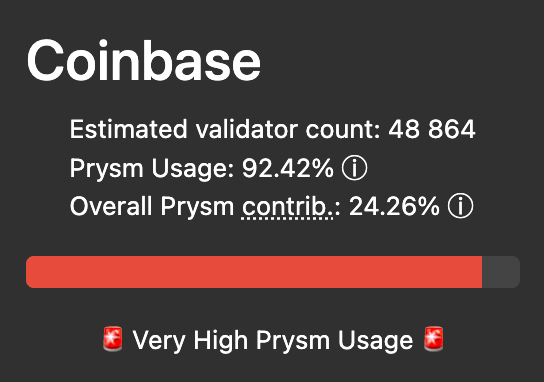
Coinbase, in its response to inquiries about client diversity, emphasized security as the primary driver for its initial choice of Prysm. The company highlighted Prysm’s support for remote signers, a feature crucial for enhancing validator security by isolating private keys. They also noted their ongoing efforts to support other clients like Lighthouse, indicating a commitment to diversification.
Kraken, another major staking provider, also acknowledged Prysm’s initial maturity and stability as key factors in their decision-making. However, they revealed that they have begun rolling out new validators on the Teku client and migrating existing ones, actively working to improve client diversity within their operations. Binance did not provide a comment by the time of publication.
Lido, a significant staking pool, also contributes to Prysm’s prevalence, though its usage is less concentrated than some of the centralized exchanges. Decentralized staking solutions like Rocket Pool, on the other hand, demonstrate a much more diversified client distribution among their validators.
The Path Forward: Collaboration and Gradual Transition
Despite the current client distribution concerns, there is a palpable sense of optimism within the Ethereum community. Discussions are actively underway between staking services, the Ethereum Foundation, and core developers to address this issue. Marius van der Wijden indicates that these discussions are progressing positively, with major staking pools reportedly working to transition parts of their infrastructure to alternative clients. This transition, while not immediate due to the need for updating monitoring and metric systems, is seen as a crucial step toward a more balanced ecosystem.
The process of switching client software for node operators is generally considered neither risky nor difficult, provided certain precautions are taken, such as properly persisting slashing databases. The primary challenges may arise for larger stakers who need to adapt to different API structures across clients.
While the likelihood of Prysm’s dominance falling below the critical 33% threshold before The Merge is considered low, the Ethereum core development team remains committed to proceeding. They express confidence in the robust testing and fuzzing infrastructure in place, which continuously seeks out discrepancies between clients. Furthermore, there is a strong consensus that the community will not bail out stakers who run a majority client if their clients misbehave, reinforcing the importance of decentralized choices.
The successful execution of The Merge will mark a pivotal moment in Ethereum’s history, paving the way for enhanced scalability, reduced energy consumption, and a more sustainable blockchain ecosystem. The ongoing efforts to address client diversity underscore the community’s commitment to a decentralized and resilient future for the platform. The world will be watching closely as this complex and crucial upgrade unfolds.