
 Layla Zulfa
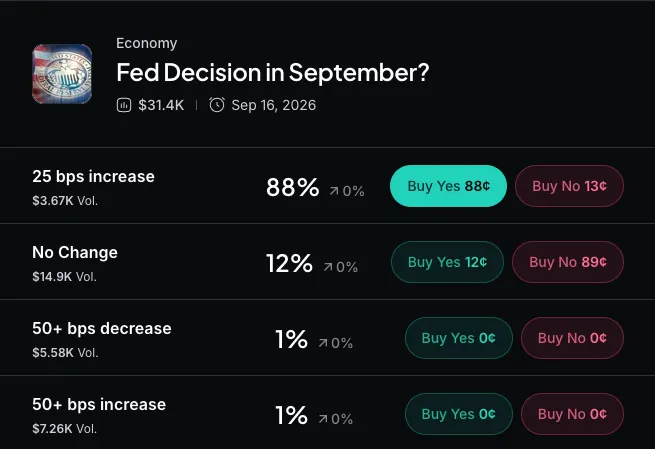
Wall Street is currently preparing for a significant shift in monetary policy as the Federal Reserve is widely expected to execute its first interest rate hike since 2023. As the Federal Open Market Committee (FOMC) concludes its two-day deliberative session this Wednesday, financial markets have undergone a rapid repricing of expectations, transitioning from a state of cautious optimism to a near-certainty of tightening. According to the CME FedWatch tool, the probability of a 25-basis-point increase has surged to 94.5%, a dramatic escalation from just 30 days ago when the odds of such a move were estimated at less than 50%. This pivot reflects a growing consensus among economists that the era of the "extended pause" has reached its conclusion, necessitated by stubborn inflationary pressures and a labor market that continues to defy cooling expectations.
The shift in market sentiment has been remarkably swift. A comprehensive survey of primary dealers and major financial institutions published by the Wall Street Journal this week reveals that nearly every significant banking entity now anticipates a rate hike on Wednesday. The forecast is not limited to a single move; a coalition of major banks, including Barclays, Citigroup, JPMorgan Chase, Morgan Stanley, and UBS, are now projecting a total of 50 basis points of tightening before the end of the calendar year. This collective outlook suggests that the FOMC may be entering a "mini-cycle" of tightening to ensure that inflation expectations do not become unanchored.
Hawkish Divergence and the Economic Outlook
While the majority of Wall Street aligns around a 50-basis-point year-end target, a more hawkish contingent of analysts argues that the Federal Reserve may need to be even more aggressive. Bank of America, Deutsche Bank, and RBC have revised their forecasts to suggest 75 basis points of tightening by December. These institutions point to the "sticky" nature of core inflation and the potential for a wage-price spiral as justification for a more robust response. Conversely, Goldman Sachs represents the more dovish end of the tightening spectrum, maintaining a forecast that calls for a single quarter-point hike this week followed by a return to a "wait-and-see" posture.
The economic landscape is further complicated by extreme outliers in the forecasting community. Jefferies has maintained a contrarian view, suggesting that a cooling economy could actually prompt a rate cut as early as December, while Oxford Economics has pushed its expectations for the next easing cycle out to 2027. These divergent views highlight the profound uncertainty currently gripping the global financial system, as policymakers attempt to navigate a "soft landing" amidst geopolitical volatility and shifting domestic fiscal policies.
The Catalysts: Inflation, Energy, and Labor
The primary driver behind the Federal Reserve’s anticipated move is an inflation rate that has proven resistant to previous tightening efforts. Headline Consumer Price Index (CPI) data for August showed an annual increase of 3.4%, while core inflation—which excludes the volatile food and energy sectors—sat at 2.5%. Both figures remains significantly above the Federal Reserve’s long-standing 2.0% target. The persistence of these numbers suggests that the "last mile" of the inflation fight may be the most difficult.
Compounding these domestic issues is the global energy market. The ongoing conflict involving Iran has introduced a significant risk premium into oil prices, which have trended higher throughout the late summer. Because energy costs are a fundamental input for almost every sector of the economy, the Fed finds itself in a position where traditional tools, such as interest rate adjustments, have limited efficacy against supply-side shocks. However, by raising rates, the FOMC hopes to dampen aggregate demand enough to offset the inflationary impact of higher fuel costs.
The decision to hike also follows a stronger-than-anticipated August jobs report. Despite high interest rates, the U.S. labor market has shown remarkable resilience, with job creation exceeding expectations and unemployment remaining near historic lows. For the Fed, a robust labor market provides the "policy space" to raise rates without the immediate fear of triggering a deep recession. However, this strength is a double-edged sword, as it continues to fuel consumer spending and upward pressure on wages.
Political Pressure and Central Bank Independence
The upcoming rate decision carries significant political weight, placing Fed Chair Kevin Warsh in a delicate position. Appointed by President Donald Trump in January and sworn in this past May, Warsh is facing his first major test of independence. During his swearing-in ceremony, the President explicitly urged Warsh to remain "totally independent," while simultaneously making it clear that his administration favored lower interest rates to stimulate growth and support domestic manufacturing.
In recent weeks, the rhetoric from the executive branch has intensified. President Trump, Vice President JD Vance, and Treasury Secretary Scott Bessent have all publicly advocated for rate cuts. The President has even linked monetary policy to trade, suggesting that he might halt trade with countries running large surpluses with the U.S. if domestic interest rates do not decrease. Despite this public pressure, Chair Warsh has maintained that the White House has no influence over the FOMC’s data-dependent decision-making process.
The timing of the hike is also sensitive, arriving just two months before the November midterm elections. Public opinion polls indicate that voters are increasingly frustrated with the cost of living and the high cost of borrowing for homes and automobiles. The irony noted by many political analysts is that the very policies championed by the administration—including aggressive tariffs and a hardline stance on Iran—are among the factors contributing to the inflationary environment that the Fed is now forced to combat with higher rates.
Bond Market Volatility and the Strengthening Dollar
The fixed-income markets have not waited for the formal announcement to react. The yield on the benchmark 10-year Treasury note touched 5.04% this week, marking its highest level since July 2007. This move reflects a "higher-for-longer" sentiment among traders, who are increasingly skeptical that the Fed will return to a low-rate environment anytime soon. The two-year Treasury yield, which is more sensitive to immediate changes in Fed policy, has also climbed to its highest levels since mid-2024.
Rising yields have a profound impact on the broader economy. They increase the cost of corporate debt, mortgage rates, and consumer loans, effectively tightening financial conditions even before the Fed acts. Furthermore, higher U.S. yields tend to attract foreign capital, strengthening the U.S. dollar. While a strong dollar helps suppress inflation by making imports cheaper, it creates a headwind for U.S. exporters and can cause significant capital flight from emerging markets.
Implications for Bitcoin and the Digital Asset Market
The cryptocurrency market has reacted poorly to the prospect of tighter monetary policy. Bitcoin, often viewed as a "high-beta" liquidity play, has seen its price slide from a September peak near $82,000 to approximately $75,700. The decline was exacerbated on Tuesday by the failure of the Clarity Act—a significant piece of legislation intended to provide a regulatory framework for market structure—to clear a Senate cloture vote.
From a technical perspective, analysts are watching the $73,200 level closely. A daily close below this support line could signal a further retreat toward $71,000 or even $66,900. Such a move would effectively negate the "golden cross" pattern—a bullish indicator where a short-term moving average crosses above a long-term moving average—that had recently triggered a wave of institutional optimism.
However, some digital asset proponents argue that the impact of a 25-basis-point hike may already be "priced in." In this view, the actual hike is less important than the "dot plot"—the chart showing where individual FOMC members expect rates to be in the future—and Chair Warsh’s subsequent press conference. If the Fed adopts a "one and done" tone, risk assets like Bitcoin could see a relief rally. Conversely, if Warsh signals that more hikes are necessary to combat energy-driven inflation, the crypto market could face a period of sustained deleveraging.
Looking Ahead: The Statement and the Press Conference
The official FOMC statement and the updated Summary of Economic Projections are scheduled for release at 2:00 p.m. ET on Wednesday. Investors will be scrutinizing the language of the statement for any shifts in how the committee describes inflation and the balance of risks to the economy. The "dot plot" will be of particular interest, as it will reveal whether the consensus among policymakers has shifted toward the more hawkish outlook held by banks like BofA and Deutsche Bank.
At 2:30 p.m. ET, Chair Warsh will hold a press conference that is expected to be one of the most closely watched in recent years. He will likely be questioned on the Fed’s independence in the face of executive branch criticism, the impact of energy prices on the 2% inflation goal, and the potential for the U.S. economy to withstand further tightening without a significant increase in unemployment.
As the financial world awaits the decision, the overarching theme is one of transition. After a period of relative stability, the Federal Reserve is re-entering a phase of active intervention. Whether this move successfully tames inflation or inadvertently precipitates an economic slowdown remains the central question for investors, policymakers, and the public alike. The outcome of Wednesday’s meeting will likely set the tone for global markets for the remainder of the year and into the critical 2027 fiscal period.









