admin
admin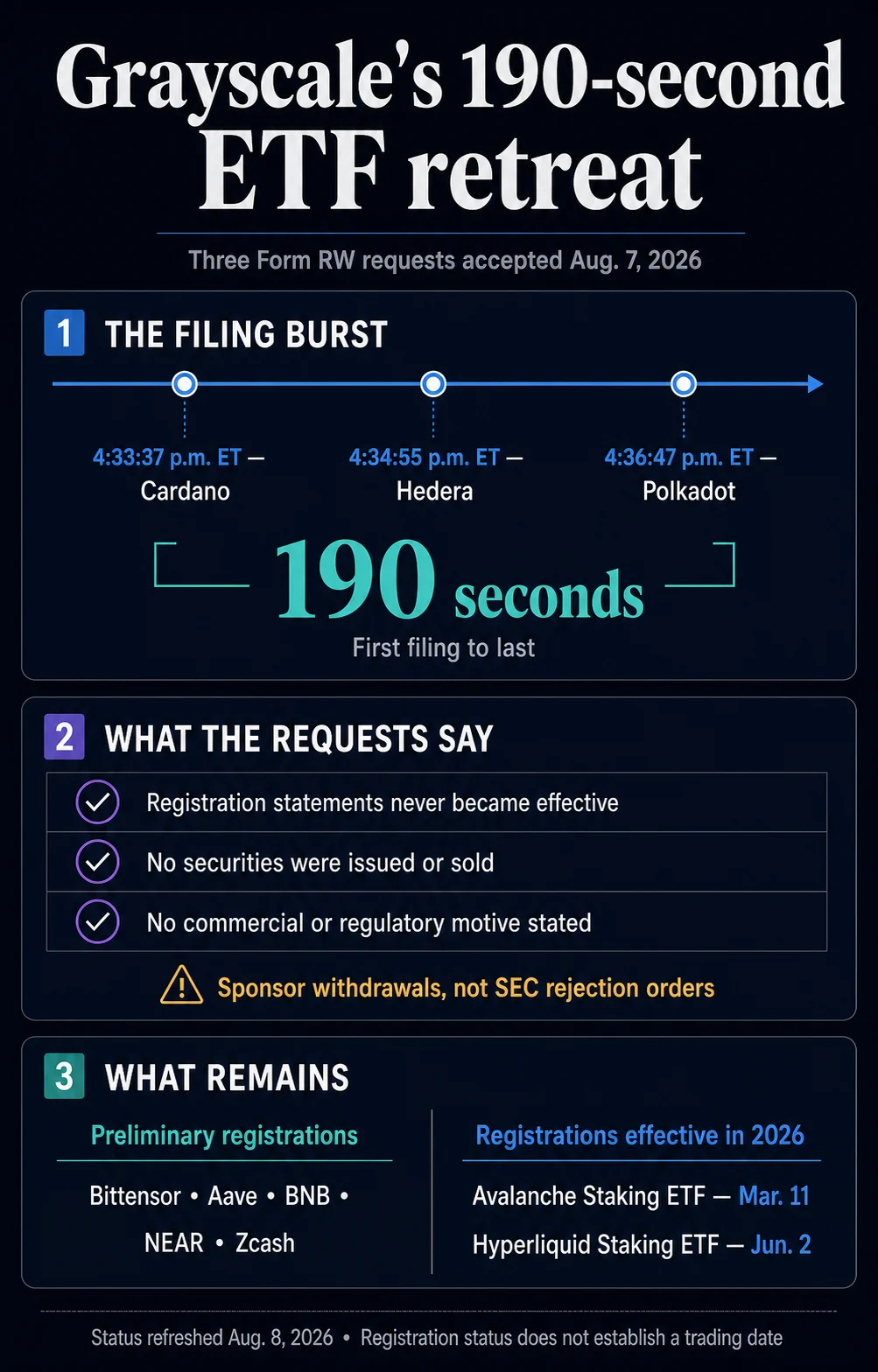
In a swift and largely unannounced move, Grayscale Investments, a prominent digital asset manager, has withdrawn the registration statements for three planned exchange-traded funds (ETFs) focused on Cardano (ADA), Hedera (HBAR), and Polkadot (DOT). The filings, submitted to the U.S. Securities and Exchange Commission (SEC) via the EDGAR database, were each retracted within a tight 190-second window on August 7th, leaving market observers and investors seeking clarity on the reasons behind this sudden retreat.
The sequence of withdrawals began precisely at 4:33:37 p.m. Eastern Time with the Grayscale Cardano Trust ETF. This was swiftly followed by the Grayscale Hedera Trust ETF at 4:34:55 p.m., and concluded with the Grayscale Polkadot Trust ETF at 4:36:47 p.m. These withdrawals were formally filed as Form RWs, which serve as requests to withdraw S-1 registration statements under Rule 477 of the Securities Act of 1933. Crucially, these filings explicitly state that Grayscale does not intend to proceed with the proposed distribution of shares for these specific products. The documentation further clarifies that the registration statements had not been declared effective by the SEC, no securities had been issued or sold under them, and no preliminary prospectuses had been distributed.
This operational explanation, while procedural, offers no specific commercial or regulatory rationale for the abrupt termination of these ETF plans. The lack of a stated reason has fueled speculation within the cryptocurrency and financial sectors, particularly given Grayscale’s significant presence and prior efforts in launching digital asset investment vehicles. The company has been a key player in the ongoing discussions and applications surrounding spot Bitcoin ETFs, which saw approval from the SEC in early 2025. However, the path for altcoin ETFs has remained considerably more complex and uncertain.
A Preceding Landscape of Exchange Rule Proposals
The withdrawals of the S-1 registration statements represent a distinct, albeit related, step from earlier actions concerning the listing of these potential altcoin ETFs on exchanges. Records indicate that the associated product-specific exchange rule proposals, which are necessary for a new financial product to be listed and traded, had already been withdrawn by the exchanges themselves.
Specifically, the New York Stock Exchange Arca (NYSE Arca) withdrew its proposal related to the Cardano ETF on September 29, 2025. Subsequently, Nasdaq withdrew its proposals for both the Polkadot and Hedera ETFs on November 3, 2025. These exchange rule proposals, governed by Section 19(b) of the Securities Exchange Act of 1934, are crucial for the regulatory approval of listing and trading a new security on an exchange. Their prior withdrawal suggests that the exchanges themselves had anticipated or encountered significant hurdles in bringing these specific products to market, potentially in anticipation of SEC decisions or feedback.
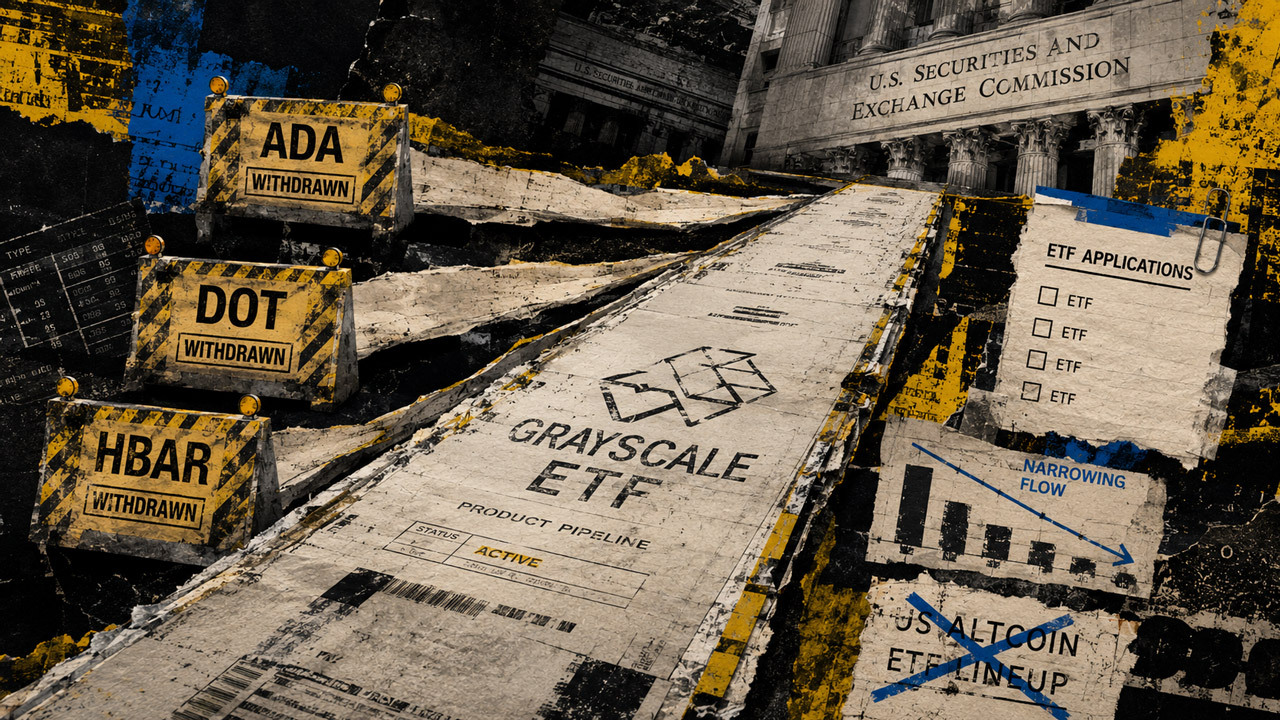
The recent Form RW filings by Grayscale, therefore, serve to formally remove the proposed public offering of shares for these ETFs from the SEC’s registration pipeline. While the exchange rule proposals pertained to the venue for trading, Grayscale’s filings addressed the offering and registration of the securities themselves. The effectiveness of these registrations is contingent upon SEC approval and the successful navigation of these complex regulatory pathways.
The Broader Regulatory Environment for Digital Assets
The SEC’s stance on cryptocurrency-related investment products has been a subject of intense scrutiny and evolving policy. In September 2025, the SEC did approve generic listing standards for qualifying commodity-based trust shares. This development was seen as a significant step, potentially streamlining the approval process for certain digital asset ETFs by allowing eligible spot digital-asset products to utilize these pre-established standards without requiring a bespoke Section 19(b) proposal for each individual product.
However, this broader approval of generic listing standards did not automatically render registration statements effective. It also did not eliminate the fundamental requirements of the Securities Act of 1933, which mandates the registration of securities offered to the public. The process of declaring a registration statement effective is a distinct and often protracted phase, requiring the SEC to review and be satisfied with the disclosures and financial information presented by the issuer.
The fact that Grayscale’s Cardano, Hedera, and Polkadot ETF registrations were withdrawn before being declared effective suggests that either Grayscale voluntarily decided to halt the process, or that the SEC had indicated significant concerns or was unlikely to grant effectiveness in the current regulatory climate. The absence of any explicit SEC rejection underscores the voluntary nature of Grayscale’s decision, but the lack of a stated reason leaves the precise motivation open to interpretation.
Other Grayscale Altcoin ETF Filings Remain in Preliminary Stages
The withdrawals of these three altcoin ETFs do not represent the entirety of Grayscale’s ambitions in the altcoin ETF space. However, a review of EDGAR filings as of August 8th reveals that several other proposed Grayscale altcoin ETF registrations remain in their preliminary stages, indicating a less advanced position in the regulatory process.
Specifically, registration statements for planned ETFs focused on Bittensor (TAO), Aave (AAVE), and BNB (BNB) have not yet been declared effective. These filings are still considered preliminary, meaning they have undergone initial submission but have not reached the crucial stage of SEC effectiveness, which would signify that the registration statements are deemed complete and acceptable for public offering.

Similarly, registration statements for proposed NEAR Protocol (NEAR) and Zcash (ZEC) products are also categorized as preliminary. This status is significant because it does not equate to exchange approval or readiness for launch. It simply indicates that the initial regulatory paperwork has been filed, and the SEC’s review process is ongoing or has not yet reached a conclusive stage.
A Differentiated Approach to Staking Products
In contrast to the withdrawn spot altcoin ETFs, Grayscale has seen more progress with its proposed altcoin staking products. Two such offerings have reached a later and more advanced registration milestone, with their registration statements being declared effective by the SEC.
The Grayscale Avalanche Staking ETF (AVAX) had its registration statement declared effective on March 11th. More recently, the Grayscale Hyperliquid Staking ETF (not yet a commonly traded ticker, indicating a novel or emerging platform) had its registration statement declared effective on June 2nd. The "effectiveness" of these registration statements signifies that the SEC has reviewed and accepted the disclosures related to these staking products. However, it is important to note that the effectiveness notices themselves do not specify an actual trading commencement date for these ETFs. The launch of trading for any ETF is a separate operational decision made by the issuer, often dependent on market conditions and further regulatory and operational preparations.
Implications and Potential Driving Factors
The withdrawal of the Cardano, Hedera, and Polkadot ETF registrations, especially given the lack of explicit reasons, raises several pertinent questions about the future trajectory of altcoin ETFs in the U.S. market. Several factors could have contributed to Grayscale’s decision:
- Regulatory Uncertainty: The SEC’s approach to altcoin ETFs has been notably more cautious than its stance on Bitcoin ETFs. The agency has repeatedly cited concerns related to market manipulation, investor protection, and the underlying assets themselves for many altcoin-related proposals. Grayscale may have assessed that the likelihood of approval for these specific altcoin ETFs was low or that the regulatory path would be excessively protracted and resource-intensive.
- Market Demand and Viability: While Cardano, Hedera, and Polkadot are established projects within the cryptocurrency ecosystem, the retail and institutional demand for ETFs specifically tracking these assets might not have reached a threshold deemed sufficient by Grayscale to justify the significant investment and regulatory effort. The performance of existing altcoin-related investment products, or broader market sentiment towards these specific assets, could have played a role in this assessment.
- Strategic Reallocation of Resources: Grayscale may be strategically reallocating its resources and focus towards other product areas or asset classes where it perceives a higher probability of success or greater market opportunity. The company is likely continuously evaluating its product pipeline in response to evolving market dynamics and regulatory landscapes.
- Interplay with Existing Spot Products: The SEC’s approval of generic listing standards in September 2025, while a positive development, did not eliminate the need for registration statements to become effective. The effectiveness of a registration statement is a critical hurdle that Grayscale appears to have encountered or strategically avoided for these particular altcoin ETFs.
The withdrawal of these three ETF registrations, occurring in such rapid succession, signifies a significant pause in Grayscale’s immediate plans for these specific altcoin products. It underscores the complex and often opaque nature of regulatory approvals within the digital asset space. While the company continues to pursue other digital asset investment vehicles, the quiet retraction of these filings serves as a stark reminder of the persistent challenges faced by issuers seeking to introduce a broader range of cryptocurrency-backed financial products to mainstream investors. The market will continue to monitor Grayscale’s future filings and any further regulatory developments that may shape the landscape for altcoin ETFs in the United States.