
 admin
admin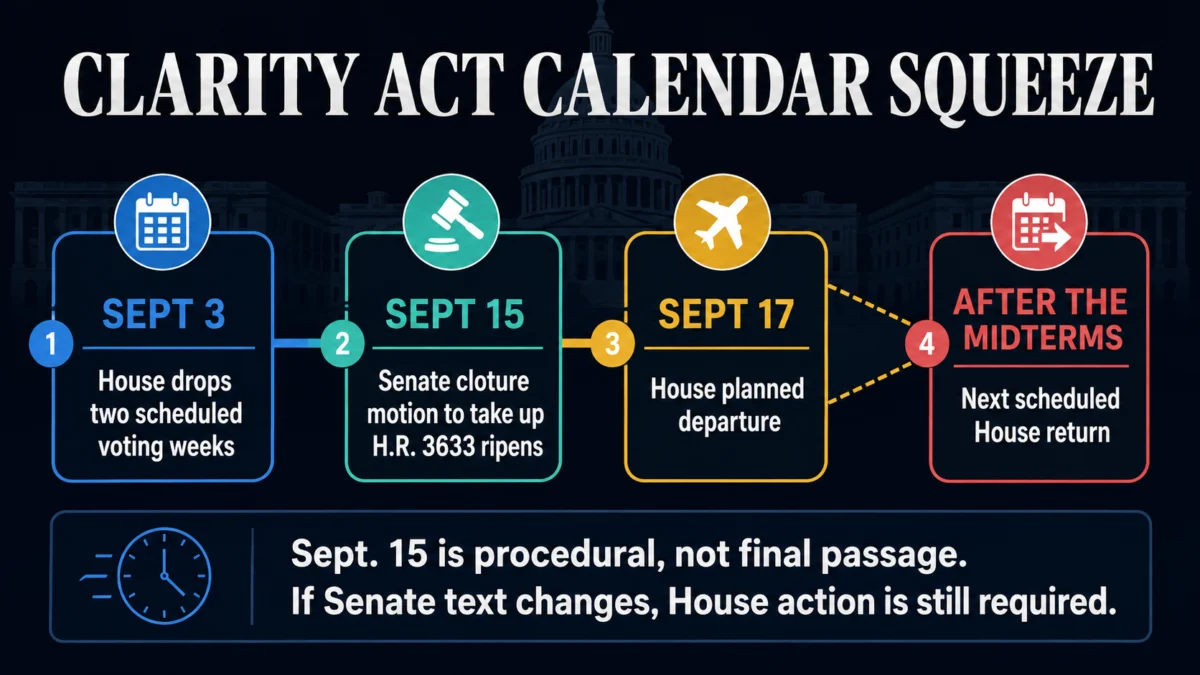
The legislative clock is ticking with increasing urgency for the CLARITY Act, a landmark bill aimed at establishing a comprehensive regulatory framework for the digital asset market. In a move that has significantly narrowed the pre-election legislative window, House Republicans have opted to advance their departure from Washington, D.C., by over two weeks, effectively erasing crucial opportunities for the bill’s passage before the November midterms. This decision creates immediate challenges for the crypto market-structure legislation, which faces a critical procedural vote in the Senate just days before the House’s scheduled adjournment.
Calendar Squeeze Intensifies as House Adjournment Looms
House Republican leadership announced the cancellation of scheduled voting weeks for September 21 and September 28, pushing the chamber’s adjournment date forward from October 1 to September 17. The House is slated to reconvene on September 14 for a concentrated four-day voting period. This compressed timeline presents a formidable obstacle for the CLARITY Act, as the Senate has scheduled its first major procedural vote on a related measure for September 15, a mere two days before the House members are set to leave the capital.
The implications of this accelerated schedule are profound. Alex Thorn, Head of Research at Galaxy Digital, a prominent digital asset financial services firm, characterized the change as making pre-midterm passage of the CLARITY Act "extremely unlikely." While the Senate retains approximately three weeks of session time extending into early October, any version of the legislation that emerges from the upper chamber must ultimately align with the text previously approved by the House before it can be sent to President Donald Trump for his signature.
The House of Representatives initially passed the CLARITY Act by a substantial margin of 294-134 in July 2025. Since then, the Senate has been engaged in the process of working through amended language. This means that even a successful vote in the Senate would not automatically finalize the bill; a reconciliation process with the House’s version would be necessary, further complicating the path forward within the limited timeframe.
Mounting Pressure Amidst a Shrinking Legislative Window
The current legislative crunch occurs against a backdrop of intensifying advocacy for the CLARITY Act from various stakeholders, including the White House, congressional Republicans, and regulatory bodies. President Trump himself publicly urged Congress in the preceding week to advance "a fair version of the Clarity Act," underscoring the executive branch’s interest in the bill’s passage. Similarly, SEC Chair Paul Atkins has reiterated the "indispensable" nature of legislative action for the digital asset sector, even as the Securities and Exchange Commission continues to develop its own regulatory proposals for cryptocurrencies.
French Hill, Chairman of the House Financial Services Committee, has also been a vocal proponent, urging the Senate to act decisively. He has frequently highlighted the bipartisan support the bill garnered in the House, noting that 78 Democrats joined Republicans in voting for its passage. In a public statement on the social media platform X, Chairman Hill articulated his perspective: "Can Democrats work with Republicans and make sure America leads the world in distributed ledger technology and financial services?" This sentiment reflects a broader desire within parts of Congress to establish clear rules of the road for the burgeoning digital asset industry, positioning the United States as a global leader in innovation.
Senator Cynthia Lummis, a key figure in the Senate’s efforts on digital asset legislation, had previously cautioned that the available legislative time was rapidly diminishing. Upon releasing updated text for the CLARITY Act in July, she indicated that the subsequent weeks represented likely the "last real chance" for several years to enact comprehensive market-structure legislation. Her assessment underscores the critical nature of the current legislative period.
Despite these calls for action, sentiment in prediction markets has remained largely skeptical regarding the bill’s immediate prospects. Traders on Polymarket, a prominent decentralized prediction market, have assigned less than a 20% probability that the CLARITY Act will be enacted into law by the end of the calendar year. This reflects a prevailing view that the legislative hurdles, compounded by political calendars and potential disagreements on specific provisions, present a significant challenge.
Navigating the Path Forward: Lame-Duck Sessions and Shifting Incentives
While the House’s accelerated adjournment significantly complicates immediate passage, the CLARITY Act’s prospects are not entirely extinguished. Lauren Belive, Ripple’s Head of Policy, has offered a counterpoint, drawing on historical precedent. She argued that post-election "lame-duck" sessions of Congress have repeatedly seen the passage of major, negotiated legislation, even in instances where election outcomes have signaled shifts in the balance of power.
This perspective shifts the immediate burden back to the Senate. If senators can successfully produce a sufficiently unified and bipartisan bill before Election Day, there remains a theoretical possibility for the House to consider and pass it during a lame-duck session. Such a scenario would require significant progress on the Senate side in the coming weeks, potentially involving swift resolution of any outstanding amendments or disagreements.

However, this potential path is not without its own set of political risks. The outcomes of the November midterms could fundamentally alter the legislative landscape. If control of one or both chambers of Congress shifts, lawmakers’ priorities and incentives might change before they reconvene for post-election legislative business. This could introduce new complexities or embolden opposing viewpoints, potentially impacting the willingness of either chamber to take up legislation that may have been a priority under a different political configuration.
The September 15th Senate Vote: A Crucial First Test
For the moment, the scheduled September 15th procedural vote in the Senate stands as the first critical litmus test for the CLARITY Act. The outcome of this vote will provide a clearer indication of the Senate’s commitment and capacity to advance digital asset legislation. While a path for the CLARITY Act to reach President Trump’s desk in 2026 remains a possibility, the House Republicans’ decision to advance their adjournment has undeniably made securing its passage before the November midterms an exceptionally challenging endeavor. The coming days and weeks will be pivotal in determining whether this significant piece of crypto legislation can overcome the converging pressures of political calendars and legislative maneuvering.
Background Context: The Evolving Digital Asset Landscape and Regulatory Uncertainty
The CLARITY Act emerges from a period of rapid growth and evolving regulatory scrutiny within the digital asset space. As cryptocurrencies and blockchain technology have moved from niche curiosities to significant financial instruments, policymakers have grappled with how to integrate them into existing financial frameworks. The absence of clear, comprehensive federal legislation has led to a patchwork of regulations and interpretations from various agencies, creating uncertainty for businesses and investors alike.
This regulatory ambiguity has been a consistent concern for industry participants. Firms like Galaxy Digital and Ripple have been vocal advocates for legislative clarity, arguing that it is essential for fostering innovation, protecting consumers, and ensuring the stability of the financial system. The CLARITY Act, in its various iterations, has sought to address this by defining the jurisdictional roles of different regulatory bodies, establishing rules for digital asset exchanges, and providing a framework for the issuance and trading of digital securities.
The bill’s journey through Congress has been marked by bipartisan efforts, reflecting a growing consensus on the need for federal action. However, specific provisions and the precise scope of regulatory authority have been subjects of considerable debate, leading to amendments and ongoing negotiations. The initial passage in the House, with significant cross-party support, demonstrated a willingness to move forward. The subsequent focus on the Senate highlights the intricate nature of legislative consensus-building in a closely divided political environment.
Supporting Data and Industry Perspectives
The growth of the digital asset market has been substantial, underscoring the urgency for regulatory clarity. Global market capitalization for cryptocurrencies has fluctuated but has seen periods of trillion-dollar valuations, indicating significant economic activity. The increasing involvement of institutional investors, the development of decentralized finance (DeFi) protocols, and the exploration of central bank digital currencies (CBDCs) by nations worldwide all point to the growing importance of this sector.
Industry advocates often cite the competitive disadvantage faced by U.S. companies operating in a less defined regulatory environment compared to jurisdictions that have established clearer frameworks. This uncertainty can stifle investment, hinder product development, and potentially lead to companies relocating to more predictable markets. The CLARITY Act is seen by many as a crucial step toward rectifying this situation and ensuring that the United States remains at the forefront of technological and financial innovation.
Broader Impact and Implications
The passage or failure of the CLARITY Act carries significant implications beyond the immediate cryptocurrency industry. A well-defined regulatory framework could foster greater investor confidence, potentially leading to increased institutional adoption and broader market participation. It could also provide a clearer path for the development of innovative financial products and services built on blockchain technology.
Conversely, a continued lack of comprehensive federal legislation risks perpetuating regulatory uncertainty, potentially leading to more enforcement actions by agencies like the SEC, which could be perceived as arbitrary or inconsistent. This could deter legitimate innovation and push activity into less regulated spaces. The potential for a fragmented regulatory landscape, with states developing their own rules, could also create compliance challenges for businesses operating nationwide.
The debate surrounding the CLARITY Act also reflects a broader discussion about the future of finance and the role of technology in shaping it. As digital assets continue to evolve, policymakers face the ongoing challenge of balancing the need for consumer protection and financial stability with the imperative to foster innovation and economic growth. The decisions made in the coming weeks regarding the CLARITY Act will be a key indicator of how effectively Congress can navigate these complex and evolving issues.








