
 Lina Irawan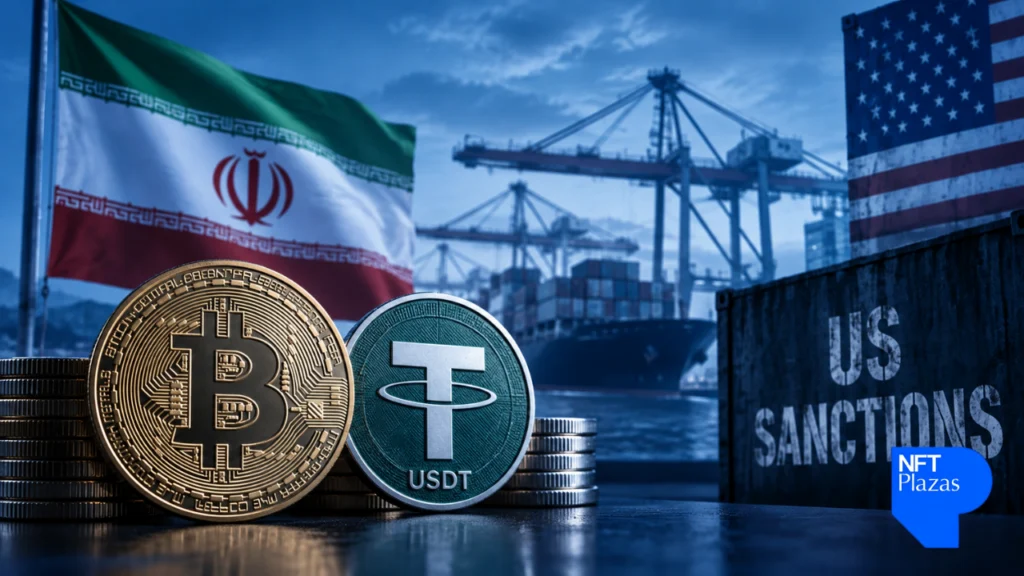
Iran is increasingly turning to cryptocurrencies, including Bitcoin and Tether’s USDT, to facilitate cross-border transactions as stringent U.S. sanctions continue to choke off its access to the global financial system, according to a recent Financial Times report. This strategic pivot signifies a significant expansion of digital assets within Iran’s burgeoning shadow economy, offering a lifeline for businesses struggling with conventional banking restrictions.
The reported shift underscores a pragmatic response by Tehran to persistent economic isolation. For years, Iranian businesses have relied on a complex web of informal channels and intermediaries to conduct international trade. However, individuals familiar with the country’s trade and financial sectors have indicated to the Financial Times that the Central Bank of Iran has recently adopted a more permissive stance, tacitly encouraging traders to repatriate overseas earnings through any available means. This includes settling cross-border transactions via Iranian cryptocurrency exchanges, with a particular emphasis on USDT, a stablecoin pegged to the U.S. dollar, alongside Bitcoin.
This development emerges against a backdrop of escalating economic pressure from Washington. The U.S. has systematically tightened sanctions against Iranian companies and intermediaries, while Treasury officials have repeatedly warned that digital assets are becoming a favored tool for the Iranian regime to circumvent these financial restrictions. The image of a digital currency icon superimposed on a map of Iran, overlaid with a lock symbol, visually encapsulates this struggle for financial autonomy in the face of external pressures.
Crypto Bridges the Gaps Left by a Constrained Banking System
Iran has operated largely outside the mainstream global financial system for years, a consequence of the severe U.S. sanctions regime. These restrictions have rendered conventional international payments exceedingly difficult, forcing businesses to depend on a patchwork of foreign-exchange houses, shadowy intermediaries, and informal networks.
Historically, Iran’s foreign-currency system mandated that exporters repatriate a substantial portion of their overseas earnings and sell these proceeds through a government-controlled platform at official exchange rates. These official rates were frequently less advantageous than those available on Iran’s more fluid open market, creating a powerful incentive for companies to either retain earnings abroad or to repatriate them through unofficial, less regulated channels.
The Financial Times report suggests a notable shift in this landscape. Iranian authorities appear to have adopted a more flexible approach, allowing traders to exchange foreign currency on the open market. In some instances, export proceeds can now be directly utilized to finance imports, bypassing the traditional, circuitous official foreign-exchange system. A business executive with close ties to the regime reportedly informed the newspaper that authorities are no longer intensely scrutinizing the specific methods of fund transfer, indicating that the acceptance of cryptocurrency for export payments has become an established practice.

Illustrating the scale of the challenge facing Tehran, Iranian authorities estimate that over $100 billion in undeclared earnings are held both domestically and internationally. Furthermore, the country’s General Inspection Organization has stated that more than 20,000 individuals and companies have failed to repatriate approximately 94 billion euros in export proceeds. These figures highlight the immense financial leakage and the profound difficulties in managing the national economy under sanctions. Cryptocurrency, in this context, is not replacing Iran’s financial system but rather augmenting it by providing an additional conduit for value transfer when conventional banking routes are obstructed.
The Strategic Significance of USDT
The stablecoin Tether (USDT) plays a particularly crucial role in Iran’s cross-border trade initiatives. Its design aims to maintain a stable value closely mirroring the U.S. dollar, without necessitating access to the traditional dollar-based banking infrastructure. For Iranian businesses grappling with volatile exchange rates and stringent restrictions on dollar transactions, a digital asset directly linked to the dollar offers a comparatively accessible and predictable means of transferring and holding value. This can mitigate some of the financial uncertainty inherent in operating under sanctions.
However, this alternative financial infrastructure is not entirely beyond the reach of U.S. authorities. Tether has previously demonstrated its capacity to freeze cryptocurrencies held in wallets identified as being connected to Iranian state entities. Following designations by U.S. authorities, the company has frozen hundreds of millions of dollars worth of USDT associated with Iranian-linked addresses.
The U.S. regulatory apparatus has also intensified its focus on the infrastructure underpinning Iran’s cryptocurrency economy. In June, the U.S. Treasury Department designated four Iranian cryptocurrency exchanges – Nobitex, Bit Pin, Wallex, and Ramzinex – accusing them of facilitating sanctions evasion and other illicit financial activities. TRM Labs, a blockchain analytics firm, estimated that these four platforms collectively accounted for approximately 78% of Iran’s attributed crypto volume in 2025, representing a significant portion of the country’s digital asset activity, valued at around $7.7 billion.
In August, the Treasury escalated its efforts by sanctioning additional exchanges, which it alleged were being utilized by Tehran to move billions of dollars and to support the Islamic Revolutionary Guard Corps (IRGC). Despite this sustained pressure, Iran’s cryptocurrency activity has not been eliminated. TRM Labs data indicates that approximately $10 billion in cryptocurrency flowed through Iran in 2025, a marginal decrease from $11.4 billion in 2024. The persistence of these significant flows suggests a structural demand for these digital assets rather than mere speculative trading.
The chart illustrating the 2025 attributed crypto volume for the four OFAC-designated Iranian exchanges, as reported by TRM Labs, visually underscores the substantial economic activity these platforms represent.
Bitcoin Mining: An Emerging Source of Crypto Revenue
Iran’s engagement with cryptocurrency extends beyond mere trading and payment mechanisms. The country has emerged as a notable hub for Bitcoin mining, leveraging its comparatively low domestic energy costs. Blockchain analytics firm Elliptic has estimated that Iran accounts for approximately 4.5% of global Bitcoin mining activity. The crypto assets generated through these mining operations can potentially be used to finance imports or to transfer value outside of conventional financial channels, providing an additional layer of financial flexibility.

Bitcoin mining offers Tehran a method to acquire Bitcoin without directly engaging with international financial markets, thereby avoiding the scrutiny and potential blockages associated with such transactions. However, it is important to distinguish the roles of Bitcoin and stablecoins within Iran’s economy. While Bitcoin can serve as a store of value and a transferable asset, its inherent price volatility makes it less practical for routine commercial settlements. In contrast, USDT, designed to maintain a stable value close to the U.S. dollar, is a more suitable instrument for businesses requiring predictable pricing for their transactions.
Washington’s Multi-Pronged Attack on Crypto and Traditional Finance
The increasing prominence of cryptocurrency has firmly placed digital assets within the crosshairs of the U.S. sanctions campaign against Tehran. The Office of Foreign Assets Control (OFAC) has stated that Iranian digital-asset exchanges can be subject to existing sanctions applicable to Iranian financial institutions. This implies that U.S. persons and financial institutions may be prohibited from engaging in any transactions involving their assets.
The U.S. administration has also signaled its intent to pursue further actions. Treasury Secretary Scott Bessent recently indicated that digital assets could become additional targets as Washington broadens its strategy to exert economic pressure on Iran. This creates a delicate balancing act for Iranian authorities. While cryptocurrencies offer businesses an alternative route to circumvent restricted banking channels, each digital transaction leaves an on-chain record that can potentially be traced by blockchain analytics firms.
Iran’s experience thus highlights both the inherent strengths and the significant limitations of cryptocurrency under a stringent sanctions regime. Digital assets possess the unique capability to move across borders without direct reliance on correspondent banks or conventional payment networks. However, the entities that facilitate these transactions – exchanges, stablecoin issuers, wallets, and intermediaries – remain susceptible to sanctions, asset freezes, and enforcement actions.
For Tehran, the overarching objective appears to be less about completely supplanting the traditional financial system and more about maintaining sufficient alternative channels to prevent sanctions from entirely isolating the economy from international trade. As U.S. pressure intensifies, cryptocurrency is solidifying its position as one of these critical conduits, alongside foreign-exchange houses, offshore intermediaries, and informal trading networks. The consequence is a financial system increasingly pushed into the shadows, where Bitcoin and USDT are evolving into indispensable tools for sustaining trade and facilitating the movement of capital when conventional channels prove unreliable. As one Tehran-based economist candidly observed to the Financial Times, the more Iran’s economy operates underground, the greater the reliance on cryptocurrency becomes.









