admin
admin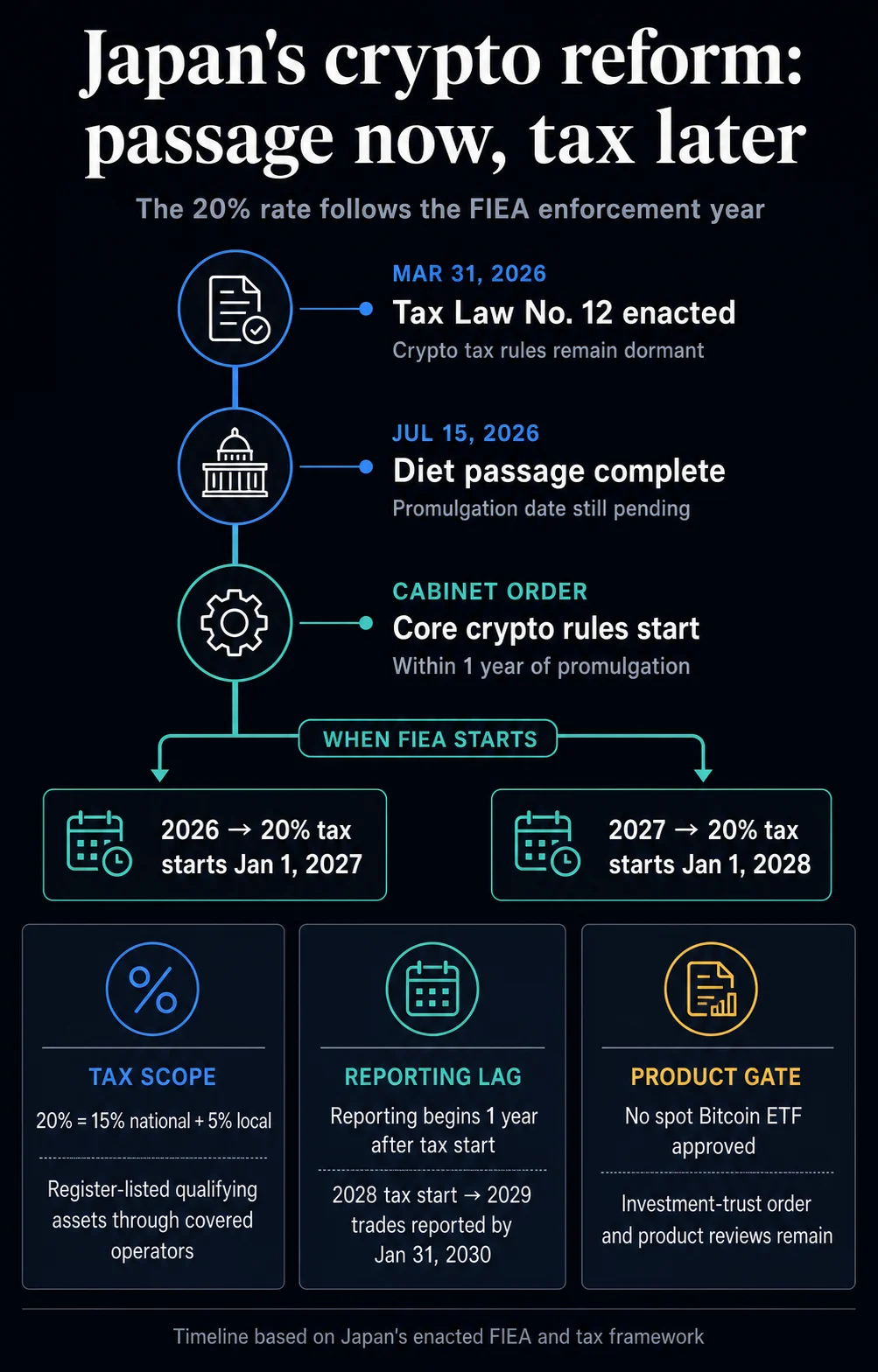
Japan’s House of Councilors has overwhelmingly approved Cabinet Bill 57, marking a significant legislative milestone that will integrate regulated cryptocurrency activities into the purview of the Financial Instruments and Exchange Act (FIEA). This pivotal vote on July 15, 2026, signifies the completion of parliamentary assent for a framework long sought by the nation’s burgeoning digital asset industry. However, the anticipated benefits, particularly a more favorable 20% tax rate on crypto gains, may not materialize for traders until 2027 or even 2028, contingent upon the timing of the Cabinet’s enforcement decrees and the fulfillment of other regulatory prerequisites.
The core of the newly passed legislation mandates that the operational commencement of these crypto-specific provisions within the FIEA will be determined by a Cabinet order, to be issued within one year of the law’s official promulgation. This crucial detail means that if the Cabinet enforces the FIEA changes during 2026, the new tax rules would take effect on January 1, 2027. Conversely, if enforcement is delayed until 2027, the tax benefits would be pushed back to January 1, 2028. The precise calendar for these advancements now rests entirely with the executive branch.
A Shift in Regulatory Landscape: From Payments to Securities Law
Historically, cryptocurrency transactions in Japan have been governed by the Payment Services Act, which primarily focused on consumer protection and anti-money laundering measures. The new legislation signals a fundamental shift, bringing crypto assets and their associated activities under the more comprehensive and robust framework of the FIEA. While cryptocurrency will retain its distinct legal classification, separate from traditional securities, the regulatory oversight will now mirror that applied to financial instruments. This move is expected to bolster investor confidence and attract institutional participation by providing a clearer and more standardized operational environment.

The Financial Services Agency (FSA), Japan’s primary financial regulator, has outlined the implications of this regulatory migration. Explanatory materials released by the FSA detail expanded disclosure and registration requirements for a range of crypto-related activities. These include the sale of crypto assets, issuer-controlled token offerings, and lending activities. Furthermore, the FIEA framework will introduce stringent requirements for asset screening, secure custody of digital assets, enhanced customer safeguards, and robust insider-trading controls. Exchanges and other intermediaries operating within the crypto space can now begin preparing for these new obligations, which will become legally binding upon the commencement of the FIEA provisions. The specifics of operational requirements, however, will be further elaborated through subsequent Cabinet orders and FSA ordinances.
The Tax Conundrum: Legislation Enacted, But Implementation Delayed
While the legislative gears have turned for regulatory integration, the promise of a more palatable tax regime for crypto investors faces its own set of hurdles. Japan’s Parliament had already enacted the necessary fiscal 2026 tax amendments, officially designated as Law No. 12, which were promulgated on March 31, 2026. This law introduced a unified 20% tax rate on qualifying cryptocurrency gains, comprising a 15% national income tax and a 5% local inhabitant tax.
However, the application of this reduced rate is intrinsically linked to the FIEA enforcement timeline. The 20% tax rate will only become applicable when investors sell eligible tokens through registered crypto businesses, and the assets themselves must be listed on Japan’s official register of qualifying digital assets. This conditionality means that the tax benefits are effectively on hold, awaiting the FIEA’s activation.
Carry-Forward Losses and Reporting Obligations: A Detailed Outlook
A significant provision within the new tax framework allows for the carry-forward of unused losses within the same tax-defined crypto category for up to three years, subject to specific conditions. This is a crucial development for traders, offering a degree of relief from the often-punitive tax treatment of previous years. However, it is important to note that tokens, trading venues, and transactions falling outside this newly defined regulatory channel will continue to be subject to existing tax regulations.

The reporting obligations associated with the new tax regime are also noteworthy. Businesses will be required to provide tax authorities with detailed customer information, including Japan’s My Number identifier and transaction specifics, by January 31st of the year following the trade year. This reporting mandate will commence one year after the tax and loss rules become active. Consequently, if the 20% tax regime begins in 2028, the reporting would encompass transactions from 2029, with the initial reports due by January 31, 2030. This staggered implementation of reporting requirements provides a buffer period for both businesses and individuals to adapt to the new system.
Pathways for Crypto Investment Products and ETFs
Beyond individual trading, the reform package also charts a course for the development of crypto investment products. The legislation brings crypto investment management and advisory services under the FIEA. Crucially, it anticipates the creation of investment trusts that can hold tax-qualifying, registered crypto assets. However, the regulatory pathway for such products is not yet fully paved. A separate amendment to the Investment Trusts Act’s enforcement order will be necessary to fully operationalize this aspect.
The current legislation does not explicitly name or approve any spot Bitcoin ETFs. In October 2025, the FSA had previously stated that the establishment and sale of domestic crypto ETFs were prohibited under the prior regulatory regime. Any entity seeking to launch such products will still need to navigate applicable product and listing reviews once the new regulatory routes are definitively established and detailed rules are in place. This suggests that while the legislative groundwork is being laid, the tangible arrival of regulated crypto ETFs in Japan may still be some time away, contingent on further regulatory clarity and approvals.
A Phased Implementation: The Interplay of Dates and Decisions
The unfolding of these new regulations is a complex interplay of legislative passage, executive decree, and regulatory refinement. The key dates for the implementation of the 20% tax rate and the broader FIEA framework are inextricably linked. The formal enactment of the law, the timing of the Cabinet’s decision to bring the FIEA changes into force, and the FSA’s completion of detailed operational rules will all collectively determine when the crypto market can fully benefit from these reforms. The 20% tax rate, a significant incentive for investors, will ultimately come into effect from the subsequent tax year following the satisfaction of these critical implementation benchmarks. This phased approach, while potentially leading to extended waiting periods, reflects a deliberate strategy to ensure a robust and well-managed transition into a new era of cryptocurrency regulation in Japan. The industry is now keenly observing the Cabinet’s forthcoming decisions, which will dictate the precise timeline for realizing these long-awaited regulatory advancements.