admin
admin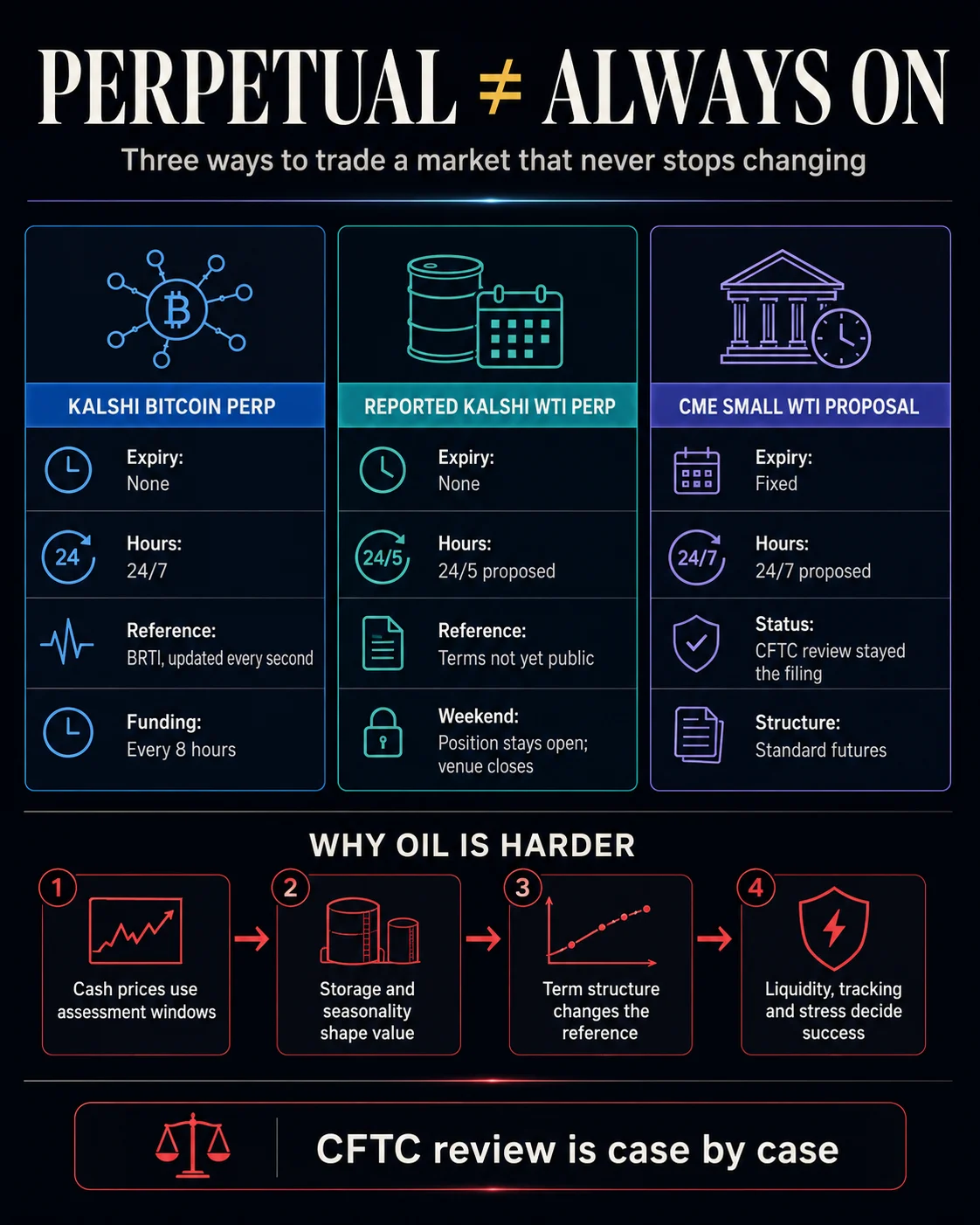
Kalshi, the U.S.-regulated exchange that gained significant attention for its May approval of a perpetual futures contract tied to Bitcoin, is now setting its sights on a new frontier: crude oil. The company is reportedly preparing to submit a proposal to the Commodity Futures Trading Commission (CFTC) for a perpetual futures contract linked to West Texas Intermediate (WTI) crude oil. If this venture receives regulatory approval, it would mark a significant milestone, introducing the first oil perpetual to trade on a regulated U.S. platform and representing a bold transfer of a derivative structure popular in the cryptocurrency space into the heart of the benchmark U.S. oil market. This move, however, is not without its complexities, as the very nature of oil markets presents distinct challenges compared to the 24/7 digital asset landscape where perpetuals first flourished.
The innovation of perpetual futures, a derivative product that has become a favorite within the cryptocurrency ecosystem, is rooted in its ability to cater to assets that trade continuously. Its defining characteristic is the absence of a fixed expiration date, allowing traders to maintain positions indefinitely through a funding mechanism that keeps the derivative’s price aligned with its underlying asset. This structure was particularly well-suited for Bitcoin, an asset whose spot market operates around the clock across a multitude of global venues. However, the reported plans for the WTI contract by Kalshi introduce a significant deviation: a 24-hour trading schedule, five days a week. While this concession might be a strategic maneuver to enhance its prospects with U.S. regulators, it simultaneously curtails what is arguably the perpetual’s strongest use case – continuous price discovery.
The fundamental difference lies in the nature of the underlying assets. Bitcoin’s globally distributed and continuously observable spot trading provides a robust reference point for its perpetual contracts, ensuring a constant connection to the real-time market value. Oil, on the other hand, is intrinsically linked to physical supply, storage dynamics, and a futures market that expresses these conditions through contracts with distinct delivery months. Even when the expiration date is stripped away in a perpetual structure, these inherent commodity features persist.
The Perpetual Contract: Bridging Crypto Innovation and Commodity Realities
Perpetual futures ingeniously replace the traditional expiration date with a dynamic funding mechanism. This system involves calculated payments exchanged between traders holding long and short positions at regular intervals. The primary objective is to incentivize the derivative’s price to converge with the price of its underlying asset, effectively allowing traders to hold onto their desired exposure as the market navigates through successive delivery periods of the underlying commodity.
Kalshi’s existing Bitcoin perpetual serves as a prime example of this crypto-native model. It operates 24/7, references the CF Benchmarks Bitcoin Real-Time Index, which is updated every second, and implements funding payments every eight hours. The CFTC’s initial approval for this Bitcoin product was, in part, predicated on Bitcoin’s globally dispersed and perpetually observable spot trading activity.
The reported plan for Kalshi’s WTI contract appears to introduce a separation between the contract’s maturity and its trading hours, as well as a potential divergence from the uninterrupted reliability of the market it seeks to track. This distinction becomes crucial when juxtaposed with other market participants and their regulatory approaches.
Table 1: Comparative Analysis of Perpetual and Futures Contract Designs
| Product Design | Expiration | Trading Schedule | Reference Challenge |
|---|---|---|---|
| Kalshi Bitcoin Perpetual | None | 24/7 | Continuous global spot Bitcoin index |
| Reported Kalshi WTI Perpetual | None | 24/5 | Final index and funding terms not yet public |
| CME’s Proposed Small WTI Future | Fixed | 24/7 proposed | Weekend liquidity and benchmark effects under review |
The U.S. Commodity Futures Trading Commission (CFTC) has been actively scrutinizing the expansion of continuous trading hours for energy products. CME Group, another major player in the derivatives market, had previously announced a proposal for a small, cash-settled 10-Barrel WTI Crude Oil future. This proposed contract aimed for 24/7 trading while retaining a traditional fixed expiration structure. However, the CFTC intervened, placing a stay on CME’s self-certification for this product to conduct a more thorough review. This regulatory action underscores the heightened scrutiny applied to extended-hours oil trading products and leaves the door open for Kalshi’s proposal, while also highlighting the delicate balance regulators are trying to strike.
Conventional WTI futures contracts already offer a trading window that extends nearly 24 hours a day, typically running from Sunday evening through Friday, with a brief daily hiatus. Given this existing market structure, the primary operational advantage of Kalshi’s proposed perpetual would stem from the elimination of contract expiration, rather than an extension of trading hours. The 24/5 schedule offers a pragmatic solution to potential operational challenges associated with continuous weekend trading. However, it also means that positions would remain exposed to overnight news and market-moving events that accumulate during the closure, which would then need to be absorbed upon the market’s reopening.
The Reference Price Conundrum: Bitcoin vs. Crude Oil
A critical element of any perpetual contract is the credibility of its funding rate, which is directly tied to the accuracy and stability of the reference price it aims to track. Bitcoin’s decentralized and high-frequency spot trading environment provides a wealth of continuously available data, enabling the calculation of a reliable index. Crude oil markets, in contrast, operate differently. Physical crude transactions occur through a network of dispersed participants and are often assessed during defined windows, rather than through a single, continuously observable spot market.
The CFTC itself has acknowledged this challenge. In its review of energy perpetuals, the agency specifically sought comment on whether a perpetual contract could effectively reference a physical assessment, an existing futures contract, or a composite of the two, without introducing undue risk of price manipulation or unreliability. This question strikes at the heart of adapting a crypto-native derivative to a physical commodity.
The sequential nature of oil delivery carries inherent market information. Storage costs, financing expenses, and the value of having physical barrels available sooner all contribute to shaping the futures curve. Contango, where contracts for later delivery trade at higher prices than near-term ones, can signal ample supply and the costs associated with holding inventory. Conversely, backwardation, where near-term contracts are priced higher, suggests physical scarcity and a premium for immediate access to oil. A perpetual contract, by eliminating expiry, must somehow compress this rich information embedded in the delivery sequence into a single reference price.
This compression means that a perpetual contract can potentially eliminate the need for manual contract "rolls" by traders, as the economic implications of these rolls are integrated into the contract’s mechanics. If Kalshi’s reference price closely follows the front-month futures contract, the methodology would still need to account for the transition to subsequent contracts as delivery approaches. The economic impact of this roll – whether a cost or a benefit – would likely manifest through the reference price, the funding rate, or a combination of both.
The extraordinary event of WTI crude oil futures collapsing below zero in April 2020 serves as a stark reminder of why the choice of reference price is far more than a minor technical detail. During that period, the expiring WTI contract plunged into negative territory due to severe storage constraints at Cushing, Oklahoma, while contracts for later delivery remained positive. A perpetual contract, lacking a terminal delivery event, would force Kalshi to make a critical decision: should its mark price accurately reflect such extreme physical market stress, or should it follow a broader, smoothed measure? Furthermore, its funding and liquidation systems would need to be robust enough to function effectively, even at or below zero prices. The CFTC’s prior approval of Kalshi’s Bitcoin perpetual was specifically limited to contracts tied to digital commodities exhibiting deep, active, and continuous spot trading, a characteristic that oil markets do not inherently possess in the same manner.
The Missed Opportunity: Weekend Price Discovery
If approved, the immediate operational benefit of Kalshi’s WTI perpetual would be the ability for traders to maintain sustained exposure to oil prices without the need to manually manage contract rollovers between successive delivery months. This could appeal to entities that require a persistent hedge against oil price volatility, such as producers, refiners, transporters, and industrial consumers. While these market participants already utilize a range of hedging instruments, the CFTC has explicitly requested evidence of an additional commercial need that a perpetual contract would fulfill, and clarification on whether its primary users would be hedgers or speculators.
Paradoxically, the most compelling argument for the utility of an oil perpetual might lie in the very feature that Kalshi’s reported design omits: continuous trading, including weekends. A study by Dune analyzing trading activity on the crypto venue Hyperliquid shed light on this. Over 30 weekend closures, Hyperliquid’s WTI perpetual reportedly captured approximately three-quarters of the price movement observed when conventional futures markets reopened. During periods of significant price shifts (over 1% on 20 weekends), the perpetual consistently predicted the direction of the move correctly. These periods also saw substantial trading volumes exceeding $100 million.
However, the effectiveness of this price discovery function is contingent on market participation. During periods of closure, order book liquidity can thin, leading to increased slippage for larger trades. The Dune study noted a rise in slippage for orders exceeding $100,000 from 0.23 basis points in April to 3.19 basis points in August as the order book became less robust. Similarly, a Brent perpetual on the same venue moved significantly more than Brent futures over weekends, making it a less reliable indicator for hedging purposes. While a continuously operating perpetual can incorporate geopolitical or supply-related news in real-time, the limited scope of analysis (30 weekends on a single venue) leaves its broader validity unproven.
Kalshi’s reported 24/5 trading schedule effectively cedes this weekend price-discovery function. This suggests that the contract’s primary appeal might be to traders seeking to establish and maintain large oil positions with relatively lower collateral requirements and automated management of contract transitions. Alternative trading schedules or unique funding mechanisms designed to address weekend closures could potentially broaden its appeal and utility.
The regulatory pathway for this contract is exceptionally narrow. The CFTC’s approval of Kalshi’s Bitcoin perpetual on May 29th was accompanied by a policy statement that mandates a case-by-case review for perpetual contracts targeting other asset classes. The agency’s subsequent inquiry into energy perpetuals has clearly delineated the significant challenges that Kalshi must address. These challenges largely stem from a fundamental structural mismatch: U.S. oil market regulations were conceived around the concept of delivery months, whereas a perpetual contract inherently lacks a final convergence event or a defined spot month. This divergence necessitates careful consideration for reference pricing, position limits, margin requirements, and liquidation rules.
The interplay of relatively small collateral requirements and potential price volatility in oil markets can lead to rapid and substantial losses for traders. Moreover, funding obligations can accumulate for the entire duration a position remains open. The ultimate contract specifications will be pivotal in determining who can participate, the leverage available relative to collateral, the types of assets accepted for margin, and the triggers for position liquidation. As of the report’s publication, these details remained undisclosed, pending Kalshi’s formal filing.
The Market Experiment: Navigating Liquidity and Price Integrity
Should Kalshi secure regulatory approval, it would represent a significant validation of its design’s compliance with legal and market integrity standards. However, the true measure of the contract’s success will lie in its trading performance and market adoption.
Liquidity and Tracking Precision: The ability of the WTI perpetual to maintain tight tracking of its underlying reference price and to attract sufficient liquidity will be paramount. A deep and active pool of participants on both the long and short sides is essential for the contract’s price and funding rate to convey meaningful market information, rather than simply reflecting the activity of a few large players.
Market Response to Volatility: The market will closely observe how the perpetual contract behaves during ordinary trading sessions, in response to inventory reports, geopolitical shocks, and market reopenings. Wide bid-ask spreads or persistent deviations from the reference price would render the contract less attractive and increase trading costs. In such scenarios, the funding rate would bear an excessive burden in attempting to bridge price discrepancies.
Stress Testing the System: Any period of market stress will invariably expose the resilience of the perpetual contract’s infrastructure. Margin calls and forced liquidations are designed to protect the clearinghouse, but automatic selling pressure in a declining market can exacerbate downward price momentum. Crude oil’s history of abrupt supply shocks and negative pricing provides regulators with real-world scenarios against which to rigorously evaluate the proposed system.
Kalshi is making a calculated bet that a derivative innovation born from the crypto market – offering exposure without the constraint of expiry – can be successfully adapted to the physical oil market, even with a weekly trading pause. While this compromise might facilitate regulatory approval in Washington, it relinquishes the most distinct advantage of the crypto perpetual model: the ability to provide oil traders with a hedging or speculative tool that offers something genuinely novel beyond their existing market instruments. If the product primarily serves to internalize the mechanics of roll management while tracking an essentially unchanged weekday market, it risks becoming a more streamlined vehicle for leveraged speculation, with a limited impact on broader oil price discovery. The forthcoming filing will reveal whether Kalshi has indeed unearthed a more profound purpose for this innovative derivative structure in the traditional commodity landscape.