Nila Kartika Wati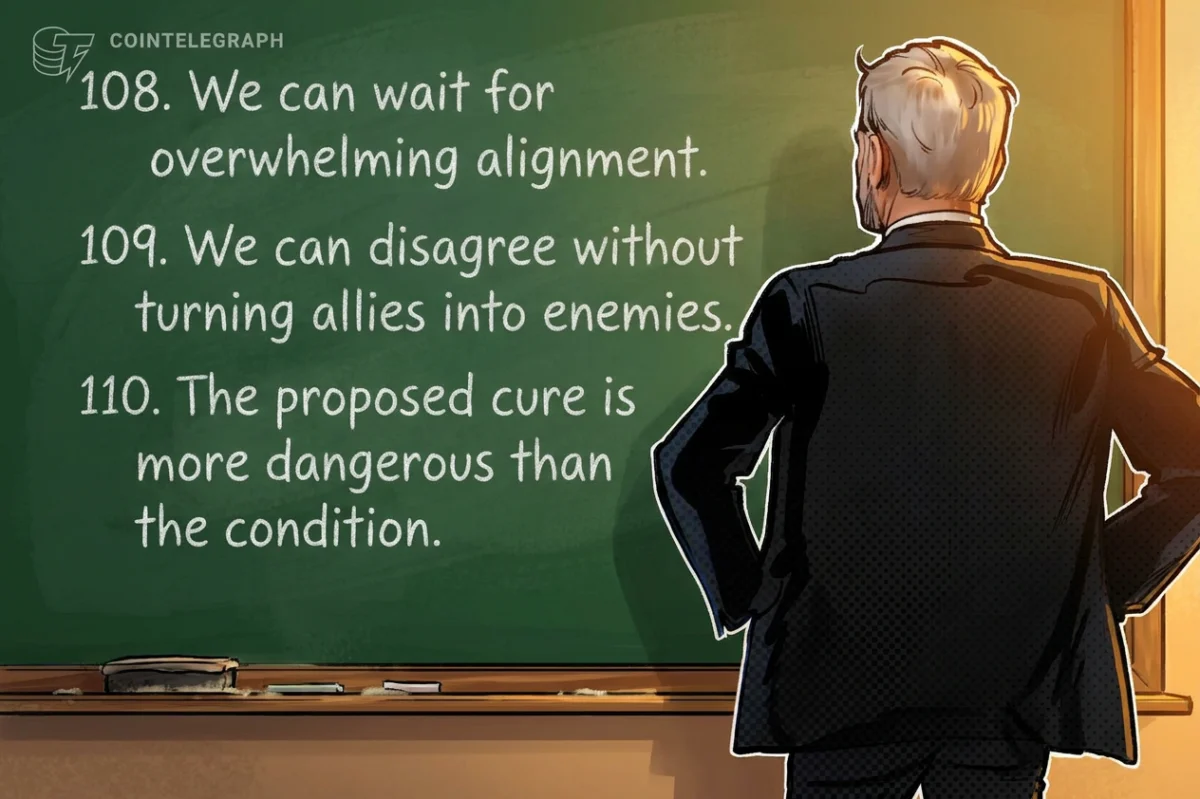
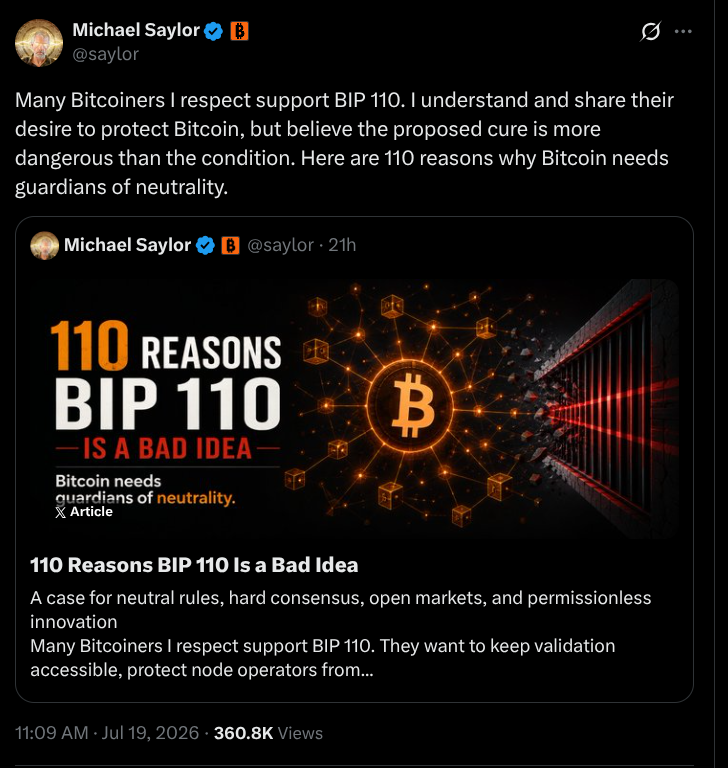
Strategy executive chairman Michael Saylor recently took to social media, unleashing a comprehensive 3,700-word treatise detailing his "110 reasons" why Bitcoin Improvement Proposal-110 (BIP-110), a proposed temporary fork designed to restrict non-monetary transactions on the Bitcoin network, represents a detrimental path forward for the digital asset. His extensive critique, published on X.com, has rapidly become a focal point in one of the most significant protocol-level disputes Bitcoin has witnessed since the contentious Blocksize Wars of 2015-2017, reigniting fundamental debates about the network’s purpose and future.
The Genesis of BIP-110: A Response to Ordinals and Network Congestion Concerns
Bitcoin Improvement Proposal-110 was formally introduced in December 2025 by pseudonymous Bitcoin developer "Dathon Ohm," with notable backing from Ocean Protocol founder Luke Dashjr. The core motivation behind BIP-110 stems from a desire to curb what its proponents describe as "spamming" of the Bitcoin network. Specifically, the proposal targets non-fungible token (NFT)-like Ordinals inscriptions and other forms of arbitrary data embedded directly onto the blockchain. Supporters of BIP-110 argue that these non-monetary transactions divert network resources, contribute to increased transaction fees, and threaten to obscure Bitcoin’s primary function as a robust, peer-to-peer electronic cash system. The long-standing ideal for many Bitcoin maximalists has been to preserve its utility as "sound money," focusing solely on financial transactions, rather than evolving into a general-purpose data storage layer.
The Ordinals protocol, launched in January 2023, enabled the inscription of arbitrary data onto individual satoshis (the smallest unit of Bitcoin) by leveraging the Segregated Witness (SegWit) upgrade’s increased block space for witness data. This innovation quickly led to a surge in activity, with artists, collectors, and developers inscribing images, text, and even small programs directly onto the Bitcoin blockchain. While hailed by some as a breakthrough for Bitcoin’s cultural and expressive capabilities, others viewed it as an unwelcome diversion, consuming valuable block space and inflating transaction costs for ordinary users, thus challenging the network’s efficiency and core identity.
Michael Saylor’s Philosophical Stand: Neutrality, Consensus, and Permissionless Innovation
Michael Saylor, whose MicroStrategy holds the largest corporate treasury of Bitcoin, articulated a powerful defense of what he terms "neutral rules, hard consensus, open markets, and permissionless innovation." His Sunday post on X.com quickly garnered significant attention, accumulating 879,000 views, 692 replies, and 852 retweets as of Sunday 12 p.m. ET, underscoring the community’s keen interest in his perspective.
Saylor acknowledged the legitimate concerns raised by proponents of BIP-110, stating, "Many Bitcoiners I respect support BIP 110. They want to keep validation accessible, protect node operators from unwanted costs and content, preserve affordable payments, and keep Bitcoin focused on sound money rather than general-purpose data storage. Those are serious concerns. I share the objectives. I disagree about the remedy." This nuanced approach highlights a critical distinction: Saylor aligns with the desired outcomes but fundamentally diverges on the methods proposed to achieve them. His argument centers on the principle that Bitcoin’s strength lies in its unchangeable, neutral ruleset, which should not be subject to subjective interpretation or censorship regarding the type of data transacted.
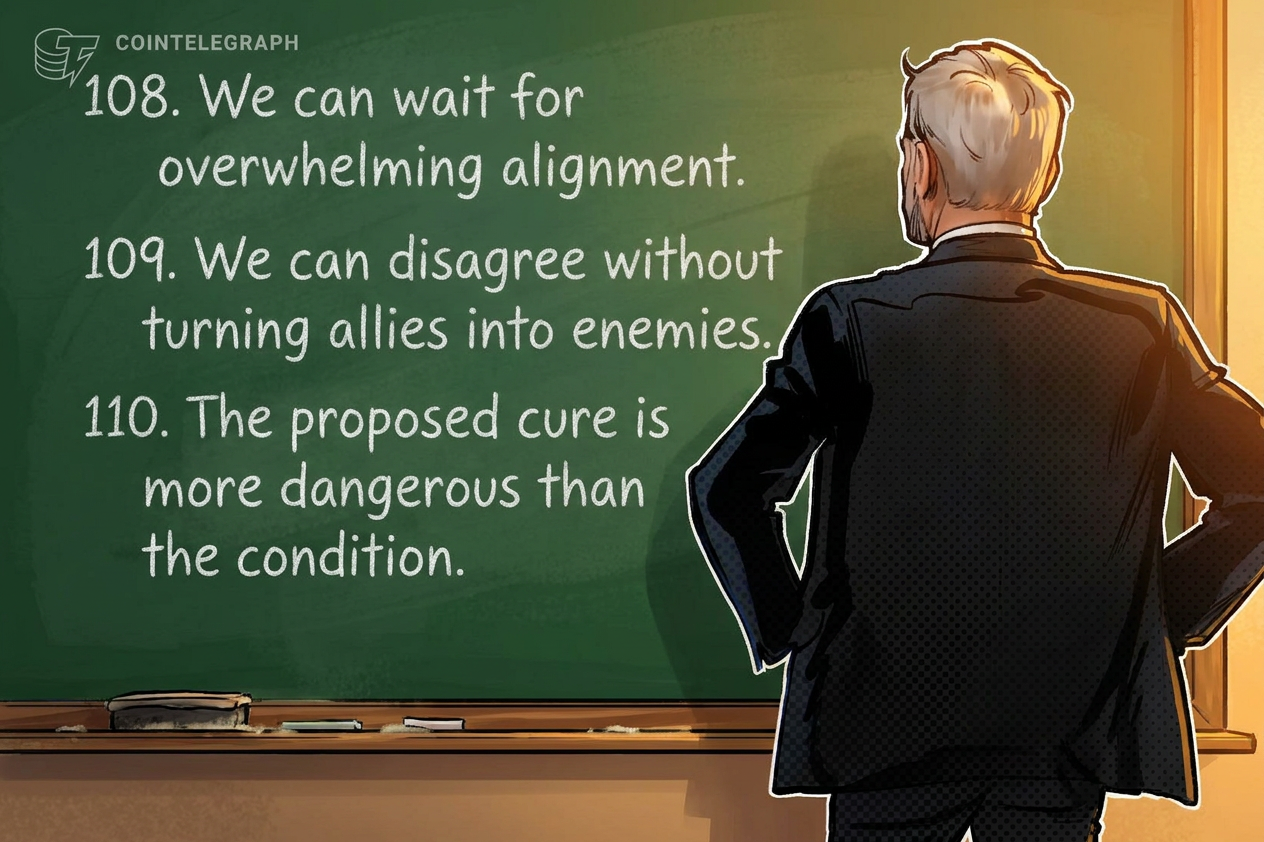
He explicitly called for a civil discourse, emphasizing, "This article critiques the proposal, not the people behind it. I assume good faith. Bitcoin is strongest when we can disagree vigorously without mistaking allies for enemies." This statement reflects a recognition of the deeply held beliefs on both sides of the debate and a call for constructive engagement, a lesson perhaps learned from past ideological battles within the community. For Saylor, tampering with the network’s permissionless nature, even temporarily, sets a dangerous precedent that could undermine Bitcoin’s fundamental value proposition as censorship-resistant money.
Historical Precedent: Echoes of the Blocksize Wars
The current debate surrounding BIP-110 is widely considered the most significant protocol-level contention since the infamous Blocksize Wars that gripped the Bitcoin community between 2015 and 2017. That era saw ecosystem participants locked in a bitter struggle over whether to increase Bitcoin’s block size limit from 1MB to enhance scalability, a move that carried the existential risk of a chain split. Key figures like Mike Hearn, Gavin Andresen, and Roger Ver advocated for larger blocks, leading to proposals like Bitcoin XT, Bitcoin Classic, and Bitcoin Unlimited. Opponents, including Blockstream co-founder Adam Back and many core developers, prioritized decentralization, security, and the original vision of small, verifiable blocks, ultimately leading to the adoption of Segregated Witness (SegWit) and the contentious hard fork that birthed Bitcoin Cash (BCH).
The parallels between the Blocksize Wars and the BIP-110 debate are striking. Both involve fundamental disagreements about Bitcoin’s scaling strategy, its core purpose, and the interpretation of its "rules." While the Blocksize Wars focused on transaction volume and throughput, the current debate centers on the nature of transactions, specifically the inclusion of non-monetary data. Both controversies underscore the inherent challenges of governing a decentralized network, where consensus is paramount but ideological divisions run deep. The specter of a chain split, though less prominent in the BIP-110 discussion due to its proposed temporary nature and different activation mechanism, remains a latent concern whenever fundamental protocol changes are discussed.
The Ordinals Phenomenon: A Rollercoaster of Activity and Debate
The urgency for BIP-110 arose during a period of intense Ordinals activity. Data from Dune Analytics shows that Ordinals inscriptions surged dramatically after their introduction in early 2023, reaching a peak of over 400,000 daily inscriptions in August 2023. This unprecedented volume of non-monetary data led to significant network congestion, driving transaction fees higher and causing delays for standard financial transactions. This period fueled the "spam wars" narrative, with many users and developers expressing frustration over the perceived misuse of block space.
However, the landscape has shifted considerably since then. Recent data indicates that Ordinals activity has dwindled to near all-time lows. Over the last month, fewer than 10,000 Ordinals have been inscribed onto the Bitcoin blockchain daily, a precipitous drop from its peak. This decline in activity raises questions about the immediate necessity of BIP-110. While proponents might argue that the underlying vulnerability remains and proactive measures are still needed, opponents could point to the current low activity as evidence that the "problem" has largely resolved itself organically, or that the market naturally adjusts. The reduced activity also provides a window for more measured debate, rather than decisions made under duress of network congestion.
The Hurdles to BIP-110 Activation: A Long Road Ahead
Despite the passionate arguments from its proponents, the path to BIP-110’s activation faces significant technical and community hurdles. For the proposal to be enacted, it requires a supermajority consensus: 55% of Bitcoin nodes validating blocks must signal support across a defined "period" of blocks. This threshold is designed to ensure broad community agreement before any fundamental change is implemented.
Current signaling data reveals a stark reality for BIP-110’s immediate prospects. In the last measurement period (period number 475, spanning blocks 955,584 to 957,599), only a mere 1% of blocks signaled support for the proposal. This low level of support indicates that, despite the vocal backing from some influential figures, the broader network of node operators and miners is far from reaching the necessary consensus. This suggests that without a significant shift in sentiment or a renewed surge in "spam" activity, BIP-110 is unlikely to be activated in its current form. The slow pace of adoption underscores the decentralized and conservative nature of Bitcoin’s governance, where changes to the core protocol are met with extreme caution and require overwhelming buy-in.
Diverse Voices: The Philosophical Divide
The debate around BIP-110 highlights a fundamental philosophical schism within the Bitcoin community regarding its identity and future.
On one side, proponents like Luke Dashjr and "Dathon Ohm" view Ordinals-driven bloat as a "serious threat" that necessitates an "imminent fix." They argue that allowing arbitrary data to proliferate on the blockchain dilutes Bitcoin’s value proposition as a sound monetary system and could eventually compromise its security and accessibility for financial transactions. Dashjr has also contended that BIP-110 would not cause a chain split, as some fear, and emphasizes its temporary nature—a proposed one-year limit—which he believes would prevent long-term invalidation of legitimate fee-paying transactions. For this faction, the temporary restriction is a pragmatic measure to protect Bitcoin’s foundational utility.
Conversely, prominent figures such as Blockstream CEO Adam Back have vehemently criticized BIP-110, describing it as a "quest to police other people." Back, a cypherpunk and one of the earliest contributors to Bitcoin’s underlying technology, argues that such restrictions are incompatible with Bitcoin’s core ethos of permissionless, censorship-resistant money. He asserts that Bitcoin’s decentralization inherently means "you can’t impose your views on others" regarding how they use the network’s block space. For Back and those who share his view, any attempt to filter or categorize transactions based on their perceived "monetary" or "non-monetary" nature undermines the network’s neutrality and opens the door to future censorship. This perspective champions the idea that the market, through transaction fees, should ultimately decide the most valuable use of block space, rather than a centralized decree.
Broader Implications for Bitcoin’s Future Trajectory
The BIP-110 debate is more than just a technical discussion; it’s a referendum on Bitcoin’s evolving identity and its foundational principles. The outcome, regardless of whether BIP-110 is adopted or rejected, will have significant implications for how the Bitcoin community navigates future challenges and innovations.
One key implication is the ongoing tension between innovation and purity. While Ordinals represent a new form of innovation on Bitcoin, they challenge the traditionalist view of its singular purpose. The debate forces the community to grapple with whether Bitcoin should remain a minimalist "cash system" or if its robust, secure blockchain can and should support a broader range of applications.
Furthermore, the discussion reinforces the importance of "neutral rules" and "hard consensus" in a decentralized system. Saylor’s emphasis on these principles highlights the community’s deep-seated aversion to subjective rule changes. Any modification that appears to impose a value judgment on specific types of transactions risks alienating a segment of the user base and potentially fracturing the network’s consensus.
The challenge of governing a decentralized network also comes to the fore. Without a central authority, protocol changes rely on a complex interplay of developer proposals, miner signaling, node operator adoption, and broader community sentiment. The slow progress of BIP-110 underscores the inherent resistance to change in such a system, a feature that many consider a strength, as it prevents hasty or ill-conceived alterations.
Looking ahead, this debate sets a precedent for how future innovations or perceived "abuses" of the Bitcoin blockchain will be addressed. Will the community continue to rely on market mechanisms (e.g., rising transaction fees making less valuable data economically unfeasible) to regulate block space usage, or will there be renewed attempts to implement protocol-level filters? The resolution of the BIP-110 discussion will offer insights into the community’s preferred approach to balancing technological evolution with its core philosophical tenets. The ongoing robust discussion, even with its disagreements, ultimately strengthens Bitcoin by forcing a thorough examination of its values and future direction.