admin
admin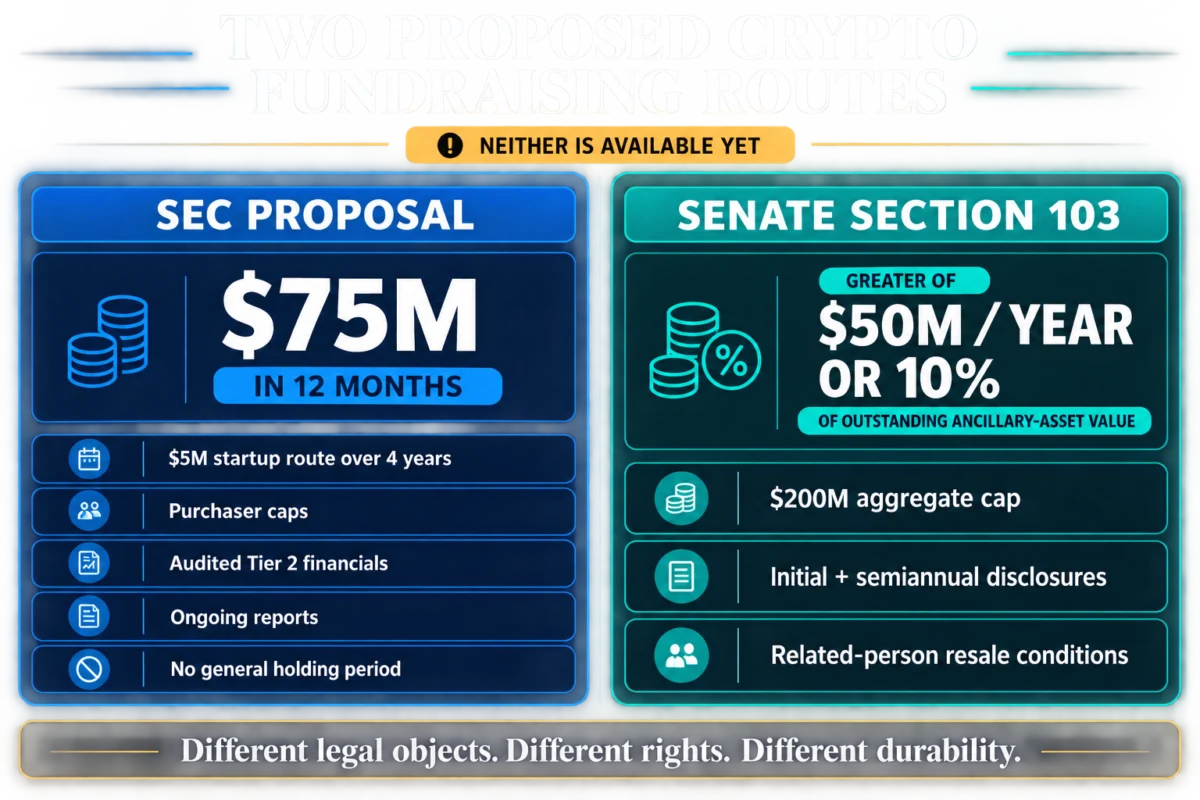
The U.S. Securities and Exchange Commission’s (SEC) proposed Regulation Crypto Assets outlines a fundraising ceiling of $75 million, a figure that at first glance appears comparable to the Senate’s market-structure framework, which initiates with a "greater-of-$50-million-or-10%" formula. However, beneath this surface similarity lies a complex web of differing legal mechanisms, distinct qualifying criteria for issuers and instruments, varied investor protections, and divergent pathways for interaction between these two significant regulatory initiatives. Understanding these distinctions is paramount for the burgeoning digital asset industry as it seeks clarity and predictability in its fundraising and operational activities.
The SEC’s proposal, officially titled "Regulation Crypto Assets," aims to establish exemptions by rule for specific crypto-asset offerings. This initiative, still open for public comment until October 20, 2026, represents a proactive effort by the agency to adapt its existing securities laws to the unique characteristics of digital assets. Concurrently, Section 103 of the Senate’s version of the CLARITY Act (an acronym whose full form and specific legislative context would be provided if available, but for this analysis, it’s understood as a legislative effort to define and regulate digital assets) proposes a statutory exemption for certain transactions involving “ancillary assets” sold pursuant to an investment contract. This legislative effort is still in its nascent stages, representing unfinished legislation that requires further congressional deliberation and passage.
Crucially, neither of these proposed regulatory avenues is currently operational. The SEC’s proposal is a regulatory notice and comment period, a critical phase where stakeholders can voice their concerns and provide feedback that may shape the final rule. The Senate’s framework, on the other hand, is subject to the full legislative process, involving committee reviews, floor debates, and potential amendments before it could become law. This temporal and procedural disparity underscores the ongoing evolution of the regulatory landscape for digital assets.
Divergent Legal Architectures Shape Distinct Fundraising Pathways
The SEC’s proposed Regulation Crypto Assets delineates two primary routes for eligible issuers. The first is a limited “startup” exemption, designed to accommodate smaller entities, which would permit fundraising up to $5 million over a four-year period. This provision appears tailored to support early-stage ventures with modest capital needs, offering them a less burdensome path to capital formation. The second, more substantial pathway is a separate offering-and-reporting exemption. This route would allow issuers to raise up to $75 million within a 12-month period, but this elevated fundraising capacity is contingent upon the issuer adhering to specific disclosure and continuing-reporting duties. These duties are likely to include providing audited financial statements and regular updates to investors and the market, mirroring some of the obligations faced by traditional public companies.
In contrast, the Senate’s legislative text adopts a fundamentally different approach. Section 103 focuses on exempting qualifying transactions involving “ancillary assets” when they are sold under an investment contract. The financial parameters here are structured as a “greater-of” formula: issuers can raise an annual amount that is the greater of $50 million or 10% of the total dollar value of the issuer’s outstanding ancillary assets. This calculation is measured over a four-year period, and importantly, an issuer cannot exceed an aggregate sales limit of $200 million under this exemption.
The “greater-of” mechanism introduces a variable ceiling that is not necessarily capped at $50 million. For an issuer whose outstanding ancillary assets are valued above $500 million, the 10% threshold would naturally exceed $50 million. In such scenarios, the $200 million aggregate limit would become the operative constraint. This structure suggests a potential for larger fundraising amounts for established entities with significant underlying asset values, provided they meet the criteria for “ancillary assets.” The definition and scope of “ancillary assets” is a critical element here, as it may not be directly synonymous with the “covered assets and transactions” contemplated by the SEC proposal, leading to potential differences in which digital assets and activities qualify for exemption.
The practical implications of these divergent approaches are significant. Legal counsel advising issuers would need to meticulously assess not only the amount of capital they intend to raise but also the nature of the asset being offered, the structure of the transaction, the eligibility of the issuer, and any existing affiliate or control relationships. A token sale that perfectly aligns with the conditions of one proposed regulatory pathway might not qualify for the other. This necessitates a granular understanding of each framework’s specific requirements and limitations.
Investor Rights and Protections: A Tale of Two Frameworks
The nature of investor rights and the protections afforded to them differ markedly between the SEC’s proposal and the Senate’s legislative text, primarily due to the varying compliance requirements and liability structures embedded within each.
Under the SEC’s proposed $75 million route, the agency anticipates implementing purchaser limits. These limits are likely to be based on an investor’s financial capacity, possibly employing a formula that restricts purchases to a certain percentage (e.g., 10%) of an investor’s net worth or income. This is a common feature in securities regulations designed to protect less sophisticated investors from excessive risk. Furthermore, this SEC route mandates comprehensive offering disclosures, including audited financial statements for offerings exceeding a certain threshold (presumably within the $75 million tier), and requires ongoing reporting through annual, semiannual, and current reports. This commitment to transparency aims to provide investors with the information necessary to make informed investment decisions.
A notable aspect of the SEC’s proposal is the absence of a general holding period for resales under the larger exemption. This could facilitate liquidity for investors. Additionally, the proposal suggests federal preemption of state registration and qualification requirements for these covered offerings, aiming to create a more uniform national market for digital asset securities. However, it is crucial to note that the SEC’s proposed exemptions would not abrogate existing federal anti-fraud laws. The agency has also explicitly stated that these exemptions are nonexclusive, meaning issuers could potentially rely on other existing exemptions if the facts and conditions permit.
The Senate’s framework, as presented in Section 103, offers a different package of investor protections and compliance obligations. It requires an initial filing after the first sale and mandates semiannual disclosures for as long as the exemption’s conditions remain applicable. Significantly, the Senate bill text preserves key federal liability provisions, including Section 12(a)(2) of the Securities Act, Section 10(b) of the Exchange Act, and Rule 10b-5. This preservation of existing liability frameworks means that private rights of action, which are critical for investor recourse, are maintained rather than replaced by a bespoke or potentially weaker remedy.

An intriguing distinction in the Senate’s text is the clause stating that failure to satisfy the exemption’s requirements does not, in itself, determine whether the ancillary asset constitutes a security. This clause effectively decouples the compliance with the transactional exemption from the fundamental legal classification of the asset itself, potentially offering a degree of clarity on the underlying security status irrespective of procedural compliance.
Resale treatment also presents a divergence. While the SEC’s larger proposed route does not impose a general holding period, the Senate text introduces specific conditions on sales by “related persons” and holders acting as part of a “coordinated group” to control the network. These provisions are likely to be most relevant for founders, insiders, and large concentrated holders, potentially imposing more scrutiny on their trading activities even if ordinary downstream trading appears less constrained.
Federal preemption is another area where the two frameworks diverge in their explicit articulation. The SEC proposal directly addresses state registration and qualification for its covered offerings. The Senate text, operating through a federal statutory exemption and related market-structure provisions, would have preemption consequences that would need to be interpreted from the enacted text as a whole, rather than being explicitly enumerated in the same manner as the SEC’s proposal.
Navigating Potential Overlap: Reconciliation, Not Erasure
The prospect of both congressional legislation and SEC rulemaking advancing concurrently raises questions about how these initiatives would interact. If Congress enacts legislation that directly conflicts with an existing or proposed SEC rule, the SEC would be obligated to administer its rules in a manner consistent with the later-enacted statute. This principle of statutory supremacy ensures that legislative mandates take precedence over agency regulations in cases of direct conflict.
However, the current texts of both proposals leave considerable room for coexistence and potential synergy. The SEC’s proposal explicitly states that its exemptions are nonexclusive. Similarly, the Senate bill, by creating a targeted statutory route for transactions involving ancillary assets, does not preclude other avenues of exemption or registration. This suggests that an issuer could potentially explore and utilize both frameworks, provided that they independently satisfy all the stipulated conditions for whichever route they choose to pursue.
The ultimate form of any enacted law or finalized SEC rule could also influence this interaction. A final congressional act might include provisions that specifically direct, narrow, or supersede portions of the SEC’s existing or proposed regulatory framework. Conversely, subsequent SEC rulemaking, occurring after a legislative framework is in place, could modify the agency’s proposal before its final adoption to ensure alignment and avoid unnecessary conflict.
Timing and Uncertainty: A Moving Regulatory Target
The temporal dimension of these regulatory developments adds another layer of uncertainty for market participants. The SEC’s proposal is currently undergoing the notice-and-comment rulemaking process, which is a statutory requirement designed to ensure transparency and stakeholder input. The Senate’s text, on the other hand, is subject to the vagaries of the legislative calendar, committee approvals, floor votes, and potential reconciliation with other legislative chambers. The bill text itself contains provisions for effective dates and implementation periods, often tied to enactment and subsequent rulemaking by relevant agencies. While transition provisions may address certain existing offerings and reporting obligations, an unfinished bill cannot be considered operative law.
Furthermore, the legislative landscape in Congress is dynamic. As of the latest available information, legislative texts have undergone revisions. For instance, the Senate Banking Committee advanced one version of text in May, a reported Senate version emerged in June, and an updated discussion text was released in July. This constant evolution means that any definitive legal conclusions must be based on the most current and advanced version of the legislation, rather than relying on earlier drafts.
Beyond the Numbers: The Substance of Regulatory Difference
The headline difference of $25 million between the SEC’s $75 million ceiling and the Senate’s $50 million starting point is, therefore, the least reliable indicator of their true impact. The SEC’s route is characterized by a fixed 12-month fundraising cap, coupled with stringent purchaser caps, mandatory audited financials for larger offerings, and ongoing reporting requirements. These elements collectively create a framework that offers a defined structure for fundraising but imposes significant compliance burdens.
The Senate’s route, conversely, utilizes an asset-valuation alternative for its annual fundraising limit, operates within a four-year framework, and includes a $200 million aggregate ceiling. Crucially, it preserves a different liability and disclosure structure, potentially offering a more flexible approach for certain types of issuers and assets.
For issuers and investors alike, the operative divide lies not in the initial numerical figures presented, but in the underlying legal objects being regulated and the associated rights and obligations. The definition of qualifying assets, the specific transaction requirements, the investor protection mechanisms, the liability provisions, and the preemption effects are the critical factors that will ultimately determine the practical implications and the viability of each proposed regulatory path. As these frameworks continue to evolve, careful analysis and strategic navigation will be essential for participants in the digital asset ecosystem.