
 admin
admin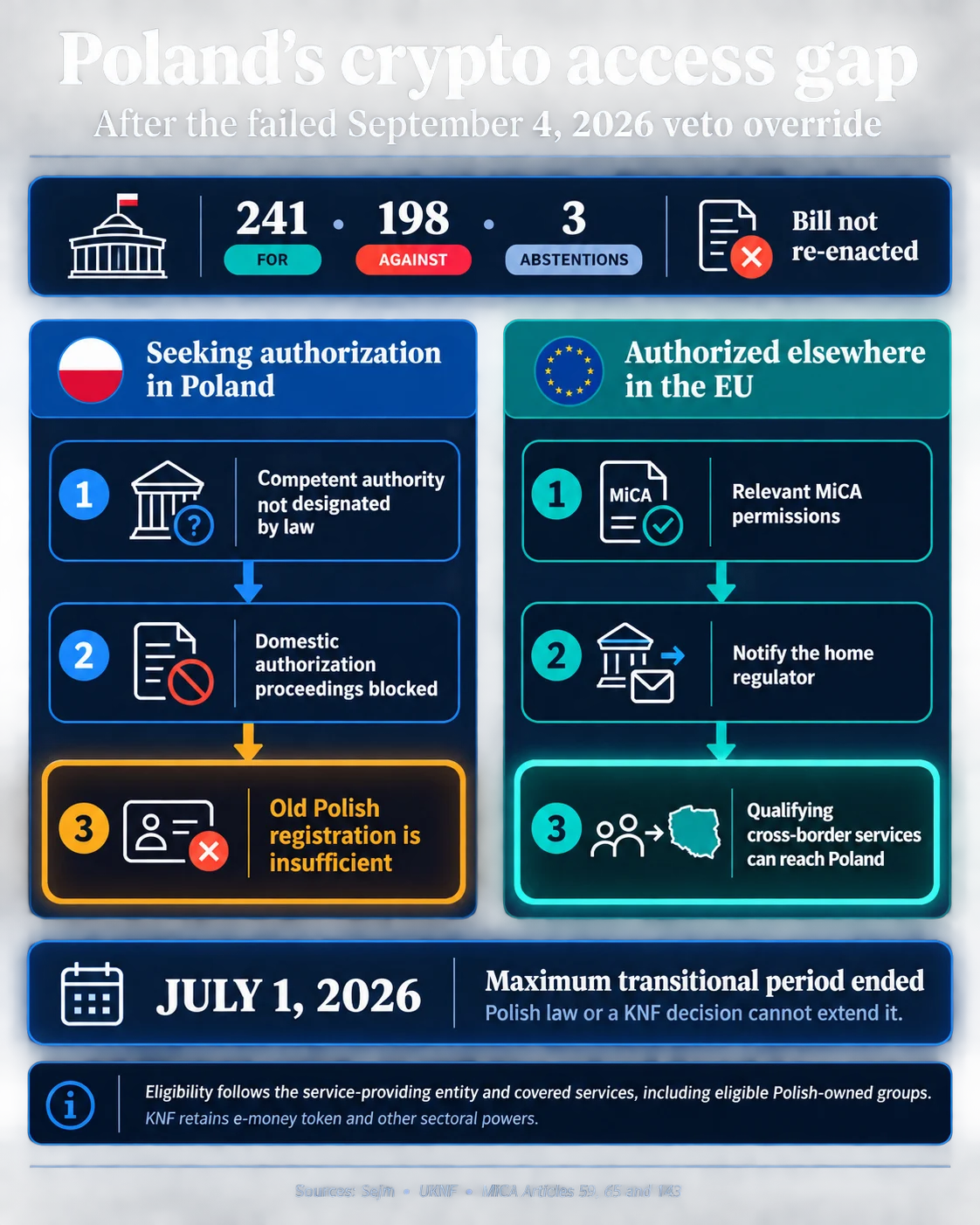
The legislative landscape for cryptocurrency businesses in Poland has been thrown into disarray following a failed vote in the Sejm, the lower house of the Polish parliament. This parliamentary misstep has created a significant licensing vacuum, effectively barring domestic firms from obtaining the necessary authorizations while allowing their European Union-based counterparts to seamlessly enter the Polish market. The implications of this deadlock are far-reaching, potentially impacting the growth of the domestic crypto sector and solidifying the market position of established foreign entities.
The critical juncture arrived on September 4th, when the Sejm was unable to muster the required majority to override President Karol Nawrocki’s veto of legislation crucial for the full implementation of the European Union’s Markets in Crypto-Assets (MiCA) Regulation. This legislative failure occurred more than two months after Poland’s mandated transition period for crypto businesses expired, leaving a void in regulatory oversight and operational frameworks. The threshold for overriding a presidential veto in Poland is a two-thirds majority of deputies present, including at least half of the statutory number of deputies. In this instance, the vote recorded 241 votes in favor of re-enacting the bill, with 198 against and three abstentions, falling significantly short of the necessary supermajority.
A Regulatory Void and its Immediate Consequences
The absence of this pivotal legislation means that Poland has yet to formally designate the competent authority responsible for processing ordinary MiCA applications. The Polish Financial Supervision Authority (KNF) has been unequivocal in its stance, stating that authorization proceedings cannot commence until such a designation is legally established. This creates a frustrating impasse for companies seeking a Polish license, leaving them in limbo while their competitors, already authorized in other EU member states, can continue to operate within Poland under the cross-border provisions of MiCA.
The MiCA framework, designed to harmonize crypto regulations across the EU, introduces a passporting mechanism. This allows a crypto-asset service provider (CASP) authorized in one member state to operate in other member states by notifying their home regulator. A CASP can inform its national competent authority about the specific countries and services it intends to offer within the EU. Once this information is transmitted, or after a stipulated waiting period, the firm can commence cross-border activities. Polish regulators have publicly confirmed that this passporting route remains fully accessible, even amidst the domestic licensing paralysis.
The Advantage of Existing EU Authorizations

The significance of this passporting advantage has been amplified since July 1st, the date when the maximum MiCA transition period expired. Prior to this deadline, companies operating in Poland could still rely on the country’s previous virtual-currency activity register to continue their operations, even if they were not yet fully compliant with MiCA. However, with the transition period concluded, this grace period has ended. The Katowice Tax Administration Chamber, a relevant authority, has clarified that an entry on the old register no longer confers authorization. Furthermore, Polish regulators maintain that neither domestic legislation nor administrative decisions can unilaterally extend this expired transition period. This effectively closes the old operational pathway before the new, MiCA-compliant one has been fully established within Poland.
This regulatory dichotomy presents a clear advantage to foreign firms that have already secured MiCA authorization in other EU member states. These entities can leverage the passporting provisions to enter the Polish market without needing to wait for Poland to finalize its domestic regulatory infrastructure. The distinction in treatment is based on the entity providing the service, not the nationality of its owners. Consequently, a Polish crypto company that wishes to serve domestic customers might find its quickest and most viable route to be through an affiliate that has obtained the necessary MiCA authorization elsewhere in the EU and has completed the requisite cross-border notification process. Conversely, a company that solely relies on its legacy Polish registration is now effectively excluded from operating.
This situation creates a strong incentive for firms that are unwilling or unable to endure the extended delays in Warsaw to seek authorization in a different EU member state where the MiCA licensing machinery is already operational and efficient. For those applicants who remain committed to establishing their presence in Poland, the path forward is contingent on the Polish parliament successfully passing the legislation that designates a competent authority. Until that legislative hurdle is cleared, their most expedient option to access Polish customers may very well involve navigating the regulatory landscape of another European capital.
Timeline of the Regulatory Standoff
The current predicament can be traced back to the initial implementation of MiCA, a landmark regulation by the European Parliament and Council aimed at creating a comprehensive and consistent framework for crypto-assets across the EU. MiCA seeks to bring clarity, consumer protection, and market integrity to a rapidly evolving digital asset space. Member states were given a specific timeframe to transpose the directive into their national laws and establish the necessary supervisory structures.
- June 11, 2024: President Karol Nawrocki issues a veto on the legislation intended to align Polish law with MiCA, citing specific concerns that led to his decision. The exact nature of these concerns has not been widely detailed in public statements, but such vetoes typically relate to constitutional compatibility, national security, or fundamental rights.
- July 1, 2024: The maximum MiCA transition period for existing crypto businesses to adapt to the new regulatory regime expires across the EU. This date marks a critical point where operations that were previously permissible under national registers must now comply with MiCA or cease to operate.
- September 4, 2024: The Polish Sejm attempts to override President Nawrocki’s veto. The vote falls short of the required two-thirds majority, meaning the president’s veto stands, and the legislation remains stalled. This parliamentary failure leaves a significant gap in Poland’s regulatory framework for crypto assets.
- Post-September 4, 2024: With the legislation still blocked, Poland is unable to designate a competent authority for MiCA licensing. Domestic firms seeking authorization are unable to initiate the process. Meanwhile, firms authorized in other EU member states can continue to operate in Poland via the passporting mechanism.
Broader Implications for the Polish Crypto Ecosystem
The ongoing regulatory uncertainty in Poland has several significant implications for the domestic cryptocurrency ecosystem. Firstly, it risks stifling innovation and growth within the Polish market. Local startups and established businesses that are unable to obtain licenses may be forced to relocate their operations to more regulated jurisdictions or face significant operational challenges. This could lead to a brain drain of talent and capital away from Poland.

Secondly, the situation may inadvertently bolster the dominance of foreign players. Companies that have already navigated the MiCA authorization process in countries like Germany, France, or Malta can now gain a competitive edge in the Polish market, potentially at the expense of local businesses. This could lead to a less diversified and less competitive market landscape in the long term.
Thirdly, the lack of clear domestic regulation could raise concerns among consumers and investors in Poland. While MiCA aims to enhance consumer protection, the absence of a fully implemented national framework might create confusion and potentially expose users to risks if unauthorized entities continue to operate in a regulatory grey area.
Potential Reactions and Future Outlook
While official statements from Polish regulatory bodies have been factual and focused on the legal requirements, one can infer the likely sentiment within the industry. Crypto industry associations in Poland are likely expressing significant concern and frustration over the prolonged legislative delay. They may be actively lobbying lawmakers to find a resolution and expedite the designation of a competent authority.
The government, on the other hand, faces the challenge of navigating parliamentary politics to pass the necessary legislation. The failed override vote indicates a division or lack of consensus within the Sejm regarding the urgency or specific aspects of the proposed legislation. It is plausible that further attempts will be made to pass the bill, potentially with amendments, or that the executive branch will explore alternative avenues to address the regulatory gap.
The future outlook for the Polish crypto market hinges on the swift resolution of this legislative deadlock. For domestic firms, the immediate path forward involves either waiting for the parliamentary process to conclude or seeking authorization in another EU member state and utilizing the passporting rights. For the Polish government, the challenge is to demonstrate its commitment to fostering a regulated and competitive digital asset market by swiftly enacting the necessary legal framework. Failure to do so could result in a sustained disadvantage for Polish businesses and a missed opportunity to harness the potential of the digital economy. The current situation underscores the critical importance of timely and effective regulatory implementation in ensuring a fair and competitive market for all participants within the European Union’s burgeoning crypto landscape.








