James Watt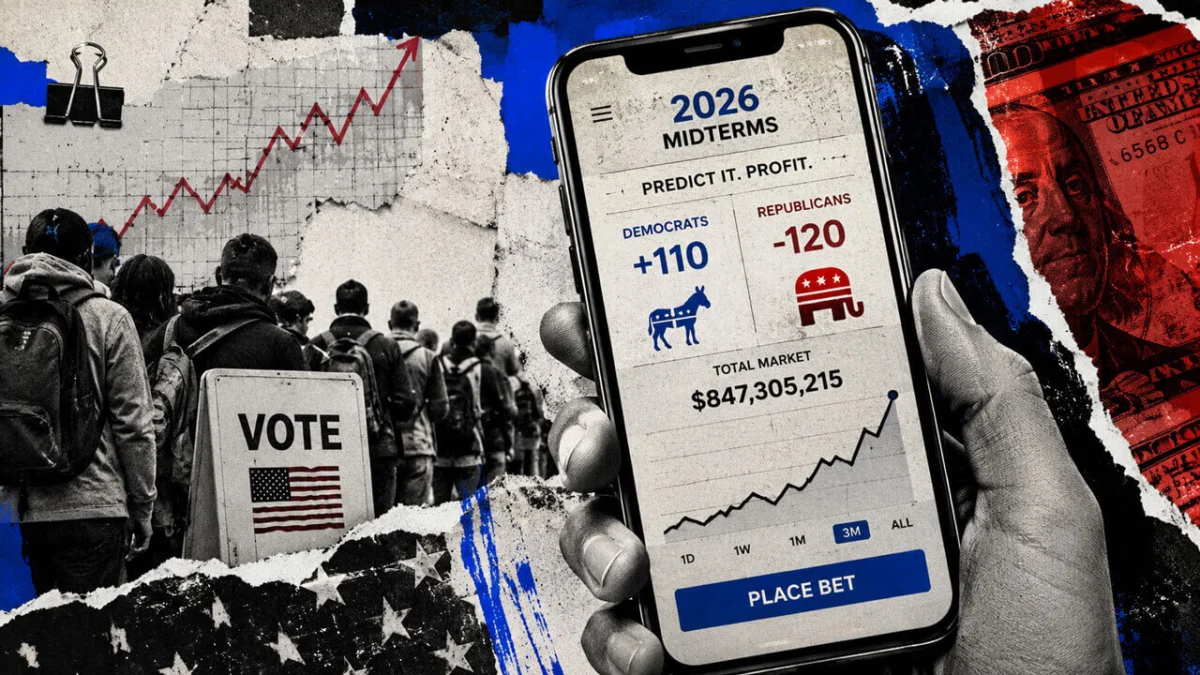
The landscape of American political forecasting is undergoing a fundamental transformation as the Nov. 3 midterm election approaches. With less than 11 weeks remaining before voters head to the polls, the betting markets surrounding congressional races have already eclipsed the total volume seen during the entire 2024 election cycle. This surge in financial activity highlights a growing reliance on prediction markets as a real-time barometer for political sentiment, even as new data suggests that these markets are being driven by a remarkably small number of high-stakes participants.
According to the latest industry data, traders had placed at least $133 million across markets tied specifically to House and Senate races by Aug. 10. This figure represents a significant leap from the $92.4 million recorded during the entirety of the 2024 cycle. The expansion is not merely financial; the menu of available bets has grown exponentially. In previous cycles, traders were largely limited to high-level outcomes across roughly 464 comparable congressional markets. Today, that number has ballooned to 7,466 distinct markets, covering everything from primary results and vote shares to specific candidate endorsements, debate remarks, and voter turnout metrics.
Concentration of Capital and the "Top 1%" Problem
While the top-line volume suggests a massive, grassroots interest in election betting, a deeper dive into participation data reveals a much narrower base of influence. Analysis of Polymarket Global—one of the industry’s leading decentralized platforms—shows that the top 1% of digital wallets account for a staggering 68% of all congressional betting volume. Even more concentrated is the influence of the top ten wallets, which alone produce 17% of the total volume. These ten entities have traded contracts touching 426 of the 470 seats currently on the ballot, effectively setting the "price" for the vast majority of the American political landscape.
This concentration poses a unique risk to the perceived accuracy of these markets. In a liquid market, prices are determined by a "wisdom of the crowds" effect, where the collective knowledge of thousands of participants filters out noise. However, in "thin" markets—those with low liquidity—a single well-funded order can drastically shift the displayed probability of an event. Because media outlets, campaign donors, and political analysts increasingly cite these market odds as "live" probabilities, a number generated by a handful of traders can be mistaken for broad public opinion.
The Anti-Corruption Data Collective (ACDC) recently analyzed 7,466 markets across platforms including Kalshi, Polymarket, and Polymarket US. Their findings suggest that while the breadth of the market has expanded, its depth remains inconsistent. For example, Senate contracts in Texas, Maine, and Michigan, along with Kentucky’s 4th Congressional District, account for 67% of all state-level volume. Conversely, 80% of Polymarket’s congressional markets have fewer than 100 participating wallets. Only ten specific markets have crossed the 1,000-participant threshold, which is the standard respondent count for a traditional scientific political poll.
A Chronology of Market Expansion
The path to the current $133 million milestone has been marked by rapid acceleration and a shift in how these platforms operate.
- The 2024 Baseline: During the 2024 cycle, election betting was largely a niche activity focused on the presidential race and a few dozen "battleground" House and Senate seats. Total volume reached $92.4 million, with most activity occurring in the final 30 days before the election.
- Early 2026 Momentum: As the current midterm cycle began, the infrastructure for event-based betting improved. Regulatory clarity—and in some cases, ongoing legal battles—allowed platforms like Kalshi and Polymarket to expand their offerings.
- The August Surge: By Aug. 10, the volume had already surpassed the 2024 total. Projections from ACDC suggest that if the current cycle follows the late-stage acceleration pattern seen in 2024, total volume could reach between $1.4 billion and $1.6 billion by Election Day.
- The Granularity Shift: The transition from 464 markets to over 7,000 reflects a move toward "micro-betting" on politics. Traders are no longer just betting on who wins; they are betting on the margin of victory, the content of victory speeches, and the timing of endorsements.
Market Price vs. Traditional Polling
As prediction markets gain cultural and political currency, analysts are quick to point out the methodological differences between a market price and a political poll. A poll attempts to estimate the opinions of a specific population through scientific sampling and weighting. It provides a snapshot of what voters say they intend to do, accompanied by a margin of error.
In contrast, a prediction market finds the clearing price for a contract that pays out $1 if an event occurs. This price reflects not just opinion, but also the incentives, capital, and risk tolerance of the traders. In this system, dollars weight influence. A trader with $100,000 has 10,000 times the influence of a trader with $10. Furthermore, traders may not be expressing a sincere political belief; they may be hedging against a specific outcome or providing liquidity to earn fees.
Despite these differences, market prices are often treated as superior to polls because they are "live" and force participants to "put their money where their mouth is." This creates a feedback loop: traders price a race, the media reports the price as a probability, and political actors—donors and candidates—react to that coverage, which then provides new data for traders to price.
The Specter of Insider Information
The expansion into granular markets—such as whether a candidate will use a specific phrase or receive a particular endorsement—introduces a higher risk of insider trading. While a general election outcome is decided by millions of voters, the timing of an endorsement or a policy shift is often known to a small circle of campaign insiders before it becomes public.
The Commodity Futures Trading Commission (CFTC) has taken a proactive stance on these risks. In a February advisory, the CFTC detailed cases involving Kalshi where a political candidate traded on his own candidacy and a YouTube editor traded on advance knowledge of unpublished content. Kalshi has reported opening over 200 investigations in the past year, resulting in account freezes and financial penalties.
ACDC’s research into "longshot" bets—defined as trades of at least $2,500 at odds of 35% or less—found that in markets where the outcome is controlled by small groups (such as military and defense decisions), longshot bets were disproportionately successful. In their study, 52% of such bets in military categories landed on the winning outcome, compared to just 14% across all other categories. This suggests that in niche markets, specialized traders—potentially with non-public information—are outperforming the general crowd.
Regulatory Responses and Future Implications
The rapid growth of these markets has forced federal regulators to move from case-by-case enforcement to systemic rulemaking. On Aug. 20, CFTC Chair Michael Selig announced that the Commission expects to propose amendments to Parts 38 and 40 of its regulations. These changes would address event-contract listing rules, consumer protection, and market design.
Selig defended the agency’s exclusive federal jurisdiction over these markets, emphasizing the need to define "public interest" criteria. The goal is to prevent markets from being used for illegal activity or gaming that could undermine the integrity of the democratic process.
For the platforms themselves, the challenge is one of scale. Monitoring thousands of thin contracts for manipulation requires significant resources. Polymarket, which operates on a decentralized blockchain infrastructure, presents additional hurdles for regulators. While every transaction is public on the blockchain, the identities behind the digital wallets remain pseudonymous, making it difficult to link a successful trade to a campaign staffer or government official.
Conclusion: A Test of Authority
By the time polls close on Nov. 3, the prediction market for the midterms will likely be the largest of its kind in history. Whether the volume hits the projected $1.6 billion or settles at a lower figure, the 2026 cycle has already proven that the appetite for political betting is growing faster than the audience of participants.
The central question remains whether these markets can earn the authority they currently wield. If a market’s probability is set by a tiny fraction of wealthy traders, its utility as a tool for public understanding is limited. However, if the influx of capital leads to more accurate and resilient pricing, prediction markets could become a permanent and respected fixture of the American information ecosystem. As the midterms approach, the tension between massive dollar volume and narrow participation will serve as a critical test for the future of "gambling on democracy."