Lina Irawan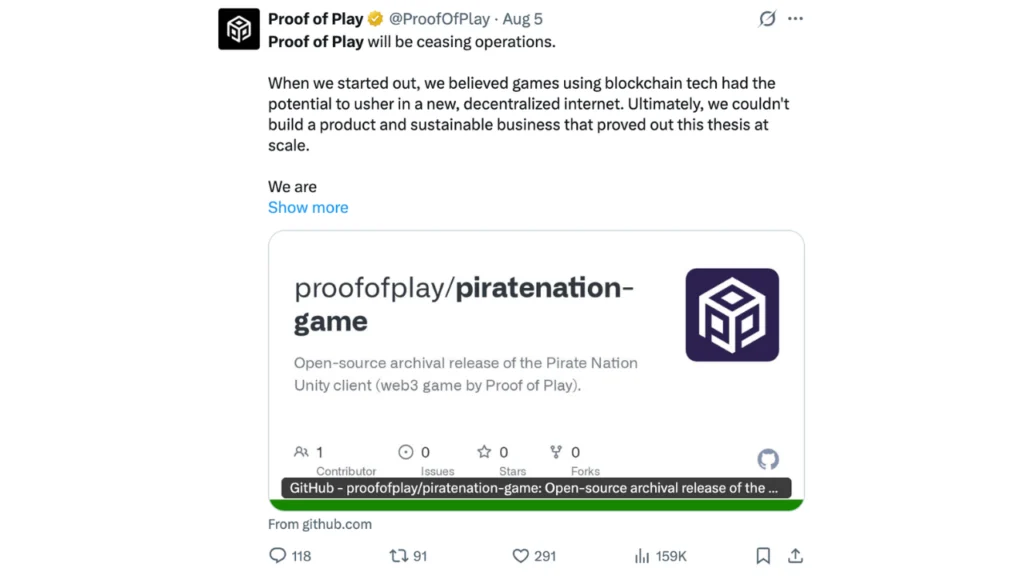
Proof of Play, the ambitious Web3 gaming studio renowned for its fully on-chain RPG Pirate Nation and backed by prominent venture capital firm Andreessen Horowitz (a16z), has announced its cessation of operations. The decision, communicated on August 4th, stems from the company’s inability to establish a scalable and sustainable business model within the blockchain gaming sector, signifying a high-profile challenge for the nascent industry. Despite years of dedicated development and substantial financial backing, the core thesis of creating commercially viable, fully on-chain games has ultimately fallen short, according to the company’s statement. While specific details regarding remaining finances, employee transitions, or a definitive closure date remain undisclosed, the acknowledgment of their vision’s commercial limitations marks a critical juncture for Proof of Play and offers a stark reality check for the broader Web3 gaming landscape.
A Grand Vision Fueled by Top-Tier Investment
Proof of Play emerged as a beacon of ambition in the blockchain gaming space, successfully raising a significant $33 million seed round in 2023. This funding round was notably led by Andreessen Horowitz (a16z) and Greenoaks, underscoring the high expectations placed upon the studio’s innovative approach. The company’s foundational premise was to fundamentally redefine game development by integrating core game logic, digital assets, and player ownership directly onto the blockchain. This vision aimed to create persistent, player-owned worlds that transcend the typical lifecycle of traditional game studios.
At the heart of this ambitious undertaking was Pirate Nation, a role-playing game designed not merely to incorporate NFTs or cryptocurrency rewards, but to serve as a comprehensive demonstration of fully on-chain infrastructure. The objective was to empower players with true ownership of their in-game assets, fostering a sense of permanence and shared ownership within the game world. This approach promised a departure from existing models where digital assets are often centralized and controlled by developers.
Despite garnering considerable attention and interest from within the cryptocurrency and gaming communities, Proof of Play ultimately admitted that its groundbreaking concept had not translated into a sustainable commercial enterprise. "We couldn’t build a product and sustainable business that proved out this thesis at scale," the company stated in its official shutdown announcement. This candid admission highlights that the decision to cease operations was driven by commercial viability concerns rather than technical limitations, a crucial distinction in the context of Web3 innovation. The company has not provided specific player statistics, revenue figures, or detailed operating costs that might further elucidate the precise factors contributing to this closure.
Preserving a Legacy: Pirate Nation Lives On Through Open Source
In a move to honor the extensive development efforts and intellectual property generated, Proof of Play is making a significant portion of Pirate Nation‘s codebase and assets publicly available. This initiative aims to ensure that the years of work invested do not vanish with the company’s closure, allowing the broader development community to learn from and potentially build upon their innovations.

The studio has released four primary public repositories. These include the game’s Unity client, the underlying smart contracts, the game’s artwork assets, and an internal AI development tool named PopBot. The Unity client has been published under the permissive MIT license. However, it is important to note that this release is primarily for archival purposes. Critical components such as proprietary commercial Unity assets, backend services, software development kits (SDKs), and authentication systems have been deliberately excluded. This means that aspiring developers would need to undertake substantial rebuilding efforts to relaunch the game in a functional capacity.
Similarly, the smart contract repository is intended as a reference for educational purposes rather than a plug-and-play solution for immediate deployment. It provides insight into the on-chain mechanics Proof of Play implemented but may require significant adaptation for production environments.
Perhaps the most impactful contribution to the open-source community is the release of Pirate Nation‘s extensive artwork. This includes, but is not limited to, Founder Pirate NFT artwork, game logos, combat cards, and voxel assets. These visual assets have been licensed under the Creative Commons CC0 dedication, which permits unrestricted public reuse, modification, and distribution without the encumbrances of traditional copyright restrictions. This generous licensing allows creators and developers worldwide to incorporate these elements into their own projects without seeking permission or incurring fees.
Furthermore, Proof of Play has open-sourced PopBot, its proprietary internal system designed to orchestrate multiple AI coding agents during the game development process. This release makes a valuable piece of their engineering stack accessible, potentially aiding other developers in streamlining their AI-driven game creation workflows.
The PIRATE Token Ecosystem Continues Under Independent Stewardship
While Proof of Play as a corporate entity is dissolving, the PIRATE token ecosystem is slated to persist under the governance of an independent organization, the Pirate Nation Foundation. Proof of Play has confirmed that this foundation remains active and committed to supporting the PIRATE token following the company’s operational shutdown. However, the company has issued a clear directive regarding its internal reward points, stating that they will not be redeemable for tokens, products, or any other form of compensation. Users are strongly advised not to interpret these internal points as claims against either the foundation or the defunct company.
The market reaction to Proof of Play’s announcement was swift and negative. Following the news, the PIRATE token experienced a notable decline, dropping by nearly 14% within a 24-hour period. At the time of reporting, the token was trading near $0.00112, with a market capitalization hovering around $803,000. The daily trading volume stood at approximately $209,000, indicating a relatively low liquidity environment where even modest trading activity could trigger significant price fluctuations.

In a separate development, Proof of Play confirmed that its mobile title, Shiba Story Go, has been acquired by an undisclosed third party. This mobile game will continue to operate independently under its new ownership. The identity of the buyer and the financial terms of this acquisition have not been disclosed.
A Sobering Reality Check for the Web3 Gaming Frontier
The closure of Proof of Play underscores the profound and persistent challenges confronting the Web3 gaming industry. Numerous studios have grappled with the complex task of translating technological advancements into sustainable and profitable business models. During the speculative fervor of the 2021-2022 crypto boom, many projects launched with business strategies heavily reliant on token incentives, speculative NFT trading, and the anticipation of sustained user engagement driven by financial gains. As market conditions normalized and the speculative bubble deflated, maintaining active and engaged player communities proved to be a significantly more arduous undertaking once the allure of financial rewards diminished.
Compounding these challenges, the operational costs associated with managing proprietary blockchain networks, sustaining intricate token ecosystems, and continuously funding live-service games have proven to be substantially higher than many developers initially anticipated. This financial strain has become a significant hurdle for many aspiring Web3 gaming ventures.
Despite these setbacks, proponents of blockchain technology in gaming continue to advocate for its inherent benefits. They emphasize the potential for true digital ownership, enhanced interoperability between different platforms and games, and the establishment of decentralized infrastructure that can empower players and developers alike. However, critics maintain that the primary driver for mainstream gaming audiences remains engaging and compelling gameplay, suggesting that tokenization and crypto-native mechanics, while innovative, may not be sufficient to capture a broad player base in the absence of fundamentally enjoyable game experiences.
Proof of Play’s dissolution serves as a potent reminder that even projects boasting substantial funding and exhibiting remarkable technical ambition can falter when confronted with these prevailing commercial realities. The company’s decision highlights the critical need for Web3 games to offer tangible value and entertainment beyond their underlying blockchain architecture.
Nevertheless, Proof of Play’s legacy may extend far beyond its operational conclusion. By open-sourcing the codebase, artwork, smart contracts, and AI development tools for Pirate Nation, the studio has ensured that its technical innovations and creative assets remain accessible to the broader development community. While the company itself is no longer active, the technology it pioneered, coupled with the invaluable lessons learned from one of Web3 gaming’s most ambitious experiments, has the potential to influence and shape the trajectory of future blockchain-powered games. This act of open collaboration could ultimately foster innovation and contribute to the maturation of the entire Web3 gaming ecosystem, even as it navigates these challenging times.