Lina Irawan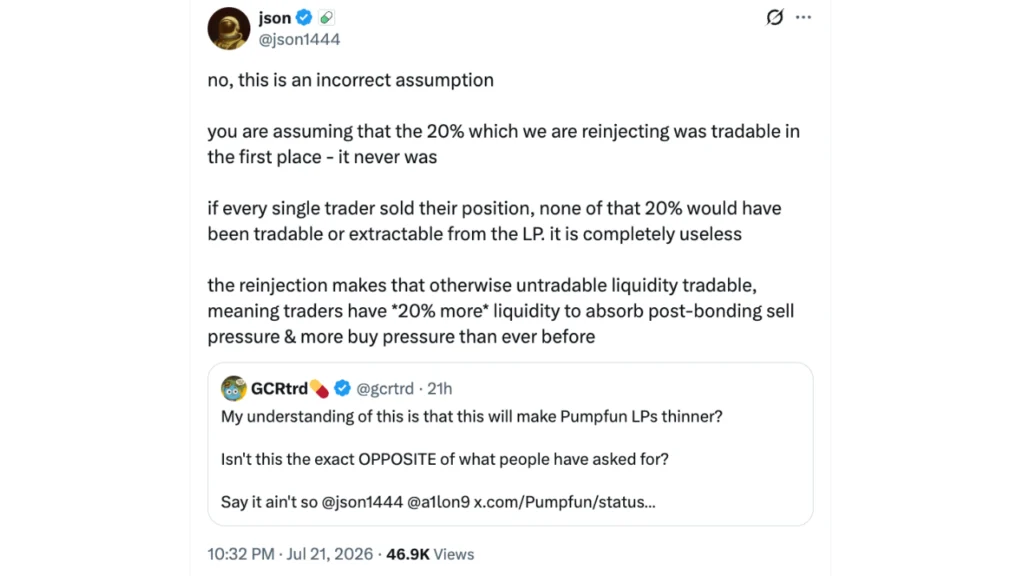
The Solana-based memecoin launchpad Pump.fun has unveiled a groundbreaking new launch mechanism named BOOST mode, designed to fundamentally alter the economics of newly launched tokens by transforming "dead liquidity" into automatic token buybacks and burns. This innovative feature, which became the default launch mechanism for all eligible new tokens on July 21, aims to significantly bolster the post-migration performance of memecoins by efficiently repurposing capital that was previously rendered inaccessible. By integrating this mechanism, Pump.fun seeks to enhance capital efficiency within its ecosystem, a critical factor in the volatile world of memecoin trading.
The implications of BOOST mode are substantial, particularly considering Pump.fun’s estimation that over $100 million worth of liquidity becomes permanently stranded annually under its former migration model. This "dead liquidity," which refers to funds locked within liquidity pools that cannot be withdrawn or redeployed even if all tokens are sold, represented a significant drain on potential market support. Instead of allowing these substantial sums to remain idle, BOOST mode redirects them into immediate market purchases of the newly launched token, which are then instantly burned, effectively reducing the circulating supply and generating upward price pressure. This strategic reallocation of capital promises to inject vitality into nascent tokens as they transition from Pump.fun’s bonding curve to decentralized exchanges.
The Genesis of BOOST Mode: Addressing "Dead Liquidity"
The core innovation of BOOST mode lies in its intervention at a crucial juncture: immediately after a token completes its bonding curve phase and migrates to PumpSwap, the platform’s decentralized exchange. Historically, upon this migration, a significant portion of the initial liquidity, estimated at approximately 20% of the migration funds, remained permanently locked within the newly established liquidity pool. While this mechanism was intended to ensure continuous trading availability, it inadvertently created a perpetual state of capital immobility. This trapped capital, described by Pump.fun as "dead liquidity," represented a substantial sum, estimated to exceed $100 million annually across all migrated tokens. This capital, though technically within liquidity pools, was effectively inert, unable to influence market dynamics or support token price action.
Pump.fun’s BOOST mode directly confronts this inefficiency by recycling these dormant funds. For every eligible migration, the protocol automatically allocates a specific amount of capital to purchase the newly migrated token. For tokens paired with SOL, approximately 17.6 SOL is utilized, while for USDC pairs, around $2,516 is deployed. Crucially, these purchases are not executed as a single, market-disrupting order. Instead, the protocol employs a Time-Weighted Average Price (TWAP) strategy, distributing the buy orders over the first five minutes post-migration. This phased approach is designed to mitigate the impact of large market orders, ensuring a more stable and organic price discovery process.

Following these strategic acquisitions, every token bought through the BOOST mechanism is immediately burned. This permanent removal from circulation serves a dual purpose: it directly reduces the available supply, a fundamental driver of token value, and simultaneously creates sustained buying pressure during the critical initial trading period. The net effect is a strengthened market position for the newly launched token, achieved without the introduction of new liquidity from external sources or the requirement for additional capital injection by the token’s creators. Pump.fun asserts that this system significantly enhances liquidity efficiency by converting previously unusable capital into active market demand, all while preserving the established trading experience for users.
Automatic Activation and Scope of BOOST Mode
BOOST mode is not an opt-in feature for token creators; it is now the default migration mechanism for all eligible tokens launched on Pump.fun following its activation on July 21. This automatic implementation ensures that a broad spectrum of new memecoins benefits from the enhanced capital efficiency provided by the feature, without requiring any additional steps from project developers. Traders engaging with these tokens will continue to experience the familiar bonding curve and PumpSwap infrastructure, meaning the user interface and fundamental launch process remain unchanged.
However, certain categories of tokens are excluded from the BOOST mode mechanism. Specifically, tokens that migrated before the activation date of July 21, and projects launched through Pump.fun’s separate "Mayhem" system, are not subject to the new protocol. This distinction is important for understanding the scope of the feature’s impact and its intended application to ongoing and future token launches.
Alon, the founder of Pump.fun, articulated the strategic advantage of BOOST mode, stating that it enhances liquidity efficiency by approximately 20% while maintaining the platform’s existing user experience. He further emphasized the potential long-term impact, suggesting that the recycling of "dead liquidity" could gradually redirect hundreds of millions of dollars back into newly launched memecoins, preventing this capital from being permanently locked away in illiquid pools. This perspective highlights Pump.fun’s commitment to optimizing the economic lifecycle of the tokens it facilitates, aiming for sustained growth and value accrual for early participants.
Community Reception: A Spectrum of Views
The introduction of BOOST mode has elicited a diverse range of reactions within the cryptocurrency community. Supporters laud the feature as a more intelligent and efficient utilization of capital, recognizing the inherent waste in the previous model. They see it as a direct response to a persistent challenge in the memecoin ecosystem.

Conversely, a segment of the community has expressed skepticism regarding the magnitude of BOOST mode’s impact. Some traders argue that the allocated amount for buybacks, approximately 17.6 SOL, might not be substantial enough to significantly influence the price of tokens that have already achieved market capitalizations of $30,000 or more. There is also a counterargument that the "permanently locked" liquidity, while inaccessible, did contribute to the overall depth of liquidity pools across the broader Solana memecoin landscape. This perspective suggests that while the capital was not actively usable, its presence as a pool component provided a degree of perceived stability.
Json, Pump.fun’s Head of Content, addressed these concerns, clarifying the nature of "dead liquidity." He posited that these locked assets were never truly usable trading liquidity, as they could not be withdrawn or reallocated under any circumstances. Therefore, BOOST mode does not, in his view, remove liquidity from the market. Instead, it converts previously inaccessible capital into tangible buy orders, which are then used to reduce the token supply through burning. This reframing of the issue underscores Pump.fun’s intention to create real economic utility from what was previously considered sunk cost.
The platform’s executives have actively countered the notion that the locked liquidity was ever truly beneficial for market dynamics. Their stance is that BOOST mode transforms capital from a passive, unusable state into an active force for price support and supply reduction, directly addressing a structural weakness in previous token launch models. This proactive approach aims to mitigate the sharp sell-offs that often characterize the immediate post-migration period, a critical time when early investors frequently take profits, leading to heightened volatility for newly launched memecoins.
A Novel Experiment in Post-Migration Token Economics
BOOST mode represents one of Pump.fun’s most significant infrastructure enhancements this year, focusing specifically on optimizing capital allocation rather than altering the core token launch process. It eschews the need for novel incentives or the infusion of external liquidity, instead opting to intelligently reallocate funds that were previously permanently locked. This approach is a testament to Pump.fun’s strategy of refining existing economic frameworks to maximize efficiency and value creation.
The ultimate success of BOOST mode hinges on its real-world performance. While automatic buybacks and token burns are theoretically designed to provide robust price support in the crucial minutes following migration, a key point of consideration is the limited duration of the buying program – only five minutes. This raises the question of whether tokens might still face significant selling pressure once these automated purchases conclude. The market will be closely watching to see if this brief window of artificial demand translates into sustained price appreciation or if it merely delays the inevitable price correction.

Nevertheless, BOOST mode introduces a novel paradigm in post-launch token economics. By actively seeking to reduce capital waste and simultaneously bolster newly migrated tokens, it offers a potential solution to a persistent problem within the memecoin space. If the mechanism proves effective, it could become a defining feature for Pump.fun, enhancing its competitive edge in attracting new memecoin launches on the Solana blockchain.
Following the announcement of BOOST mode, the performance of PUMP, Pump.fun’s native token, remained largely unchanged. This suggests that the market is adopting a wait-and-see approach, prioritizing empirical data and real-world performance metrics before fully pricing in the potential impact of this new feature. Investors are keenly awaiting evidence that BOOST can consistently improve the performance trajectory of newly launched memecoins in the coming weeks and months, a period that will be crucial in validating Pump.fun’s innovative approach to liquidity management and token economics. The long-term implications for capital efficiency and investor confidence within the Solana memecoin ecosystem will undoubtedly be a focal point of observation.