James Watt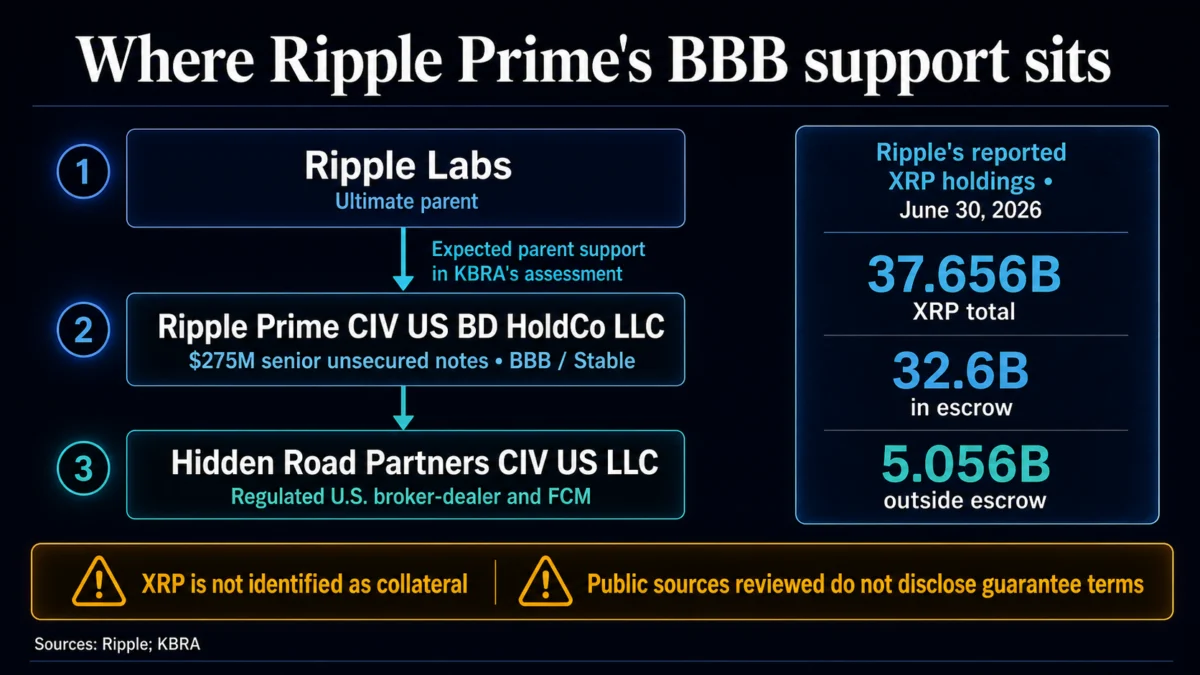
Ripple Prime has finalized an upsized $275 million private placement of senior unsecured notes, marking a significant milestone in the non-bank prime broker’s efforts to solidify its capital base for a broader expansion into the United States financial markets. The offering, which closed on August 18, 2026, was led by Piper Sandler as the lead placement agent and represents a critical test of the firm’s ability to access traditional credit markets while operating under the umbrella of Ripple Labs. This capital raise follows a period of rapid growth for the brokerage, which has sought to bridge the gap between digital asset markets and traditional institutional finance.
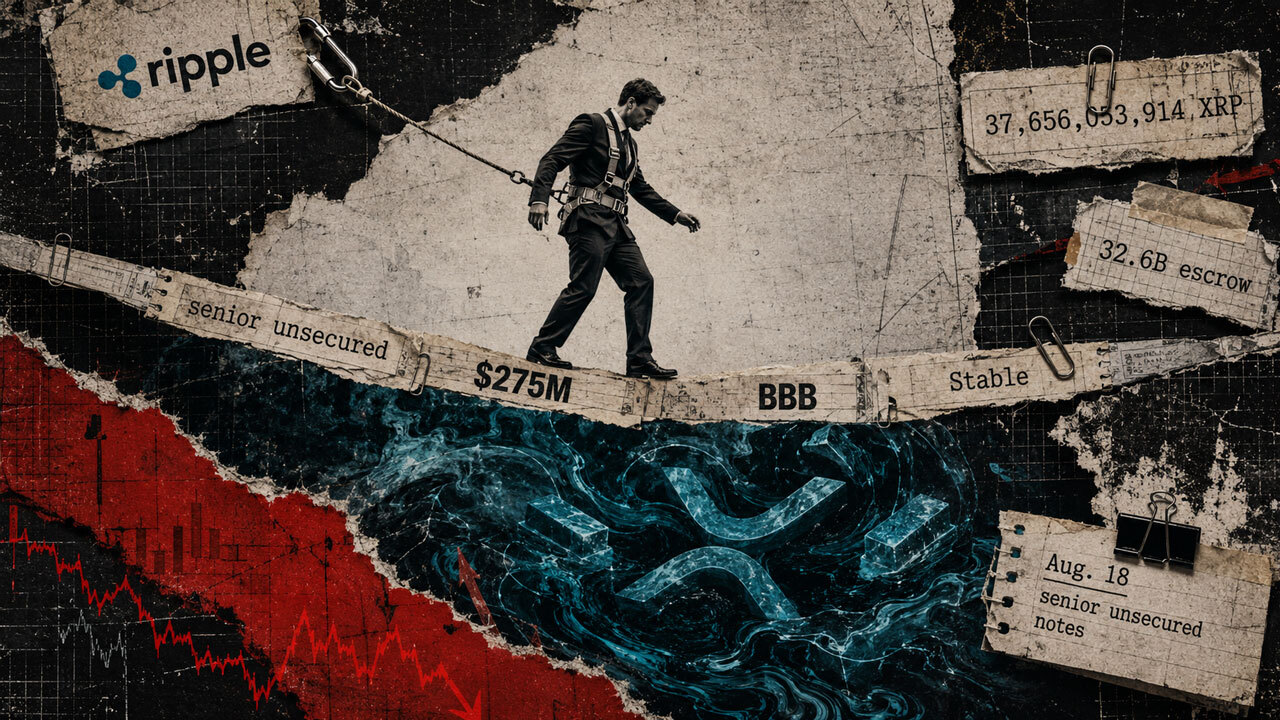
The successful closing of the notes offering is underscored by an investment-grade assessment from Kroll Bond Rating Agency (KBRA), which assigned a BBB rating with a Stable Outlook to the debt. Central to this credit assessment is the "parent-support mechanism," a structural expectation that Ripple Labs, the ultimate parent company, would provide necessary financial backing to the brokerage should liquidity or regulatory hurdles prevent the movement of capital from the operating subsidiaries. This dynamic highlights the evolving relationship between Ripple’s institutional-finance buildout and its historically XRP-sensitive balance sheet.
Strategic Objectives and Use of Proceeds
According to official statements from Ripple, the proceeds from the $275 million offering are earmarked for working capital and general corporate purposes within its regulated entities. The decision to pursue an upsized offering—initially projected at a lower figure—indicates strong institutional demand for the paper, despite the complexities inherent in the issuer’s corporate structure.
The senior unsecured notes are issued by Ripple Prime CIV US BD HoldCo LLC, an intermediate holding company. By positioning the debt at the holding company level, the firm allows the proceeds to be deployed strategically across its regulated subsidiaries, most notably Hidden Road Partners CIV US LLC. This subsidiary functions as the primary U.S. operating arm, maintaining registrations as both a broker-dealer with the Securities and Exchange Commission (SEC) and a futures commission merchant with the Commodity Futures Trading Commission (CFTC).
The influx of capital is expected to support Ripple Prime’s scaling efforts, particularly in capital-intensive areas such as spread-based financing and fixed-income repurchase agreements (repo). As the firm moves into 2027, the focus is shifting toward diversifying revenue streams through newer product lines, including Delta1 products and equity prime brokerage services.
Chronology of Ripple’s Institutional Buildout
The road to the August 2026 debt offering began several years prior, as Ripple Labs sought to diversify its business model beyond its core payments and messaging protocols.
- Acquisition and Integration (2023-2024): Ripple completed the acquisition of Hidden Road Partners, a move designed to secure a foothold in the prime brokerage space. Following the acquisition, Ripple reportedly injected approximately $500 million into the business to stabilize its balance sheet and fund initial operations.
- Product Launches (2024): The brokerage launched its exchange-traded derivatives platform, catering to institutional clients looking for regulated exposure to both traditional and digital assets.
- Scaling and Credit Rating (Early 2025): By the first quarter of 2025, the firm’s fixed-income repo activity reached a meaningful scale. In April 2025, KBRA assigned initial BBB issuer ratings to both the holding company and the operating company, citing the firm’s growing market presence and parental support.
- Secondary Financing (May 2026): Ripple Prime announced a separate debt facility of up to $200 million from Neuberger Specialty Finance. This facility was designed specifically to provide capacity for client financing and margin requirements, distinguishing it from the general corporate purposes of the senior unsecured notes.
- Profitability and Notes Closing (August 2026): The firm achieved operational profitability in 2025. On August 18, 2026, the $275 million private placement closed, cementing the firm’s status as a viable borrower in the investment-grade market.
Analyzing the Corporate Structure and Legal Separation
The credit profile of Ripple Prime is defined by a distinct three-tier hierarchy that separates the parent company’s resources from the regulated broker’s obligations.
- Ripple Labs (Ultimate Parent): Holds the vast majority of corporate resources, including cash reserves and XRP holdings.
- Ripple Prime CIV US BD HoldCo LLC (Issuer): The intermediate entity where the $275 million in senior unsecured debt resides.
- Hidden Road Partners CIV US LLC (Operating Company): The regulated entity that interacts with customers, clears trades, and holds regulatory licenses.
This legal separation is a double-edged sword. While it protects the parent company from the direct liabilities of the brokerage, it also necessitates the "parent-support" view held by rating agencies. KBRA’s analysis suggests that if the operating company were to face liquidity constraints or if regulatory "walls" prevented dividends from flowing upward to the holding company, Ripple Labs would likely step in to service the debt. This expectation is rooted in the strategic importance of the brokerage to Ripple’s long-term vision and the substantial capital already committed to the venture.
The Role of XRP in the Credit Narrative
A central point of discussion among analysts is the extent to which the parent company’s support capacity is tied to the market value of XRP. As of June 30, 2026, Ripple reported holding approximately 37.6 billion XRP. However, a significant portion of this—32.6 billion tokens—is held in on-ledger escrow, subject to monthly release schedules. This leaves roughly 5 billion XRP as liquid or "outside-escrow" holdings.
KBRA’s credit rationale treats these holdings as substantial unrecognized value. Nevertheless, the agency notes that Ripple’s earnings remain largely driven by digital-asset activity, including the programmatic and institutional sale of XRP. This creates a sensitivity to market volatility; a prolonged downturn in the digital asset market could, in theory, diminish the parent’s ability to provide emergency liquidity.
Crucially, the senior unsecured notes are not collateralized by XRP. Public disclosures confirm that the tokens are not pledged as security for the $275 million offering. Instead, XRP serves as a foundational component of the parent company’s balance sheet strength, which in turn supports the credit rating of the subsidiary.
Risk Management and Operational Execution
For Ripple Prime to maintain its BBB rating and eventually seek an upgrade, it must demonstrate that it can grow into its current valuation and debt load. KBRA has identified several key areas of operational risk:
- Revenue Concentration: Currently, a large portion of the brokerage’s revenue is derived from spread-based financing. While profitable, this makes the firm sensitive to interest rate fluctuations and balance-sheet constraints.
- Counterparty Risk: As a prime broker, the firm is exposed to the creditworthiness of its institutional clients. Ripple Prime manages this through a matched-principal structure and the use of high-quality repo collateral.
- Regulatory Compliance: Operating as an SEC-registered broker-dealer and CFTC-registered futures commission merchant requires rigorous adherence to capital adequacy and reporting standards.
The firm’s public financial statements for the period ending December 31, 2025, reinforce the importance of matched repo and reverse-repo activity. By ensuring that financing provided to clients is offset by equivalent borrowing, the firm minimizes its directional exposure to market movements.
Institutional Implications and Future Outlook
The closing of the $275 million offering is a bellwether for the broader "fintech-to-institutional" transition. It demonstrates that firms with roots in the cryptocurrency sector can achieve the transparency and structural rigor required to satisfy investment-grade credit analysts and institutional debt investors.
For the wider market, the success of Ripple Prime suggests a growing appetite for non-bank prime brokerage services. Traditional banks have faced increasing capital constraints under Basel III and other regulatory frameworks, creating a vacuum that firms like Ripple Prime are eager to fill. By providing clearing, settlement, and financing services across both digital and traditional asset classes, Ripple Prime is positioning itself as a "one-stop shop" for the modern institutional investor.
However, the road ahead remains contingent on execution. KBRA has signaled that the Stable Outlook could be pressured if the firm engages in greater risk-taking, experiences a reduction in parental support, or fails to diversify its revenue. Conversely, a track record of sustained earnings and successful scaling of its equity and Delta1 desks could provide positive momentum for future credit assessments.
As Ripple Prime begins deploying the $275 million in new capital, the industry will be watching closely to see if the firm can truly decouple its operational success from the price of XRP. While the token remains a vital part of the parent company’s wealth, the goal of Ripple Prime is to build a self-sustaining, regulated financial powerhouse that can stand on its own merits in the global credit markets. For now, the "parent-support" bridge remains the vital link that allows this ambitious expansion to proceed with investment-grade confidence.