James Watt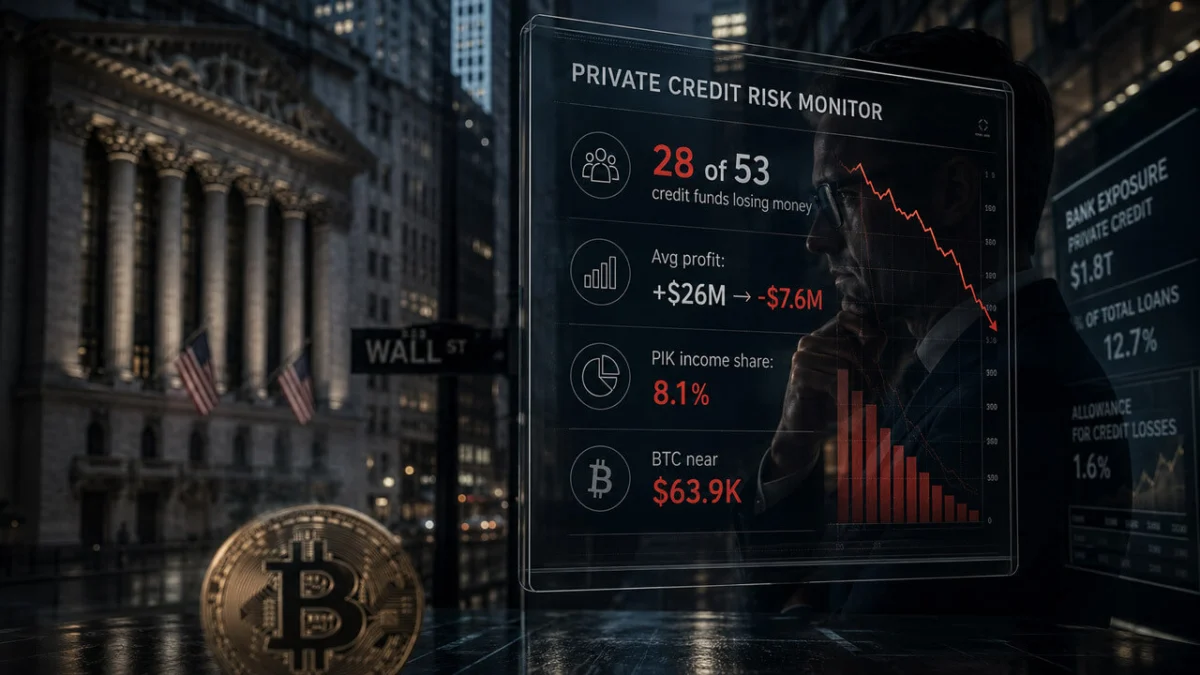
The global financial landscape is currently navigating a period of profound uncertainty as the $1.8 trillion private credit market, once hailed as a resilient alternative to traditional bank lending, shows signs of significant structural strain. In April 2026, JPMorgan Chase CEO Jamie Dimon assured analysts and investors that the private credit sector did not pose a systemic risk to the broader economy, suggesting that the buffer between private losses and bank balance sheets remained substantial. Dimon’s sentiment was echoed by leadership at Citigroup, Bank of America, and Wells Fargo, all of whom characterized their respective exposures to the sector as manageable and "comfortable." However, a comprehensive analysis of the first-quarter performance of 53 publicly traded business development companies (BDCs) reveals a starkly different reality, suggesting that the "firewall" between private credit and the banking system may be more porous than previously admitted.
The analysis, conducted by Reuters in collaboration with S&P Global Market Intelligence, indicates that 28 of the 53 examined BDCs swung into the red during the first quarter of 2026. This represents a dramatic increase from the previous year, where only 12 such firms reported losses. Average profits for these entities collapsed from a positive $26 million to a negative $7.6 million within a twelve-month window. This sharp reversal highlights a growing crisis in the mid-market lending space, where rising borrowing costs and loan markdowns are beginning to erode the capital foundations of specialized lenders. The discrepancy between the confidence of Wall Street executives and the deteriorating balance sheets of BDCs suggests a potential miscalculation regarding the interconnectedness of the modern credit ecosystem.
The Evolution and Role of Business Development Companies
To understand the current instability, one must look at the role BDCs play in the financial hierarchy. Established by Congress in 1980 to encourage the flow of capital to small and mid-sized American businesses, BDCs function essentially as publicly traded private equity or credit funds. They provide vital financing to companies that are often deemed too risky or too small for traditional commercial bank loans. In exchange for certain tax advantages, BDCs are required to distribute at least 90% of their taxable income to shareholders in the form of dividends.
For much of the last decade, this model flourished. As post-2008 regulations forced traditional banks to retreat from riskier lending, private credit moved in to fill the vacuum. Institutional investors, starved for yield in a low-interest-rate environment, poured hundreds of billions of dollars into these vehicles. However, the rapid expansion of the market has led to concerns regarding underwriting standards and the true quality of the underlying collateral. As interest rates remained elevated through 2025 and into 2026, the cost of servicing debt for mid-sized borrowers increased, leading to the current wave of markdowns and losses now surfacing in BDC financial statements.
Phantom Income and the Risks of Payment-in-Kind (PIK)
A critical factor in the recent downturn is the increasing reliance on "Payment-in-Kind" (PIK) interest. PIK is a financial arrangement that allows a borrower to defer cash interest payments by adding the interest amount to the principal balance of the loan. While this provides temporary liquidity relief for the borrower, it creates what analysts call "phantom income" for the lender. On paper, the BDC records the interest as earned income, even though no cash has actually changed hands.
In 2025, PIK accounted for an average of 8.1% of BDC interest and dividend income, nearly double the levels seen prior to 2020. This trend accelerated in the first quarter of 2026. While BDC managers often highlight "net investment income" to reassure shareholders, these figures can be deceptive if a significant portion is non-cash. When credit conditions tighten, the distinction between cash and PIK becomes a matter of solvency. A borrower utilizing PIK is often a borrower in distress; eventually, the mounting principal must be repaid or the loan must be written down. The current surge in PIK usage suggests that a growing number of mid-sized companies are struggling to meet their obligations, creating a delayed-action fuse within the private credit market.
Hidden Leverage and Off-Balance Sheet Exposure
Beyond the visible losses, there is the issue of "layered leverage." Many BDCs utilize joint ventures and special-purpose vehicles (SPVs) to finance their lending activities. These structures allow firms to move debt off their primary balance sheets, making their headline leverage ratios appear more conservative than they truly are. According to disclosures from 14 major BDCs, off-balance-sheet borrowing increased by 80% during 2025 and continued to climb in early 2026.
The Financial Stability Board (FSB) has repeatedly warned that hidden leverage can amplify market shocks. In a downturn, these side-vehicles can face margin calls or funding freezes that force the parent BDC to provide emergency liquidity, dragging the entire structure into a crisis. The analogy of a "spouse’s credit card" is often used: the debt may not appear on the primary statement, but the household is still responsible for the obligation. As regulators struggle to gain full transparency into these private arrangements, the true scale of the risk remains obscured.
The Bank-Private Credit Feedback Loop
The central tension in the current market lies in the relationship between private lenders and the "Big Four" US banks. While Jamie Dimon and his peers have suggested that the banks are insulated from private credit losses, the data shows that banks are the primary source of funding for these lenders. JPMorgan, Citigroup, Bank of America, and Wells Fargo hold a combined exposure of more than $128 billion in loans to the private credit sector.
JPMorgan’s direct exposure is estimated at $50 billion, while Wells Fargo’s broader portfolio of "financials except banks"—which includes various forms of private credit support—totals a staggering $210.2 billion. This funding is delivered through subscription facilities, revolving credit lines, and "Net Asset Value" (NAV) loans. Essentially, the banks lend to the BDCs, which then lend to the corporations. If the underlying corporate loans fail, the BDCs lose the ability to service their lines of credit with the banks. This creates a circular risk profile where the "private" market is effectively a leveraged extension of the regulated banking system.
The Liquidity Squeeze and Market Contagion
The strain in the credit markets is already manifesting in reduced lending volumes and investor retreats. Direct-lending volume in the United States plummeted by 55% quarter-over-quarter in early 2026, falling from $74.67 billion to $33.59 billion. This contraction occurred despite North American funds successfully raising over $16 billion in new capital, suggesting that managers are hoarding cash to support existing, stressed loans rather than funding new business activity.
Investors have also begun to head for the exits. In the first quarter of 2026, investors requested more than $20.8 billion in redemptions from the largest semi-liquid private credit funds. However, because these funds invest in illiquid loans, they cannot easily liquidate assets to meet withdrawal requests. Consequently, many managers have been forced to cap redemptions at 5% of net asset value, honoring only about half of the total requests. This "gating" of funds often serves as a precursor to broader panic, as investors fear their capital will be trapped in a declining asset class.
Implications for Bitcoin and High-Risk Assets
The tightening of credit and the subsequent drain on dollar liquidity have significant implications for the cryptocurrency market, particularly Bitcoin. While Bitcoin is often touted as "digital gold" or an alternative to the traditional system, it functions in practice as a high-beta risk asset that is highly sensitive to global liquidity cycles.
When bank funding lines to private lenders tighten, the overall supply of credit in the economy contracts. This leads to a "risk-off" environment where institutional investors reduce leverage across all portfolios to raise cash. Historically, Bitcoin has shown a strong correlation with liquidity indices; when the dollar becomes "expensive" or scarce due to credit freezes, risk assets are the first to be sold.
On July 17, 2026, Bitcoin was trading near $63,900, representing a 38% decline from the previous year. This price action coincided with the rising reports of BDC losses and redemption gates. For crypto traders, the health of the BDC market has become a leading indicator. A major default in the private credit space or a significant increase in bank loss provisions could trigger a liquidity vacuum that impacts BTC as severely as it impacts equity markets.
Chronology of the 2025-2026 Credit Shift
The current situation is the result of a multi-year trajectory of rising rates and mounting debt:
- Early 2024: Private credit reaches a record $1.7 trillion valuation; banks begin increasing credit lines to BDCs to capture indirect yields.
- Late 2024: The Federal Reserve maintains higher-for-longer interest rates, putting pressure on mid-market borrowers’ cash flows.
- Mid-2025: PIK interest usage doubles compared to pre-pandemic levels; regulators express concern over "shadow banking" transparency.
- Q4 2025: Direct lending volume begins to plateau; redemptions in semi-liquid funds start to tick upward.
- Q1 2026: 28 out of 53 major BDCs report losses; average profits turn negative. Banks insist systemic risk is low despite $128B+ in exposure.
- July 2026: Redemption requests hit $20.8 billion; fund managers begin capping withdrawals as Bitcoin and other risk assets experience high volatility.
Future Outlook and Systemic Signals
The disconnect between the "comfortable" outlook of Wall Street’s elite and the empirical data from the BDC sector suggests a period of reckoning is approaching. The stability of the financial system now rests on whether these private credit losses can be contained within the funds themselves or if they will spill over into the banking sector through the $220 billion in drawn and undrawn bank lines.
Market analysts are closely watching for several "red flag" signals that would indicate a transition from a localized credit squeeze to a systemic crisis. These include a major bank materially increasing its loan loss provisions for the "non-bank financial" sector, a large-scale private credit fund suspending all withdrawals indefinitely, or evidence of "valuation arbitrage" where multiple lenders mark the same distressed loan at wildly different prices to hide losses.
While Jamie Dimon argues that the losses must be "very large" before banks are hit, the historical precedent of the 2008 financial crisis serves as a reminder that interconnectedness is often underestimated until liquidity vanishes. In the current environment, the private credit market is no longer a peripheral player; it is a core component of the global financial architecture. If the foundation of that architecture—the mid-market borrower—continues to crumble, the impact will be felt from the boardrooms of Manhattan to the digital wallets of Bitcoin investors worldwide. The question is no longer whether losses are occurring, but who will ultimately be forced to absorb them when the credit lines snap shut.